All explainers
Explainers
88 pieces · each reviewed and source-cited
Why India's Recognition of Israel Took Until 1950
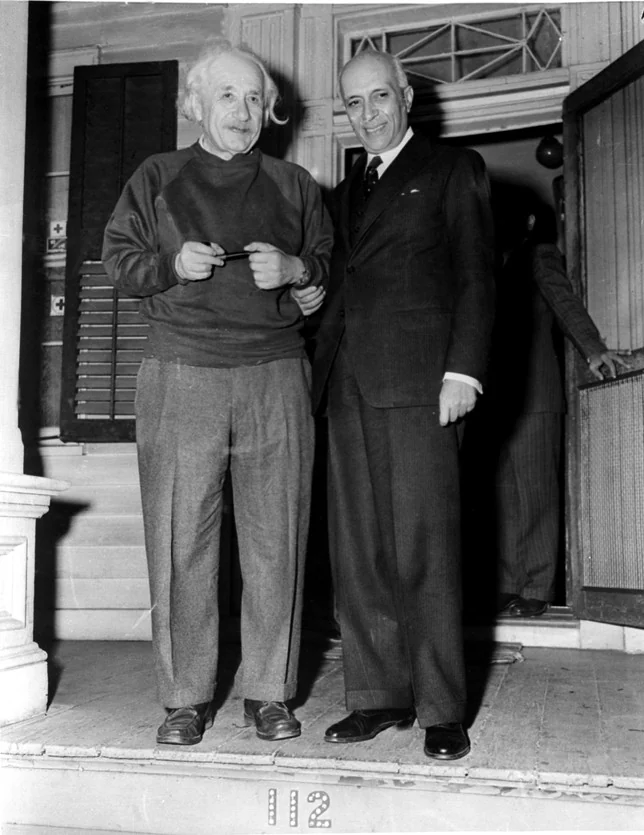
India recognised Israel on 17 September 1950, more than two years after Israel declared independence on 14 May 1948. Nehru's papers show that by February 1949 he privately accepted that Israel had come to stay. The delay was about timing. He held back for four reasons. The first was the Congress party's long commitment to an Arab-majority Palestine, which was tied to its rivalry with the Muslim League. The second was fear of angering Indian Muslims after partition. The third was the need for Arab support at the United Nations over Kashmir and against Pakistan. The fourth was a wish not to disturb India's Asian diplomacy, especially a January 1949 conference on Indonesia. Cabinet colleagues, senior diplomats, the Hindu Mahasabha and Indian Jews pressed for recognition. It came only after Turkey and Iran had recognised Israel first. Full diplomatic relations followed on 29 January 1992.
Why India-Israel Relations Took Until 1992
India recognised Israel on 17 September 1950 but did not establish full diplomatic relations until 29 January 1992. For four decades, New Delhi allowed Israel only a consulate in Bombay, which operated from 1953. The delay came from India's vote against the 1947 partition plan, its ties with Arab states and the Non-Aligned Movement, its reliance on the Soviet Union, and concern over domestic Muslim opinion. Israel kept seeking relations and gave India quiet military help in 1971. Prime Minister P. V. Narasimha Rao changed course after the Soviet collapse, the Madrid Peace Conference of October 1991, and India's December 1991 vote to revoke the UN resolution equating Zionism with racism. Foreign Secretary J. N. Dixit announced the decision two weeks after PLO chairman Yasser Arafat said the matter was India's sovereign choice. Defence, farming, and trade ties followed. India's formal support for a Palestinian state did not change.
The Sinai and Palestine Campaign, 1915–1918
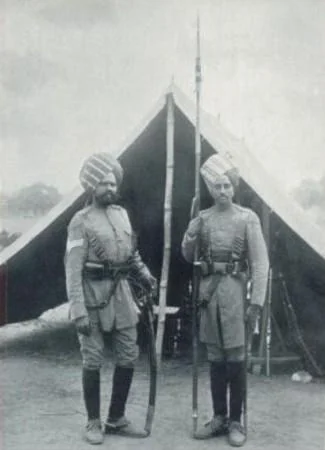
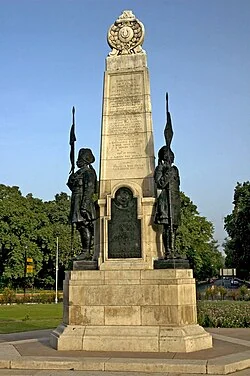
Indian soldiers served from the first battle of the Sinai and Palestine Campaign to the last. In February 1915, Indian infantry and camel troops helped defeat an Ottoman attempt to cross the Suez Canal. About 144,000 Indian personnel were sent to Egypt and Palestine during the war. When Jerusalem surrendered on 9 December 1917, Indian Muslim guards were sent to protect its holy places. In early 1918 the British moved most of their own infantry to France, and Indian soldiers replaced them. By the final offensive in September 1918, Indians made up most of General Allenby's infantry and two full cavalry divisions. On 23 September 1918 the Jodhpur and Mysore Lancers captured Haifa, and their commander, Dalpat Singh, was killed. India and Israel now honour this battle together. New Delhi renamed Teen Murti Chowk as Teen Murti Haifa Chowk on 14 January 2018.
The Prime Minister of Israel
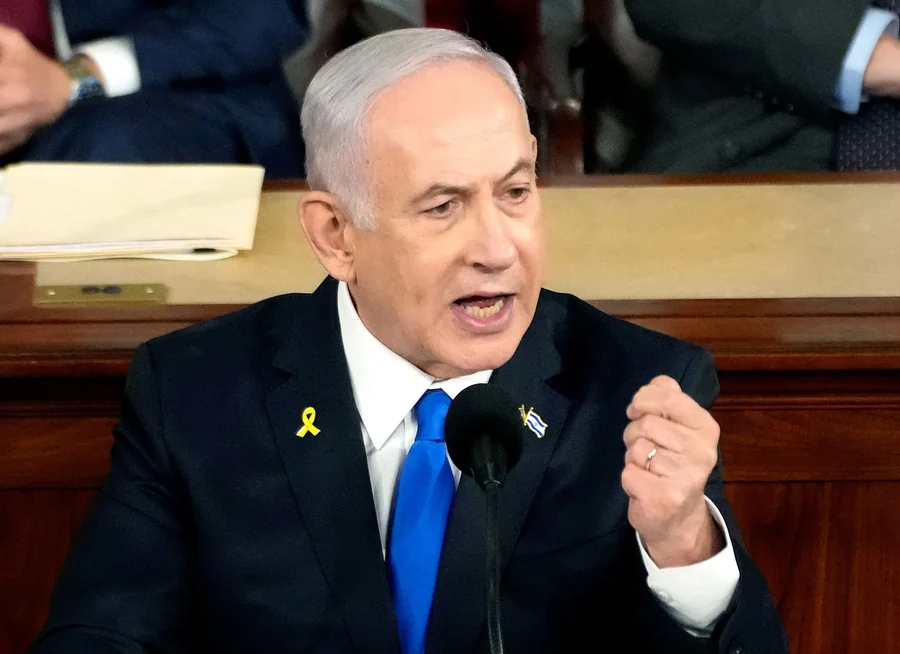
The Prime Minister of Israel heads the Government, which is the executive branch of the state. The office has existed since 14 May 1948. Its current rules come from Basic Law: The Government, adopted in 2001 and applied from the 2003 election. After an election, the President gives a Knesset member 28 days, plus up to 14 more, to form a government. The Government takes office only when the Knesset votes confidence in it. The Knesset can remove it only by electing a named replacement with 61 of 120 votes. The prime minister can dissolve the Knesset with the President's consent. The Attorney General must approve any criminal investigation of a prime minister. A law passed on 15 July 2026 makes the Attorney General's opinions non-binding on the Government from 1 January 2027. Fourteen people have held the office. Benjamin Netanyahu has served since 29 December 2022. The next election is on 27 October 2026.
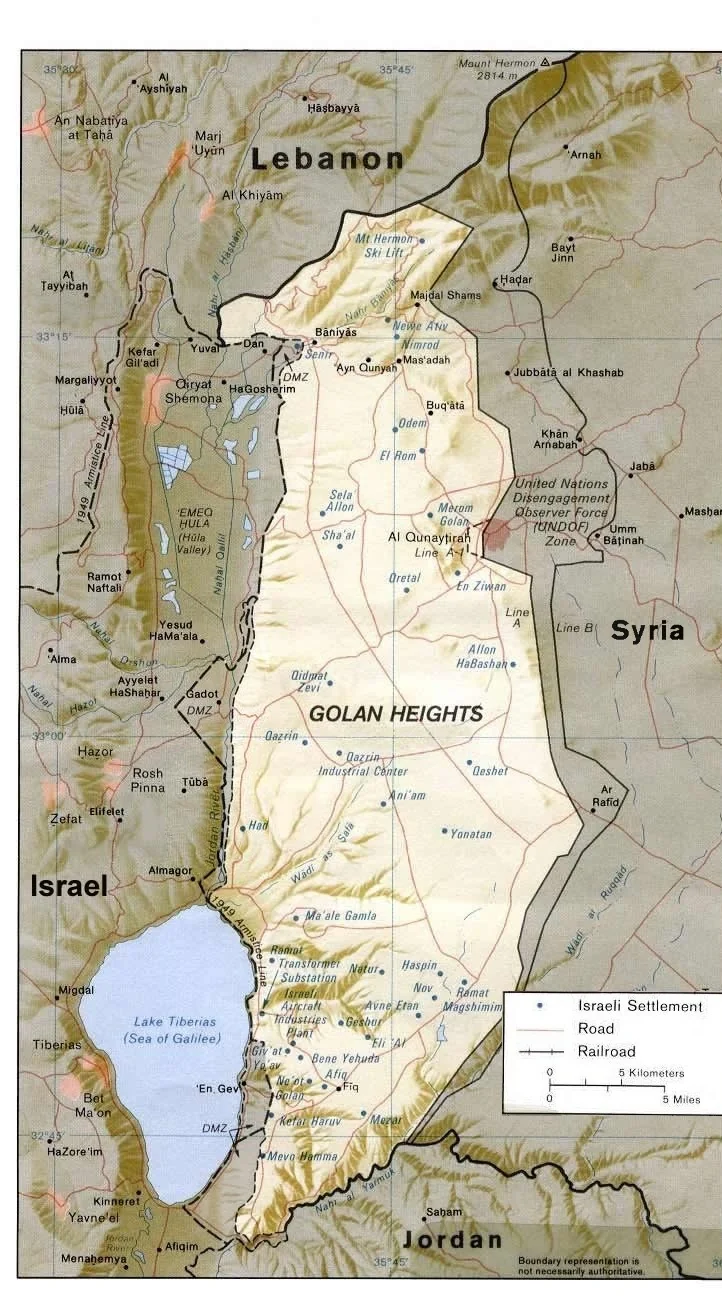
The Golan Heights
The Golan Heights is a plateau in southwest Syria. Israel captured most of it in the June 1967 war. Most of the Syrian population left or was displaced. Syria says more than 140,000 people lived there before the war. An Israeli census in August 1967 counted 6,396. Syria tried to retake the plateau in October 1973 and failed. A disengagement agreement signed on 31 May 1974 created a buffer zone patrolled by UN troops. On 14 December 1981 Israel applied its law to the territory. Three days later the UN Security Council unanimously declared that act null and void. Syria has claimed the Golan without a break since 1967. The United States recognized Israeli sovereignty on 25 March 2019, and Colombia did the same on 10 August 2026. The UN counts more than 31,000 Israeli settlers in 35 settlements, and about 29,000 Druze also live there. Since December 2024, Israeli troops have held positions inside the buffer zone.
The First and Second Intifadas
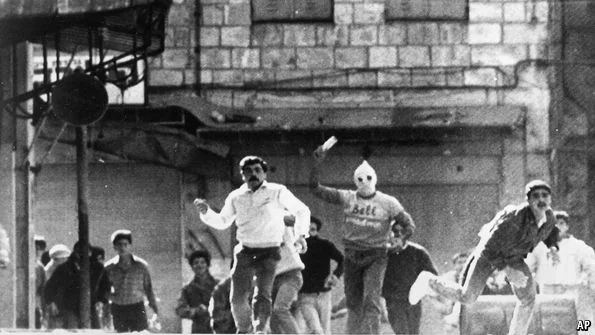
The First Intifada was a Palestinian uprising against Israeli military rule in the West Bank and Gaza Strip. It began on 9 December 1987 and is usually counted as ending with the Israel-PLO Declaration of Principles, signed on 13 September 1993. Its main methods were strikes, boycotts, tax refusal and stone-throwing. The Israeli rights group B'Tselem counts 1,087 Palestinians killed by Israeli security forces and 160 Israelis killed by Palestinians in that period. The Second Intifada began on 28 and 29 September 2000, two months after the Camp David summit failed. It was an armed conflict marked by suicide bombings and Israeli military operations. B'Tselem counts 3,793 Palestinians killed by Israeli security forces and 1,011 Israelis killed by Palestinians up to September 2006. The first uprising led to the Oslo process. The second ended it and was followed by the West Bank barrier and Israel's 2005 withdrawal from Gaza.

The British Mandate
Britain governed Palestine under a League of Nations Mandate from 1920 to 1948. The League approved the Mandate in July 1922, and it came into force in September 1923. It required Britain to secure a Jewish national home while protecting the civil and religious rights of all inhabitants. Jewish immigration raised the Jewish share of the population from about 13 % in 1922 to about 33 % at the end of 1946. Arab opposition to this policy led to violence in 1920, 1921 and 1929, and to the Arab Revolt of 1936 to 1939. Britain responded with commissions of inquiry and with policy statements called White Papers in 1922, 1930 and 1939. The 1939 White Paper limited Jewish immigration to 75,000 over five years. In 1947 Britain referred the question to the United Nations, which recommended partition. British rule ended on 15 May 1948.
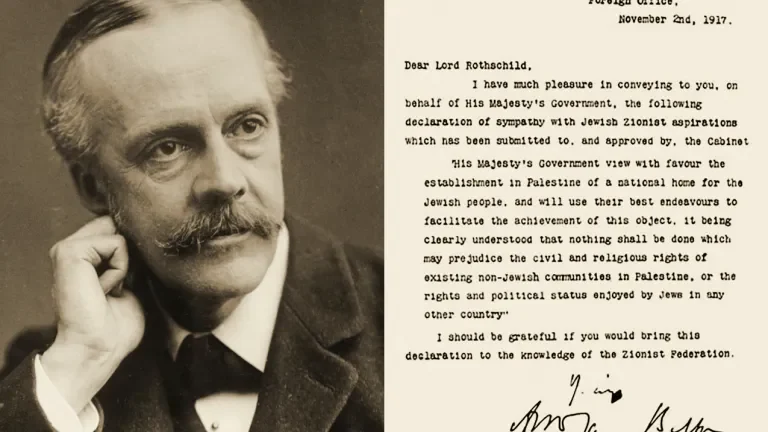
The Balfour Declaration
The Balfour Declaration is a statement of British policy in a letter dated 2 November 1917 from Foreign Secretary Arthur James Balfour to Lord Walter Rothschild. It said the British government viewed "with favour the establishment in Palestine of a national home for the Jewish people" and would use its "best endeavours" to help. It added two conditions. Nothing would prejudice the civil and religious rights of existing non-Jewish communities in Palestine. Nothing would prejudice the rights and political status of Jews in other countries. The War Cabinet approved the final text on 31 October 1917, after drafts that began in July. The Declaration overlapped with two earlier British commitments: the McMahon-Hussein letters of 1915 and 1916, and the Sykes-Picot agreement with France of May 1916. In 1922 the League of Nations wrote the Declaration into the Mandate for Palestine.
The Abraham Accords
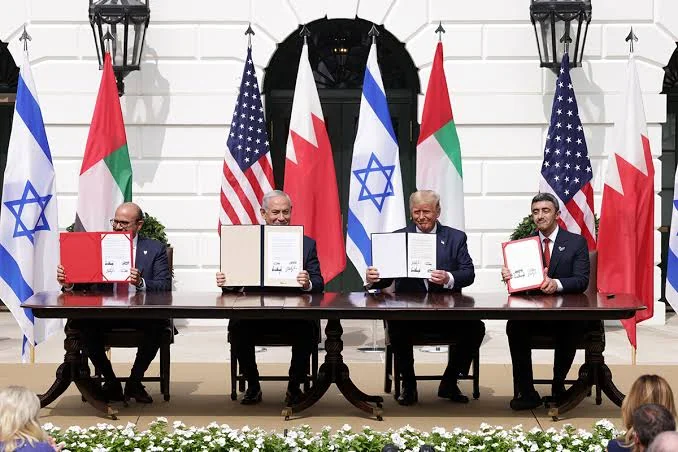
The Abraham Accords are a set of US-brokered agreements, made between August 2020 and January 2021, under which Israel established or began to establish relations with four Arab League states. The United Arab Emirates and Bahrain signed at the White House on 15 September 2020. Morocco signed a joint declaration on 22 December 2020. Sudan signed the Accords declaration on 6 January 2021 but never signed a bilateral agreement with Israel. Israel agreed to suspend its plan to annex parts of the West Bank. The United States offered the UAE 50 F-35 jets, a sale the UAE later suspended. It recognised Moroccan sovereignty over Western Sahara and removed Sudan from its terrorism list. Israel-UAE trade passed $3 billion in 2024. Saudi Arabia has not joined. It says it needs a path to a Palestinian state first. In 2026 the United States tied a Saudi nuclear deal to Saudi entry into the Accords.
The 2005 Gaza Disengagement
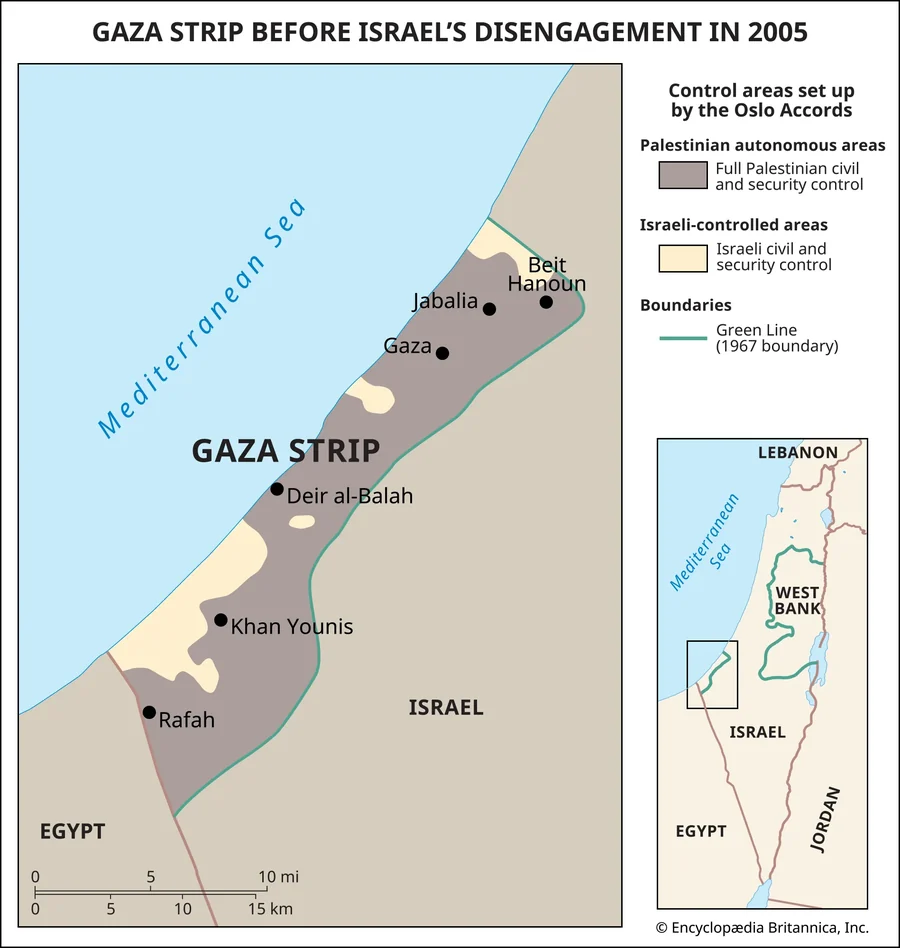
The Gaza disengagement was Israel's unilateral removal of all its settlements and military forces from the Gaza Strip in 2005. Four small settlements in the northern West Bank were also removed. Prime Minister Ariel Sharon proposed the plan in December 2003. The cabinet approved it on 6 June 2004. The Knesset endorsed it on 26 October 2004 by 67 votes to 45 and passed the implementing law on 16 February 2005. Eviction notices were served on 15 August 2005, forced removals began after the deadline of midnight on 16 August, and the last Gaza settlement, Netzarim, was emptied on 22 August. The last soldiers left on 12 September 2005. Between 8,000 and 9,000 residents were moved, depending on the count used. Israel kept control of Gaza's airspace, sea and most crossings. Hamas won Palestinian elections in January 2006 and seized Gaza by force in June 2007. Whether the withdrawal ended the occupation, and whether it served Israel's security, remain disputed.
The 1948 War
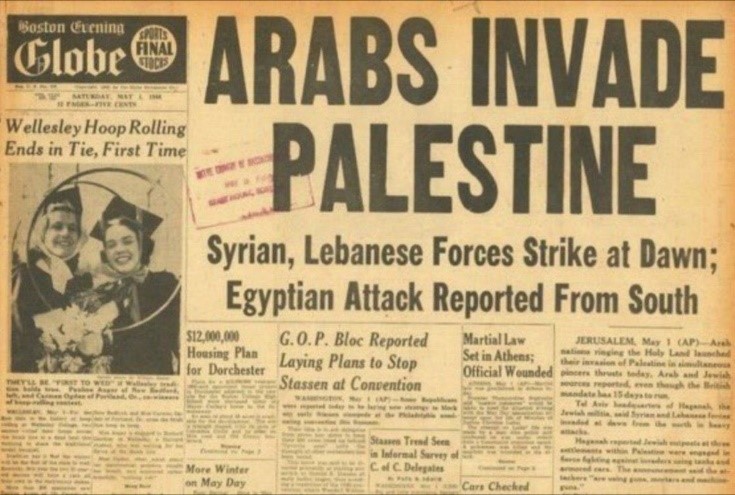
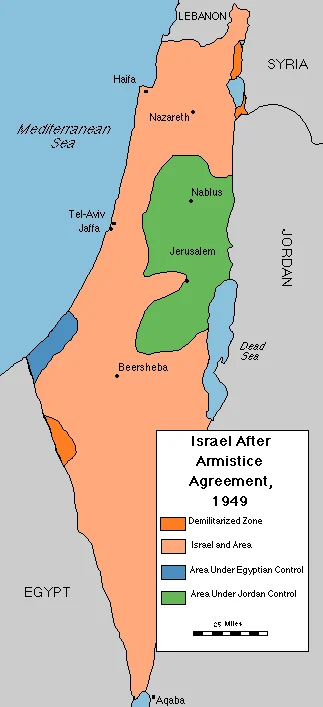
The 1948 War was fought between the Jewish community of Palestine, which became the State of Israel, and Palestinian Arab forces joined by the regular armies of the Arab states. It began the day after the United Nations General Assembly recommended partition on 29 November 1947. It ended with four armistice agreements signed between 24 February and 20 July 1949. The first phase was a civil war inside British-ruled Palestine. The second began on 15 May 1948, when Egypt, Transjordan, Syria, Lebanon and Iraq sent armies across the borders a day after Israel declared independence. Israel survived at a cost of about 6,000 dead, close to one percent of its Jewish population. It ended the war holding about 77 percent of Mandate Palestine. Jordan held the West Bank and East Jerusalem, and Egypt held Gaza. Israelis call it the War of Independence. Palestinians call it the Nakba, meaning the catastrophe.
Teen Murti Haifa Chowk
Teen Murti Haifa Chowk is a roundabout in central New Delhi built around a First World War memorial. The memorial honours the soldiers of the 15th (Imperial Service) Cavalry Brigade. The brigade was drawn from the princely states of Hyderabad, Jodhpur and Mysore, and it fought in Sinai, Palestine and Syria. The British sculptor Leonard Jennings made its three life-size figures of lancers. The memorial was built in 1922, and the Viceroy, Lord Reading, inaugurated it on 8 March 1924. On 23 September 1918, the Jodhpur and Mysore Lancers captured the port of Haifa from Ottoman and German forces. On 14 January 2018, Prime Ministers Narendra Modi and Benjamin Netanyahu renamed the roundabout Teen Murti Haifa Chowk. Every 23 September is Haifa Day. The Indian Army's 61st Cavalry marks it as its raising day, and ceremonies are held in New Delhi and in Haifa.
Pre-State History: From Antiquity to UN Resolution 181
Jews formed kingdoms and a temple-centred nation in the land in antiquity. They lost self-rule after Roman wars in 70 and 135 CE. A small Jewish community stayed in the land, while most Jews lived in a diaspora marked by expulsions from England, France, Spain and Portugal. Under Ottoman rule from 1517 to 1917, a religious community called the Old Yishuv lived mainly in Jerusalem, Hebron, Safed and Tiberias. Organised modern immigration began with the First Aliyah in 1882. Theodor Herzl's First Zionist Congress in Basel in August 1897 set the goal of a Jewish home in Palestine secured by public law. Britain issued the Balfour Declaration in November 1917, entered Jerusalem in December 1917, and governed under a League of Nations mandate from 1922. Britain's 1939 White Paper limited Jewish immigration while the Holocaust killed about six million Jews. After 1945, clandestine immigration and a UN inquiry led to Resolution 181 on 29 November 1947.
The PLO, Fatah and the Palestinian Authority
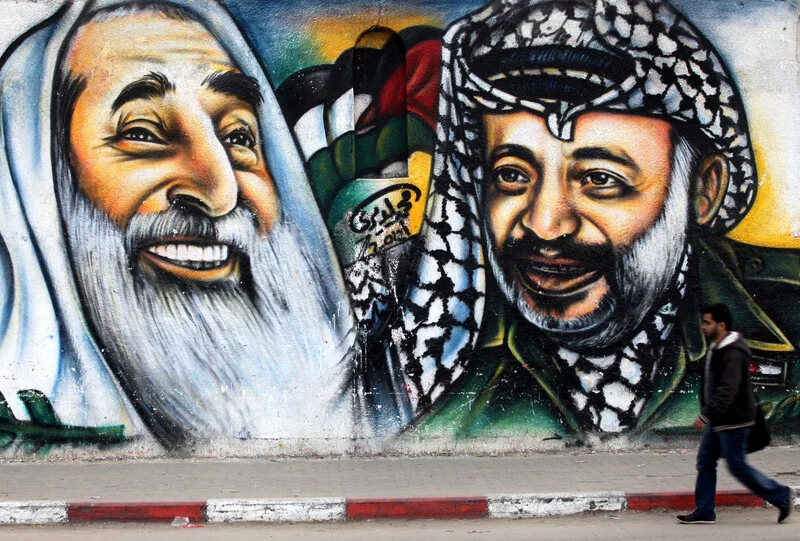
The Palestine Liberation Organization (PLO) was founded in May 1964. Fatah, the movement led by Yasser Arafat, took control of it in 1969 and still dominates it. The PLO's 1968 Charter called armed struggle the only way to liberate Palestine. On 9 September 1993 the PLO recognized Israel's right to exist. The Oslo agreements of 1993 and 1995 then created the Palestinian Authority (PA) to govern parts of the West Bank and Gaza. The Palestine National Council voted in 1996 to cancel the charter clauses that denied Israel's existence and reaffirmed this in 1998, though Israel disputed whether the legal process was complete. Hamas won the January 2006 legislative election and took Gaza by force in June 2007, which split Palestinian rule. Mahmoud Abbas has led the PLO and the PA since 2005 without a new election. The PA is in a fiscal crisis, and a presidential vote is promised for 2027.
Palestinian Refugees and UNRWA
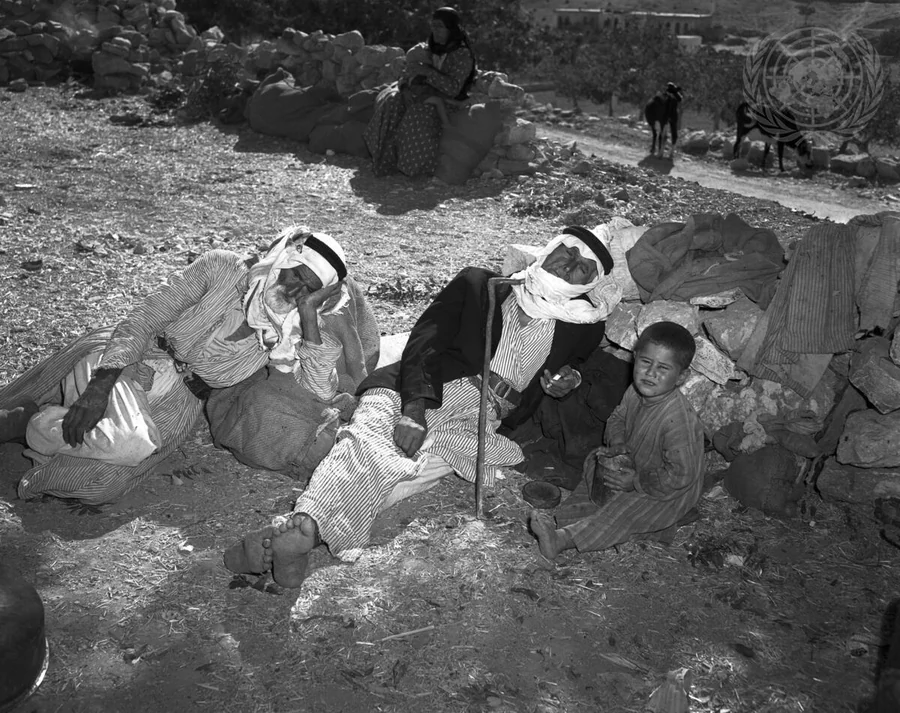
Between November 1947 and 1949, hundreds of thousands of Palestinian Arabs fled or were expelled from the area that became Israel. Counts made at the time differ. Israel gave about 520,000, a United Nations technical committee gave 711,000, and Arab officials gave 900,000 to 1 million. On 11 December 1948, UN General Assembly Resolution 194 said that refugees wishing to return home and live at peace should be allowed to do so, and that those not returning should be compensated. The Assembly created UNRWA on 8 December 1949, and the agency began work on 1 May 1950. In the June 1967 war, the UN counted about 113,000 registered refugees and 210,000 other people displaced. UNRWA registers the descendants of refugee men, so about 5.9 million people are on its rolls. Critics say this rule enlarges the problem. UNRWA says it matches other long refugee crises. The agency's voluntary funding fell sharply after 2024. Historians still disagree about why the 1948 refugees left.
Israel's International Relations
Israel's foreign relations rest on one close alliance, a small group of peace and normalisation agreements with Arab states, and a long, contested record at the United Nations and in international courts. The United States is Israel's main partner. A 2016 agreement pledged 38 billion US dollars in military aid for 2019 to 2028. Egypt made peace with Israel in 1979 and Jordan in 1994. The United Arab Emirates, Bahrain, Morocco and Sudan joined the Abraham Accords in 2020 and 2021. Saudi Arabia says it will not establish relations without a Palestinian state. Since October 2023, Israel's position has weakened in several places. Turkey halted trade, Bolivia and Colombia cut ties, the International Court of Justice and the International Criminal Court acted, and in September 2025 the United Kingdom, France and other states recognised Palestine. In March 2026, 60 % of Americans viewed Israel unfavourably.
Israel's Geography: Land, Water, Ports, Heritage and Cities
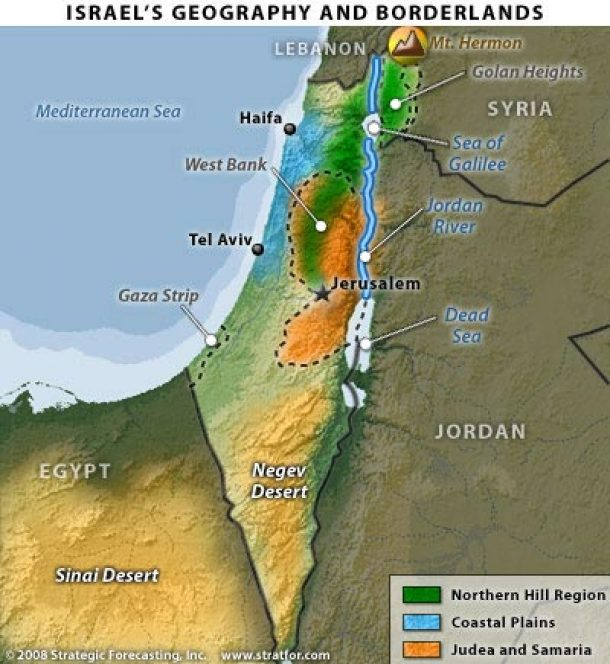
Israel has four physical regions. The coastal plain is 5 to 40 kilometres wide. The central highlands rise to 1,208 metres at Mount Meron in the Galilee. The Jordan Rift Valley holds the Sea of Galilee and the Dead Sea. The Negev desert covers more than half the land. Most rain falls between November and March. Yearly rainfall drops from about 1,100 millimetres in the north to under 100 in the far south. The Dead Sea, more than 400 metres below sea level, has fallen by about a metre a year. The Sea of Galilee has stayed below its lower red line of 213 metres below sea level for most of 2026. Six desalination plants supply 70 to 80 % of drinking water, and farms use most of the 87 % of wastewater that is reused. Eilat port has been nearly idle since November 2023. Israel has nine UNESCO World Heritage sites.
Israel's Economy
Israel's economy began after 1948 under heavy control by the state and the Histadrut labour federation. It moved toward open markets after a crisis in the early 1980s, when annual inflation came close to 500 %. The Economic Stabilisation Plan of July 1985 brought inflation below 20 % within about two months. In the same year Israel signed a free trade agreement with the United States. Israel joined the OECD in 2010. Technology now leads the economy. In 2025, high-tech exports were $85 billion and exits were $84 billion. Defence exports reached $19.2 billion in 2025. Natural gas from the Tamar field (producing since 2013) and the Leviathan field (exporting since 2020) turned Israel into an exporter. This includes a $35 billion deal with Egypt. The wars since October 2023 raised public debt from about 60 % to about 68.5 % of GDP by 2025. About 53 % of Haredi men are employed.
Israel's Defence and Security
Israel's defence doctrine dates from David Ben-Gurion in the 1950s. It rests on deterrence, early warning and decisive victory, and the IDF's first public strategy, in 2015, added defence as a fourth pillar. A small conscript army relies on reservists, so warning is vital. Warning failed twice: in October 1973, and on 7 October 2023, when about 1,200 people were killed in Israel and 251 were taken hostage. Military spending reached $46.5 billion, or 8.8 % of GDP, in 2024. State-owned IAI and Rafael and privately owned Elbit build the Arrow, David's Sling and Iron Dome interceptors, drones and other systems. Defence exports reached a record $19.2 billion in 2025. Israel fought Iran directly in June 2025, and again alongside the United States from February to April 2026. It has also fought Iran's allies in Lebanon, Gaza and Yemen. The High Court ordered Haredi conscription in June 2024, and the question remains unresolved.
Israeli Society
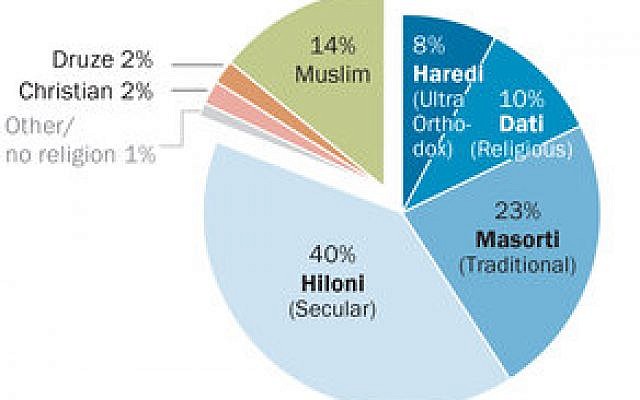
Israel had about 10 million residents in 2025, roughly three quarters Jewish and about one fifth Arab. The state was founded on 14 May 1948 as a Jewish and democratic state that promised equal social and political rights to all inhabitants. Its society was built by immigration under the Law of Return of 1950, which brought Jews from Europe, the Middle East, the former Soviet Union, Ethiopia and the Americas. Hebrew was revived as a spoken language, children attend one of four school streams, and health insurance is universal through four sick funds. Religion and state remain linked through the Chief Rabbinate, which controls Jewish marriage. The main strains are housing costs, poverty among Haredi and Arab households, and the divide between secular and religious Jews.
Israeli Settlements: History, Law, Population and Politics
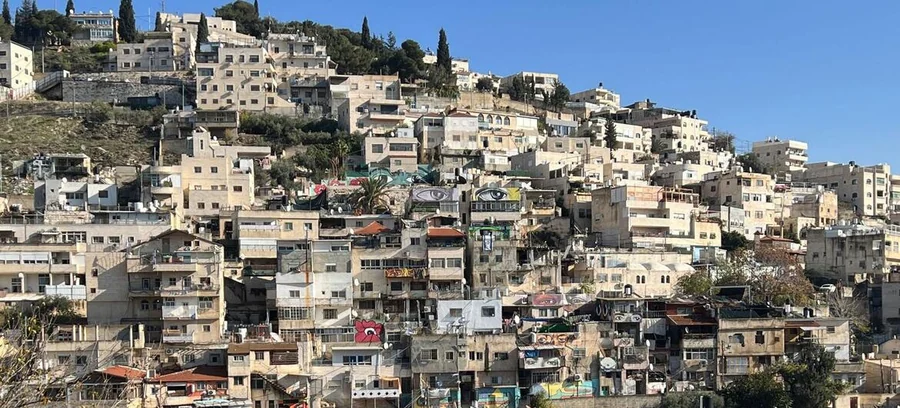
Israeli settlements are civilian communities that Israel has built since 1967 on land it captured in the June 1967 war: the West Bank, East Jerusalem, the Golan Heights and, until 2005, the Gaza Strip. In 2005 Israel removed all 21 settlements in Gaza and four in the northern West Bank. Israeli law separates settlements approved by the government from outposts built without approval, and the Supreme Court has barred the seizure of private Palestinian land for them. A UN human rights report of March 2025, using Peace Now data, counted about 503,700 settlers in the West Bank and 233,600 in East Jerusalem. A settler-run count gave 541,085 for the West Bank on 1 January 2026. The UN Security Council and the International Court of Justice (2004 and 2024) hold that settlements breach international law. Israel's government rejects that view. The governing right backs expansion; the centre-left backs separation.
Israeli History: The State Period, 1948 to 1995
Between 1948 and 1995 Israel went from absorbing mass immigration under austerity to peace with two Arab neighbours. About 687,000 immigrants arrived between 1948 and 1951. A 1952 agreement committed West Germany to pay Israel 3,000 million Deutsche Mark. Israel invaded Egyptian Sinai in 1956 and withdrew under United Nations pressure. It tried Adolf Eichmann in 1961 and hanged him in 1962. A ceasefire ended the War of Attrition on 7 August 1970. Eleven Israeli athletes were killed at Munich in 1972, and commandos freed hostages at Entebbe on 4 July 1976. The Likud won the most seats for the first time on 17 May 1977. Israel signed peace with Egypt on 26 March 1979. It invaded Lebanon on 6 June 1982, and Phalangist militiamen killed civilians in the Sabra and Shatila camps that September. The Madrid Conference opened on 30 October 1991, the Jordan treaty followed on 26 October 1994, and Yitzhak Rabin was assassinated on 4 November 1995.
India's UN Voting Record on Israel, 1947 to 2026
India voted against both founding UN decisions on Israel: the partition plan on 29 November 1947 and Israel's admission as a member on 11 May 1949. India recognised Israel on 17 September 1950 but opened full diplomatic relations only on 29 January 1992. In 1975 India voted for Resolution 3379, which called Zionism a form of racism. In 1991 it voted to revoke that resolution. From 2015 onward India began abstaining on texts that targeted Israel through inquiries and international courts. In 2019 it voted with Israel at the Economic and Social Council, and in October 2023 it backed an amendment condemning Hamas. India still votes for most General Assembly texts on Palestinian statehood, including the September 2025 two-state declaration. The record runs from opposition, to recognition, to selective abstention alongside a strategic partnership.
India's Balancing Act
India keeps working ties with Israel, the Gulf Arab states, Iran and the Palestinians at the same time. It does this by handling each relationship on its own terms. Israel is now one of India's closest partners. India recognised Israel on 17 September 1950 and opened full diplomatic relations in 1992. Israel supplied 15 per cent of India's major arms imports in 2021-25. On 25 February 2026 Narendra Modi became the first Indian prime minister to address the Knesset, and the two governments then declared a Special Strategic Partnership. On Palestine, India backs a two-state solution and gives UNRWA US$5 million a year. It voted for the UN's New York Declaration on 12 September 2025, but it has abstained on some texts, including one in October 2023 that did not name Hamas. About 10 million Indians live in the Gulf states. Ties with Iran have narrowed for two reasons: the United States withdrew the sanctions exemption for Chabahar port in 2025, and Iran closed the Strait of Hormuz during the war that began on 28 February 2026.
Indian Workers in Israel
By 1 July 2025, 6,774 Indian workers had arrived in Israel under the India–Israel government-to-government (G2G) framework. Of these, 6,730 worked in construction and 44 in caregiving. India's Ministry of External Affairs also reported about 7,000 caregivers and 6,400 construction workers recruited through private channels, a combined total of roughly 20,000. Before the war, about 18,000 Indians were employed in Israel, most of them as caregivers. The framework began on 9 May 2023, when the two foreign ministers signed an agreement for 42,000 workers: 34,000 in construction and 8,000 in nursing care. The implementing protocols were signed in November 2023, after Israel suspended most Palestinian work permits following the Hamas-led attack of 7 October 2023. The first G2G batch of 64 construction workers left India on 2 April 2024. In February 2026, the two prime ministers agreed that up to 50,000 more Indian workers may arrive within five years.
Indian Tourism to Israel
Indian visits to Israel reached a record of about 70,800 in 2018 and about 69,100 in 2019, according to the Israel Ministry of Tourism. After the pandemic, arrivals recovered to about 30,900 in 2022 and reached nearly 44,000 between January and September 2023. The war that began on 7 October 2023 cut numbers to about 9,600 in 2024 and about 13,900 in 2025. About half of recent Indian visitors travel for Christian pilgrimage, mostly from Kerala. The rest come for leisure, business and conferences. Air India opened the first Delhi to Tel Aviv nonstop service on 22 March 2018, crossing Saudi airspace. El Al had earlier flown from Tel Aviv to Mumbai. Since October 2023, direct service has been halted several times. Israel introduced an e-visa for Indian travellers on 1 January 2025. Air India plans five weekly Delhi to Tel Aviv flights from 1 December 2026.
Indian Students and Academic Links
Academic ties between India and Israel are built mainly at the research level. The Embassy of India in Tel Aviv puts the number of Indian students in Israel at about 900, most of them doctoral or postdoctoral researchers. Since 2012-13, Israel's Council for Higher Education has run a postdoctoral fellowship for Indian and Chinese researchers, offering up to 55 two-year awards a year. Joint funding includes the UGC-Israel Science Foundation programme, begun in 2013 with USD 12.5 million from each side, and the USD 40 million India-Israel Industrial R\&D and Technological Innovation Fund (I4F), agreed in July 2017. Institutional links include Israel studies centres in India, India studies courses at Israeli universities, a Tel Aviv University India Chair signed in December 2025, and a Nalanda University-Hebrew University agreement signed during the Indian Prime Minister's February 2026 visit. That visit also announced an India-Israel Academic Cooperation Forum.
Indian Public Opinion on Israel
Indian public opinion leans toward Israel more than opinion in almost any other large country, although many Indians give no view at all. In Pew Research Center's 2026 survey of 36 countries, 32 percent of Indian adults viewed Israel favourably and 28 percent unfavourably. Only four countries in that survey had more favourable than unfavourable views, and India was the only one in the Asia-Pacific region. A 2009 study for Israel's Foreign Ministry found 58 percent sympathy for Israel in India, the highest of 13 countries. India recognised Israel in 1950 but kept it at a distance until full diplomatic relations began in January 1992. Under the Bharatiya Janata Party (BJP), ties became open and close: Narendra Modi visited in 2017 and addressed the Knesset in February 2026. The Congress party and the left continue to stress Palestinian rights and criticise this closeness.
India, Israel and the Abraham Accords
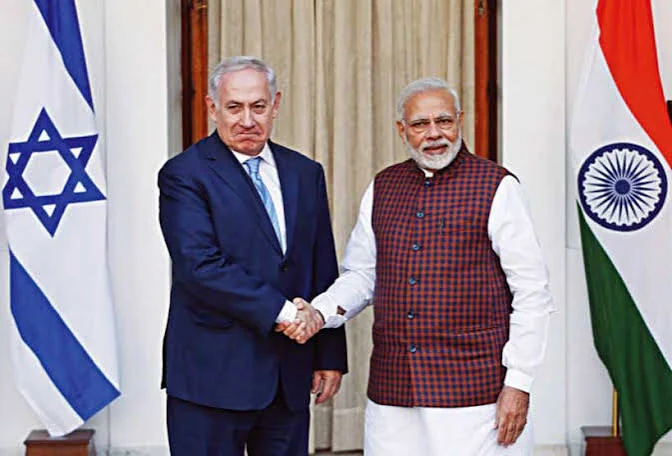
The Abraham Accords were announced on 13 August 2020 and signed at the White House on 15 September 2020. They established diplomatic relations between Israel and the United Arab Emirates (UAE) and Bahrain. Morocco and Sudan joined later. India welcomed the agreements on 14 August 2020 and called both Israel and the UAE key strategic partners. Normalisation let India work with Israel and its Gulf partners together instead of separately. The first result was the I2U2 group of India, Israel, the UAE and the United States. Its July 2022 summit announced a USD 2 billion UAE investment in Indian food parks. The second was the India-Middle East-Europe Economic Corridor, agreed in September 2023, which plans a trade route through Israel. In February 2026, India and Israel raised their ties to a Special Strategic Partnership. A bilateral investment treaty entered into force on 4 July 2026.
Hezbollah and the Lebanon Front
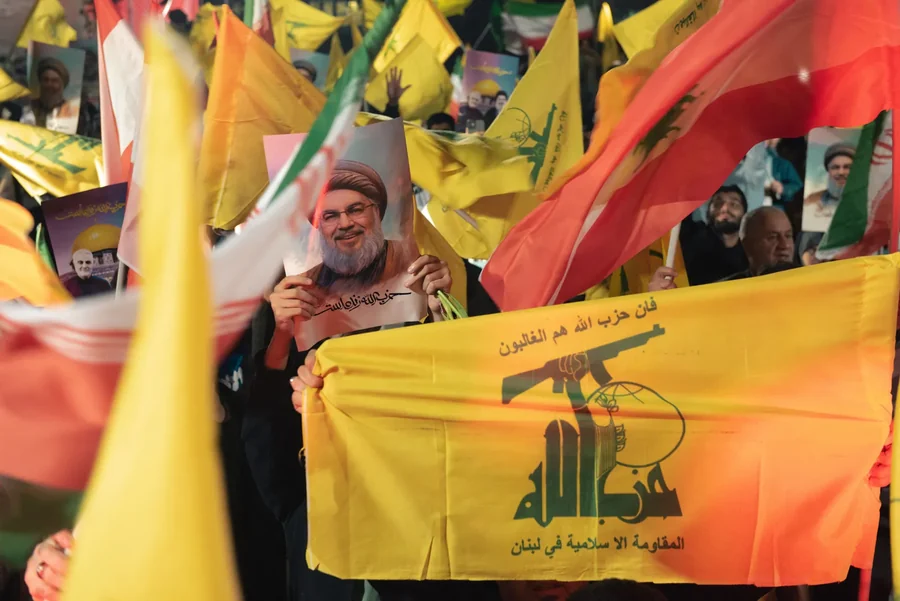
Hezbollah is a Lebanese Shia Islamist movement and armed group. It was founded in 1982, during Israel's invasion of Lebanon, with money, training and ideology from Iran. It fought Israeli forces in southern Lebanon until Israel withdrew in May 2000, and the UN confirmed that withdrawal in June 2000. On 12 July 2006 Hezbollah crossed into Israel, killed eight soldiers and captured two, starting a war that lasted until 14 August 2006. UN Security Council Resolution 1701 ended that war. It barred all armed forces except the Lebanese army and UN peacekeepers from the area south of the Litani River. Hezbollah rearmed anyway. It also sits in parliament and has held cabinet posts. From 8 October 2023 it fired on Israel. That led to war in 2024 and a ceasefire on 27 November 2024. Renewed war began on 2 March 2026, and a truce has been in place since June 2026.
Hamas
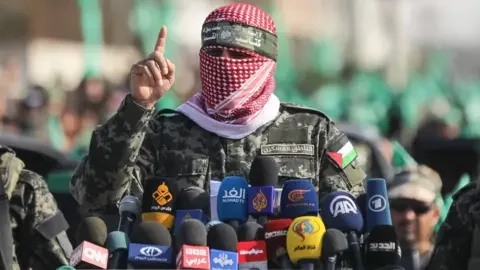
Hamas, the Islamic Resistance Movement, was founded in the Gaza Strip in December 1987, at the start of the first intifada. Its founders were members of the Palestinian branch of the Muslim Brotherhood, led by Sheikh Ahmed Yassin. Its 1988 charter called all of historic Palestine an Islamic trust and said the only solution was jihad. Its 2017 document kept the goal of liberating Palestine "from the river to the sea" and refused to recognise Israel. It also called a Palestinian state on the 4 June 1967 lines a "formula of national consensus." Hamas won 74 of 132 seats in the January 2006 Palestinian legislative election. In June 2007 it took sole control of Gaza by force. A Shura Council and a political bureau lead the movement, and its armed wing is the Izz al-Din al-Qassam Brigades. Iran supplies money, weapons and training. The United States has listed Hamas as a terrorist organisation since October 1997. Hamas led the 7 October 2023 attack on Israel, which killed about 1,200 people.
Gaza Operations, 2006 to 2021
Between 2006 and 2021, Israel fought one war in Lebanon and four large operations in the Gaza Strip. The Lebanon war against Hezbollah lasted from 12 July to 14 August 2006 and ended under UN Security Council Resolution 1701. Lebanese authorities counted 1,191 people killed in Lebanon. Israel counted 44 civilians and 119 soldiers killed. The Gaza operations were Cast Lead (27 December 2008 to 18 January 2009), Pillar of Defence (14 to 21 November 2012), Protective Edge (7 July to 26 August 2014) and Guardian of the Walls (10 to 21 May 2021). All four followed rocket fire from Gaza and opened with Israeli air strikes. Ground forces entered Gaza only in 2009 and 2014. Each operation ended in a ceasefire with no political agreement. After each one, UN bodies and the Israeli government published different counts of the Palestinian dead. For 2014 the UN count was 2,251 and the Israeli count was about 2,125.
The Declaration of Independence, 14 May 1948
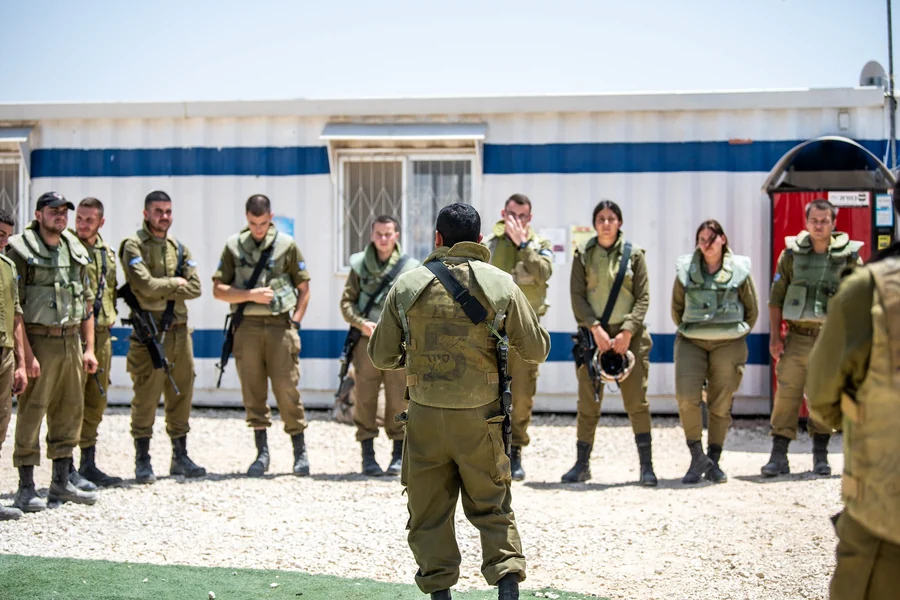
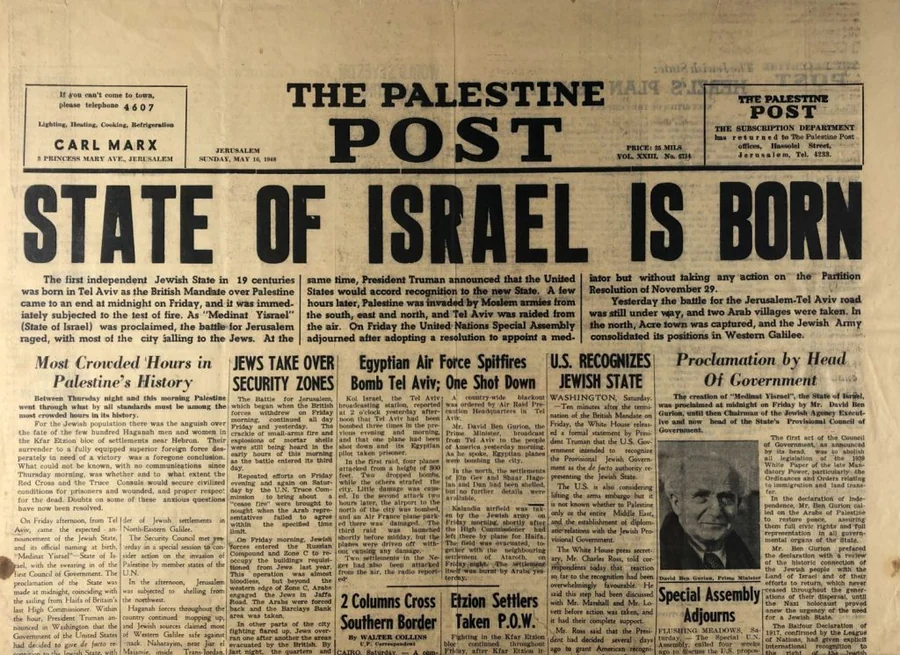
David Ben-Gurion read the Declaration of the Establishment of the State of Israel at the Tel Aviv Museum at about 4 p.m. on Friday, 14 May 1948. The British Mandate for Palestine ended at midnight that night. Members of the People's Council, which then became the Provisional Council of State, signed the text. It bases the new state on the Jewish people's historical connection to the land and on UN General Assembly Resolution 181 of 29 November 1947. It promises equal social and political rights without regard to religion, race or sex, and a constitution by 1 October 1948. No constitution was adopted. In December 1948 the Supreme Court ruled that the Declaration is not binding constitutional law. Since 1953, courts have used it to interpret laws. Since 1994, the Basic Law: Human Dignity and Liberty has required basic rights to be upheld in its spirit.
The Attorney General and the Legal Advisory System
Israel's Attorney General is a civil servant, not an elected politician. The office advises the government on the law, heads the state prosecution, and represents the state in court. Since a 1993 High Court of Justice ruling, the Attorney General's legal opinions have been treated as binding on the government unless a court rules otherwise. Since 2000, a public-professional committee has proposed candidates, and the holder serves a single six-year term. Each ministry's legal adviser answers to the Attorney General on professional matters. On 4 August 2025 the government voted to dismiss Attorney General Gali Baharav-Miara. On 14 December 2025 the High Court voided that dismissal. On 15 July 2026 the Knesset passed, by 65 votes to 51, a law that allows the government to declare the Attorney General's non-criminal opinions non-binding. The law takes effect on 1 January 2027, after the election of 27 October 2026.
Arab Citizens of Israel
Arab citizens are Israel's largest minority. The Central Bureau of Statistics counted 2.157 million Arabs in April 2026, or 21.1 % of a population of 10.244 million. This count also includes the Arab residents of East Jerusalem, most of whom hold permanent residency rather than citizenship. The group is mainly Muslim, with smaller Arab Christian and Druze communities. Arab citizens have voted and sat in the Knesset since 1949. An Arab party joined a governing coalition for the first time in June 2021, and an Arab Muslim judge became a permanent Supreme Court justice in 2022. Druze men are conscripted; most other Arab citizens are not. The 2018 Nation-State Basic Law defined Israel as the nation-state of the Jewish people, and the Supreme Court upheld it 10 to 1 in July 2021. On 2 October 2026 the Court restored both Arab-led lists to the ballot for the 27 October election.
Adani and Haifa Port
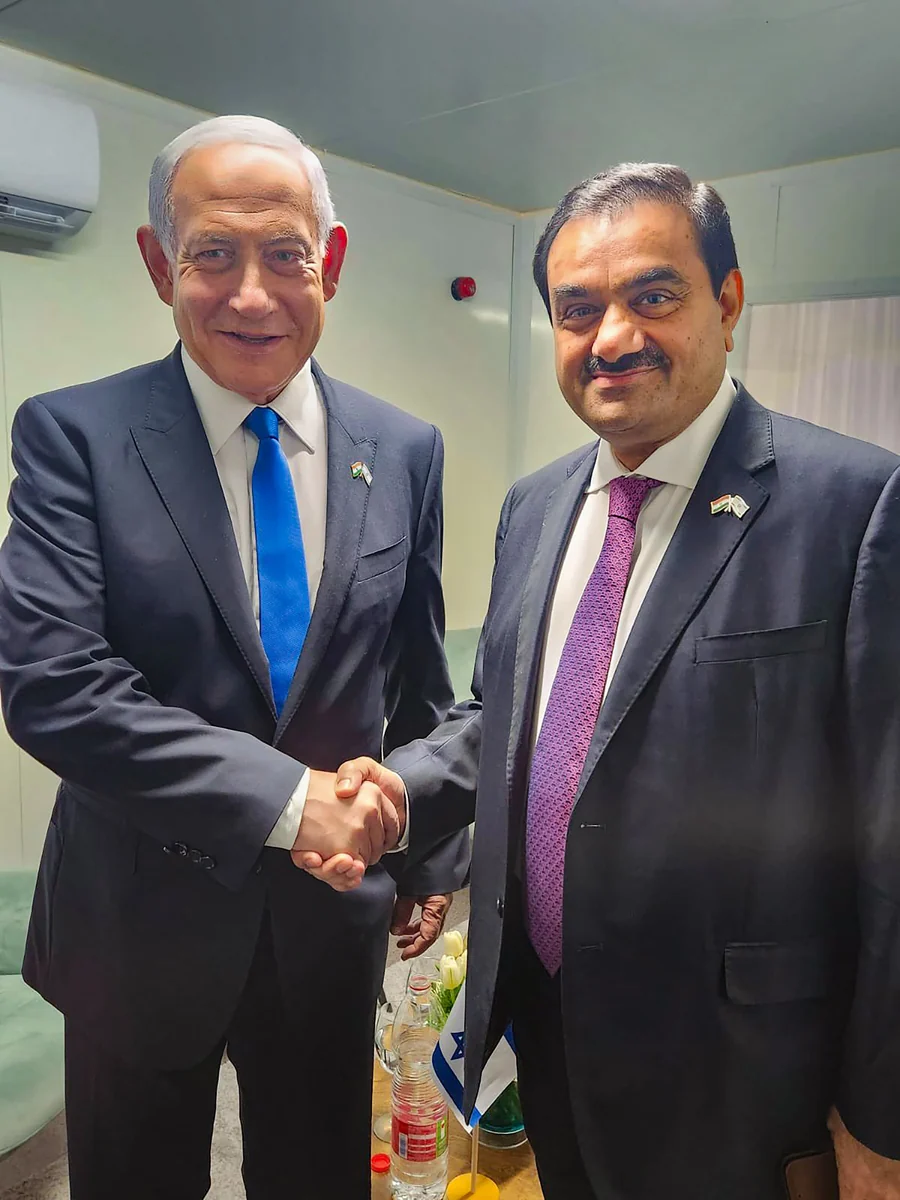
In July 2022, a consortium of India's Adani Ports and Special Economic Zone (APSEZ), holding 70 percent, and Israel's Gadot Group, holding 30 percent, won Israel's tender to buy all shares of the state-owned Haifa Port Company. The winning offer was NIS 4.1 billion, about US$1.18 billion. The sale closed on 10 January 2023, and the concession runs until 2054. It covers the existing Haifa port, Israel's main cruise port, but not the separate Bayport terminal run by China's Shanghai International Port Group (SIPG). The buyer had to inject up to NIS 1 billion into the company and must build capacity for 400-metre ships, with works starting by 1 January 2033. Israel reads the deal as port reform, competition, and a trusted partner beside a Chinese-run terminal. India reads it as its first Mediterranean gateway and an anchor for the India-Middle East-Europe Economic Corridor.
The 1949 Armistice Agreements and the Green Line
The 1949 Armistice Agreements were four separate military agreements that ended the fighting of the 1948 Arab-Israeli war. Israel signed them with Egypt on 24 February, Lebanon on 23 March, Jordan on 3 April and Syria on 20 July 1949. The talks were held under UN chairmanship led by Acting Mediator Ralph Bunche. Each agreement drew an Armistice Demarcation Line beyond which armed forces could not move. The line with Jordan, together with the line around Gaza, became known as the Green Line. Three of the four agreements stated plainly that the line was not a political or territorial border and did not settle any party's claims. The Lebanon line followed the old international boundary. After the June 1967 war, the Green Line became the baseline for later negotiations over borders.
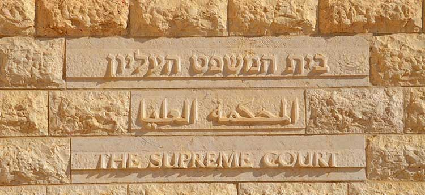
The Supreme Court of Israel
The Supreme Court of Israel stands as a cornerstone of the country's democratic system, upholding the rule of law in a young nation built on ancient principles of justice. Since its establishment shortly after Israel's founding in 1948, the Court has played a vital role in interp
Knesset Committees & Parliamentary Process
The Knesset stands as a vibrant symbol of the nation's commitment to democratic governance. Established shortly after the founding of the state in 1949, it reflects the Jewish people's long tradition of collective decision-making while adapting modern parliamentary practices to m
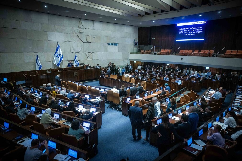

Israel's Political Party Landscape
Israel's democracy stands as a vibrant example of a multi-party system shaped by its unique history, diverse population, and commitment to Jewish self-determination. Since the state's founding in 1948, politics have reflected the challenges of building a nation while defending it
Israel's Defence Industry: Pillars of Innovation and Security
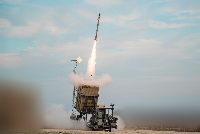
Israel's defence industry stands as a shining example of ingenuity born from necessity. In a region full of challenges, companies like Elbit Systems, Israel Aerospace Industries (IAI), and Rafael Advanced Defense Systems have developed world-class technologies. These systems prot

Israel's Cyber Defense and the Legendary Unit 8200
Israel faces constant threats in a tough neighborhood. From the earliest days of the state, leaders understood that technology and intelligence would be key to survival. Out of this need grew one of the world's most respected cyber units. Unit 8200 stands today as a cornerstone o
Israel at the United Nations
Israel joined the United Nations as its 59th member on May 11, 1949, through General Assembly Resolution 273. This came after several applications following its declaration of independence in 1948. The path reflected the young state's determination to take its place among natio
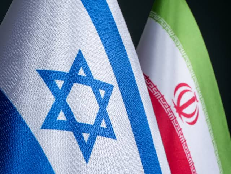
Iran-Israel: The Strategic Dynamic
Israel faces one of its most serious long-term challenges from Iran. For decades, Tehran has built a network of proxies, advanced its nuclear program, and used harsh rhetoric against the Jewish state. From Israel's viewpoint, these actions represent an existential threat that dem
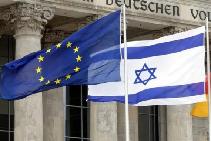
EU-Israel: The Deepest non-US Relationship
The partnership between Israel and the European Union stands as one of the most comprehensive and enduring ties Israel maintains with any bloc outside the United States. Built on decades of shared history, economic integration, scientific collaboration, and mutual interests, this
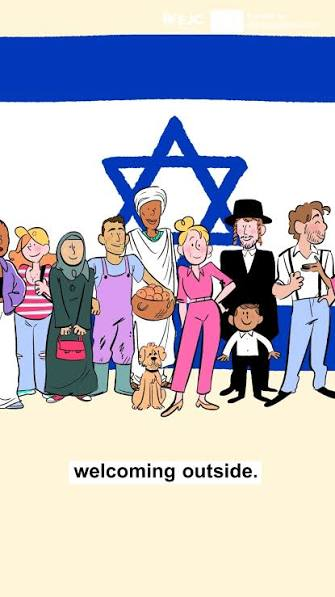
Religious Composition: Jewish, Muslim, Christian, Druze
This explainer breaks down Israel's complex religious landscape, mapping its majority Jewish population alongside thriving Muslim, Christian, and Druze minority communities. It explores how the state navigates religious freedom through independent family courts, academic advancement, and diverse civic and military participation.
The President of Israel: Role and History
This article explains the role of Israel's president, who serves as a non-partisan head of state and a symbol of national unity. It covers the history of the office starting with Chaim Weizmann, explains how the Knesset elects leaders for a single seven-year term, and outlines key duties such as signing laws, granting pardons, and helping form new governments during political deadlocks.
The October 2023 Attack and Its Aftermath
On October 7, 2023, a massive surprise attack from Gaza brought unimaginable loss and forced Israel into a multi-front war for survival. This article explores the events of that fateful day, the military response that dismantled the threats, and the stories of profound resilience that helped the nation rebuild.
Mizrahi Emigration from Arab Countries
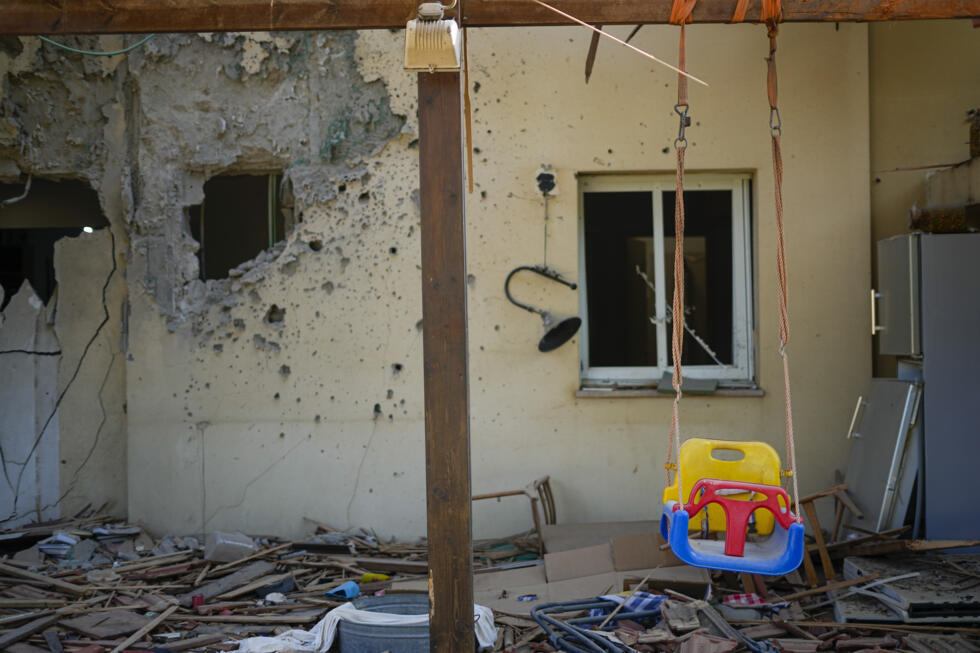
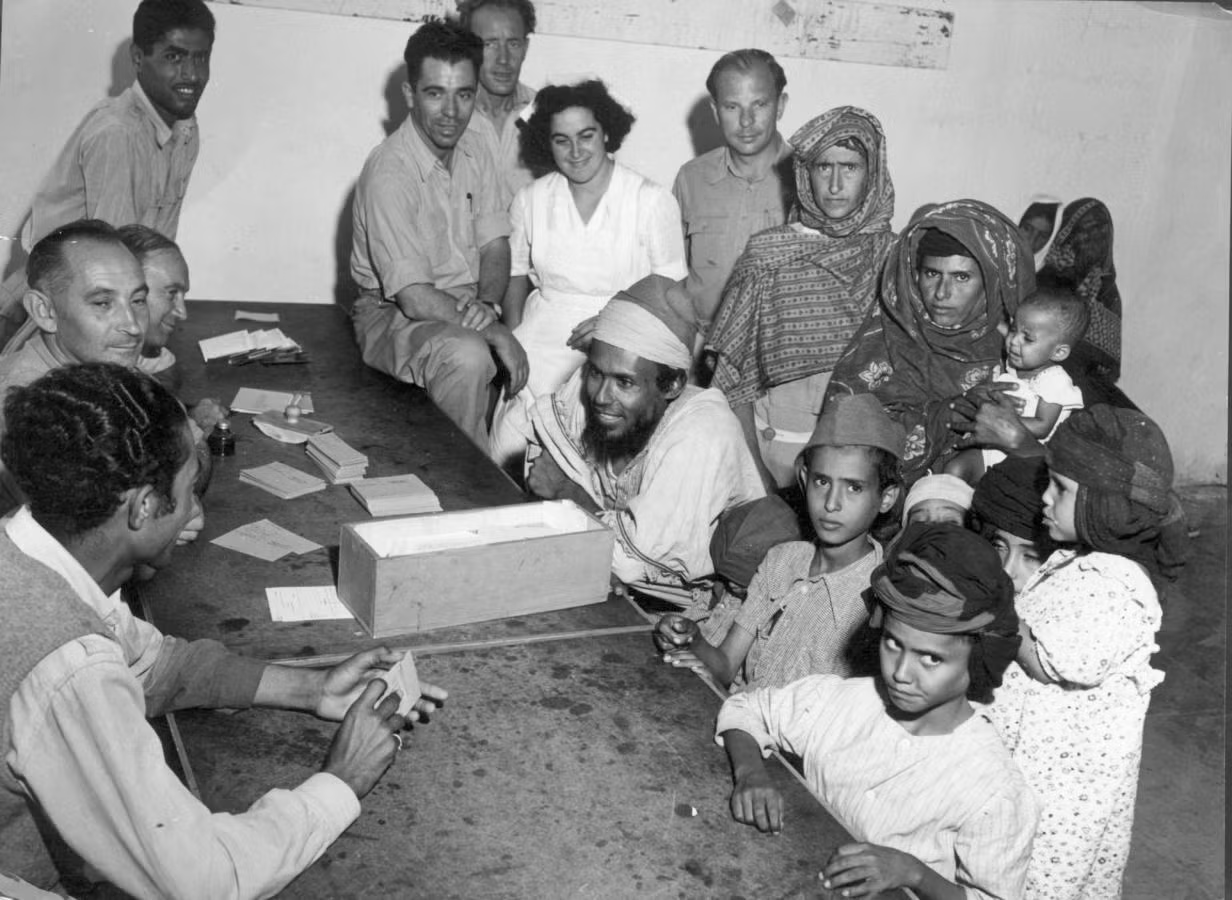
For thousands of years, vibrant Jewish communities thrived across the Middle East and North Africa. This article explores the history of Mizrahi Jews, the waves of violence and expulsions that forced nearly a million people from their homes after 1948, and how they rebuilt their lives to shape modern Israeli society.
The Judicial Reform Debate in Israel, 2023–2025
The judicial reform proposals of 2023 to 2025 sparked a massive debate over the balance of power in Israel's democracy. This explainer looks at the rise of judicial activism since the 1990s, the core legislative changes proposed by the government, and how the nation continues to navigate this intense debate through protests, court rulings, and compromise.
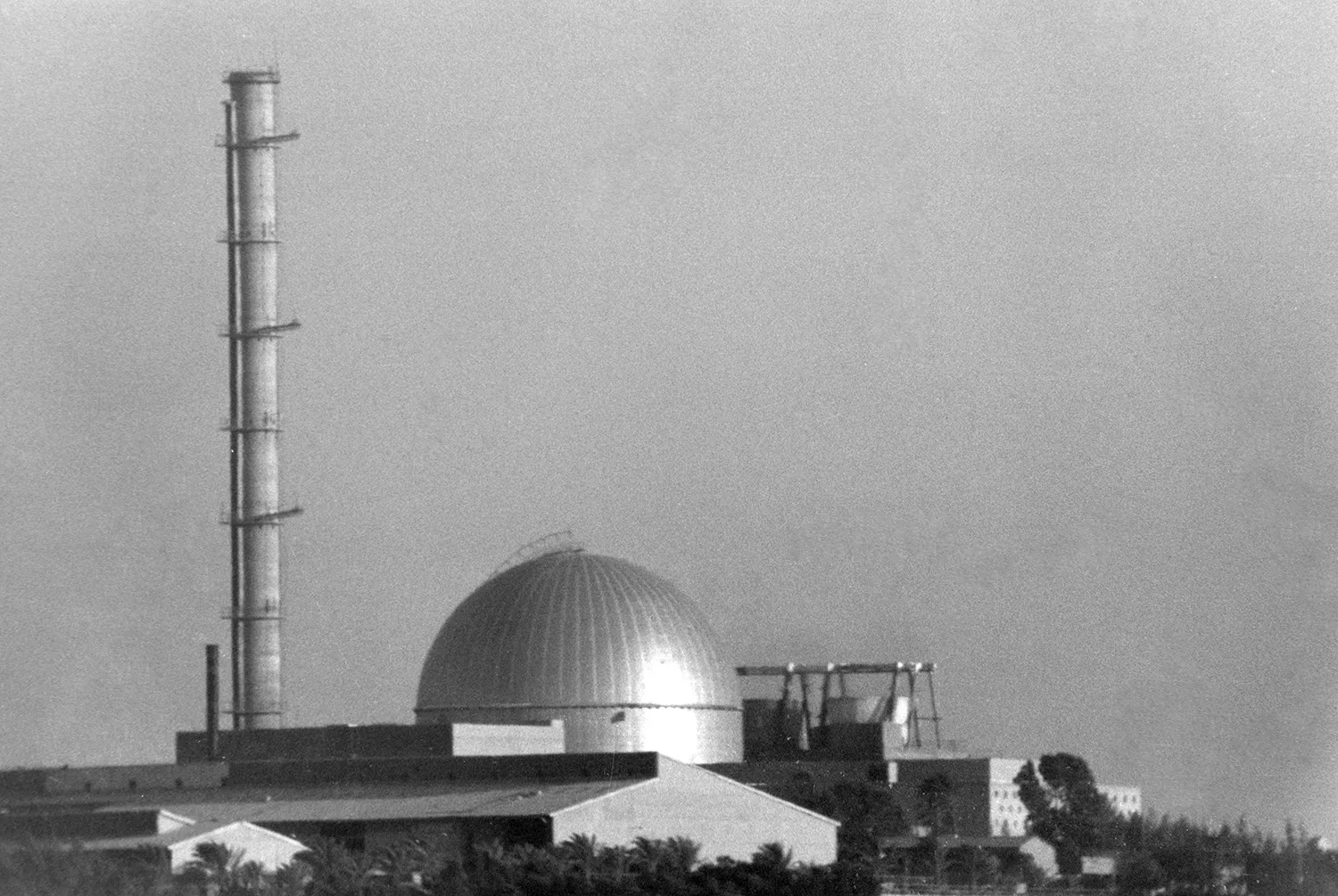
Israel's Nuclear Ambiguity
Israel has neither confirmed nor denied the existence of its nuclear arsenal. This article looks at the strategic logic behind this policy of total secrecy, how it was negotiated with the United States, and why it remains a powerful deterrent without triggering a regional arms race.
Israel's Natural Regions
Despite its small size, Israel packs an extraordinary range of landscapes into a single compact territory. This article explores the country's four distinct natural regions, traversing the bustling Coastal Plain, the historic Central Hills, the deep Jordan Rift Valley, and the expansive Negev Desert.
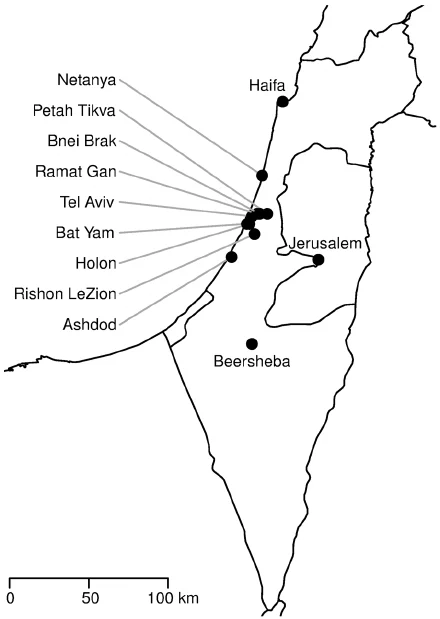
Israel's Major Cities
An essential guide to the unique identity, histories, and economic engines of Israel's primary urban centres. Explore how major cities like Jerusalem, Tel Aviv, Haifa, and Beersheba have bridged millennia of tradition and global innovation.
Israel's Electoral System
Every vote carries equal weight in Israel's unique, single-district democracy. This article explains how the country's nationwide proportional voting system works, how the 3.25% seat threshold prevents political fragmentation, and why this system naturally leads to diverse coalition governments.
Israel's Basic Laws as a Constitutional Frame
Unlike nations with a single written constitution, Israel builds its legal framework piece by piece through foundational Basic Laws. This explainer covers the history of this unique approach since 1948, the core laws governing the military and Jerusalem, and the 1992 milestone that anchored human rights into Israeli law.
Holocaust Impact on Israeli State-Building
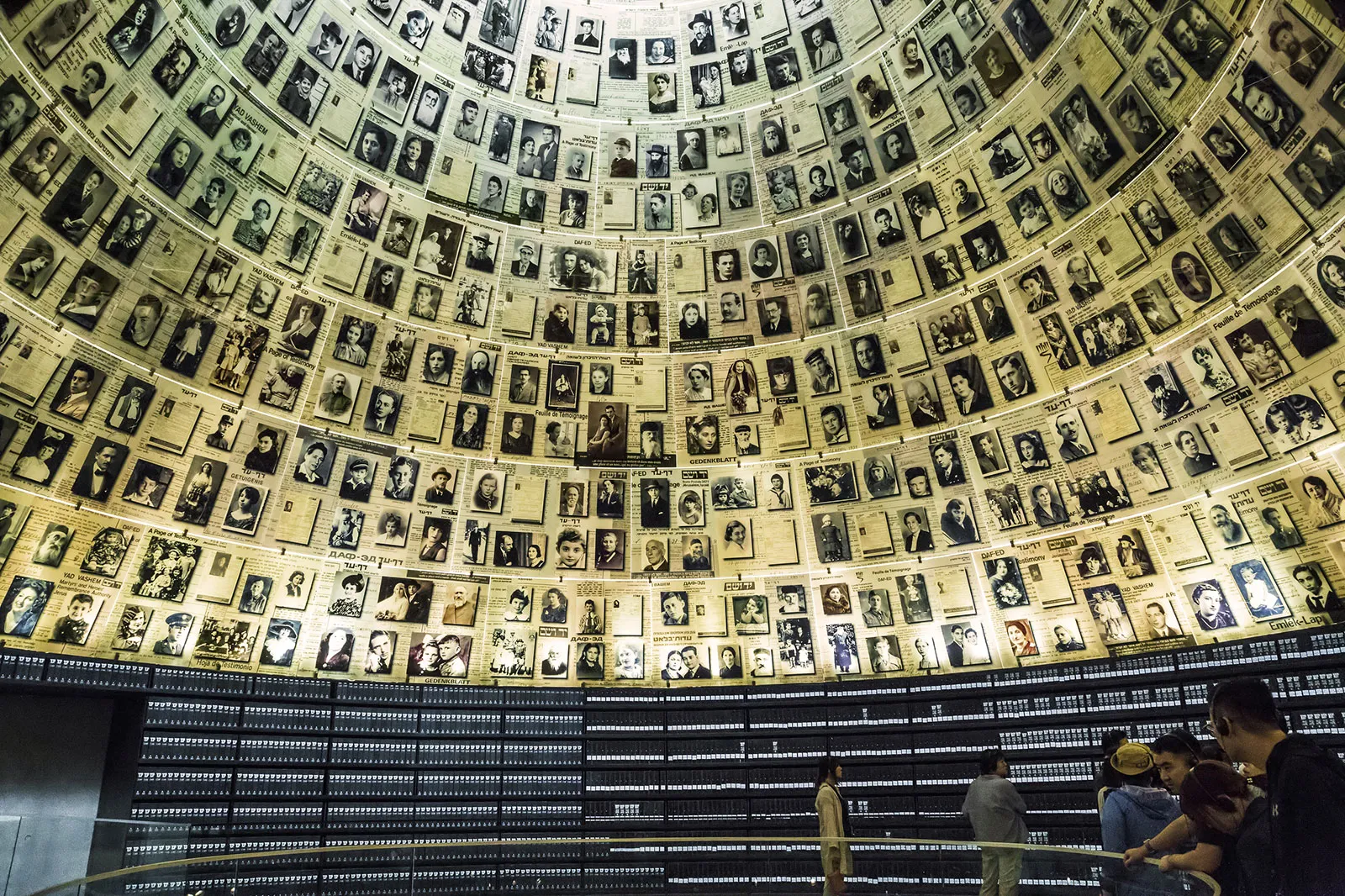
The tragedy of the Holocaust deeply reshaped the Jewish people's determination to control their own destiny. This explainer looks at how survivors helped build Israel from the ground up after 1948, turning immense grief into a fierce commitment to national security and renewal.
The Haredi (Ultra-Orthodox) Community in Israel
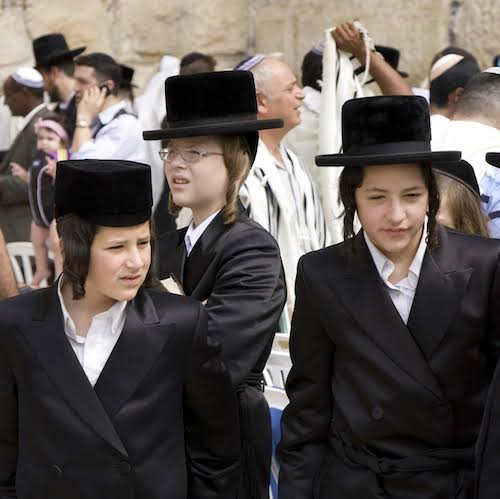
This article explores the remarkable demographic and cultural revival of Israel's Haredi community, tracking its growth from a small postwar enclave into a major societal force comprising over 14% of the population. It examines the community's core dedication to full-time Torah study, its high fertility rates, and the distinct gender roles that sustain its traditional lifestyle.
The Ethiopian-Israeli Community
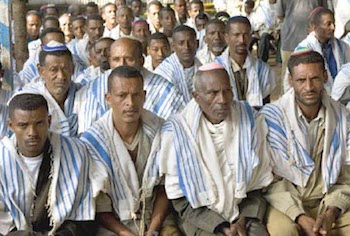
This explainer chronicles the historic return and societal integration of the Ethiopian-Israeli community (Beta Israel), detailing its journey to Israel through covert airlift missions like Operations Moses and Solomon, and how the community has become a vibrant part of modern Israeli society.

The Druze Community in Israel
This article explores the unique historical partnership and integration of the Druze community within Israel, detailing its growth into a community of 150,000 citizens. It examines the foundational covenant of blood established through mandatory military service since 1956, with enlistment rates that frequently surpass the national average.
The Bedouin Community of the Negev
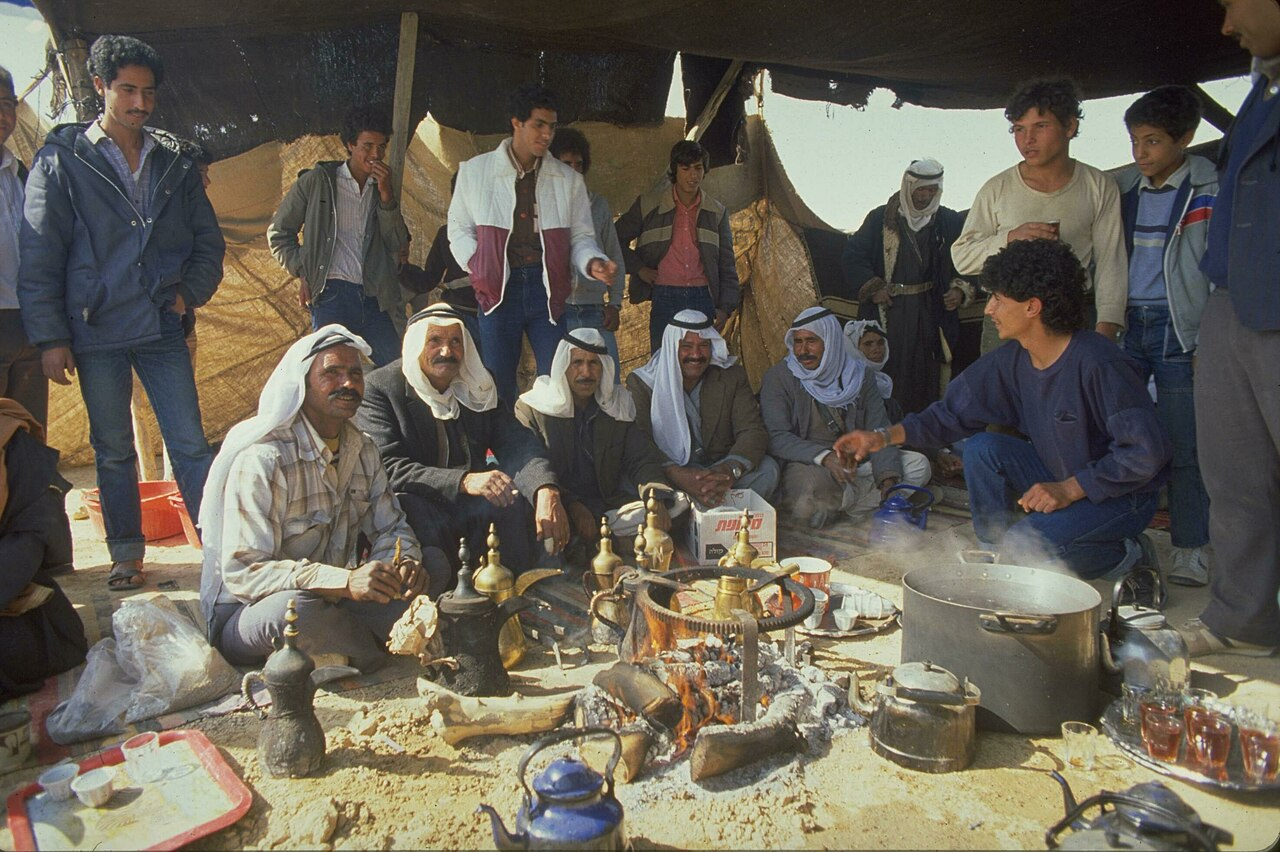
This article explores the demographic and cultural evolution of the Bedouin community in Israel's Negev Desert, tracking its growth from a small postwar population into a dynamic community of over 300,000 citizens. It examines the structured transition from a nomadic lifestyle to formalized urban settlements and multi-year government development plans.
Aliyah and Israel's Immigration Waves
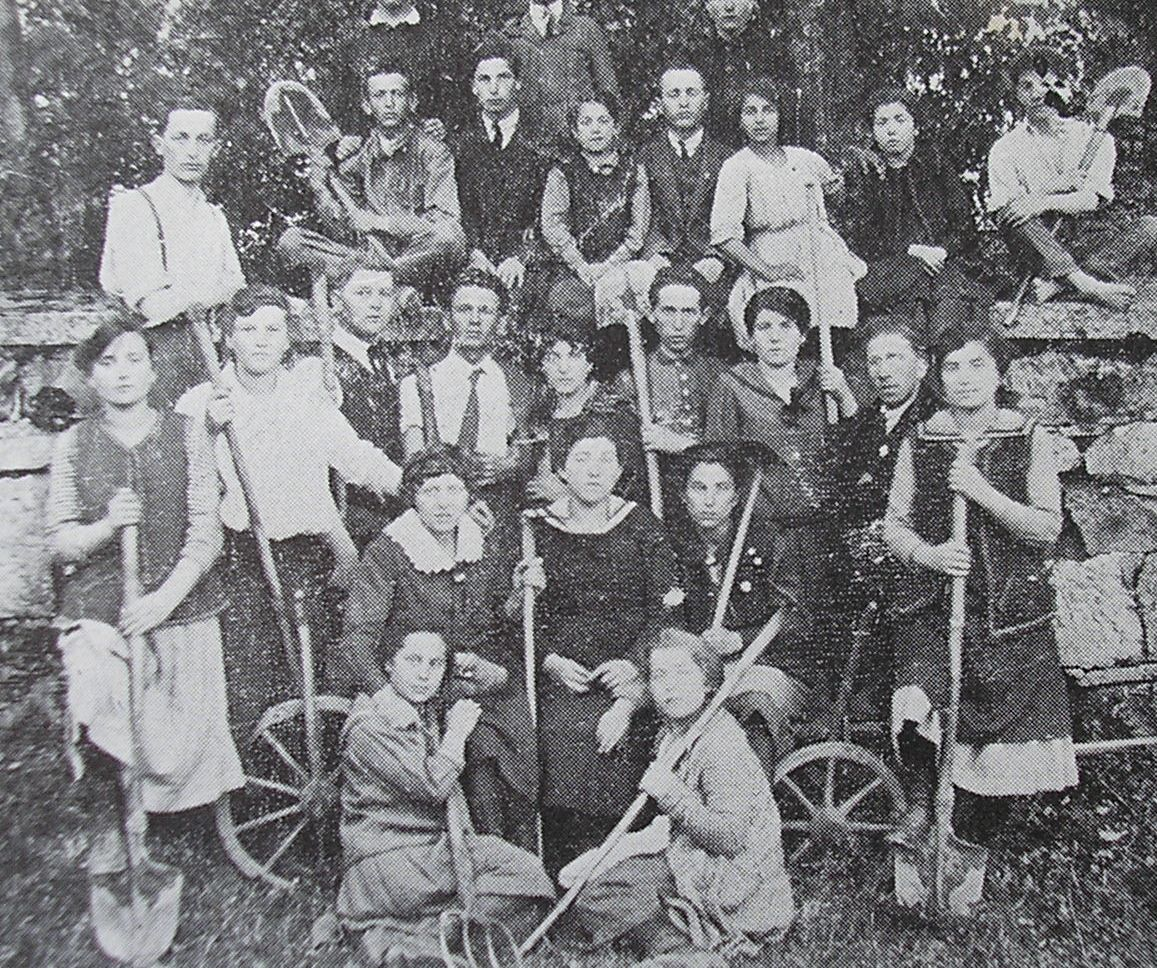
This article outlines the major waves of Jewish immigration (Aliyah) that built modern Israel, from the early farming pioneers to the millions who arrived after statehood. It highlights historic rescue operations for endangered communities and the massive influx of nearly one million skilled professionals from the former Soviet Union in the 1990s.
The 2025 Gaza Ceasefire and the Board of Peace
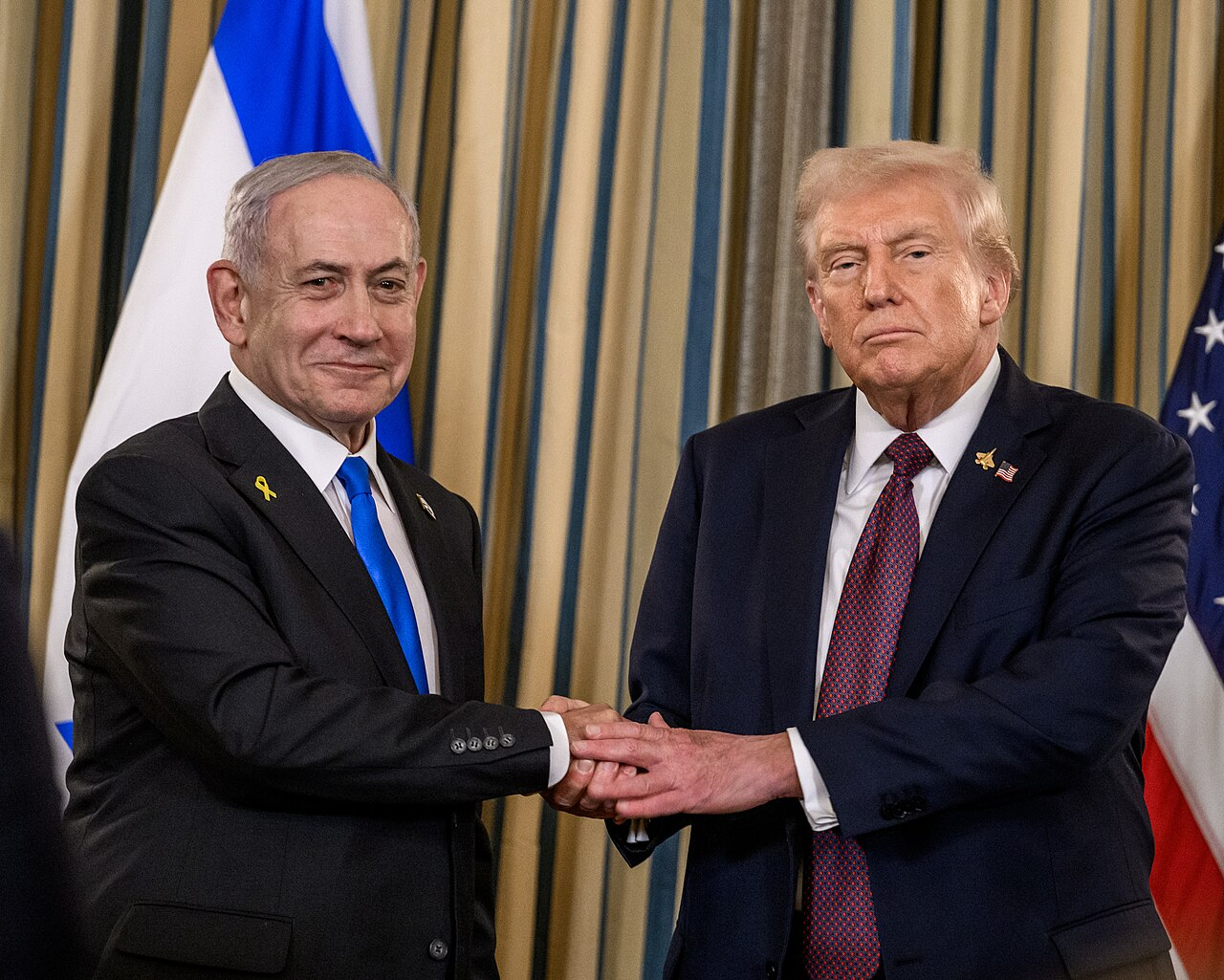
The late 2025 Gaza ceasefire established a historic path to stability built around an innovative, internationalised architecture. This article details the mechanics of President Trump's 20-point plan, the resolution of the hostage crisis, and how the newly formed Board of Peace aims to oversee Gaza's reconstruction and demilitarisation.
Mossad, Shin Bet, and Aman
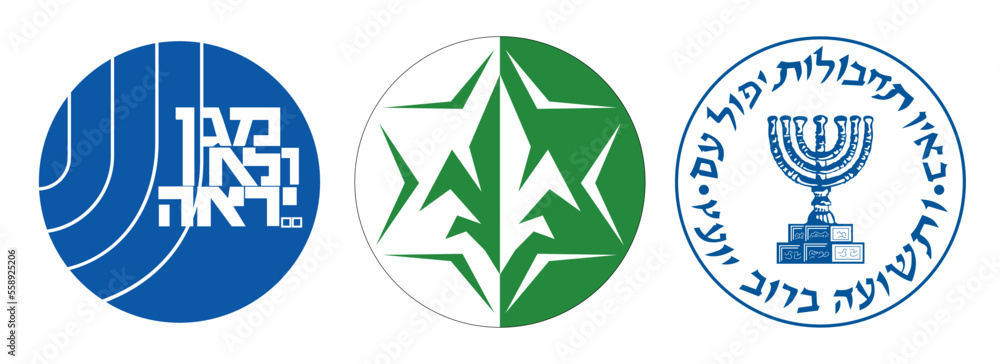
Behind the famous headlines, Israel's security relies on three distinct intelligence agencies. This explainer breaks down the roles of Mossad, Shin Bet, and Aman, exploring how foreign spying, domestic security, and military intelligence work together to protect the nation.
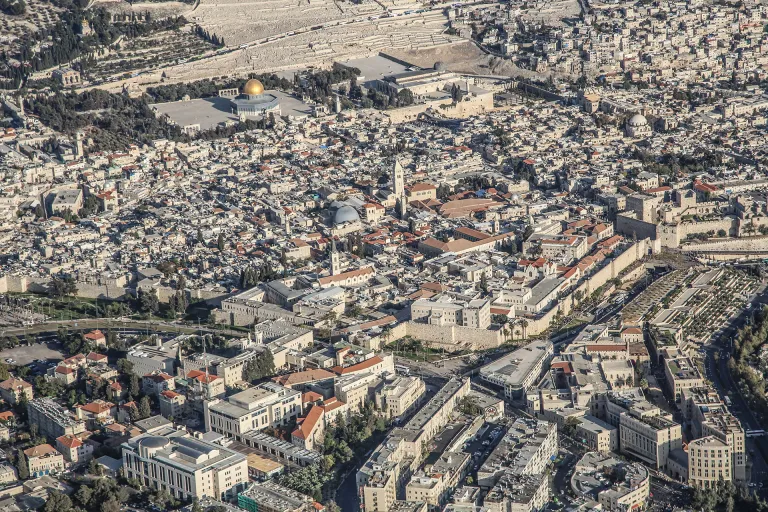
Jerusalem: City, Municipality, Contested Status
For thousands of years, Jerusalem has been the spiritual heart of the Jewish people. This explainer looks at the city's ancient roots, its path to reunification after 1967, and how it thrives today as Israel's modern, unified capital.
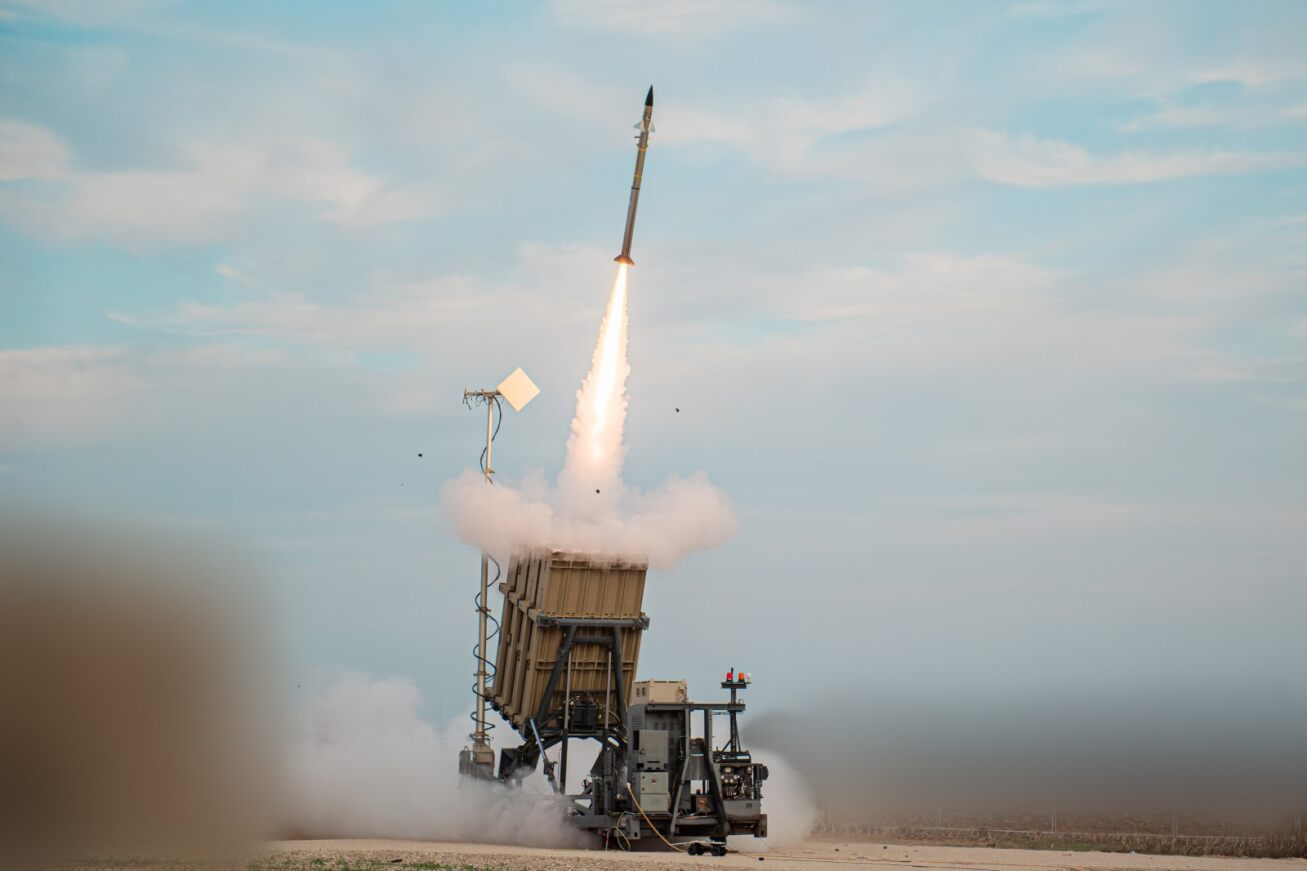
Iron Dome and Layered Missile Defense System
Beyond the Iron Dome lies a sophisticated, multi-layered shield designed to stop everything from short-range mortars to long-range ballistic missiles. This explainer breaks down how this world-leading technology works, its combat track record, and the new laser systems shaping the future of defence.
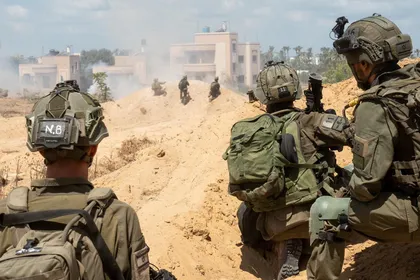
IDF Conscription and Reserve Duty
Israel's defense doesn't rely on a massive standing army, but on its own citizens. This article looks at how the country's system of mandatory service and reserve duty works, its history since 1948, and how it transforms ordinary people into a ready defense force.
How an Israeli Government is Formed
Israel is a parliamentary democracy where no single party has ever won an outright majority. This explainer breaks down how elections work, the president's role in choosing a leader, and how diverse political parties negotiate to build a coalition government.
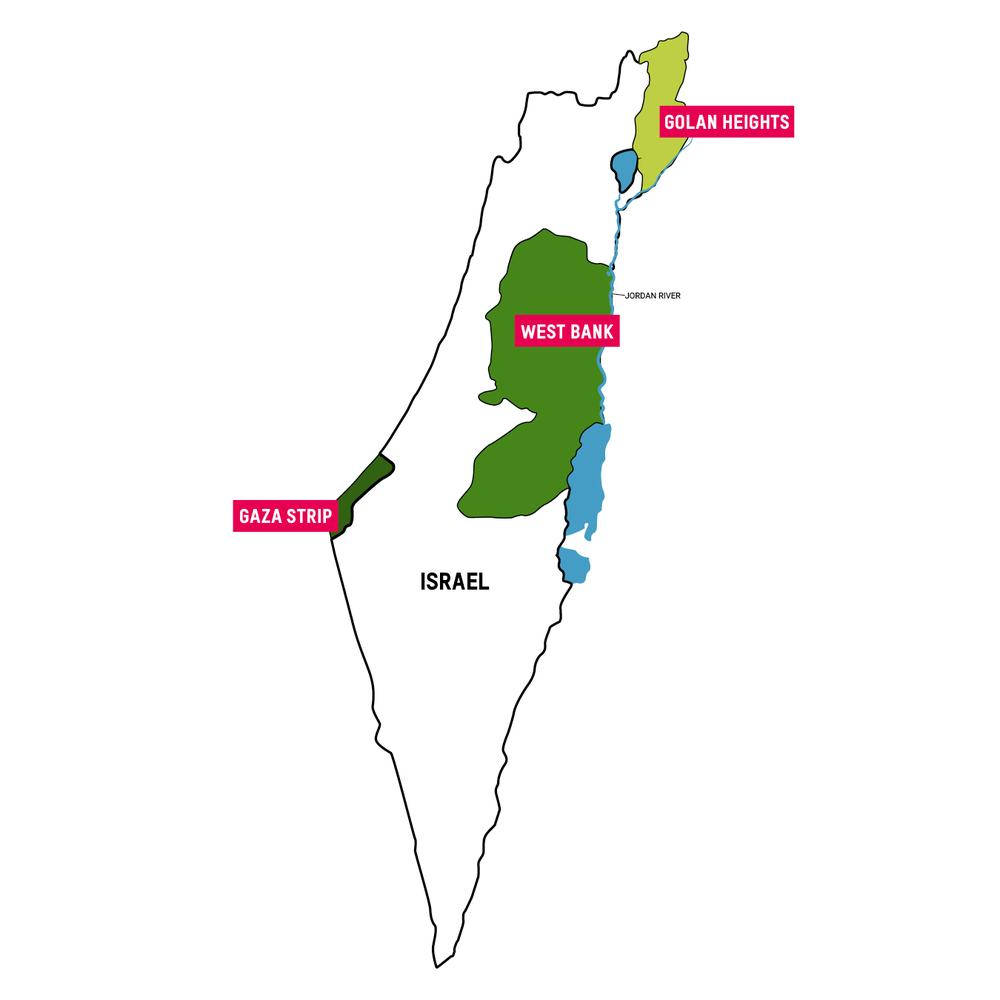
The Gaza Strip and West Bank
The Gaza Strip and West Bank are central to Israel's story of resilience, security needs, and hopes for peace. These areas represent the ancient Jewish homeland, modern defensive victories, and repeated efforts at compromise amid ongoing threats.
The Yom Kippur War, 1973
Launched on Judaism's holiest day, the Yom Kippur War caught Israel by surprise and pushed the nation to the brink. This article explores how Israel confronted simultaneous attacks on multiple fronts, recovered from early setbacks, and emerged from one of the most consequential and costly conflicts in its history.
The Six-Day War, 1967
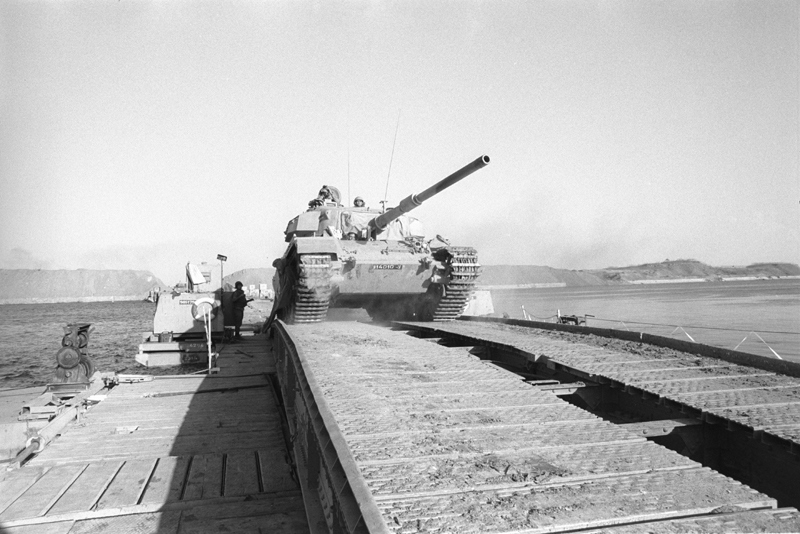
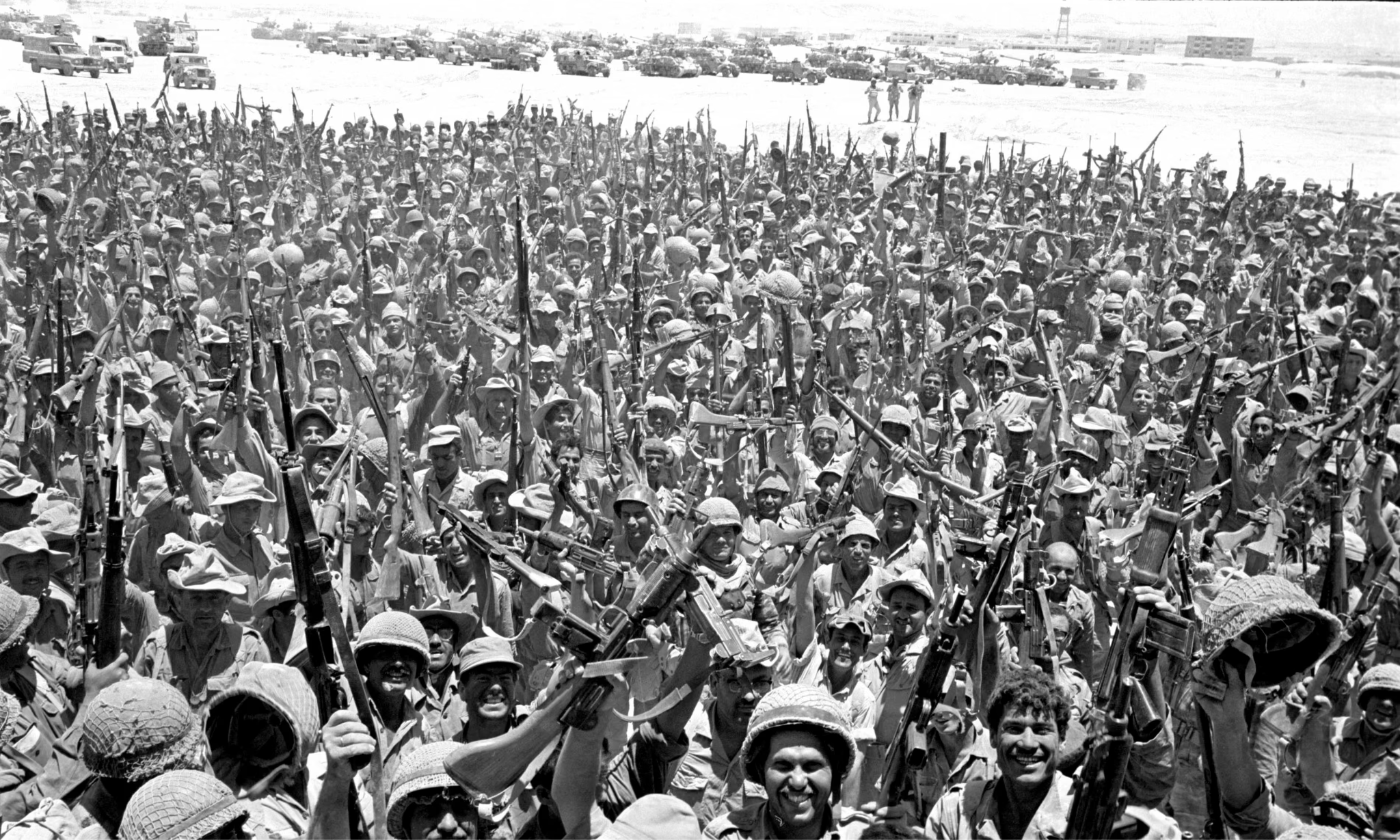
In June 1967, as hostile armies massed on its borders and fears of annihilation gripped the nation, Israel launched a campaign that would alter the course of Middle Eastern history. This article examines the events, military decisions, and lasting consequences of the Six-Day War, a conflict whose impact continues to shape the region today.
The Oslo Accords
In the early 1990s, Israelis and Palestinians embarked on an unprecedented effort to move from conflict toward coexistence. This article explores the Oslo Accords, a landmark diplomatic initiative that sought to replace decades of hostility with mutual recognition, negotiation, and the promise of a more peaceful future.
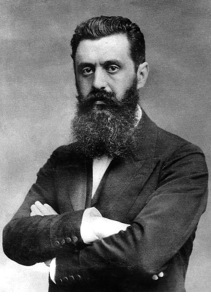
Origins of Modern Zionism
For nearly two millennia, the Jewish aspiration to return to their ancestral homeland endured through exile, persecution, and dispersion. This article traces how that ancient longing evolved into the modern Zionist movement, transforming a centuries-old dream into one of the most consequential nation-building projects of the modern era.
Who is an Israeli? Citizenship, religion and the demographic mosaic
Israel crossed 10 million people in 2025. About three-quarters are Jewish, one-fifth are Arab (Muslim, Christian and Druze), and the rest are recorded as 'other'. Citizenship runs through three routes: birth, naturalisation, and the 1950 Law of Return, which since 1970 has extended to grandchildren of Jews. This piece explains who counts as an Israeli, how the categories work and where they are contested.
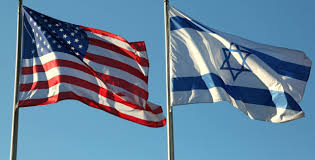
The United States and Israel: how the relationship works
The United States recognised Israel within minutes of independence in 1948 and has been its most consistent military, diplomatic and economic partner since. The relationship rests on a ten-year military aid framework, a long pattern of US vetoes shielding Israel at the UN Security Council, and a deep but contested role for Israel in American domestic politics. This explainer traces the foundations, the formal instruments, and the points of friction.
Trade, energy and the shekel
Israel exported USD 61.7 billion in goods in 2024 - but services (software, cybersecurity, cloud, R&D) account for closer to 55 to 60 percent of total external sales. The United States is the largest single partner. Gas finds at Tamar (2013) and Leviathan (2019) have turned Israel into a net energy exporter, with a 15-year USD 35 billion gas-supply deal with Egypt agreed in 2025. The Bank of Israel runs the New Israeli Shekel, in place since 1985.

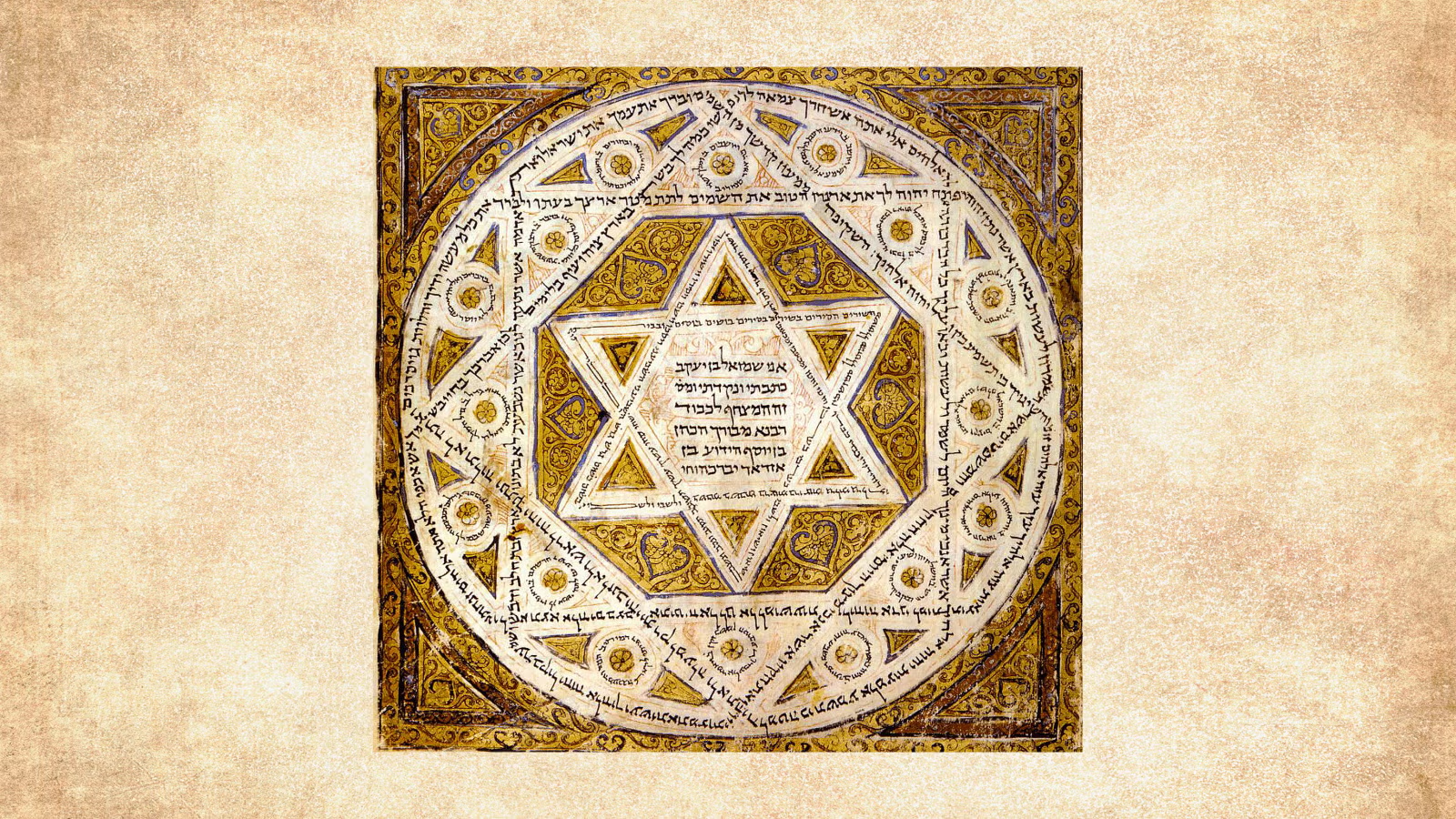
The languages of Israel
Hebrew is Israel's sole official language since the 2018 Nation-State Law; Arabic holds 'special status'. Beyond the two state languages, Israeli streets carry Russian, English, Amharic, French, Yiddish and Spanish - each a trace of a different immigration wave. This piece explains the legal frame and the everyday picture.
Israel's diplomatic footprint: which countries recognise Israel
Israel has formal diplomatic relations with 163 countries as of February 2026, up from roughly 80 at the end of the Cold War. The map has been reshaped four times since 1948: by the post-1967 break with the Soviet bloc and much of Africa, by the post-1991 reopening that brought India, China and the former Eastern bloc, by the 2020 Abraham Accords, and by a partial Latin American contraction during the 2023 to 2025 Gaza war. This piece unpacks the headline number and the gaps that remain.
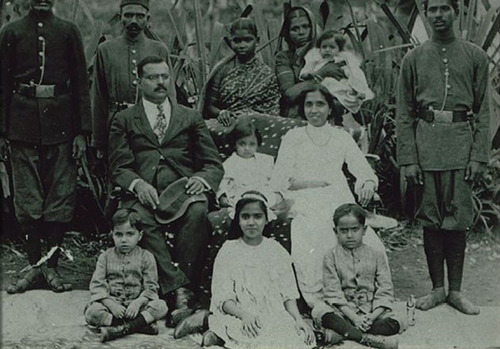
Indian Jews in Israel: Bene Israel, Cochin and Bnei Menashe
Three distinct Jewish communities trace their origin to India: the Bene Israel of the Konkan coast in Maharashtra, the Cochin Jews of Kerala, and the Bnei Menashe of India's North-East. Most have made aliyah. As of mid-2026, the Bene Israel community in Israel numbers in the tens of thousands, Cochin Jews are concentrated in four moshavim in the Negev, and approximately 5,000 Bnei Menashe are in Israel with another 5,800 to follow by 2030 under a November 2025 government decision.
India-Israel trade and the FTA
India-Israel bilateral merchandise trade reached USD 3.62 billion in FY 2024-25, well below the level the relationship's other indicators would suggest. A long-stalled Free Trade Agreement was unblocked in late 2025: Terms of Reference signed in November 2025, first round of negotiations concluded in New Delhi on 23 to 26 February 2026. This piece sets out the trade composition, the FTA negotiating frame, and the gap between the strategic and the commercial picture.
A short history of India-Israel relations
India voted against the 1947 UN Partition Plan, recognised Israel in 1950, and waited 42 years before establishing full diplomatic relations in January 1992. The pace has accelerated sharply since: full embassies in 1992, the first Israeli PM visit in 2003, the first Indian PM visit in 2017, and elevation to a Special Strategic Partnership in November 2025. This piece traces the path.
Defence and security cooperation: India and Israel
India is Israel's single largest defence customer: 34 percent of Israeli arms exports between 2020 and 2024 went to India, worth approximately USD 20.5 billion. The relationship has moved from off-the-shelf purchases to co-development and co-production, formalised by a November 2025 MoU and an expected USD 8 to 10 billion of agreements during PM Modi's February 2026 visit. This piece sets out the structure.


Agriculture and water cooperation: India and Israel
India-Israel agricultural cooperation runs through a network of Centres of Excellence under MASHAV (Israel's foreign-aid agency) and the India-Israel Agricultural Action Plan, established by a May 2006 work plan. Coverage spans precision farming, drip irrigation, post-harvest handling and dairy. The framework expanded materially in 2026 with a new Innovation Centre for Agriculture, a fisheries and aquaculture Centre of Excellence, and an Indo-Israel Cyber Centre. Water-tech transfer runs in parallel.
I2U2 and IMEC: India's two new architectures with Israel
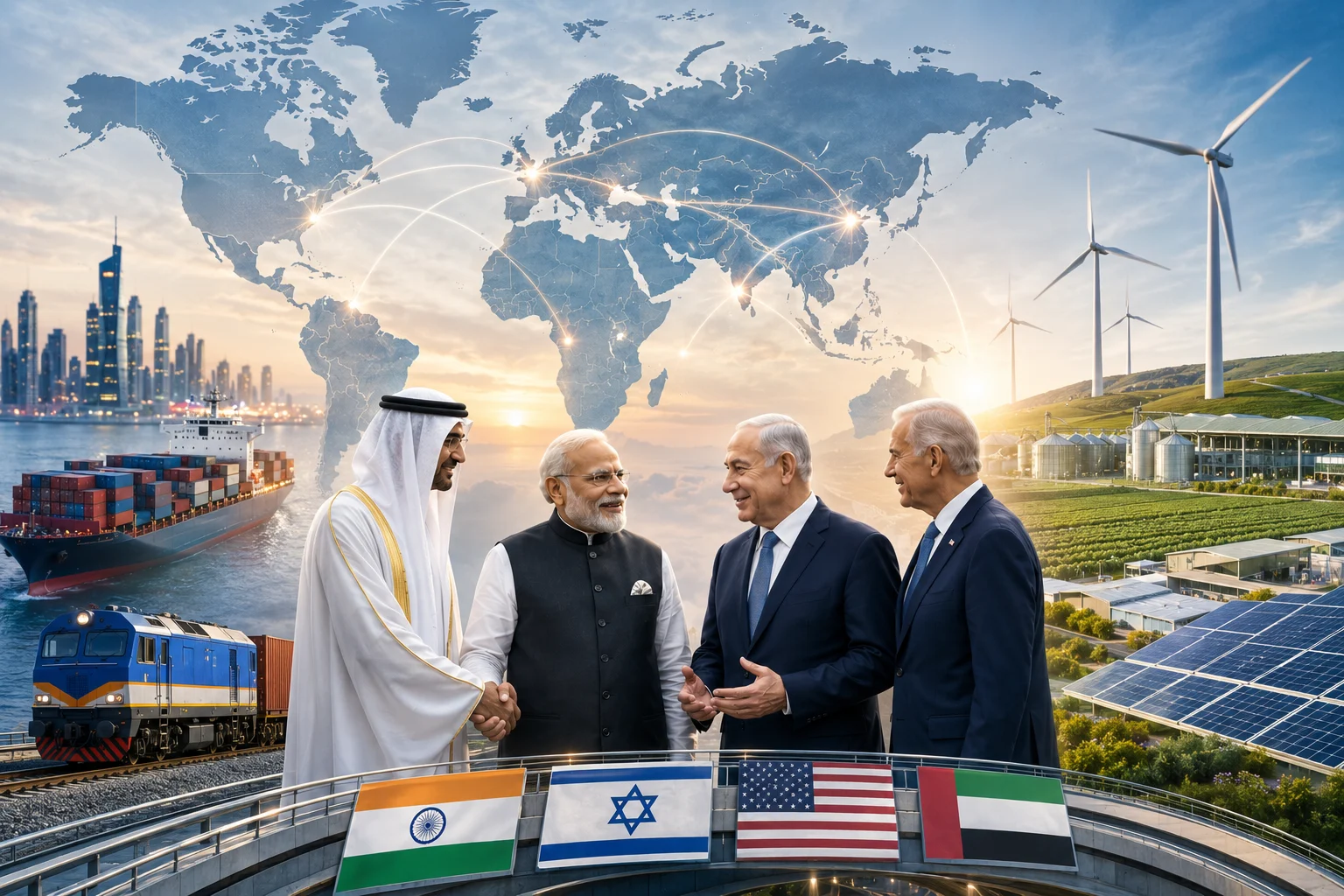
Two new multilateral architectures connect India and Israel through the Arabian Peninsula. The I2U2 grouping (India, Israel, UAE, USA), formed in 2021, runs a working agenda across water, energy, transport, space, health and food security. The India-Middle East-Europe Economic Corridor (IMEC), announced at the G20 in September 2023, plans a rail and shipping corridor from India through the Gulf and Israel to Europe. Construction began in April 2025; build-out remains uneven. This piece explains both.
How Israel became Start-Up Nation
Israel spends a higher share of its GDP on research and development than any other country, hosts 42 unicorn startups, and contains the largest concentration of multinational R&D centres outside Silicon Valley. The trajectory has clear historical drivers: military-grade engineering training through universal conscription, the 1990s Soviet aliyah, the 1993 Yozma fund-of-funds programme, and a sustained pull of US venture capital. This piece sets out how each driver works.
Israel's borders: recognised lines, armistice lines, and contested boundaries
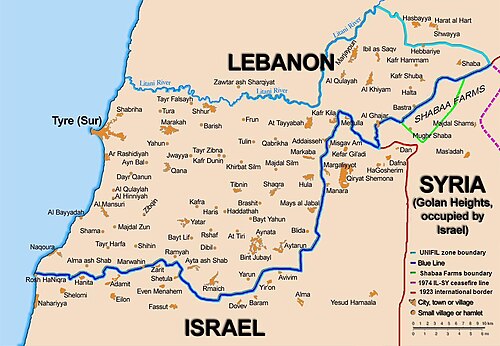
Israel has internationally recognised borders with Egypt (since the 1979 peace treaty) and Jordan (since the 1994 Wadi Araba treaty). Its northern borders with Syria and Lebanon are based on 1949 armistice lines that were never converted into peace treaties. The West Bank and Gaza Strip are not internationally recognised as part of Israel - their final status is subject to unresolved negotiations.
The Israel Defense Forces: structure, doctrine, and history
The Israel Defense Forces (IDF) is Israel's military, established on 26 May 1948, two weeks after independence. It is a unified force with three branches - ground, air, and naval - under a single chief of staff. Israel maintains mandatory military service (conscription) for most Jewish and Druze citizens. The IDF is one of the most battle-experienced militaries in the world and has been involved in every major Israeli conflict since 1948.
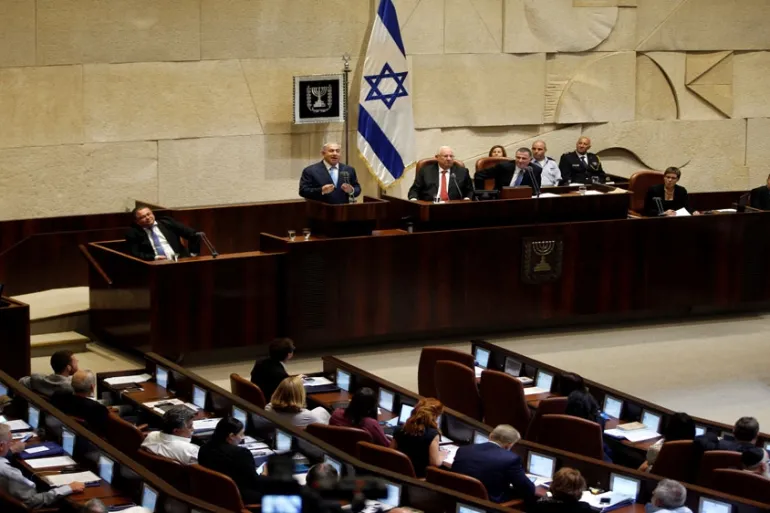
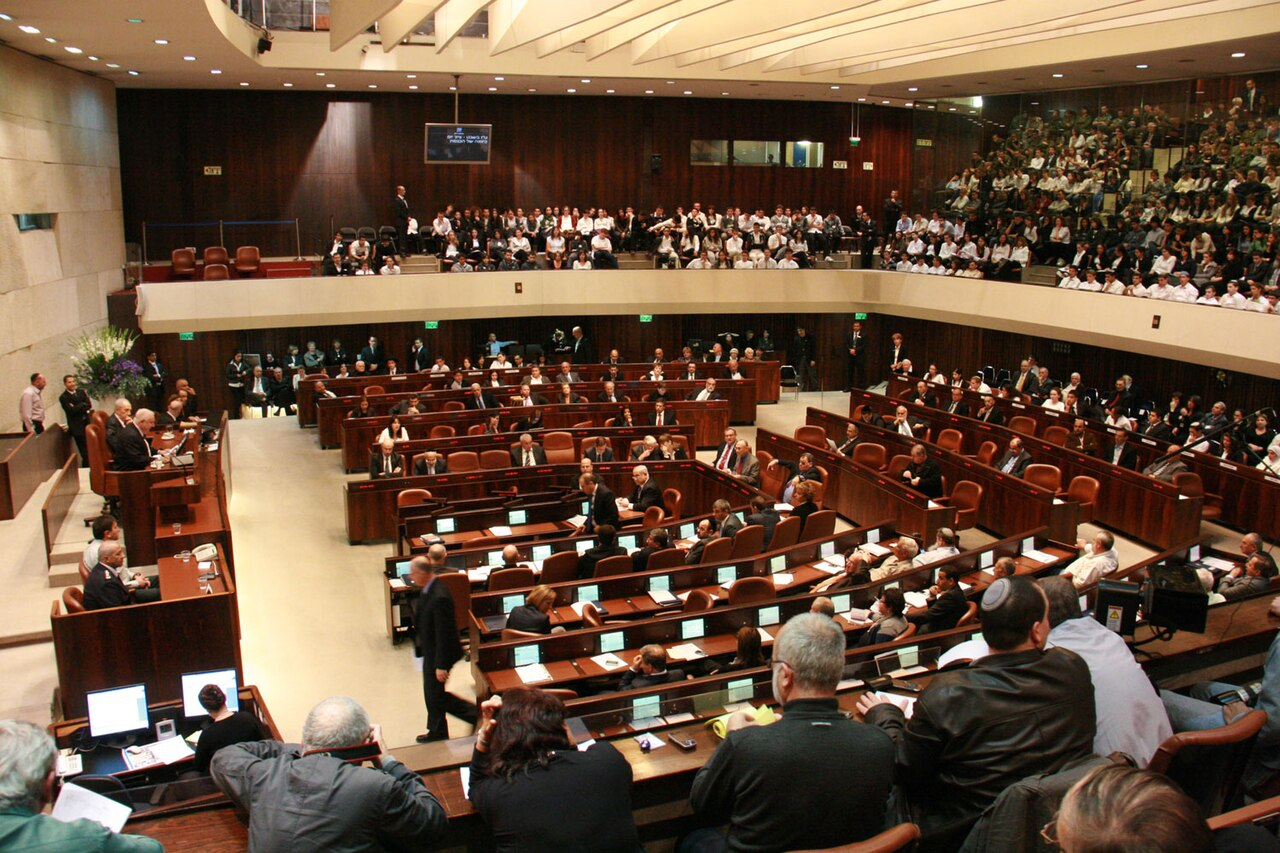
What is the Knesset? Israel's parliament explained
The Knesset is Israel's unicameral (single-chamber) parliament, located in Jerusalem. It has 120 members elected by proportional representation every four years, though early elections are common. It passes laws, approves the budget, and has the power to dissolve itself and call new elections. Because no single party has ever won a majority, Israeli governments are always coalitions.
The 1947 UN Partition Plan: what Resolution 181 actually said
UN General Assembly Resolution 181, adopted on 29 November 1947 by a vote of 33 to 13 with 10 abstentions, recommended partitioning Mandatory Palestine into an independent Jewish state, an independent Arab state, and an international zone for Jerusalem. The resolution was accepted by the Jewish Agency and rejected by the Arab Higher Committee and the Arab League. It was a non-binding recommendation - not a directive. Communal violence began the following day.