
Israel's Natural Regions
Quick answer · ~120 words
Israel stands out for its remarkable geographic diversity packed into a small area. From the sandy Mediterranean shores to snow-capped peaks and dramatic deserts, the land offers a vibrant mosaic of landscapes that have shaped its history, culture, and people for thousands of years.
The Coastal Plain
The Mediterranean coastal plain stretches along Israel's western edge, from Rosh Hanikra in the north to the south near Gaza. It widens to about 40 kilometres in the south and narrows in the north. Sandy beaches, fertile farmland, and kurkar ridges define this region, which has long served as a vital corridor for trade and agriculture.
Today it is home to major cities like Tel Aviv and Haifa. The area enjoys a classic Mediterranean climate with mild, wet winters and warm, dry summers. Rainfall supports citrus groves, vegetables, and flowers that have become export successes. Israel's ingenuity has turned much of the land into highly productive agricultural zones.
The Central Hills and Mountains
East of the coast rise the central hills and mountains, including the Galilee in the north, Samaria, and Judea. Peaks like Mount Meron at 1,208 metres offer stunning views and cooler climates. Limestone and dolomite formations create rolling hills, fertile valleys, and ancient oak and pine forests.
In Upper Galilee, higher rainfall nurtures lush greenery. The Jezreel Valley, separating Galilee from Samaria, ranks among Israel's most productive agricultural areas. Judea's hills, where Jerusalem sits, feature terraced slopes and olive groves that have sustained communities for millennia. The region's biodiversity shines with Mediterranean woodlands supporting deer, wild boars, and numerous bird species.
The Jordan Rift Valley
The Jordan Rift Valley forms part of the great Syrian-African Rift system, running north-south and featuring the Sea of Galilee (Lake Kinneret), the Jordan River, and the Dead Sea.
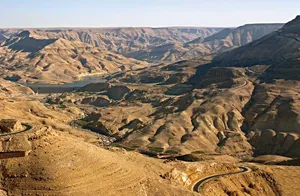
The Sea of Galilee serves as a vital freshwater reservoir, supplying much of the country through innovative water management. The Dead Sea, the lowest point on Earth at about 417 metres below sea level, attracts visitors worldwide with its mineral-rich waters and therapeutic mud. The Arava section extends to Eilat on the Red Sea, where advanced agriculture and solar energy projects flourish.
The Negev Desert
Covering over half of Israel's land area, about 12,000 square kilometres, the Negev extends from Beersheba southward in a triangular shape to Eilat. Dramatic features include Makhtesh Ramon, unique erosion craters found in few places on Earth.
Israel's pioneers transformed this area through drip irrigation and desert-adapted crops, turning challenges into opportunities. Historically, the Negev hosted Nabataean cities like Avdat, which managed water ingeniously. Today it hosts research centres, airbases, and thriving communities.
Rich Biodiversity Across Regions
Israel's position at the meeting point of Mediterranean, Irano-Turanian, Saharo-Arabian, and Sudanese zones supports extraordinary biodiversity — over 2,800 plant species and thousands of animals. Bird migration routes pass through Israel, making it a paradise for birdwatchers. Millions of trees have been planted as part of sustained reforestation efforts.
Sources
[1]: State of Israel. "The Land: Geography and Climate." Government of Israel. https://www.gov.il/en/pages/the-land-geography-and-climate
[2]: "Israel." Encyclopædia Britannica. https://web.archive.org/web/20210126161741/https://www.britannica.com/place/Israel
[3]: Shtober-Zisu, Nurit. "Landscapes and Landforms of Israel — An Overview." In Landscapes and Landforms of Israel. Springer, 2024. https://doi.org/10.1007/978-3-031-44764-8_1
[4]: Israel Ministry of Foreign Affairs. "Flora and Fauna in Israel." September 2001. https://web.archive.org/web/20091213061849/http://www.mfa.gov.il/MFA/MFAArchive/2000_2009/2001/9/Flora%20and%20Fauna%20in%20Israel
[5]: Frumkin, Amos, and Nurit Shtober-Zisu, eds. Landscapes and Landforms of Israel. Springer, 2024. https://doi.org/10.1007/978-3-031-44764-8