The 1948 Arab-Israeli War
Causes, course, armistice lines, and demographic consequences.
Explainers in this topic
3 pieces
The 1948 War
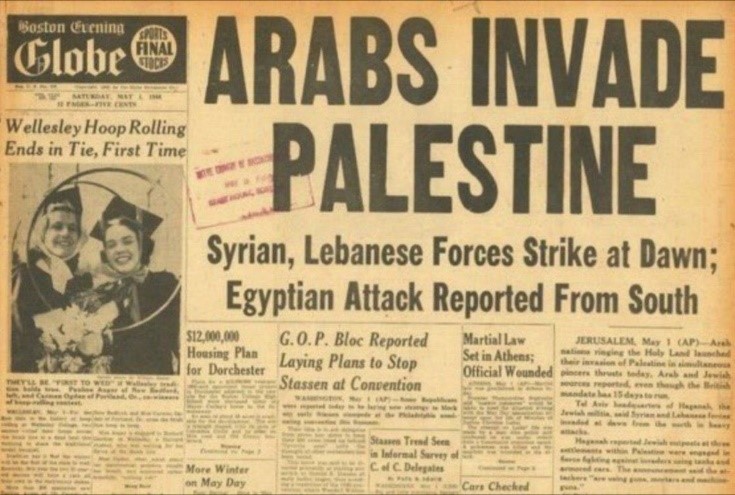
The 1948 War was fought between the Jewish community of Palestine, which became the State of Israel, and Palestinian Arab forces joined by the regular armies of the Arab states. It began the day after the United Nations General Assembly recommended partition on 29 November 1947. It ended with four armistice agreements signed between 24 February and 20 July 1949. The first phase was a civil war inside British-ruled Palestine. The second began on 15 May 1948, when Egypt, Transjordan, Syria, Lebanon and Iraq sent armies across the borders a day after Israel declared independence. Israel survived at a cost of about 6,000 dead, close to one percent of its Jewish population. It ended the war holding about 77 percent of Mandate Palestine. Jordan held the West Bank and East Jerusalem, and Egypt held Gaza. Israelis call it the War of Independence. Palestinians call it the Nakba, meaning the catastrophe.
The Declaration of Independence, 14 May 1948
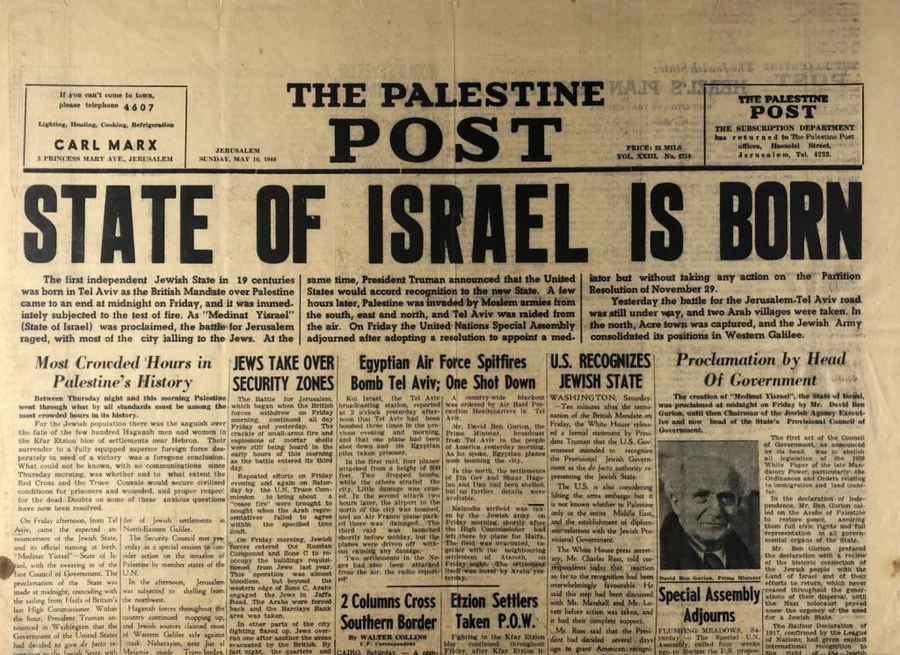
David Ben-Gurion read the Declaration of the Establishment of the State of Israel at the Tel Aviv Museum at about 4 p.m. on Friday, 14 May 1948. The British Mandate for Palestine ended at midnight that night. Members of the People's Council, which then became the Provisional Council of State, signed the text. It bases the new state on the Jewish people's historical connection to the land and on UN General Assembly Resolution 181 of 29 November 1947. It promises equal social and political rights without regard to religion, race or sex, and a constitution by 1 October 1948. No constitution was adopted. In December 1948 the Supreme Court ruled that the Declaration is not binding constitutional law. Since 1953, courts have used it to interpret laws. Since 1994, the Basic Law: Human Dignity and Liberty has required basic rights to be upheld in its spirit.
The 1947 UN Partition Plan: what Resolution 181 actually said
UN General Assembly Resolution 181, adopted on 29 November 1947 by a vote of 33 to 13 with 10 abstentions, recommended partitioning Mandatory Palestine into an independent Jewish state, an independent Arab state, and an international zone for Jerusalem. The resolution was accepted by the Jewish Agency and rejected by the Arab Higher Committee and the Arab League. It was a non-binding recommendation - not a directive. Communal violence began the following day.