
The Declaration of Independence, 14 May 1948
Quick answer · ~120 words
David Ben-Gurion read the Declaration of the Establishment of the State of Israel at the Tel Aviv Museum at about 4 p.m. on Friday, 14 May 1948. The British Mandate for Palestine ended at midnight that night. Members of the People's Council, which then became the Provisional Council of State, signed the text. It bases the new state on the Jewish people's historical connection to the land and on UN General Assembly Resolution 181 of 29 November 1947. It promises equal social and political rights without regard to religion, race or sex, and a constitution by 1 October 1948. No constitution was adopted. In December 1948 the Supreme Court ruled that the Declaration is not binding constitutional law. Since 1953, courts have used it to interpret laws. Since 1994, the Basic Law: Human Dignity and Liberty has required basic rights to be upheld in its spirit.
Phase One: From the UN Vote to the Proclamation, 29 November 1947 to 14 May 1948
On 29 November 1947 the UN General Assembly adopted Resolution 181. The partition plan divided the area into three entities: a Jewish state, an Arab state, and an international zone around Jerusalem. It provided that the Mandate for Palestine would end as soon as possible and in any case no later than 1 August 1948. [1] Britain left earlier than that date, and the Mandate ended at midnight between 14 and 15 May 1948.
In April 1948 the Zionist leadership set up two bodies to take power when the British left. Ben-Gurion gained authority to create a thirteen-member executive council called Minhelet ha'Am and an oversight body called Moetzet ha'Am. [3] The first became the provisional cabinet and the second the provisional legislature.
The ceremony took place at the Tel Aviv Museum on Rothschild Boulevard. Planners chose this two-story building because they believed it was less exposed to Egyptian air attack than the larger Habimah Theatre nearby. [2] Ben-Gurion's diary for that day records that independence was declared at four o'clock in the afternoon [2]. The text itself is dated the Sabbath eve, 5 Iyar 5708, 14 May 1948, in Tel Aviv. [5] The Israel State Archives lists the signatories by name, among them Ben-Gurion, Golda Meir and Moshe Sharett [4].
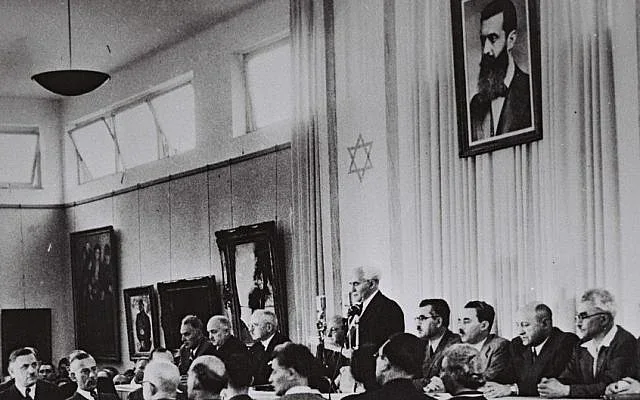
David Ben-Gurion reads the Declaration of Independence in the Tel Aviv Museum Hall on May 14, 1948.
Recognition from the United States came quickly. Ten minutes after the new state's independence took effect, at 6:11 p.m. Washington time, President Truman announced that the United States recognized the Provisional Government of Israel as the de facto authority of the new country. [8][6] The United States extended de jure recognition on 31 January 1949. [7]
How the Text Was Drafted, Late April to 13 May 1948
The Declaration went through several drafts in about three weeks. In late April, Pinchas Rosen gave the task of writing the first draft to Mordechai Beham, a thirty-three-year-old Tel Aviv lawyer trained in London. [3] Beham wrote first in English. He drew on the opening of the American Declaration of Independence, the English Bill of Rights of 1689, the Book of Deuteronomy, and UN Resolution 181. [3] His English phrase for divine providence became Tzur Yisrael, the Rock of Israel, when he translated the draft into Hebrew. [3]
A second draft followed a Labor Zionist approach. Tzvi Berenson, a Labor Party jurist and later a Supreme Court justice, wrote it with the Legal Department. Its list of rights, with a few key changes, entered the final text. [3] This draft reached Ben-Gurion and the People's Administration on 11 May 1948. [3]
The main dispute concerned the United Nations. Moshe Sharett wanted a declaration in line with the UN process. Ben-Gurion argued for declaring the state directly, recognizing the principle of Resolution 181 without committing to its details. [3]
Religion caused a smaller debate. Aharon Zisling, a secularist, objected to the Rock of Israel phrase. Rabbi Fishman wanted the fuller wording Rock of Israel and Redeemer. Ben-Gurion kept the shorter phrase as a compromise that each member could understand in his own way. [3]
Ben-Gurion and his drafting committee settled the final wording on the night of 13 May 1948. [3] He also changed the verb for rights. Earlier drafts said the state would bestow rights. His version says it will ensure them, since, as he told colleagues, rights belong to the people. [3]
What the Text Says
The Declaration has four parts: a historical preamble, the proclamation, a statement of principles, and a set of appeals [5].
The preamble describes the Land of Israel as the birthplace of the Jewish people. It then traces a line from the First Zionist Congress of 1897 through the Balfour Declaration and the Mandate to the Holocaust and Resolution 181 [5]. The proclamation declares a Jewish state in Eretz-Israel, to be called Israel, by virtue of natural and historic right and on the strength of the UN resolution [5].
The text also sets out interim government. Until elected authorities took office under a constitution, the People's Council would act as the Provisional Council of State and the People's Administration as the Provisional Government. An elected Constituent Assembly was to adopt that constitution no later than 1 October 1948. [11]
The principles section makes several commitments. The state will rest on freedom, justice and peace as the prophets of Israel envisioned. It will ensure complete equality of social and political rights "irrespective of religion, race or sex." It will guarantee freedom of religion, conscience, language, education and culture. It will protect the Holy Places of all religions and follow the principles of the UN Charter. [3][5] The same paragraph opens the state to Jewish immigration and commits to developing the country for the benefit of all its inhabitants [5].
The appeals section addresses four audiences. It calls on the Arab inhabitants of the state to preserve peace and to take part in building the state on the basis of full and equal citizenship and due representation in all its institutions. [5] It offers peace and good-neighbourliness to the surrounding states and their peoples and asks them to cooperate for the advancement of the entire Middle East. It also calls on Jews of the diaspora to join in immigration and construction. [5]
What the Text Does Not Say
The Declaration leaves several matters out, most of them on purpose.
It does not define the state's borders. Berenson's draft had proclaimed a state within the borders set by the UN General Assembly. Leaders debated whether declaring on the basis of Resolution 181 would bind them to those UN borders. [3] The final text cites the resolution but draws no boundary line [5].
It does not use the word "democracy." The word appeared in most of the Legal Department drafts, but Sharett deleted it, and the drafters did not discuss the change. [3] The text still commits the state to equal rights and to elected institutions under a constitution [5].
It does not name God. The closing sentence places trust in the Rock of Israel, the compromise described above [5].
It is not a full bill of rights. It lists freedoms of religion, conscience, language, education and culture, but not freedom of speech or rights to life, liberty and property. [3] The two authors of the leading study conclude that the text only partly explains what a "Jewish state" means. Given the different agendas of the people in the room, it could not give a full answer. [3]
Finally, the Declaration is not itself a constitution. It promised one and set a deadline for it. The constitution was to come from a separate elected body [11].
Legal Status in the Courts, 1948 to 1992
The Supreme Court first ruled on the Declaration in Zeev v. Gubernik, decided on 2 December 1948. The petitioner challenged a requisition order made under the British Defence Regulations of 1939. He argued that the Declaration was part of the law of the land and had repealed regulations that took away citizens' freedoms. [9] The court rejected this. It held that the Declaration's only object was to affirm the founding of the state for recognition under international law. The Declaration expresses "the vision of the people and its faith," but contains no constitutional law that decides whether ordinances are valid or repealed. [9]
Kol Ha'am v. Minister of the Interior, decided on 16 October 1953, gave the Declaration an interpretive role. The Minister of the Interior had suspended two newspapers under the Press Ordinance, for ten and fifteen days. [10] Justice Agranat, for the court, accepted the Zeev ruling that the Declaration is not constitutional law. But he held that because it expresses the people's vision, courts must take its content into account when they interpret the laws of the state. [10] The court read the Press Ordinance to require a probable danger to public peace, not a mere tendency, and set both suspension orders aside. [10]
The constitution itself was never adopted. From May 1949 to June 1950 the Knesset debated a constitution without reaching agreement. It then adopted a compromise proposed by Knesset Member Yizhar Harari: a constitution built chapter by chapter, each chapter a Basic Law. [11]
Legal Status Under the Basic Laws, 1992 to the Present
The Declaration's legal weight grew in the 1990s. The Knesset passed the Basic Law: Human Dignity and Liberty on 17 March 1992. [12] A later amendment added a new opening section. It states that fundamental human rights in Israel rest on recognition of the value of the human being, the sanctity of human life, and the principle that all persons are free. These rights must be upheld "in the spirit of the principles set forth in the Declaration." [12]
This clause matters because of what the courts did next. Soon after the new Basic Laws passed, the Supreme Court said their enactment was a constitutional revolution that gave the Court authority to review ordinary Knesset legislation. [11] The Declaration's principles therefore now enter constitutional review indirectly, through the text of a Basic Law.
The Declaration itself has not been enacted as a Basic Law. There have been modest efforts to legislate it as one, including a proposal about five years before 2023 as an alternative to the Jewish State Law that was finally passed. [3] Its status today rests on three layers: the 1948 holding that it is not binding law in itself [9], the 1953 holding that courts must use it in interpretation [10], and the 1994 clause that ties basic rights to its principles [12].
In One Paragraph
Israel's Declaration of Independence was proclaimed in Tel Aviv on the afternoon of 14 May 1948, just before the British Mandate ended at midnight. It rested the new state on the Jewish people's historical right and on UN Resolution 181. It promised equal rights regardless of religion, race or sex, freedom of religion and culture, protection of all Holy Places, and a constitution by 1 October 1948. The drafters left out fixed borders, the word "democracy," and a direct reference to God. The United States recognized the provisional government within minutes. The promised constitution was replaced in 1950 by a plan to build one from Basic Laws. The Supreme Court ruled in 1948 that the Declaration is not binding law, and in 1953 that it guides interpretation. Since 1994, a Basic Law has required basic rights to be upheld in the spirit of its principles.
Sources
- United Nations General Assembly. “Resolution 181 (II), Future Government of Palestine.” A/RES/181(II), November 29, 1947. Plan of Partition with Economic Union, Part I, section A, paragraph 1. https://digitallibrary.un.org/record/667160/files/A_RES_181%28II%29%5BA%5D-EN.pdf
- Rogachevsky, Neil, and Dov Zigler. “Introduction.” In Israel’s Declaration of Independence: The History and Political Theory of the Nation’s Founding Moment, 1–16. Cambridge: Cambridge University Press, 2022. https://www.cambridge.org/core/books/abs/israels-declaration-of-independence/introduction/0739201BE23A51BEEBCBAE82B76FA81A
- Rogachevsky, Neil, and Dov Zigler. “Israel’s Declaration of Independence: A Biography.” Jewish Review of Books, Spring 2023. https://jewishreviewofbooks.com/uncategorized/13858/israels-declaration-of-independence-a-biography/
- Israel State Archives. “The Declaration of Independence.” Online catalogue chapter, list of signatories. https://catalog.archives.gov.il/site/en/chapter/the-declaration-of-independence/
- Provisional Council of State. “Declaration of the Establishment of the State of Israel.” May 14, 1948. Laws of the State of Israel 1 (1948): 7. English text, Knesset. Flag: the page has no paragraph anchors. Cited paragraphs are identified by their opening words: “WE DECLARE that” (interim government), “THE STATE OF ISRAEL will be open” (principles), “WE APPEAL” (Arab inhabitants), “WE EXTEND our hand” (neighbouring states), and “PLACING OUR TRUST” (closing). https://main.knesset.gov.il/EN/About/pages/declaration.aspx
- Truman, Harry S. “Statement by the President Announcing Recognition of the State of Israel.” May 14, 1948. Public Papers of the Presidents, no. 100. Harry S. Truman Library. https://www.trumanlibrary.gov/library/public-papers/100/statement-president-announcing-recognition-state-israel
- U.S. National Archives and Records Administration. “Press Release Announcing U.S. Recognition of Israel (1948).” Milestone Documents. https://www.archives.gov/milestone-documents/press-release-announcing-us-recognition-of-Israel
- U.S. National Archives and Records Administration. Press Release 98-64. Washington, DC, May 1998. https://www.archives.gov/press/press-releases/1998-242
- Zeev v. Acting District Commissioner of the Urban Area of Tel Aviv (Gubernik). HCJ 10/48, 1 P.D. 85. Supreme Court of Israel, December 2, 1948. English translation, Cardozo Israeli Supreme Court Project (Versa). Relevant passage: paragraph beginning “We cannot accept the attractive argument.” https://versa.cardozo.yu.edu/opinions/zeev-v-acting-district-commissioner-urban-area-tel-aviv
- Kol Ha’am Co. Ltd. v. Minister of the Interior. HCJ 73/53, 7 P.D. 871. Supreme Court of Israel, October 16, 1953. English translation, Versa. Relevant passage: paragraph beginning “The system of laws under which the political institutions.” https://versa.cardozo.yu.edu/opinions/kol-haam-co-ltd-v-minister-interior
- Sapir, Gideon, Daphne Barak-Erez, and Aharon Barak. “Introduction: Israeli Constitutional Law at the Crossroads.” In Israeli Constitutional Law in the Making, edited by Gideon Sapir, Daphne Barak-Erez, and Aharon Barak, 1–5. Oxford: Hart Publishing, 2013. Author-hosted copy, Tel Aviv University, pp. 1–3. https://www.tau.ac.il/law/barakerez/articals/E%2051%20Sapir%20Ch1.pdf
- State of Israel. Basic Law: Human Dignity and Liberty. 1992, as amended 1994. Section 1 (“Basic principles”) and enactment note. WIPO Lex. https://www.wipo.int/wipolex/fr/legislation/details/15282