
The 1948 War
Quick answer · ~120 words
The 1948 War was fought between the Jewish community of Palestine, which became the State of Israel, and Palestinian Arab forces joined by the regular armies of the Arab states. It began the day after the United Nations General Assembly recommended partition on 29 November 1947. It ended with four armistice agreements signed between 24 February and 20 July 1949. The first phase was a civil war inside British-ruled Palestine. The second began on 15 May 1948, when Egypt, Transjordan, Syria, Lebanon and Iraq sent armies across the borders a day after Israel declared independence. Israel survived at a cost of about 6,000 dead, close to one percent of its Jewish population. It ended the war holding about 77 percent of Mandate Palestine. Jordan held the West Bank and East Jerusalem, and Egypt held Gaza. Israelis call it the War of Independence. Palestinians call it the Nakba, meaning the catastrophe.
Phase One: Civil War Inside the Mandate (29 November 1947 to March 1948)
On 29 November 1947 the UN General Assembly adopted Resolution 181. It recommended ending the British Mandate, creating an Arab state and a Jewish state, and placing Jerusalem under a special international regime. The two states were to come into being no later than 1 October 1948, and the Mandate was to end no later than 1 August 1948 [1]. The Jewish Agency accepted the plan. The Arab Higher Committee, which spoke for the Palestinian Arab leadership, rejected it.
Fighting began within days. The UN body charged with carrying out partition, the United Nations Palestine Commission, reported to the Security Council on 16 February 1948. Its central finding was that powerful Arab interests inside and outside Palestine were defying the Assembly's resolution and were trying to alter the settlement by force [2]. The Commission recorded the Arab Higher Committee's formal position that it would never recognise partition and would resist any Jewish state by force. The Committee's delegation told the UN that partition could only be imposed by first wiping out the Arabs of Palestine, "man, woman and child" [2].
The same report gave British figures for casualties between 30 November 1947 and 1 February 1948. In that period 381 Jews, 427 Arabs, 46 British personnel and 15 others were killed, a total of 869 dead, with 1,909 wounded [2]. These are counts of persons killed and wounded, collected by the Mandatory Power and passed to the Commission.
The Commission also documented armed forces entering from outside. British reports cited in its findings described a band of about 700 Syrians crossing from Transjordan on the night of 20 to 21 January 1948. They described a further unit of the Arab Liberation Army, about 950 men in 19 vehicles, crossing on 29 to 30 January [2]. The Commission noted that certain Jewish elements also committed violent acts that worsened security, while the Jewish community as a whole supported the Assembly's recommendations [2].
The Commission asked the Security Council for an international armed force. It warned that without one, the end of the Mandate would bring uncontrolled bloodshed [2]. By April it reported that the Council had given it no armed assistance [3]. Through the winter, Arab forces concentrated on the roads. Jewish Jerusalem depended on a single highway from the coast that ran through Arab villages. Convoys on that road suffered repeated ambushes, and by late March the city was close to siege. Isolated settlements in the Galilee, the Negev and the Etzion bloc south of Bethlehem faced the same pressure.
Phase Two: Plan D, Independence and the Invasion (April to 18 July 1948)
In early April 1948 the Haganah, the main Jewish defence force, moved from defence to attack under Plan D (Plan Dalet). The text of the plan states that its aim was to secure the area of the Hebrew state and the Jewish settlements outside it, and that it was not an operation of occupation beyond the state's borders [4]. Its first task was to reopen the road to Jerusalem. Through April and early May, Jewish forces took control of Haifa, Tiberias, Safed and Jaffa's surroundings, and the Palestinian Arab military effort collapsed. Large numbers of Arab civilians left these areas. The causes of that flight are the most disputed question of the war and are treated in the final section.
On 14 May 1948, the last day of the Mandate, the Jewish People's Council met in Tel Aviv and declared the establishment of the State of Israel. The Declaration cited the Assembly's resolution of 29 November 1947 as international recognition of the Jewish people's right to a state. It appealed to the Arab inhabitants of the new state, "in the very midst of the onslaught launched against us now for months," to keep the peace and take part in building the state as full and equal citizens. It also offered peace to the neighbouring Arab states [5].
On 15 May the Secretary-General of the Arab League cabled the UN to announce that the Arab states were sending forces into Palestine. The cable described Palestine as an Arab country, called partition a breach of the rights of its Arab inhabitants, and said the Arab states were entering to restore order [6]. Israel's Ministry of Foreign Affairs records that the armies of six Arab states, Egypt, Syria, Jordan, Lebanon, Saudi Arabia and Iraq, attacked together with local Arab militia forces, with the declared aim of preventing partition [7].
The invasion met a state that had existed for one day. Egyptian columns advanced up the coast toward Tel Aviv and through the Negev toward Jerusalem. Transjordan's Arab Legion, the best-trained Arab army, took the Old City of Jerusalem and its Jewish Quarter by 28 May and held the Latrun heights on the Jerusalem road. Syrian forces attacked in the Jordan Valley and Iraqi forces pushed into the northern West Bank. Israeli forces halted the Egyptian advance at Ashdod and held most fronts. In Jerusalem they opened a bypass track, called the Burma Road, to supply the city.
The UN Mediator, Count Folke Bernadotte, took up his post on 21 May. A four-week truce under Security Council Resolution 50 ran from 11 June to 9 July 1948 [8]. Israel used it to import arms and organise the new Israel Defense Forces. When the truce ended, the Security Council recorded that Israel had accepted a prolongation in principle, while the Arab League states had rejected successive appeals to extend it [9]. Fighting resumed for ten days. In that period Israeli forces took Lydda, Ramle and Nazareth. On 15 July the Council determined that the situation was a threat to the peace under Article 39 of the UN Charter and ordered a ceasefire under Article 40 [9]. A second, open-ended truce began on 18 July [8].
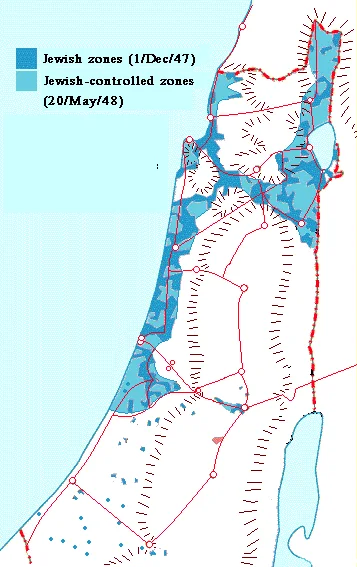
Zones controlled by Yishuv before and after the implementation of the Plan Dalet.
Phase Three: Israeli Offensives and the Road to Rhodes (19 July 1948 to 7 January 1949)
The second truce held unevenly through the summer. On 16 September 1948 Bernadotte sent the General Assembly a progress report proposing new borders. He suggested that the Negev, allotted to the Jewish state under partition, should go to the Arab side, and that the Galilee should go to Israel [8]. Israel rejected the proposal. The next day Bernadotte was assassinated in Jerusalem by members of Lehi, a Jewish underground group. The Israeli government condemned the killing and dissolved the remaining Lehi units into the army. Ralph Bunche, an American UN official, became Acting Mediator.
The Egyptian army still held a line across the northern Negev that cut off Israel's southern settlements. In October 1948 Israel launched Operation Yoav, which broke this line, took Beersheba and trapped an Egyptian brigade at Faluja. In the same month Operation Hiram cleared the Arab Liberation Army from the central Galilee and pushed into a strip of southern Lebanon. In late December Operation Horev drove Egyptian forces from the remaining Negev positions and briefly crossed into Sinai. Under British and American pressure Israel withdrew from Sinai, and a ceasefire on the Egyptian front took effect on 7 January 1949.
The Security Council had already set the frame for ending the war. Its Resolution 62 of 16 November 1948 decided that an armistice should be established in all sectors of Palestine. It called on the parties to negotiate, directly or through the Acting Mediator, to reach one [10]. The Council grounded this decision in its earlier finding that the situation was a threat to the peace [10]. On the Jerusalem front, Israeli and Jordanian commanders reached a local ceasefire agreement on 30 November 1948. Its lines later became the base for the armistice line in the city [11].
By January 1949 the military picture was settled. Israel held the coastal plain, the Galilee, the Negev down to the Gulf of Aqaba approaches, and a corridor to western Jerusalem. The Arab Legion held the hill country of the West Bank and the Old City. Egypt held a coastal strip around Gaza. Syria held small positions west of the old international border near the Sea of Galilee. Talks began on the island of Rhodes on 13 January 1949, chaired by Bunche.
Phase Four: The Four Armistice Agreements (24 February to 20 July 1949)
Israel signed separate General Armistice Agreements with each of the four neighbouring states that had fought it. Iraq, which had no border with Israel, signed none and handed its sector to Jordan.
Egypt, 24 February 1949.** The first agreement was signed at Rhodes. It fixed a demarcation line around a coastal strip from Gaza to Rafah, which stayed under Egyptian control. The besieged Egyptian brigade at Faluja was allowed to withdraw. The text states that its provisions were "dictated exclusively by military considerations" and were valid only for the period of the armistice [12]. It also states that the demarcation line was not to be read as a political or territorial boundary, and that it did not prejudice the rights or claims of either side in a final settlement [12].
Lebanon, 23 March 1949.** The second agreement was signed at Ras en Naqoura. Its demarcation line followed the old international boundary between Lebanon and Mandate Palestine [13]. Israel withdrew from the Lebanese villages it had taken in Operation Hiram. This was the simplest of the four agreements, because the line matched an existing border.
Jordan, 3 April 1949.** The third agreement, signed at Rhodes, covered the longest front. Jordanian forces replaced the Iraqi forces in the northern sector, and Jordan accepted responsibility for all Iraqi forces in Palestine [11]. In that sector the line was moved east in Israel's favour, which gave Israel the villages of Wadi Ara and the area later called the Triangle. In return the line in the Hebron to Dead Sea sector was drawn in Jordan's favour, and Israel agreed to pay for 20 kilometres of new road to replace one Jordan lost between Tulkarem and Qalqiliya [11]. In Jerusalem the agreement adopted the lines of the 30 November 1948 ceasefire, which left the city divided [11]. It also set up a Special Committee to arrange free access to the holy places and to the Jewish institutions on Mount Scopus [11]. Jordan never allowed that access, and Jews were barred from the Western Wall from 1949 until June 1967.
Syria, 20 July 1949.** The last agreement took the longest. Syria held small areas west of the old international border, including ground near Mishmar HaYarden. Under the agreement Syrian forces withdrew east of the border, and the evacuated land became demilitarised zones under UN supervision [14]. The agreement left the question of sovereignty over these zones open. Disputes over farming and water in the zones caused repeated clashes in the 1950s and 1960s.
All four agreements shared the same formula: they ended the fighting, drew lines, and created Mixed Armistice Commissions chaired by UN officers. None was a peace treaty, and none recognised a permanent border [12]. The Arab states treated the armistices as a pause in a continuing state of war, and they refused to recognise Israel. The lines of 1949, known as the Green Line, remained Israel's de facto frontiers until June 1967.
The Territorial Outcome Against the Partition Lines
Resolution 181 drew three units: a Jewish state, an Arab state and an international zone around Jerusalem and Bethlehem. The Jewish state was to include the eastern Galilee, most of the coastal plain and most of the Negev. The Arab state was to include the western Galilee, the hill country of Samaria and Judea, a coastal strip around Gaza, and the town of Jaffa as an enclave [1]. None of these units came into being as drawn, because the Arab side rejected the plan and went to war to prevent it.
By the measure used by the UN Secretariat's Division for Palestinian Rights, Israel ended the war holding 77 percent of the territory of Mandate Palestine, including the larger part of Jerusalem [15]. Compared with the partition map, Israel kept all the areas allotted to the Jewish state, including the Negev, which Bernadotte had proposed to remove [8]. It added the western Galilee, the Lydda and Ramle area, the corridor to Jerusalem, and western Jerusalem itself. These areas had been allotted to the Arab state or to the international zone.
The remaining 23 percent did not become a Palestinian Arab state. The same UN source states that Jordan and Egypt took control of the rest of the territory that Resolution 181 had assigned to the Arab state [15]. Jordan held the West Bank and East Jerusalem, including the Old City and its holy places, and formally annexed them in April 1950. Egypt kept the Gaza Strip under military administration and did not annex it. Neither state created a Palestinian government in the territory it held. The 1949 lines therefore divided the land among Israel, Jordan and Egypt, and the Jerusalem international regime never came into effect.
In December 1948 the General Assembly adopted Resolution 194. Paragraph 11 stated that refugees wishing to return to their homes and live at peace with their neighbours should be permitted to do so at the earliest practicable date, and that compensation should be paid for the property of those choosing not to return [16]. The UN Conciliation Commission for Palestine later reported the two positions that blocked progress. The Arab governments demanded that Israel accept the right of return before they would enter peace negotiations. Israel held that the refugee question could only be settled within a general peace settlement [17].
The size of the refugee population is a contested figure, and the Israeli and UN counts differ severely. The Conciliation Commission's Technical Committee on Refugees estimated that 711,000 people had left territory under Israeli control. The Commission published this estimate in its report covering 11 December 1949 to 23 October 1950. The unit is persons displaced [17]. The Government of Israel, at the end of the war, set the number of Palestinian Arab refugees at 550,000 to 600,000 persons. This figure is recorded in historian Efraim Karsh's peer-reviewed study of 2011, which also notes that about 962,000 people were registered with UNRWA within a year [18]. The two official figures are given here separately and are not averaged.
Two Names, Two National Accounts, and the Historians' Positions
Israelis call the war Milhemet HaAtzmaut, the War of Independence. In the Israeli account, the Jewish people accepted the UN's compromise and the Arab side rejected it and chose war. Israel's Ministry of Foreign Affairs states this account directly. Local Arab forces and militias from neighbouring states attacked Jewish communities after the partition vote. Six Arab armies then invaded with the stated goal of preventing partition and removing the Jews by force. Israel defeated them at the cost of about 4,000 soldiers and 2,000 civilians, around one percent of its population [7]. The UN's own record supports the core of this account. The Palestine Commission found in February 1948 that Arab interests were trying to overturn the Assembly's decision by force [2]. The Arab League announced the invasion to the UN in its own cable [6]. The Security Council recorded that Israel accepted an extension of the first truce and the Arab League states refused it [9]. For Israelis the war is the founding of the state, the first Jewish sovereignty in the land in nearly two thousand years, won three years after the Holocaust.
Palestinians call the war al-Nakba, the catastrophe. In the Palestinian account, the war is the loss of the homeland and the displacement of most of the Arab population from the areas that became Israel. The UN Division for Palestinian Rights, which presents the Palestinian narrative within the UN system, describes the Nakba as the mass displacement and dispossession of Palestinians during the war. It states that more than half of the Palestinian population was permanently displaced, and it records UN commemorations of the Nakba held on 15 May, the anniversary of the Arab invasion [19].
Scholars divide into four main positions, named here as positions.
The first is the traditional Israeli position, which matches the Foreign Ministry account above [7]. It holds that the war was forced on Israel and that the refugee problem arose from a war the Arab side started.
The second is the Palestinian historical position. Its leading statement is Walid Khalidi's study of Plan D, first published in 1961 and reissued with the plan's text in the Journal of Palestine Studies in 1988. Khalidi argues that Plan D was a master plan for the conquest of Palestine and that Zionism bears responsibility for the exodus [4]. Defenders of the Israeli position reply that the plan's own text limits it to securing the area of the Jewish state against an expected invasion and does not order a general expulsion [4].
The third position comes from Benny Morris, the most cited Israeli historian of the war, who worked from Israeli and Western archives opened from the late 1980s. His 2008 history, published by Yale University Press, stresses the jihadi character of the two-stage Arab assault on the Jewish community. It treats the refugee problem as a by-product of the war and of the collapse of Palestinian Arab society, and it identifies the military pressure of the fighting as the main driver of the exodus [20]. This position rejects both the claim of a master plan of expulsion and the claim that the Arabs left only on their leaders' orders.
The fourth position is represented by Efraim Karsh. Using declassified Arab, Israeli and British documents, he argues that the refugee count was inflated after the war, and he places the number well below the UN estimate [18].
These positions agree on the main military facts and on the armistice outcome. They differ on intent, on responsibility for the refugees, and on numbers.
In One Paragraph
The 1948 War began after the UN recommended partition on 29 November 1947. The Jewish Agency accepted the plan and the Arab leadership rejected it. Six months of civil war inside British Palestine were followed, on 15 May 1948, by the invasion of Arab state armies one day after Israel declared independence. Israel held off the invasion, accepted UN truces that the Arab states at first refused to extend, and took the offensive in the second half of 1948. Armistices with Egypt, Lebanon, Jordan and Syria, signed between 24 February and 20 July 1949, ended the fighting without peace treaties or recognised borders. Israel emerged with about 77 percent of Mandate Palestine and about 6,000 dead. Jordan took the West Bank and East Jerusalem, Egypt took Gaza, and no Arab state was formed in Palestine. Israelis remember the war as the War of Independence. Palestinians remember it as the Nakba, the catastrophe of displacement, and the number and causes of the refugees remain disputed.
Sources
- United Nations General Assembly. “Resolution 181 (II), ‘Future Government of Palestine.’” A/RES/181(II), November 29, 1947. Part I.A, paragraphs 1 and 3 (end of Mandate; date for the two states), and Part II (boundaries). https://www.un.org/unispal/document/auto-insert-185393/
- United Nations Palestine Commission. “First Special Report to the Security Council: The Problem of Security in Palestine.” A/AC.21/9, S/676, February 16, 1948. Section I, paragraph 3.C; Section II, paragraphs 5–9 (casualty table, Arab Higher Committee statement, armed incursions). https://www.un.org/unispal/document/auto-insert-187427/
- United Nations Palestine Commission. Report to the Second Special Session of the General Assembly. April 10, 1948. Introduction.C. https://www.un.org/unispal/document/auto-insert-210916/
- Khalidi, Walid. “Plan Dalet: Master Plan for the Conquest of Palestine.” Journal of Palestine Studies 18, no. 1 (Autumn 1988): 4–33, with the text of Plan D in the appendices. https://www.palestine-studies.org/sites/default/files/attachments/jps-articles/Plan%20dalet.pdf
- Provisional Council of State. “Declaration of the Establishment of the State of Israel.” Official Gazette, no. 1, Tel Aviv, May 14, 1948. Text published by the Israel Ministry of Foreign Affairs. https://www.gov.il/en/pages/declaration-of-establishment-state-of-israel
- League of Arab States, Secretary-General. “Cablegram Dated 15 May 1948 Addressed to the Secretary-General.” S/745, May 16, 1948. https://www.un.org/unispal/document/auto-insert-214183
- Israel Ministry of Foreign Affairs. “The War of Independence (1948).” About Israel: Maps. https://embassies.gov.il/MFA/AboutIsrael/Maps/Pages/The-War-of-Independence-1948.aspx https://www.gov.il/en/pages/the-war-of-independence-1948
- United Nations Mediator on Palestine. “Progress Report of the United Nations Mediator on Palestine.” A/648, September 16, 1948. Part One, Section VIII (conclusions on boundaries); Part Two, Sections II and III (the four-week truce of June 11 to July 9 and the truce from July 18). https://www.un.org/unispal/document/auto-insert-198227
- United Nations Security Council. “Resolution 54 (1948).” S/902, July 15, 1948. Preamble and operative paragraphs 1 and 2. https://www.un.org/unispal/document/auto-insert-179624
- United Nations Security Council. “Resolution 62 (1948).” S/1080, November 16, 1948. Preamble and operative paragraphs 1 and 2. https://unispal.un.org/pdfs/1A2B613A2FC85A9D852560C2005D4223.pdf
- Hashemite Jordan Kingdom and Israel. “General Armistice Agreement.” Rhodes, April 3, 1949. Articles V and VI (Iraqi sector, road compensation) and VIII (Special Committee). Avalon Project, Yale Law School. https://avalon.law.yale.edu/20th_century/arm03.asp
- Egypt and Israel. “General Armistice Agreement.” Rhodes, February 24, 1949. Articles IV and V (military character; line not a political boundary) and VI (Gaza to Rafah line). Avalon Project, Yale Law School. https://avalon.law.yale.edu/20th_century/arm01.asp
- Lebanon and Israel. “General Armistice Agreement.” Ras en Naqoura, March 23, 1949. Article V. Avalon Project, Yale Law School. https://avalon.law.yale.edu/20th_century/arm02.asp
- Syria and Israel. “General Armistice Agreement.” July 20, 1949. Article V (withdrawal and demilitarised zone). Avalon Project, Yale Law School. https://avalon.law.yale.edu/20th_century/arm04.asp
- United Nations Division for Palestinian Rights. “History of the Question of Palestine.” Section “1947 to 1977.” https://www.un.org/unispal/history/
- United Nations General Assembly. “Resolution 194 (III).” A/RES/194(III), December 11, 1948. Paragraph 11. https://www.un.org/unispal/document/auto-insert-177019/
- United Nations Conciliation Commission for Palestine. “General Progress Report and Supplementary Report, Covering the Period from 11 December 1949 to 23 October 1950.” A/1367/Rev.1. Chapter I, “The Conciliation Effort”; Report of the Technical Committee on Refugees. https://digitallibrary.un.org/record/704900/files/A_1367_Rev-1-EN.pdf
- Karsh, Efraim. “How Many Palestinian Arab Refugees Were There?” Israel Affairs 17, no. 2 (April 2011): 224–246. Abstract. https://cris.biu.ac.il/en/publications/how-many-palestinian-arab-refugees-were-there-4/
- United Nations Division for Palestinian Rights. “About the Nakba.” https://www.un.org/unispal/about-the-nakba/
- Morris, Benny. 1948: A History of the First Arab-Israeli War. New Haven: Yale University Press, 2008. Chapter: “Some Conclusions.” https://search.worldcat.org/oclc/402826490