
Yitzhak Rabin
Quick answer · ~120 words
Yitzhak Rabin (1922–1995) was an Israeli military commander and statesman who served twice as Prime Minister, from 1974 to 1977 and from 1992 to 1995. Born in Jerusalem, he joined the Palmach, the elite fighting force of the pre-state Haganah, and rose through the ranks of the Israel Defense Forces (IDF). As Chief of the General Staff during the 1967 Six-Day War, he helped lead Israel to a decisive military victory. He later served as ambassador to the United States, Defence Minister and Prime Minister. His major decisions included ordering the 1976 Entebbe hostage rescue, responding forcefully to the First Intifada, signing the 1993 Oslo agreements with the Palestine Liberation Organization (PLO), and making peace with Jordan in 1994. A Jewish extremist assassinated Rabin on 4 November 1995. His legacy combines military leadership, a strong commitment to Israeli security and a controversial effort to reach peace with the Palestinians.
A Jerusalem Childhood and the Palmach (1922–1948)
Yitzhak Rabin was born in Jerusalem on 1 March 1922, during the British Mandate for Palestine. His parents, Nehemiah Rabin and Rosa Cohen, were active in the Labour Zionist movement. The family later lived in Tel Aviv, where Rabin grew up in a society shaped by Jewish immigration, agricultural settlement and the effort to establish a national home for the Jewish people. He attended the Kadoorie Agricultural School in the Lower Galilee and graduated with distinction. [1]
In 1941, Rabin joined the Palmach, the full-time fighting force of the Haganah, the main Jewish defence organisation before Israel’s independence. The Palmach trained its members for difficult military operations and became an important source of leadership for the future IDF. Rabin gained experience in field operations and command during a period when Jewish communities faced serious security challenges. [2]
During the 1948 War of Independence, Rabin commanded the Harel Brigade on the Jerusalem front. The brigade fought to keep the road between the coastal plain and Jerusalem open and to support Jewish communities in and around the city. Jerusalem was strategically important and held deep national and religious significance for the Jewish people. The fighting was costly, and the city’s Jewish population faced severe shortages and the threat of isolation. These experiences shaped Rabin’s view that Israel needed a capable army and secure lines of communication to survive. [2]
Rabin’s wartime record also included difficult decisions involving Arab civilians. During the fighting around Lydda and Ramle, Israeli forces expelled or moved Arab residents from the two towns. Rabin later described aspects of these events in his memoirs. The circumstances, orders and responsibility for the expulsions remain subjects of historical debate. The episode is important to understanding the choices made during the war and the lasting consequences of Israel’s establishment for both Jewish and Arab communities. [3]
Chief of Staff and the First Premiership (1948–1977)
Rabin remained in the military after independence. He commanded the Northern Command from 1956 to 1959, served in senior operational roles and became Chief of the General Staff in January 1964. He held the post until 1968. During these years, Arab states continued to build their military strength, and Israel faced border tensions and the threat of a wider regional war. Rabin worked to improve the IDF’s equipment, training and operational plans. [2]
In June 1967, Israel fought Egypt, Jordan and Syria in the Six-Day War. Egypt had moved troops into Sinai, the United Nations Emergency Force had withdrawn, and the Straits of Tiran had been closed to Israeli shipping. Israel’s leaders feared a major attack and considered the closure a serious security threat. The IDF launched its offensive on 5 June and achieved a rapid victory. Israel captured Sinai, Gaza, the West Bank, East Jerusalem and the Golan Heights. Rabin’s leadership as Chief of Staff made him one of the central figures in the victory. [2]
After retiring from the army in 1968, Rabin became Israel’s ambassador to the United States. He worked to strengthen relations with Washington, which became increasingly important to Israel’s defence and diplomatic position. He returned to Israel in 1973, entered the Knesset and became Minister of Labour in 1974. Following the political crisis after the Yom Kippur War, he succeeded Golda Meir as Prime Minister on 2 June 1974. [1]
His first government worked to strengthen Israel’s diplomatic position after the 1973 war. It reached military disengagement agreements with Egypt and Syria and improved defence cooperation with the United States. In June 1976, Rabin’s government ordered Operation Entebbe, a daring mission to rescue passengers held hostage at Entebbe Airport in Uganda after their Air France flight was hijacked. Israeli commandos rescued most of the hostages in a surprise night operation. The mission became a powerful symbol of Israel’s determination to protect its citizens and resist international terrorism. The operation’s commander, Yonatan Netanyahu, was killed during the raid. [4]
Rabin’s first term ended amid a domestic political scandal. In 1977, it emerged that he and his wife, Leah, had maintained a US bank account after his ambassadorship, contrary to Israeli currency regulations. Rabin announced that he would step aside as Labour Party leader. Labour lost the May 1977 election to Menachem Begin’s Likud, ending its long period of dominance in Israeli politics. Rabin moved into opposition. [5]
Defence Minister and the First Intifada (1977–1992)
Rabin served in the opposition until Labour and Likud formed national unity governments in the 1980s. He became Defence Minister in 1984 and held the post until 1990. One of his priorities was reducing Israel’s military commitment in Lebanon while maintaining security for communities along Israel’s northern border. In 1985, he supported a withdrawal from most of Lebanon while retaining a security zone intended to limit attacks against northern Israel. [1]
The First Intifada began in December 1987, when widespread Palestinian protests and violence erupted in the West Bank and Gaza. Israeli forces faced stone-throwing, demonstrations, attacks and other forms of resistance. The uprising created a serious security challenge and drew international attention to Israel’s administration of the territories captured in 1967.
As Defence Minister, Rabin supported a forceful response intended to restore order and deter attacks. His approach became controversial, particularly after reports of soldiers beating demonstrators. A declassified US intelligence assessment recorded that Rabin had authorised troops to use beatings against individual demonstrators in January 1988. Rabin later rejected the description of a general policy of beatings, explaining that he had sought to reduce reliance on firearms while restoring control. [6]
The episode shows the difficult choices faced by Israeli leaders during the uprising. The government had a duty to protect Israeli civilians and soldiers, but its response also affected the lives of Palestinian residents and Israel’s international standing. The uprising demonstrated that military force alone could not resolve the wider political conflict. Rabin’s later willingness to negotiate with the PLO developed against this background, although security remained central to his thinking.
In February 1992, Rabin won the Labour Party leadership election. Labour won the national election in June, and Rabin formed a government in July. He became both Prime Minister and Defence Minister. His return to office created an opportunity to pursue a diplomatic process while retaining direct responsibility for Israel’s security. [1]
The Oslo Agreements and the Search for Peace (1992–1995)
Rabin initially worked within the Madrid peace process, which had begun in 1991. However, talks between Israel and Palestinian representatives made limited progress. Secret negotiations in Norway offered a different route. Rabin approved the negotiations, which led to direct contact between Israel and the PLO leadership. [7]
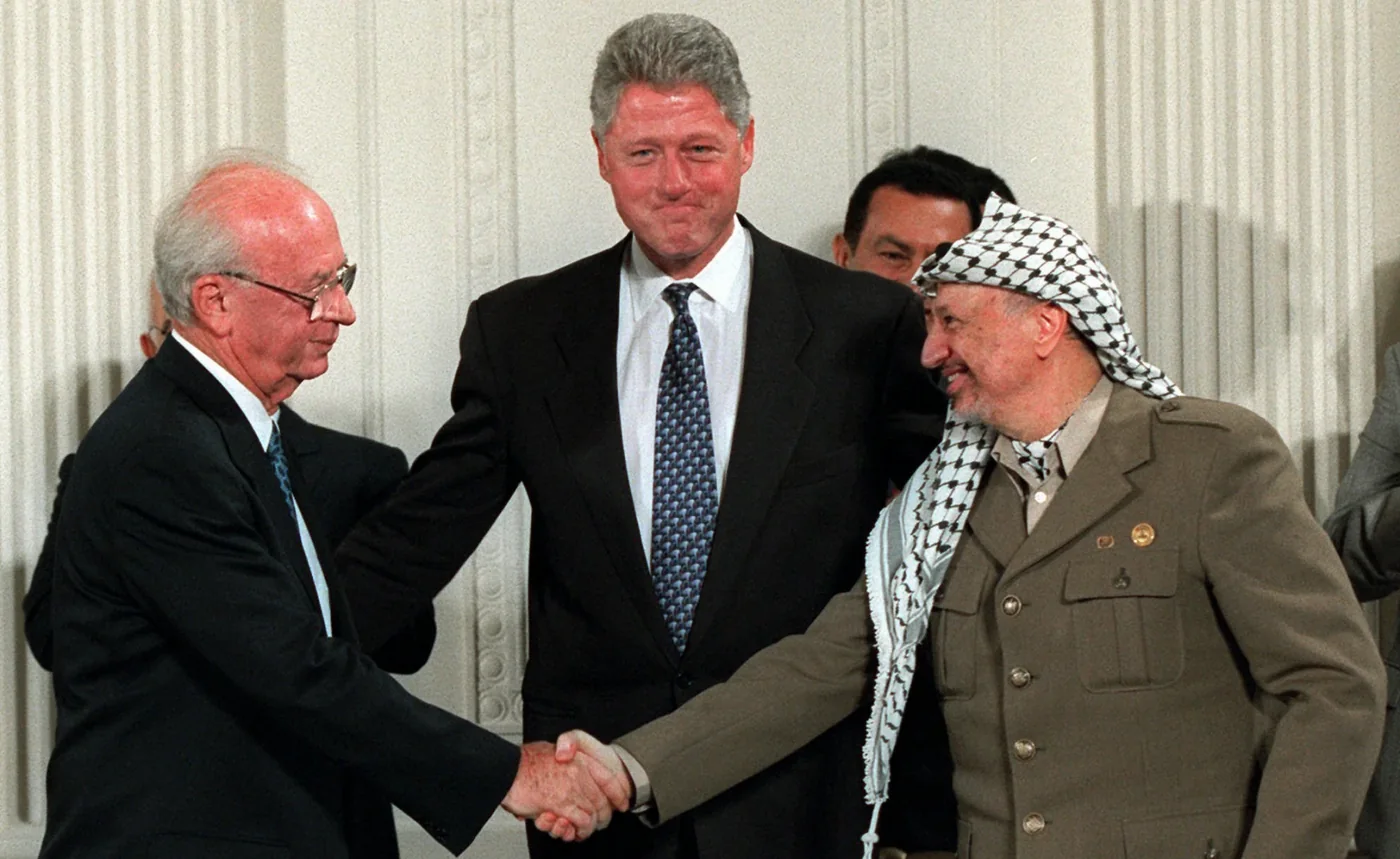
On 9 September 1993, PLO Chairman Yasser Arafat recognised Israel’s right to exist in peace and security, accepted United Nations Security Council Resolutions 242 and 338, and stated that the PLO renounced terrorism. Rabin responded by recognising the PLO as the representative of the Palestinian people and agreeing to negotiate with it. On 13 September, the two sides signed the Declaration of Principles on Interim Self-Government Arrangements at the White House in Washington. [8]
The agreement created a framework for limited Palestinian self-government during a transitional period. It did not settle the most difficult issues, including Jerusalem, borders, Israeli settlements, Palestinian refugees and long-term security arrangements. These questions were left for later negotiations. For Rabin, Oslo was a calculated political and security decision rather than a guarantee that the conflict would end quickly.
The process faced determined opposition from groups that rejected compromise. Hamas and Palestinian Islamic Jihad carried out attacks against Israeli civilians, including suicide bombings. On 19 October 1994, a Hamas suicide bombing on a Tel Aviv bus killed 22 people. Such attacks strengthened Israeli concerns about whether the Palestinian leadership could prevent terrorism and enforce its commitments. [9]
Rabin continued to argue that negotiations offered a way to reduce the conflict and improve Israel’s long-term security. At the same time, he publicly stressed that Palestinian action against terrorism had to be judged by results. His approach reflected the belief that peace required practical security measures, not declarations alone.
The second Oslo agreement, commonly called Oslo II, was signed on 28 September 1995. It set out further arrangements for Palestinian self-government in parts of the West Bank and divided responsibilities between Israel and the Palestinian Authority. The Knesset approved the agreement on 5 October by 61 votes to 59. The narrow margin reflected deep disagreement within Israeli society over the peace process. [10]
Rabin’s policy remained controversial. Supporters believed that negotiations could reduce Israel’s long-term security burden and create more stable relations with the Palestinians. Critics feared that transferring responsibilities and territory could expose Israeli communities to further attacks. These concerns continue to shape the debate over the Oslo process.
Peace with Jordan and Rabin’s Security Priorities (1994–1995)
Rabin’s clearest diplomatic success came with Jordan. Israel and Jordan had formally remained at war since 1948, despite years of practical contacts and shared interests. On 25 July 1994, the Washington Declaration formally ended the state of war and established a framework for peace. On 26 October, Rabin and Jordanian Prime Minister Abdul Salam Majali signed the Treaty of Peace at the Arava crossing, with US President Bill Clinton attending the ceremony. [11]
The treaty established diplomatic relations and addressed borders, security, water and economic cooperation. It reduced the risk that Jordan would join a future military coalition against Israel and created a basis for cooperation between the two neighbours. Unlike the negotiations with the Palestinians, the agreement with Jordan produced a formal peace treaty between two states.
Rabin nevertheless maintained clear security conditions in his broader diplomatic policy. In his final major address to the Knesset on 5 October 1995, he described his vision for a permanent settlement with the Palestinians. He opposed a return to Israel’s pre-June 1967 lines, supported a united Jerusalem under Israeli sovereignty and insisted on an Israeli security presence in the Jordan Valley. He envisaged Palestinian self-government but did not support the creation of a fully sovereign Palestinian state on terms that he believed would endanger Israel. [10]
These positions are important to understanding Rabin’s approach. He was willing to make agreements and accept limited territorial changes, but he did not abandon the principle that Israel needed defensible borders and the ability to protect its population. His diplomacy sought to combine political compromise with the security requirements of a small country in a difficult region.
Assassination and Legacy (1995–Present)
On 4 November 1995, Rabin was assassinated by Yigal Amir, a Jewish extremist, after attending a peace rally in Tel Aviv. Amir opposed Rabin’s agreements with the Palestinians and believed the government’s territorial concessions were unacceptable. He was convicted of murder and sentenced to life imprisonment. Rabin’s assassination shocked Israel and exposed the danger of political extremism within the country. [12]
A state commission of inquiry, chaired by former Supreme Court President Meir Shamgar, investigated the security failures that had allowed the assassination. Its findings identified serious problems in the protection arrangements and coordination among the police and the Shin Bet, Israel’s domestic security service. Subsequent reporting also examined the role of Avishai Raviv, a Shin Bet informant who had been active in extremist circles. Raviv was later acquitted of charges connected to failing to prevent the murder. [13]
Rabin’s death ended his political career but did not end the debate over his decisions. His supporters remember him as a soldier who understood the cost of war and was prepared to take political risks for peace. His critics question whether the Oslo agreements adequately protected Israel against terrorism and whether the promised diplomatic gains justified the risks.
A balanced assessment recognises both parts of his record. Rabin helped build Israel’s military strength, led the IDF during the Six-Day War and authorised the Entebbe rescue. As Prime Minister, he pursued peace with Jordan and negotiated with the PLO while continuing to insist on Israeli security requirements. His assassination showed the damage that political violence can inflict on a democratic society.
In One Paragraph
Yitzhak Rabin was a Jerusalem-born military commander who became Chief of the General Staff during Israel’s 1967 victory and later served twice as Prime Minister. He strengthened Israel’s ties with the United States, ordered the Entebbe hostage rescue and responded forcefully to the First Intifada. In the 1990s, he took the risk of recognising the PLO and signing the Oslo agreements, while insisting that Israel needed secure borders and effective protection against terrorism. His 1994 peace treaty with Jordan established lasting diplomatic relations between the two countries. A Jewish extremist assassinated Rabin in 1995 because of his peace policy. His legacy remains debated, but his career illustrates the relationship between military strength, national security and the search for peace.
Sources
- Knesset. “Yitzhak Rabin.” The Knesset. https://main.knesset.gov.il/EN/About/Pages/rabin.aspx.
- Israel Defense Forces. “Lt. Gen. Yitzhak Rabin (1964–1968).” Past Chiefs of Staff. https://www.idf.il/en/mini-sites/past-chiefs-of-staff/lt-gen-yitzhak-rabin-1964-1968/. See also Israel Defense and Security Establishment Archive, “Yitzhak Rabin – a General and a Leader,” https://archives.mod.gov.il/sites/English/Exhibitions/Pages/Yitzhak-Rabin.aspx.
- Knesset. “Yitzhak Rabin.” Commemoration of Leaders. https://main.knesset.gov.il/About/commemoration/Pages/rabin.aspx.
- Israel Defense and Security Establishment Archive. “Operation Entebbe.” Exhibitions. https://archives.mod.gov.il/sites/English/Exhibitions/Pages/default.aspx.
- Jewish Telegraphic Agency. “Rabin Resigns Following Probe into Illegal Bank Accounts Held by Him and His Wife in Washington.” April 8, 1977. https://www.jta.org/archive/rabin-resigns-following-probe-into-illegal-bank-accounts-held-by-him-and-his-wife-in-washington.
- Central Intelligence Agency. “[Assessment of Israeli Measures against the Palestinian Uprising].” June 29, 1988. Document CIA-RDP06T00412R000707990001-8, declassified in part September 30, 2013. CIA FOIA Electronic Reading Room, section “Beatings.” https://www.cia.gov/readingroom/print/2008439. See also “Israeli Foresees More Unrest: Long Haul Ahead.” The Christian Science Monitor, February 9, 1988. https://www.csmonitor.com/1988/0209/orab.html.
- Government of Norway, Ministry of Foreign Affairs. “Norway’s Involvement in the Peace Process in the Middle East.” https://www.regjeringen.no/en/documents/involvement/id420034/.
- United Nations General Assembly and Security Council. “Declaration of Principles on Interim Self-Government Arrangements.” A/48/486–S/26560, October 11, 1993. https://digitallibrary.un.org/record/174951/files/A_48_486%26S_26560-EN.pdf. See also United Nations, “Israel-PLO Recognition: Exchange of Letters between PM Rabin and Chairman Arafat,” September 9, 1993, https://www.un.org/unispal/?p=205528.
- Permanent Representative of Israel to the United Nations. “Letter Dated 19 October 1994 Addressed to the Secretary-General.” A/49/552–S/1994/1186, October 19, 1994. https://www.un.org/unispal/document/auto-insert-177253.
- United Nations, Division for Palestinian Rights. Developments Related to the Middle East Peace Process, Issue 3: October 1994–October 1995. New York: United Nations, November 1995. See Rabin’s speech on ratifying the Interim Agreement, October 5, 1995, pp. 91–98. https://www.un.org/unispal/document/auto-insert-204914/.
- United Nations Treaty Collection. “Treaty of Peace between the State of Israel and the Hashemite Kingdom of Jordan.” Signed October 26, 1994. https://treaties.un.org/Pages/showDetails.aspx?clang=_en&objid=080000028009bc5b.
- Knesset. “Yitzhak Rabin.” The Knesset. https://main.knesset.gov.il/EN/About/Pages/rabin.aspx.
- Jewish Telegraphic Agency. “Assassination Report Charges Shin Bet Mishandled Informer.” November 14, 1997. https://www.jta.org/archive/assassination-report-charges-shin-bet-mishandled-informer-2. See also “Cabinet Accepts Findings of Inquiry into Rabin Killing,” March 31, 1996, https://www.jta.org/archive/cabinet-accepts-findings-of-inquiry-into-rabin-killing.