
Yasser Arafat
Quick answer · ~120 words
Yasser Arafat founded Fatah, chaired the Palestine Liberation Organization (PLO) from 1969 until his death, and became the first president of the Palestinian Authority (PA). Born in Cairo to a Palestinian family, he built his political career around armed struggle against Israel, including campaigns that targeted civilians. His international standing grew despite the PLO’s record of terrorism and its rejection of Israel’s legitimacy during much of his leadership. In 1993, he formally recognised Israel and signed the Oslo Accords, sharing the 1994 Nobel Peace Prize with Israeli leaders Yitzhak Rabin and Shimon Peres. Yet the agreements failed to produce a permanent settlement. Arafat’s leadership was marked by personal control, weak public institutions, corruption allegations, and an inconsistent record of security cooperation. The Camp David summit collapsed in 2000, and the Second Intifada brought years of deadly violence. For Israel, his legacy is the failure of a historic diplomatic opportunity to deliver a durable end to the conflict.
A Revolutionary Formed in Defeat (1929–1967)
Yasser Arafat was born Mohammed Abdel-Raouf Arafat al-Qudwa al-Husseini on 24 August 1929. Most accounts place his birth in Cairo, although some identify Jerusalem or Gaza. His father was a Palestinian textile merchant, and his mother came from a Jerusalem family. After her death when Arafat was five, he spent several years with an uncle in Jerusalem under the British Mandate before returning to Cairo.[1]
Arafat’s political formation was shaped by the conflict surrounding the end of the British Mandate and the establishment of Israel. Before the age of seventeen, he was reportedly smuggling weapons to Palestine for use against the British and the Jewish community. In 1948, he left his studies at Fuad I University, later Cairo University, to take part in the fighting against the newly established State of Israel near Gaza. The Arab defeat reinforced his commitment to armed struggle. He returned to university, became active in Palestinian student politics, and completed an engineering degree in 1956.[1]
Arafat subsequently moved to Kuwait, where he ran a contracting business and devoted much of his income to political activity. In 1958, he and associates founded Fatah, which developed into a clandestine organisation committed to armed action against Israel. Its magazine began advocating armed struggle in 1959. Arafat distrusted the Arab governments that sponsored the Palestine Liberation Organization, established in 1964, and sought to place Palestinian national activity under independent Palestinian leadership. At the end of that year, he left Kuwait to organise Fatah operations against Israel from Jordan.[1]
The chronology is significant. Fatah’s armed campaign against Israel began before the Six-Day War of 1967, when Israel captured the West Bank and Gaza. Its initial objective was therefore not simply to end Israel’s later military control of those territories. Arafat’s political project was rooted in a wider struggle against Israel itself. This distinction is central to understanding why Israeli leaders later questioned whether his recognition of Israel represented a fundamental change in objectives or a tactical adjustment to political circumstances.
Terrorism and International Legitimacy (1967–1988)
Israel’s victory in the Six-Day War weakened the standing of Arab governments and created an opening for Palestinian organisations. Fatah became the dominant faction within the PLO, and Arafat was elected chairman of its Executive Committee in 1969.[1] He transformed the organisation into a major regional actor, but his strategy also repeatedly brought Palestinian armed groups into conflict with the states in which they operated.
In Jordan, the PLO developed extensive military and political structures that challenged King Hussein’s authority. Fighting between Jordanian forces and Palestinian organisations in 1970–71 ended with the PLO’s expulsion. Arafat subsequently established a major base in Lebanon, where Palestinian armed groups became entangled in the country’s internal conflict. Israel’s 1982 invasion of Lebanon forced Arafat and much of the PLO leadership to relocate to Tunis.[1] These episodes demonstrated the costs of maintaining an armed movement whose leadership and operations could undermine the authority of its host state.
Attacks against civilians and foreign officials further damaged the PLO’s standing. On 1 March 1973, gunmen from the Black September Organisation seized the Saudi embassy in Khartoum and killed US Ambassador Cleo Noel, his deputy George Moore, and Belgian chargé d’affaires Guy Eid. A US Department of State documentary history records evidence that Arafat had “full knowledge and personal approval” of the operation.[2] This is a conclusion drawn from US government records, rather than a criminal conviction against Arafat, but it is a serious historical allegation that cannot be separated from his leadership of the Fatah movement.
Arafat nevertheless gained diplomatic recognition. On 13 November 1974, the UN General Assembly invited him to address it. Wearing a gun holster, he declared that he carried “an olive branch and a freedom fighter’s gun.”[3][4] The speech presented diplomacy and armed struggle as complementary instruments of the same political project. Supporters viewed his appearance as recognition of Palestinian national aspirations; many Israelis saw it as international legitimisation of a leader whose movement had not abandoned violence.[4]
Arafat’s turn towards formal diplomacy culminated in December 1988, when he accepted UN Security Council Resolutions 242 and 338, recognised Israel’s right to exist, and renounced terrorism. President Ronald Reagan responded by authorising a US dialogue with the PLO.[5] However, the durability of that renunciation was immediately questioned. In April 1989, US senators cited reports of at least nine attacks or attempted attacks by PLO-affiliated groups since Arafat’s statement.[6] Such incidents did not by themselves establish Arafat’s personal responsibility for each operation, but they reinforced the concern that the PLO’s diplomatic declarations had not yet produced a clear and enforceable end to violence.
Oslo: Recognition Without a Durable Settlement (1988–1999)
Arafat’s decision to support Saddam Hussein’s Iraq during the 1990–91 Gulf crisis further isolated the PLO from several Arab governments and weakened its financial position.[1] The subsequent diplomatic environment encouraged a turn towards negotiations. On 9 September 1993, Arafat wrote to Israeli Prime Minister Yitzhak Rabin that the PLO recognised Israel’s right “to exist in peace and security.” He also renounced terrorism and pledged to seek changes to the Palestinian National Covenant, which contained provisions directed against Israel. Rabin, in return, recognised the PLO as the representative of the Palestinian people.[7]
The Declaration of Principles was signed in Washington on 13 September 1993. The agreement created a framework for Palestinian self-government and further negotiations, while postponing difficult final-status questions, including Jerusalem, refugees, settlements, borders, and security. Arafat shared the 1994 Nobel Peace Prize with Rabin and Shimon Peres.[8] Israel permitted him to return from exile and lead the new Palestinian Authority. In January 1996, he won the PA presidential election with 88.1 % of the vote, against Samiha Khalil, who received 9.3 %.[9]
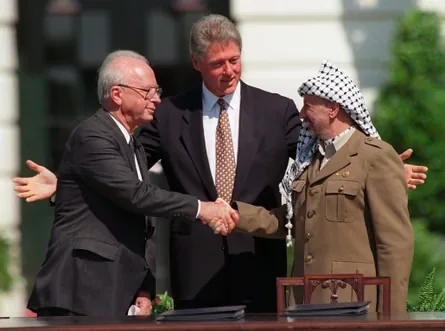
Oslo was a major diplomatic gamble for Israel. Its supporters argued that recognising Arafat and transferring authority could create a Palestinian leadership capable of negotiating an end to the conflict. But the agreement depended on reciprocal performance, particularly security cooperation and progress towards a permanent settlement. That dependence became a central weakness. Hamas and Palestinian Islamic Jihad carried out suicide bombings in Israel, while Israeli governments repeatedly accused Arafat’s administration of failing to arrest militants, dismantle their networks, and prevent attacks. Arafat’s own forces and institutions also lacked a transparent, unified system of accountability.
The Nobel Foundation’s biographical account itself describes his rule as more dictatorial than democratic.[1] Arafat relied heavily on personal networks and overlapping security organisations, concentrating authority rather than building institutions able to operate independently of him. The result was a political system in which public accountability was weak and security commitments depended substantially on the leader’s choices. Israeli policy and settlement disputes also contributed to the deterioration of the peace process; Netanyahu’s election in 1996 changed the political context for negotiations.[1] But these difficulties did not remove the central responsibility of Arafat’s leadership to act consistently against violence and honour the commitments it had made.
Camp David, the Second Intifada and Isolation (2000–2004)
The decisive test came at the Camp David summit in July 2000. Israeli Prime Minister Ehud Barak put forward proposals involving extensive territorial withdrawal and arrangements for Jerusalem, but the summit ended without agreement. President Bill Clinton publicly credited Barak with moving further from his initial position than Arafat had, particularly on Jerusalem.[10] The precise terms of the proposals and the reasons for the failure remain disputed. Palestinian and other critics have argued that the proposals did not provide sufficient sovereignty or a satisfactory resolution of the Jerusalem and refugee questions. Nonetheless, the summit failed to produce a counterproposal and agreement capable of bridging the differences.
The Second Intifada began in September 2000, following a period of heightened tensions and Ariel Sharon’s visit to the Temple Mount/Haram al-Sharif. The visit was widely viewed by Palestinians as provocative, but it should not be treated as a complete explanation for the uprising. The Mitchell Committee later found no evidence that the PA had planned the violence in advance; it also found no evidence that the PA made a consistent effort to contain it once it began.[11] This distinction matters: the available findings do not establish that Arafat planned the uprising from the outset, but they do support serious criticism of his failure to restrain the violence.
Clinton made another effort to secure an agreement in December 2000 with his final-status parameters. Israel accepted the framework with reservations. A UN review of events reported that Arafat also indicated acceptance, although the parties differed over the reservations and how the proposals would be implemented.[12] Clinton later said that Israel had accepted his plan and Arafat had rejected it.[13] The record is therefore more complex than a simple claim that one side accepted everything and the other rejected everything. Even so, the negotiations ended without agreement, and the opportunity to establish a negotiated final settlement was lost.
The human cost was severe. According to the Israeli Ministry of Foreign Affairs, Palestinian attacks killed 207 Israelis in 2001, 452 in 2002, and 214 in 2003, with more than 1,000 Israelis killed by October 2004.[14] Palestinians also suffered extensive casualties, destruction, and economic hardship. The violence deepened Israeli public scepticism about the peace process and strengthened the argument that diplomatic commitments could not be trusted without verifiable action on security.
The discovery of the Karine A arms shipment further damaged Arafat’s credibility. On 3 January 2002, Israeli naval commandos seized the vessel in the Red Sea. Israel informed the United Nations that it was carrying approximately 50 tons of weapons destined for the Palestinian Authority.[15] Israel attributed the shipment to the PA leadership; Arafat denied personal responsibility. The episode reinforced concerns in Washington and Jerusalem that arms acquisition and militant activity were incompatible with the commitments underpinning Oslo.
On 24 June 2002, US President George W. Bush called for Palestinians to elect new leaders “not compromised by terror.”[16] The statement marked a major rupture in Arafat’s standing with Washington. From December 2001, Arafat was largely confined by the Israeli army to his headquarters in Ramallah. He became ill in October 2004 and died in a French hospital on 11 November 2004.[1][8]
A Legacy of Weak Institutions and Unfinished Conflict
Arafat’s supporters credit him with turning a dispersed Palestinian population into an internationally recognised national movement. His leadership helped secure a place for Palestinian representatives in diplomacy, and his signature on the Oslo Accords constituted formal recognition of Israel. Those achievements were significant. They must, however, be weighed against the failure to convert diplomatic recognition into a durable settlement, the continuation of violence, and the weakness of the institutions he led.
Financial accountability was another major problem. In 2003, an International Monetary Fund official reported that approximately US$900 million had been diverted from the Palestinian Authority budget between 1995 and 2000 to a special account controlled by Arafat and his chief economic adviser. The official also stated that most of the funds had been invested in assets that remained in public hands.[18] The report does not establish that the entire sum was personally stolen by Arafat. It does, however, illustrate the opacity of the PA’s financial system and the extent to which public resources were managed through accounts under the leadership’s personal control. For a government expected to build credible institutions, this was a serious failure.
The collapse of the peace process remains the most contested part of Arafat’s legacy. Israeli leaders, including Barak, and former US President Clinton argued that Arafat failed to accept a realistic opportunity for a final agreement. Other scholars contend that Barak’s proposals were insufficient, particularly on Jerusalem, territorial continuity, and refugees. Political scientist Jerome Slater emphasises Israeli rigidity in the negotiations, while David Bromwich also acknowledged Arafat’s inflexibility on many issues.[13] A critical assessment need not claim that every Israeli proposal was adequate to recognise that Arafat had a responsibility to negotiate seriously, make clear counterproposals, and prevent a return to sustained violence.
Controversy also surrounded his death. Swiss investigators reported findings they considered consistent with possible polonium exposure. French judicial authorities later concluded that poisoning had not been demonstrated and closed their investigation without charges; Russian experts also rejected the poisoning theory, and Israel denied involvement.[17][19] The available evidence has not established that Arafat was murdered, and the allegation should remain clearly distinguished from proven fact.
Arafat’s legacy is therefore contradictory but consequential. He secured international recognition for Palestinian nationalism and entered an agreement that once raised hopes of reconciliation. Yet he did not build a transparent, accountable Palestinian state-in-waiting, and his leadership failed to establish a consistent end to armed violence. From an Israeli perspective, the lesson is not that negotiation is inherently futile, but that recognition and territorial compromise cannot by themselves secure peace. Any future agreement requires accountable institutions, enforceable security commitments, and demonstrated rejection of violence.
In One Paragraph
Yasser Arafat (1929–2004) founded Fatah, led the PLO from 1969, and became the first president of the Palestinian Authority. He built his political career around armed struggle and gained international recognition despite the PLO’s record of attacks and terrorism. In 1993, he formally recognised Israel and signed the Oslo Accords, but the commitments underpinning the agreement were not translated into a durable settlement. His government remained highly personalised, financial accountability was weak, and the Palestinian Authority did not consistently contain militant violence. The Camp David summit failed in 2000, and the Second Intifada caused extensive Israeli and Palestinian casualties. Although Arafat helped establish Palestinian national representation on the international stage, his legacy is also one of failed diplomacy, weak institutions, and unresolved questions about the relationship between political recognition and the renunciation of violence.
Sources
- Abrams, Irwin, ed. “Yasser Arafat: Biographical.” In Nobel Lectures, Peace 1991–1995. Singapore: World Scientific Publishing, 1999. Reproduced at NobelPrize.org. https://www.nobelprize.org/prizes/peace/1994/arafat/biographical/.
- U.S. Department of State, Office of the Historian. “Backchannel Message From the Egyptian Presidential Adviser for National Security Affairs (Ismail) to the President’s Assistant for National Security Affairs (Kissinger), Cairo, March 20, 1973.” Document 41, note 3. In Foreign Relations of the United States, 1969–1976, vol. 25, Arab-Israeli Crisis and War, 1973. https://history.state.gov/historicaldocuments/frus1969-76v25/d41.
- United Nations General Assembly. Official Records, Twenty-Ninth Session, 2282nd Plenary Meeting, 13 November 1974. A/PV.2282. New York: United Nations, 1974. https://digitallibrary.un.org/record/743671/files/A_PV.2282-EN.pdf.
- Kramer, Martin. “Arafat’s UN Moment: The Gun and the Olive Branch Revisited.” Journal of the Middle East and Africa 16, no. 1 (2025): 1–14. https://doi.org/10.1080/21520844.2025.2449738. Author’s posted version: https://martinkramer.org/arafats-un-moment-the-gun-and-the-olive-branch-revisited/.
- Reagan, Ronald. “Statement on Opening a U.S. Dialogue with the PLO.” December 14, 1988. Ronald Reagan Presidential Library and Museum. https://www.reaganlibrary.gov/research/speeches/121488c.
- U.S. Congress, Senate. “Senate Resolution 97: Relating to Palestine Liberation Organization Terrorism.” Congressional Record, 101st Cong., 1st sess., April 7, 1989. https://irp.fas.org/congress/1989_cr/s890407-plo.htm.
- United Nations Information System on the Question of Palestine (UNISPAL). “Israel-PLO Recognition: Exchange of Letters between PM Rabin and Chairman Arafat.” September 9, 1993. https://www.un.org/unispal/?p=205528.
- Nobel Prize Outreach. “Yasser Arafat: Facts.” NobelPrize.org. https://www.nobelprize.org/prizes/peace/1994/arafat/facts/.
- United Press International. “Palestinian Elections Results.” January 22, 1996. https://www.upi.com/Archives/1996/01/22/Palestinian-elections-results/2111822286800/.
- Clinton, William J. “Remarks on the Middle East Peace Summit and an Exchange With Reporters.” July 25, 2000. The American Presidency Project, edited by Gerhard Peters and John T. Woolley. https://www.presidency.ucsb.edu/node/229387.
- Sharm el-Sheikh Fact-Finding Committee. Report of the Sharm el-Sheikh Fact-Finding Committee. April 30, 2001. UNISPAL. https://www.un.org/unispal/?p=200482.
- United Nations, Division for Palestinian Rights. “Chronological Review of Events Relating to the Question of Palestine: Monthly Media Monitoring Review, January 2001.” UNISPAL. https://www.un.org/unispal/?p=209319.
- Slater, Jerome, and David Bromwich. “What Did Arafat and Barak Accept?” The New York Review of Books, February 11, 2010. https://www.nybooks.com/articles/2010/02/11/what-did-arafat-and-barak-accept/.
- Israel Ministry of Foreign Affairs. “Four Years of Conflict: Israel’s War against Terrorism.” October 3, 2004. https://embassies.gov.il/MFA/FOREIGNPOLICY/Terrorism/Palestinian/Pages/Four%20Years%20of%20Conflict%203-Oct-2004.aspx.
- Permanent Representative of Israel to the United Nations. “Letter Dated 4 January 2002 from the Permanent Representative of Israel to the United Nations Addressed to the Secretary-General.” UN Security Council, January 4, 2002. UNISPAL. https://www.un.org/unispal/?p=182131.
- Bush, George W. “President Bush Calls for New Palestinian Leadership.” White House, Office of the Press Secretary, June 24, 2002. https://georgewbush-whitehouse.archives.gov/news/releases/2002/06/text/20020624-3.html.
- Agence France-Presse. “French Judges End Investigation into Arafat’s Death.” The Times of Israel, May 2015. https://www.timesofisrael.com/french-judges-end-investigation-into-arafats-death/.
- International Monetary Fund. “Transcript of a Press Briefing on the West Bank and Gaza by Adam Bennett and Karim Nashashibi of the IMF’s Middle Eastern Department.” Dubai, September 20, 2003. https://www.imf.org/external/np/tr/2003/tr030920.htm.
- Jewish Telegraphic Agency. “Arafat Poisoning Case Closed without Charges Filed.” September 2015. https://www.jta.org/?p=1056820.