
The Sinai Campaign and the Suez Crisis, 1956
Quick answer · ~120 words
On 26 July 1956, Egyptian President Gamal Abdel Nasser nationalised the Suez Canal Company, triggering a crisis with Britain and France. Israel had separate security concerns: fedayeen attacks launched from Egyptian-controlled Gaza, restrictions on Israeli shipping through the Suez Canal and the closure of the Strait of Tiran to Israeli vessels. In the secret Protocol of Sèvres, signed on 24 October, Israel, Britain and France coordinated military action against Egypt. Israel launched Operation Kadesh on 29 October, beginning with a parachute drop of 395 troops near the Mitla Pass, and rapidly captured Sinai and the Gaza Strip. Britain and France then intervened militarily in the Canal Zone. American financial and diplomatic pressure, alongside Soviet threats, helped force a ceasefire. Israel completed its withdrawal on 8 March 1957, after the deployment of the United Nations Emergency Force (UNEF). The campaign strengthened French-Israeli military cooperation, but the security arrangements that followed depended on Egyptian consent and collapsed in May 1967.
Nationalisation and the Motives of Britain, France and Israel, July-October 1956
On 26 July 1956, Nasser announced the nationalisation of the Suez Canal Company in Alexandria. The company had been largely British- and French-owned and operated the canal under a concession due to expire in 1968. Nasser declared that canal revenues would help finance the Aswan High Dam after the United States and Britain withdrew their financial offers. Britain and France regarded nationalisation as a threat to their commercial interests and remaining political influence in the Middle East. The canal was also an important route for European trade and oil supplies. [1]
Israel's concerns were more immediate. Relations with Egypt had deteriorated since the 1949 armistice. Egyptian-supported Palestinian fedayeen operated from bases in the Gaza Strip and carried out repeated raids into Israel. Israeli reprisals against Egyptian positions contributed to the escalation. Egypt also restricted Israeli shipping through the Suez Canal and the Strait of Tiran, affecting access to Eilat and the Red Sea. The United Nations' own account of the crisis records both the fedayeen attacks and the restrictions on Israeli shipping as important sources of tension before October 1956. [2]
The Egyptian arms agreement with Czechoslovakia in September 1955 had also altered the regional military balance. Egypt acquired substantial quantities of Soviet-bloc weapons, including aircraft, tanks and artillery. Israeli leaders viewed this military expansion, together with the attacks from Gaza and the maritime restrictions, as a growing security threat. The Israeli Ministry of Defence's historical account records that Moshe Dayan and David Ben-Gurion considered different ways of addressing the problem, including action in Gaza and the occupation of positions overlooking the Strait of Tiran. [3]
The three governments therefore entered the crisis with different objectives. Britain and France wanted to reverse Nasser's nationalisation and weaken his regional position. Israel wanted to damage Egypt's military capability, end the fedayeen threat and secure freedom of navigation through the Strait of Tiran. These interests created the conditions for secret cooperation.
The Protocol of Sèvres, 22–24 October 1956
Representatives of Israel, France and Britain met secretly at Sèvres, outside Paris, between 22 and 24 October 1956. Israeli Prime Minister David Ben-Gurion, French Foreign Minister Christian Pineau and British representative Patrick Dean were among those involved. The meeting produced a secret agreement, known as the Protocol of Sèvres. [4]
The plan established a sequence of military and diplomatic actions. Israel would attack Egyptian forces in Sinai on 29 October and advance towards the Suez Canal. Britain and France would then issue an ultimatum demanding that Egypt and Israel withdraw ten miles from the canal. They would also demand permission to occupy strategic positions in the Canal Zone. If Egypt rejected the ultimatum, Britain and France would begin military operations against Egyptian forces. The arrangement gave the two European powers a pretext to intervene while presenting their action as an attempt to separate the combatants and protect the canal. [4]
The protocol also provided for Israeli forces to occupy the western shore of the Gulf of Aqaba and the islands of Tiran and Sanafir, with the stated purpose of securing navigation in the gulf. It included an Israeli undertaking not to attack Jordan during the operation. These were provisions of the secret agreement; they should be distinguished from the military positions that Israeli forces are documented as having captured during the campaign. The Israeli Ministry of Defence records the occupation of positions at the Strait of Tiran as one of the operation's objectives and the advance of Israeli forces towards Sharm el-Sheikh. [3, 4]
The agreement was significant because it demonstrated that the Israeli campaign was coordinated with the European intervention rather than being an entirely separate operation. The secret arrangement later became an important part of the historical record of the Suez Crisis.
Operation Kadesh and the Capture of Sinai, 29 October–5 November 1956
Israel launched Operation Kadesh on the evening of 29 October 1956. The operation had three principal objectives: create a military threat near the Suez Canal, capture positions overlooking the Strait of Tiran and destroy Egyptian military positions in northern Sinai. [3]
The opening phase included a parachute drop by 395 troops of the 202nd Paratroop Brigade near the eastern approaches to the Mitla Pass. The force was part of Battalion 890, commanded by Rafael Eitan, while the brigade was commanded by Ariel Sharon. This was the first large-scale Israeli parachute operation of the campaign and an important early step in the advance across Sinai. [3, 5]
The Mitla Pass became the site of a costly engagement. Israeli paratroopers encountered Egyptian resistance in the narrow pass, where the terrain favoured the defenders. The battle cost 38 Israeli paratroopers their lives, with more than 100 wounded. The engagement became one of the most discussed episodes of the campaign, both for the determination shown by the troops and for the heavy losses incurred. [6]
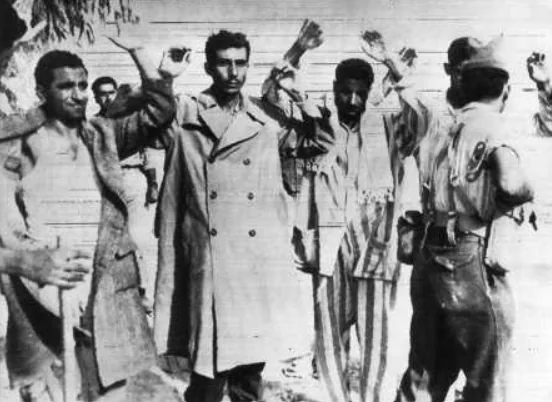
Other Israeli forces advanced across Sinai along northern, central and southern routes. The campaign involved coordinated movements by ground forces and air units, and represented a major deployment of Israeli military formations. Israeli forces captured key positions across the peninsula and advanced towards Sharm el-Sheikh. By early November, they had taken control of Sinai and the Gaza Strip, including the approaches to the Strait of Tiran. [3]
The Israeli advance was closely connected to the next stage of the Sèvres plan. On 30 October, Britain and France issued their ultimatum to Egypt and Israel. Israel accepted the demand, while Egypt rejected it. British and French air attacks against Egyptian military targets began on 31 October. Their forces subsequently landed in the Suez Canal Zone, beginning the military intervention that had been planned at Sèvres. [4, 7]
Anglo-French Intervention, American Pressure and Soviet Threats, November–December 1956
Britain and France began bombing Egyptian airfields on 31 October. Their forces landed at Port Said on 5–6 November under Operation Musketeer and occupied positions in the northern Canal Zone. Although the intervention achieved its immediate military objective of taking control of part of the canal area, it quickly became politically unsustainable. [7]
US President Dwight D. Eisenhower opposed the Anglo-French intervention. Washington feared that the operation would damage Western relations with Arab and Asian countries, undermine the United Nations and weaken the Western position during the Cold War. The United States also opposed the secret coordination between Israel and the European powers. American pressure included diplomatic measures and financial leverage at a time when Britain was facing a serious crisis in its foreign-exchange reserves and the value of sterling. [1, 8]
The financial pressure on Britain was closely connected to its need for American support and access to International Monetary Fund resources. IMF economist James M. Boughton documents how the Suez intervention intensified pressure on sterling and how British Prime Minister Anthony Eden and Chancellor Harold Macmillan sought American backing for a substantial IMF financial package. The United States was in a position to influence the assistance Britain needed. Macmillan later recalled that Washington had refused an IMF-related request until Britain agreed to a ceasefire. However, a US State Department editorial note records that it found no direct documentation of that specific British request or American response in its files, and explains that IMF matters fell under the US Treasury. The broader financial pressure is documented; the precise claim that IMF support was withheld until the ceasefire rests on Macmillan's later account. [8, 9]
The Soviet Union also threatened action. In messages to British and French leaders, Soviet Premier Nikolai Bulganin warned of possible military consequences if the intervention continued. American intelligence assessments described the Soviet communications as serious threats, although they did not establish a definite Soviet plan for unilateral military action. The Hungarian uprising was taking place at the same time, adding to the international danger and diplomatic complexity. [10]
The United Nations General Assembly called for a ceasefire and withdrawal. Britain and France accepted the ceasefire on 6 November. Their forces completed their withdrawal from the Canal Zone by 22 December 1956. Israel faced continued American pressure to leave Sinai and Gaza. [2, 7]
Israel's withdrawal involved negotiations over the security arrangements that would follow. Ben-Gurion sought guarantees that the fedayeen threat would not simply return and that Israeli shipping would be able to use the Strait of Tiran. Israel also wanted an international presence in the area to reduce the risk of renewed fighting. The United States pressed Israel to comply with the UN demand for withdrawal, while Israeli representatives discussed the practical arrangements with the United Nations and American officials. [11]
Israel withdrew in stages. Its forces left the Sinai Peninsula and Gaza, completing the withdrawal on 8 March 1957. The campaign had achieved a rapid military victory, but Israel did not retain the territory it had captured. [2]
UNEF Deployment and the Road to the Six-Day War, 1956–1967
The United Nations established the United Nations Emergency Force in November 1956 to supervise the ceasefire and the withdrawal of foreign forces. UNEF was the first armed UN peacekeeping force. It included troops from countries such as India, Brazil, Canada, Colombia, Denmark, Finland, Indonesia, Norway, Sweden and Yugoslavia. Its strength reached more than 6,000 personnel in February 1957. [2, 12]
After Israel's withdrawal, UNEF was deployed on Egyptian territory along the armistice demarcation line and the international frontier, as well as in the Sharm el-Sheikh area. Its presence helped maintain relative quiet along the border and supported the arrangements that allowed Israeli shipping to pass through the Strait of Tiran. However, the force was stationed on Egyptian territory with Egypt's consent. It could not remain if the Egyptian government withdrew that consent. [2]
That limitation became decisive in May 1967. As tensions rose, Egypt requested the withdrawal of UNEF. Secretary-General U Thant accepted the request, and the force began leaving its positions. Egyptian troops moved into Sinai, and Egypt again closed the Strait of Tiran to Israeli shipping. The withdrawal of UNEF removed the buffer that had helped maintain the post-1957 arrangement. [2]
The closure of the Strait of Tiran, alongside the movement of Egyptian forces into Sinai and the wider regional mobilisation, contributed directly to the crisis that led to the Six-Day War in June 1967. The events demonstrated that the security arrangements established after the Sinai Campaign had not resolved the underlying disputes. They depended on Egyptian consent and could be withdrawn when the political situation changed.
French Arms, Nuclear Cooperation and the Dimona Link
The Suez Crisis strengthened the military relationship between France and Israel. French arms supplies had already become important to Israel as Egypt acquired Soviet-bloc weapons. Cooperation during the campaign reinforced the relationship, and French assistance continued to play a significant role in Israel's military development. [3]
The relationship also extended into nuclear cooperation. Declassified American records from 1960 document US concern about French assistance to Israel in constructing a large reactor at Dimona in the Negev. A memorandum to President Eisenhower in January 1961 records that reports of French-Israeli cooperation had reached the American embassy in Tel Aviv during 1960. The document also records the American government's efforts to obtain information and assurances about the reactor's purpose. [13]
The Suez Crisis formed part of the political context for this closer relationship. France and Israel had cooperated against Nasser and shared concerns about his regional ambitions. The military partnership continued after the crisis, contributing to Israel's access to French equipment and technical assistance. The Dimona project became one of the most consequential aspects of this cooperation.
Sources
- U.S. Department of State, Office of the Historian. “The Suez Crisis, 1956.” Milestones in the History of U.S. Foreign Relations. https://history.state.gov/milestones/1953-1960/suez.
- United Nations Peacekeeping. “First United Nations Emergency Force (UNEF I): Background.” https://peacekeeping.un.org/sites/default/files/past/unef1backgr2.html.
- Israel Ministry of Defense, IDF and Defense Establishment Archive. “Operation Kadesh – the Suez Crisis 1956.” https://archives.mod.gov.il/sites/English/Exhibitions/Pages/Operation-Kadesh.aspx.
- U.S. Department of State, Office of the Historian. “Editorial Note: The Protocol of Sèvres.” In Foreign Relations of the United States, 1955–1957, vol. 16, Suez Crisis, July 26–December 31, 1956, doc. 373. Washington, DC: U.S. Government Printing Office, 1990. https://history.state.gov/historicaldocuments/frus1955-57v16/d373.
- “The Parachute Drop at Mitla.” Black Arrow Book, Paratroopers Heritage Archive. https://202.gilai.com/Pages/moreshet/blackarrow/Black-Arrow_Book.pdf.
- National Library of Israel. “Nahal: The Story of the Green Brigade.” https://blog.nli.org.il/en/nahal-the-story-of-the-green-brigade/.
- U.S. Department of State, Office of the Historian. Foreign Relations of the United States, 1955–1957, vol. 16, Suez Crisis, July 26–December 31, 1956. Washington, DC: U.S. Government Printing Office, 1990. https://history.state.gov/historicaldocuments/frus1955-57v16.
- James M. Boughton. “Northwest of Suez: The 1956 Crisis and the IMF.” IMF Working Paper WP/00/192. Washington, DC: International Monetary Fund, 2000. https://www.imf.org/-/media/websites/imf/imported-full-text-pdf/external/pubs/ft/wp/2000/_wp00192.pdf.
- U.S. Department of State, Office of the Historian. “Editorial Note: The British Financial Crisis and the IMF, November 6, 1956.” In Foreign Relations of the United States, 1955–1957, vol. 16, doc. 516. Washington, DC: U.S. Government Printing Office, 1990. https://history.state.gov/historicaldocuments/frus1955-57v16/d516.
- U.S. Department of State, Office of the Historian. “Special National Intelligence Estimate: Sino-Soviet Intentions in the Suez Crisis, November 6, 1956.” In Foreign Relations of the United States, 1955–1957, vol. 16, doc. 521. Washington, DC: U.S. Government Printing Office, 1990. https://history.state.gov/historicaldocuments/frus1955-57v16/d521.
- Dwight D. Eisenhower. “Message from President Eisenhower to Prime Minister Ben Gurion, November 7, 1956.” In Foreign Relations of the United States, 1955–1957, vol. 16, doc. 550. Washington, DC: U.S. Government Printing Office, 1990. https://history.state.gov/historicaldocuments/frus1955-57v16/d550.
- United Nations Peacekeeping. “First United Nations Emergency Force (UNEF I): Facts and Figures.” https://peacekeeping.un.org/sites/default/files/past/unef1facts.html.
- U.S. Department of State. “Memorandum for the President: Israel’s Atomic Energy Activities, January 30, 1961.” Declassified document, National Security Archive. https://nsarchive.gwu.edu/sites/default/files/documents/2806668/Document-1A-Secretary-of-State-Rusk-to-President.pdf.