
The Golan Heights
Quick answer · ~120 words
The Golan Heights is a plateau in southwest Syria. Israel captured most of it in the June 1967 war. Most of the Syrian population left or was displaced. Syria says more than 140,000 people lived there before the war. An Israeli census in August 1967 counted 6,396. Syria tried to retake the plateau in October 1973 and failed. A disengagement agreement signed on 31 May 1974 created a buffer zone patrolled by UN troops. On 14 December 1981 Israel applied its law to the territory. Three days later the UN Security Council unanimously declared that act null and void. Syria has claimed the Golan without a break since 1967. The United States recognized Israeli sovereignty on 25 March 2019, and Colombia did the same on 10 August 2026. The UN counts more than 31,000 Israeli settlers in 35 settlements, and about 29,000 Druze also live there. Since December 2024, Israeli troops have held positions inside the buffer zone.
Capture and Displacement, June 1967 to November 1967
Israel took the Golan Heights from Syria in the final two days of the June 1967 war. Fighting on the plateau ended on 10 June, when Israeli forces reached the town of Quneitra. Israeli leaders later gave security as the reason for keeping the land. In 1981, Prime Minister Menachem Begin told his cabinet that Syria had used the heights to attack Israeli civilians in the valley below while it controlled them [1]. Most of the civilian population left during or soon after the fighting, and the sources give different numbers. The Syrian government states that more than 140,000 Syrians lived in the Golan before the occupation and that most were driven out. It says these people and their descendants now number more than 500,000 [2]. An Israeli military intelligence document written three days after the capture estimated the population at about 90,000, including about 20,000 in Quneitra. An Israeli census on 10 August 1967 counted 6,396 residents, most of them Druze. These Israeli army records were published by Akevot, an Israeli archive research group [3]. A UN mission led by Nils-Göran Gussing visited Damascus in 1967. It reported that the refugees staying in temporary shelter there numbered an estimated 105,000 to 110,000 people, including 16,000 Palestinian refugees registered with UNRWA [4]. On 22 November 1967 the Security Council adopted Resolution 242. It called for Israel to withdraw its armed forces from territories occupied in the recent conflict. It also called for every state in the region to be able to live in peace within secure and recognized boundaries [5]. Every later negotiation between Israel and Syria has referred back to this text.
War and Disengagement, October 1973 to June 1974
On 6 October 1973, Syria and Egypt attacked Israeli forces on two fronts. Syrian armoured units advanced into the Golan in the first days of the war. Israeli forces then pushed them back and advanced beyond the 1967 ceasefire line toward Damascus. On 22 October 1973 the Security Council adopted Resolution 338. It called for a ceasefire, for the parties to carry out Resolution 242 in all of its parts, and for negotiations toward a just and durable peace [6].
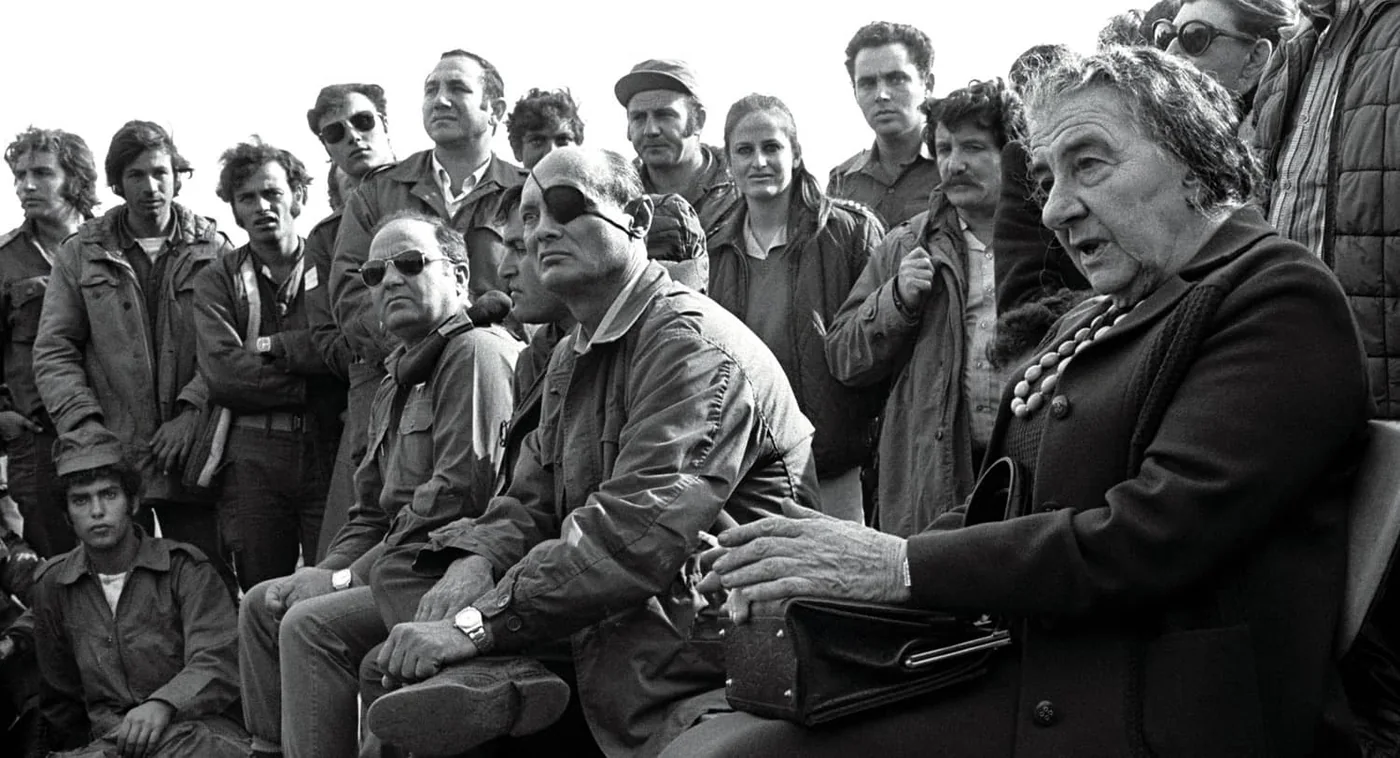
Prime Minister Golda Meir, accompanied by Defense Minister Moshe Dayan, meets with Israeli soldiers at a base on the Golan Heights during the 1973 Yom Kippur War.
After months of mediation by United States Secretary of State Henry Kissinger, military officers of Israel and Syria signed the Agreement on Disengagement in Geneva on 31 May 1974. The agreement placed all Israeli forces west of a line marked Line A on an attached map, and west of Line A-1 near Quneitra. It placed all territory east of Line A under Syrian administration and said Syrian civilians would return there. It made the strip between Line A and Line B an area of separation, where a United Nations Disengagement Observer Force (UNDOF) would be stationed. It also set two equal zones where the number of troops and weapons on each side would be limited [7]. Under these terms, Israel gave back the land it had taken in 1973 and the town of Quneitra. It kept the rest of the plateau it had held since 1967. The agreement was a military arrangement, not a peace treaty, and it did not settle who owned the territory. The Security Council still renews UNDOF's mandate every six months. Its most recent renewal, Resolution 2824 of 25 June 2026, extends the mandate to 31 December 2026 and requires both parties to respect the 1974 agreement fully [8].
The Golan Heights Law and Resolution 497, December 1981
From 1967 to 1981, Israel ran the Golan through a military government. On 14 December 1981, Begin proposed a law to apply Israeli law there. The Knesset passed it through all three readings on the same day [1]. The law has three articles. The first states that the law, jurisdiction and administration of the state shall apply to the Golan Heights, as marked on an attached map. The second makes the law take effect on the day the Knesset adopts it. The third makes the Minister of the Interior responsible for carrying it out [9]. The text does not use the words "annexation" or "sovereignty." Begin gave his reasons to the cabinet. He said Syria had refused to negotiate peace. He quoted President Hafez al-Assad as saying Syria would not recognize Israel even if the Palestine Liberation Organization did. He said Israel expected strong international protest and would act anyway [1]. On 17 December 1981, the Security Council adopted Resolution 497 by 15 votes to none, with no abstentions. The United States voted in favour [10]. The resolution declared the Israeli decision "null and void and without international legal effect." It demanded that Israel cancel the decision immediately. It also stated that the Fourth Geneva Convention of 1949, which protects civilians in occupied territory, still applies to the Syrian territory Israel has occupied since June 1967 [11]. Israel did not cancel the law. The UN General Assembly has passed resolutions each year since then calling on Israel to comply with Resolution 497 and to stop building settlements in the Golan [12].
The Syrian Claim, 1967 to February 2026
Syria has claimed the Golan as its own territory since 1967, and every Syrian government since then has held this position. Israel and Syria held direct talks in the 1990s and indirect talks through Turkey in 2008, and neither reached an agreement. The government of Bashar al-Assad fell on 8 December 2024. On 26 May 2025, the new government in Damascus sent a formal note to the UN human rights office. It stated that the occupied Syrian Golan is an integral part of Syrian territory. It also stated that Syria has a permanent right to recover the Golan by all lawful means under international law [12]. The same note repeated Syria's demand that Israel withdraw fully to the line of 4 June 1967, the position of the forces on the day before the war began. It asked the UN to enforce Resolutions 242, 338 and 497 and the 1974 agreement [12]. The note also objected to Israeli plans to double the number of settlers and to wind farms covering more than 6,000 dunams, which is about 6 square kilometres [12]. In an earlier submission to the UN, Syria called the 2019 United States recognition null and void and a breach of Resolution 497 [13]. In February 2026, during United States-brokered security talks, Syrian Foreign Minister Asaad al-Shaibani said the talks covered only the areas Israel had occupied since December 2024. He said they did not cover the wider question of the Golan Heights [14].
Recognition by the United States and Colombia, March 2019 to August 2026
On 25 March 2019, President Donald Trump signed Proclamation 9852, which was published in the Federal Register on 28 March. The proclamation said Israel had taken control of the Golan in 1967 to protect itself from outside threats. It said that Iran and armed groups including Hizballah were active in southern Syria and could use the Golan to launch attacks on Israel. It then declared that "the Golan Heights are part of the State of Israel" [15]. The United States was the first state to recognize Israeli sovereignty over the territory. Syria asked the UN to act against the decision. Syria also noted that the next United States administration had not cancelled it [13]. No other state followed until 10 August 2026. On that date, the new government of Colombia recognized Israeli sovereignty over the Golan. Its foreign ministry referred to instability in the region and to the importance of the Golan for Israel's defence. It said that keeping Israeli control and sovereignty there was an essential part of Israel's ability to protect its citizens. The announcement followed a visit by Israeli Foreign Minister Gideon Sa'ar and Colombia's decision to move its embassy to Jerusalem [16]. Other states and the UN Secretariat still treat the Golan as occupied Syrian territory. The Secretary-General's report of September 2025 repeats that the Israeli decision to apply its law there is null and void and that the settlements are illegal under international law [17]. The two recognitions changed the position of two governments. They did not change the text of Resolution 497, which remains in force.
Population and Current Status, December 2024 to September 2026
The UN Secretary-General reported in September 2025 that there were 35 Israeli settlements in the Golan, with a population of more than 31,000 settlers. The figure is based on Israeli government data [17]. The other main community is Syrian Druze, who live mostly in four villages in the north: Majdal Shams, Mas'ade, Buq'ata and Ein Qiniyye. Israel offered all residents citizenship after 1981, and at first only a small minority accepted it. Data from Israel's Population and Immigration Authority, reported in January 2025, showed that about 6,000 of the more than 29,000 Druze residents held Israeli citizenship, or 20.45 % [18]. In May 2026, a report citing the same authority put the share above 35 % [19]. Israel continues to fund settler growth. A 2021 government decision set a target of doubling the settler population within five years. In December 2024, the Israeli cabinet added more than 40 million shekels, about 11 million US dollars, to support this plan [17]. In April 2026, the government approved a plan worth about 1 billion shekels, or 334 million US dollars, for 2026 to 2030. The plan is meant to turn Katzrin into the first Israeli city in the Golan [20]. On 8 December 2024, the day the Assad government fell, Israeli troops entered the area of separation. Prime Minister Benjamin Netanyahu said the Golan would be "an inseparable part of the State of Israel forever." By 8 May 2025, Israeli forces held 10 positions in the area of separation and 2 in the nearby limitation zone [17]. A Secretary-General report of 10 March 2026 counted 11 positions as of 13 February 2026 [21]. Israel says the 1974 agreement fell apart because the other side could no longer carry it out. The UN says the Israeli presence violates the agreement [22].
In One Paragraph
Israel captured most of the Golan Heights from Syria in June 1967. Most of the Syrian population left or was displaced: Syria counts more than 140,000 people before the war, and an Israeli census of August 1967 counted 6,396. After Syria's failed attempt to retake the plateau in October 1973, the agreement of 31 May 1974 set up a buffer zone patrolled by UN troops. Israel applied its law to the Golan on 14 December 1981, and the Security Council unanimously declared that act void on 17 December 1981. Syria has claimed the territory ever since and still demands a full withdrawal to the line of 4 June 1967. The United States recognized Israeli sovereignty in March 2019 and Colombia in August 2026, while the UN still treats the Golan as occupied Syrian territory. More than 31,000 Israeli settlers and about 29,000 Druze live there. Israeli forces have held positions inside the buffer zone since December 2024.
Sources
- Menachem Begin Heritage Center. "The Golan Heights Law: Government Meeting, December 14, 1981." Begin Center Archive Database.https://db.begincenter.org.il/en/?p=30296.
- Permanent Mission of the Syrian Arab Republic to the United Nations. "The Syrian Golan."https://www.un.int/syria/syria/syrian-golan.
- Akevot Institute for Israeli-Palestinian Conflict Research. "Displacement in the Heights: How the Population of the Golan Heights Vanished in 1967." 2021. Reproduces IDF Intelligence Division estimate of June 1967 and IDF census of 10 August 1967.https://www.akevot.org.il/en/article/displacement-in-the-golan/.
- United Nations Secretary-General. "Report by the Secretary-General under General Assembly Resolution 2252 (ES-V) and Security Council Resolution 237 (1967)" (Gussing Mission Interim Report). 1967, para. 42.https://www.un.org/unispal/document/auto-insert-181277/.
- United Nations Security Council. Resolution 242 (1967). S/RES/242 (1967), 22 November 1967, para. 1.https://docs.un.org/en/S/RES/242(1967).
- United Nations Security Council. Resolution 338 (1973). S/RES/338 (1973), 22 October 1973, paras. 1–3.https://docs.un.org/en/S/RES/338(1973).
- U.S. Department of State, Office of the Historian. "Syrian-Israeli Disengagement Agreement," 31 May 1974. Foreign Relations of the United States, 1969–1976, vol. XXVI, doc. 88, sec. B.https://history.state.gov/historicaldocuments/frus1969-76v26/d88.
- United Nations. "Security Council Renews Mandate of UN Disengagement Observer Force for Six Months, Unanimously Adopting Resolution 2824 (2026)." SC/16398, 25 June 2026.https://press.un.org/en/2026/sc16398.doc.htm.
- Knesset. Golan Heights Law, 5742-1981. Official English translation, arts. 1–3.https://main.knesset.gov.il/EN/about/history/Documents/kns10_golan_eng.pdf.
- United Nations Digital Library. "Security Council Resolution 497 (1981) [on Annexation of the Golan Heights]: Voting Data." 17 December 1981.https://digitallibrary.un.org/record/280165.
- United Nations Security Council. Resolution 497 (1981). S/RES/497 (1981), 17 December 1981, paras. 1–3.https://www.un.org/unispal/document/auto-insert-180751.
- United Nations Secretary-General. "The Occupied Syrian Golan: Report of the Secretary-General." A/80/443, 14 October 2025, paras. 1–2, 8, 11, 19–20.https://www.un.org/unispal/document/sg-report-the-occupied-syrian-golan-14nov25/.
- United Nations Secretary-General. "Human Rights in the Occupied Syrian Golan: Report of the Secretary-General." A/HRC/55/71, 14 March 2024, para. 8.https://www.un.org/unispal/document/human-rights-in-the-occupied-syrian-golan-hrc-55th-session-secretary-general-report-advance-edited-version-a-hrc-55-71/.
- Times of Israel. "Syrian FM: Security Talks with Israel Are Focused on Buffer Zone, Not Golan Heights." 14 February 2026.https://www.timesofisrael.com/syrian-fm-security-talks-with-israel-are-focused-on-buffer-zone-not-golan-heights/.
- Trump, Donald J. "Proclamation 9852 of March 25, 2019: Recognizing the Golan Heights as Part of the State of Israel." Federal Register 84, no. 60 (28 March 2019): 11875.https://www.govinfo.gov/content/pkg/FR-2019-03-28/pdf/2019-06199.pdf.
- Times of Israel. "New Colombian Government Recognizes Israel's Sovereignty over Golan Heights." Live blog entry, 10 August 2026.https://www.timesofisrael.com/liveblog_entry/new-colombian-government-recognizes-israels-sovereignty-over-golan-heights/.
- United Nations Secretary-General. "Israeli Settlements in the Occupied Palestinian Territory, including East Jerusalem, and the Occupied Syrian Golan." A/80/399, 25 September 2025, paras. 66, 67, 70.https://www.un.org/unispal/document/report-of-the-secretary-general-25sep25/.
- Shomrim and Times of Israel. "Taboo No More: One in Five Golan Druze Now Holds Israeli Citizenship." 6 January 2025.https://www.timesofisrael.com/taboo-no-more-one-in-five-golan-druze-now-holds-israeli-citizenship/.
- Globes. "Golan Druze Adoption of Israeli Citizenship Surges." 24 May 2026.https://en.globes.co.il/en/article-golan-druze-adoption-of-israeli-citizenship-surges-1001543762.
- Times of Israel. "Government Approves 5-Year, Billion-Shekel Plan to Develop Golan, Give It Its 1st City." 16 April 2026.https://www.timesofisrael.com/government-approves-5-year-billion-shekel-plan-to-develop-golan-give-it-its-1st-city/.
- Security Council Report. "UNDOF (Golan), June 2026 Monthly Forecast." 1 June 2026, summarizing the Secretary-General's UNDOF report of 10 March 2026.https://www.securitycouncilreport.org/monthly-forecast/2026-06/undof-golan-13.php.
- Times of Israel. "Israel Presented Syria with Detailed Proposal for New Security Agreement: Report." 17 September 2025.https://www.timesofisrael.com/israel-presented-syria-with-detailed-proposal-for-new-security-agreement-report/. ** **