
The German Reparations Agreement, 1952
Quick answer · ~120 words
The Luxembourg Agreement of 10 September 1952 established a framework for West German reparations to Israel and Jewish organisations representing Holocaust survivors. Israel, struggling to absorb hundreds of thousands of immigrants and rebuild its economy, sought compensation for the enormous material losses caused by Nazi persecution. Under the agreement, West Germany committed to provide Israel with goods and services worth three billion Deutsche Marks over twelve years. A parallel arrangement allocated 450 million marks to the Conference on Jewish Material Claims Against Germany (Claims Conference), while separate legislation was to provide individual compensation to eligible survivors. The agreement provoked intense opposition in Israel, led by Menachem Begin, who regarded negotiations with Germany as morally unacceptable. Despite the protests, it became an important foundation for Israel's economic development and the gradual establishment of diplomatic relations with West Germany in 1965.
Israel's Economic Crisis and the Need for Reparations, 1948–1952
The first years of Israeli independence were marked by a severe economic and social challenge. The country had to build state institutions, establish infrastructure and defend itself while absorbing a large immigrant population. Between 1948 and 1951, Israel's population nearly doubled, rising from approximately 800,000 to more than 1.5 million. New arrivals included Holocaust survivors from Europe and Jewish refugees from Arab countries.
The government faced shortages of housing, food, employment and foreign currency. Austerity measures, introduced in 1949, rationed essential goods and placed limits on consumption. The state needed substantial resources to provide housing, employment, transport, industrial capacity and public services for its growing population.
The Holocaust had also destroyed much of European Jewry's property and economic base. Millions had been murdered, while survivors had lost homes, businesses, savings and family assets. Israel argued that the German government should contribute towards the cost of resettling Jewish refugees whose displacement had resulted from Nazi persecution.
This was not presented as a payment that could compensate for the murder of six million Jews. Rather, Israel sought material restitution for the damage inflicted on the Jewish people and assistance with the costs of rebuilding Jewish life. The government also argued that the agreement would help strengthen the young state's economic independence.[1]
Negotiations: Adenauer, Sharett and Nahum Goldmann, 1951–1952
The negotiations began after West German Chancellor Konrad Adenauer publicly acknowledged Germany's responsibility for Nazi crimes against the Jewish people. In a statement to the Bundestag on 27 September 1951, he declared that the Federal Republic was prepared to discuss material compensation with Israel and Jewish representatives.
The negotiations involved three central figures. Adenauer represented the West German government, which faced domestic opposition to large financial commitments but sought to acknowledge responsibility for Nazi persecution. Moshe Sharett, Israel's Foreign Minister, led the Israeli government's negotiations. Nahum Goldmann, a leading Jewish diplomat and president of the newly established Claims Conference, represented Jewish organisations seeking restitution for victims outside Israel.
The Claims Conference had been formed in 1951 by 23 Jewish organisations to coordinate claims against Germany. It argued that the destruction of Jewish property and communities required compensation beyond payments to the State of Israel. Goldmann therefore pursued a separate arrangement for Jewish survivors and refugees living in other countries.
Formal negotiations began in The Hague on 21 March 1952. The discussions covered the amount of compensation, the form of payment and the relationship between state reparations and individual restitution. Adenauer's government faced resistance within its own political establishment, while the Israeli delegation had to address the moral and political objections to negotiating with Germany.
On 10 September 1952, the parties signed the agreement in Luxembourg. Adenauer signed for West Germany and Sharett for Israel. Two additional protocols were concluded with the Claims Conference, with Goldmann representing the organisation.[2]
The Luxembourg Agreement: Three Billion Marks and the Claims Conference
The agreement established two principal financial commitments.
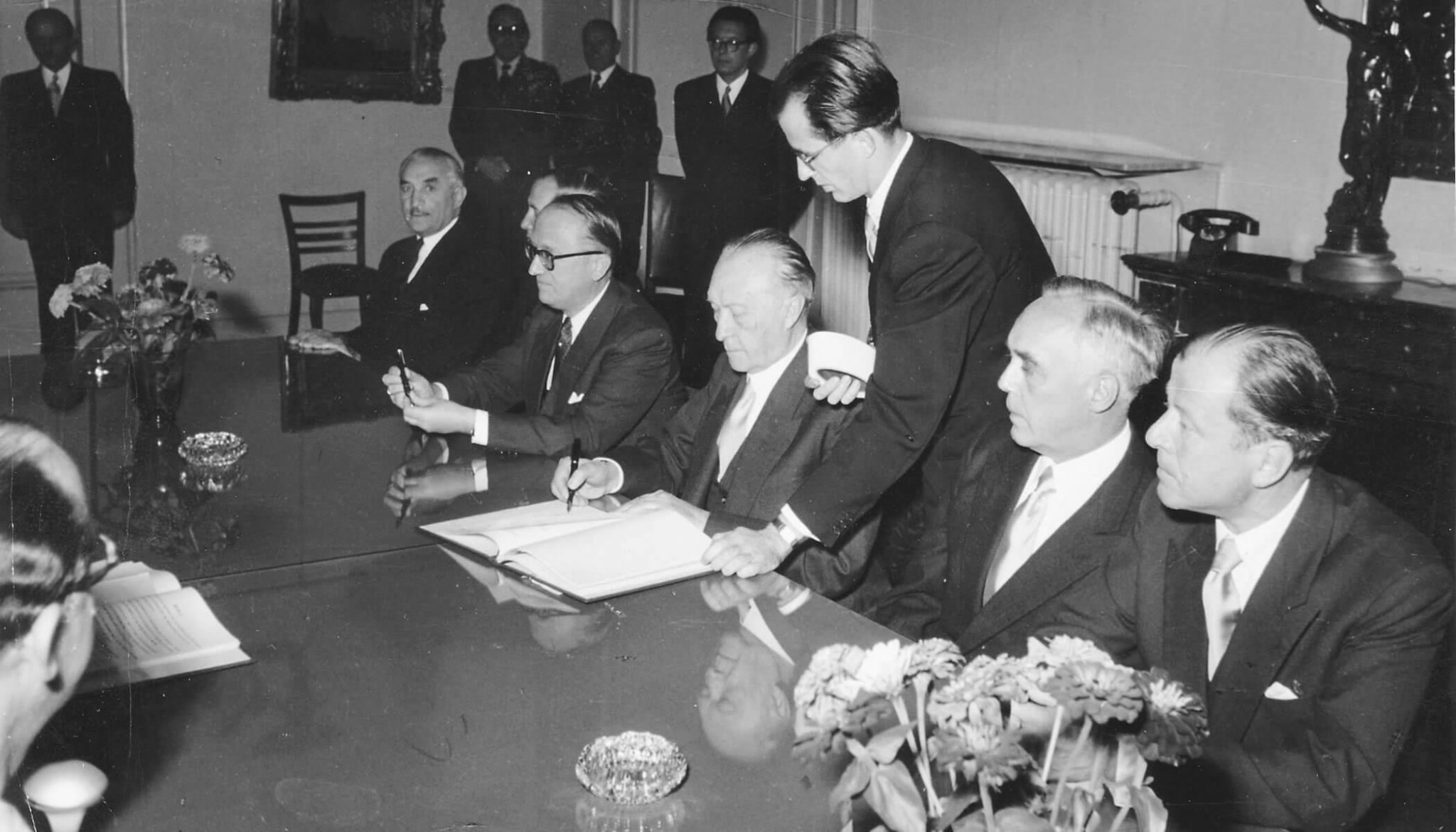
The first was a commitment by West Germany to provide Israel with goods and services worth three billion Deutsche Marks. The payments were intended to help cover the cost of integrating Jewish refugees who had come to Israel as a result of Nazi persecution. They were scheduled to be delivered over twelve years, beginning in 1953.
The second commitment was a payment of 450 million Deutsche Marks to the Claims Conference. This money was intended to support Jewish victims of Nazi persecution living outside Israel, including assistance with resettlement and integration. The parallel protocols also committed West Germany to establishing a legal framework for individual restitution and compensation.[3]
The agreement did not mean that the three billion marks would be deposited directly into Israel's treasury as unrestricted cash. Much of the payment was made through deliveries of goods, industrial equipment and services. Israel could use these resources to expand its productive capacity and reduce pressure on its limited foreign-currency reserves.
The distinction between these arrangements is important. The three billion marks went to the State of Israel, while the 450 million marks went to the Claims Conference. Neither payment replaced the separate legal claims of individual Holocaust survivors. Those claims were addressed through German compensation and restitution legislation, including the Federal Compensation Act of 1956. Eligible victims could receive payments for physical injury, loss of freedom, damage to health, professional and economic losses, and other forms of persecution.[4]
The agreement was ratified by the West German Bundestag on 18 March 1953 and entered into force on 27 March, following the exchange of ratification instruments. Its implementation continued through the 1950s and 1960s.
Begin's Protest and the Political Crisis in Israel, January 1952
The negotiations triggered one of the most intense political confrontations in Israel's early history. For many Israelis, especially Holocaust survivors and families who had lost relatives, accepting money from Germany so soon after the Holocaust appeared morally unacceptable. They feared that the agreement would allow the German state to place a financial value on the destruction of European Jewry and move on without adequate accountability.
Menachem Begin, leader of the Herut opposition, became the most prominent political opponent. He argued that no government had the authority to negotiate with Germany over the crimes committed against the Jewish people. His opposition reflected a wider public belief that reparations could not erase the responsibility of the perpetrators.
On 7 January 1952, Begin addressed a large demonstration in Jerusalem against the proposed negotiations. Protesters gathered outside the Knesset, where the government was debating whether to proceed. The demonstration escalated into violence, with stones thrown at the parliament building and clashes between protesters and police. Windows were broken, and security forces struggled to control the crowd. The unrest became known as the Knesset riot.
The confrontation also exposed divisions within Israeli politics. Begin's Herut party opposed negotiations outright, while Prime Minister David Ben-Gurion and his Mapai-led government argued that accepting reparations was a practical necessity and a matter of securing restitution for the Jewish people. The government maintained that refusing compensation would leave Germany with the material benefits of Nazi persecution.
On 10 January, after a ten-hour debate, the Knesset voted 61 to 50, with five abstentions, to authorise the government to proceed with negotiations. Begin's position had mobilised significant opposition, but the government secured parliamentary approval.[5]
The agreement remained controversial even after its signing. Its supporters regarded it as a means of recovering some of the material losses inflicted on the Jewish people and strengthening Israel. Its opponents believed that the moral cost of negotiating with Germany was too high. The debate reflected the difficulty of reconciling historical memory with the practical needs of a state still in its first years of existence.
Goods Delivered and Israel's Economic Development
The reparations were largely delivered through goods and services rather than direct cash transfers. This enabled Israel to obtain equipment and materials that would otherwise have required scarce foreign currency.
The deliveries included ships, industrial machinery, metals, raw materials, agricultural products and transport equipment. They supported the expansion of Israel's ports, shipping capacity, manufacturing industries and infrastructure. Railway-related equipment, including signalling equipment and components, also formed part of the broader supply programme.[6]
The deliveries included:
-
Ships and maritime equipment: Israel acquired vessels that strengthened its merchant fleet and expanded its capacity to transport goods.
-
Industrial machinery: Equipment supported factories and the development of manufacturing industries, including textiles and food processing.
-
Railway and transport equipment: Supplies included railway signalling equipment and components for transport infrastructure.
-
Agricultural and irrigation equipment: Machinery and pumps helped expand irrigation and agricultural production.
-
Metals and raw materials: Supplies supported construction, manufacturing and industrial expansion.
The scale of the programme was substantial. A West German report published in 1966 recorded the completion of payments under the agreement. It stated that the three billion marks committed to Israel had been delivered in goods and services, including 60 ships, machinery and other capital equipment. A portion of the payments was also channelled through Britain to finance oil shipments to Israel.[7]
The deliveries helped Israel expand its productive capacity at a time when private investment and foreign currency were limited. They did not single-handedly create the Israeli economy, which also relied on domestic development, immigration, foreign aid, diaspora contributions and investment. However, the agreement provided important resources during a critical period of state-building.
Individual Compensation for Holocaust Survivors
The Luxembourg Agreement was only one part of the wider German restitution process. Individual survivors were entitled to pursue compensation under separate German legislation, depending on their circumstances and eligibility.
The first Hague Protocol committed West Germany to developing legislation for individual compensation. The Federal Compensation Act of 1956 established a broader framework for claims by victims of Nazi persecution. It covered categories including physical injury, damage to health, imprisonment, loss of professional opportunities and economic harm.
These payments were distinct from the three billion marks transferred to Israel and the 450 million marks allocated to the Claims Conference. They were paid to eligible individuals rather than to the Israeli state.
The Claims Conference continued to negotiate with Germany for expanded compensation programmes, including payments for survivors who had not been adequately covered by earlier laws. Over the following decades, these negotiations produced additional agreements and assistance programmes, including pensions, home-care support and emergency aid for survivors.[8]
The distinction matters because the reparations agreement did not settle every claim arising from the Holocaust. It established an important framework, but restitution and compensation remained an ongoing process.
From Reparations to Diplomatic Relations, 1953–1965
The Luxembourg Agreement did not immediately establish full diplomatic relations between Israel and West Germany. The two governments maintained a limited official relationship, partly to administer the reparations programme. In July 1953, Israel opened a mission in Cologne to manage the deliveries and related matters.
Gradual contacts developed over the following years. In March 1960, Ben-Gurion and Adenauer held the first meeting between an Israeli Prime Minister and a West German Chancellor in New York. The meeting marked an important step in political rapprochement, although the two countries still lacked formal diplomatic relations.
West Germany was initially concerned that establishing full relations with Israel would damage its ties with Arab states. The issue was complicated by the broader Cold War and the question of the recognition of East Germany. Meanwhile, military and security cooperation developed quietly during the 1950s and early 1960s.
In 1965, the two governments moved towards formal diplomatic relations. On 12 May, West German Chancellor Ludwig Erhard and Israeli Prime Minister Levi Eshkol agreed to establish full diplomatic ties. The decision marked the formal beginning of a relationship that had developed through reparations, official contacts and growing cooperation.[9]
The Luxembourg Agreement had therefore served not only as a financial arrangement but also as an early institutional foundation for the gradual normalisation of relations between the two states.
Germany–Israel Relations Today: Strategic Cooperation and Submarine Deals
Germany and Israel have developed extensive relations in trade, science, technology, education, diplomacy and defence. Germany identifies its responsibility for the Holocaust as a central foundation of its relationship with Israel and describes the partnership as a distinctive element of its foreign policy.
Germany is one of Israel's most important European economic partners. The relationship includes industrial trade, scientific research, academic exchanges and cooperation in technology. The two countries also maintain close security ties, including defence procurement and military-industrial cooperation.[10]
Submarine procurement has become one of the most visible examples of this defence relationship. German shipbuilder Thyssenkrupp Marine Systems (TKMS) has supplied submarines to the Israeli Navy since the 1990s. The Dolphin-class vessels were developed and built in Germany, with German government financial support for parts of the procurement.
In January 2022, Israel and TKMS agreed on the development and production of three new Dakar-class submarines. The agreement was valued at approximately €3 billion. The German government was expected to contribute towards part of the cost under a separate bilateral arrangement. The new submarines are intended to replace older vessels in Israel's fleet.[11]
The submarine programme continued alongside the delivery of the final Dolphin-class submarine, INS Drakon. In September 2026, the vessel departed the TKMS shipyard in Kiel for Israel, completing the delivery of the three Dolphin-class submarines equipped with air-independent propulsion. Construction of the three Dakar-class submarines is also under way.[12]
These projects demonstrate the long-term development of German-Israeli defence cooperation. They also show how the relationship has evolved from the reparations and reconstruction arrangements of the 1950s into a broader strategic partnership. The two countries continue to have policy differences on regional and international questions, but cooperation in security, technology and economic affairs remains an important part of their relationship.
Sources
- German Federal Foreign Office. “Reparations Agreement.” Negotiating Matters: Germany and Israel. https://www.auswaertiges-amt.de/resource/blob/2487488/5674ee7f43587e87aad3c315bb67db76/211006-negmatters-data.pdf.
- German Federal Archives. “Das Luxemburger Abkommen.” Bundesarchiv. https://www.bundesarchiv.de/themen-entdecken/online-entdecken/geschichtsgalerien/das-luxemburger-abkommen/; German History in Documents and Images. “Communiqué Regarding Restitution for Israel and the Jews (September 10, 1952).” https://germanhistorydocs.org/en/occupation-and-the-emergence-of-two-states-1945-1961/communique-regarding-restitution-for-israel-and-the-jews-september-10-1952.
- United Nations Treaty Collection. “Agreement between the State of Israel and the Federal Republic of Germany.” Signed at Luxembourg, 10 September 1952; registered 27 March 1953. https://treaties.un.org/Pages/showDetails.aspx?clang=_en&objid=080000028014fe9f; German Federal Ministry of Finance. “Questions and Answers on the Luxembourg Agreement.” https://www.bundesfinanzministerium.de/Content/DE/FAQ/luxemburger-abkommen.html.
- German Federal Ministry of Finance. Wiedergutmachung: Provisions Relating to Compensation for National Socialist Injustice. https://www.bundesfinanzministerium.de/Content/EN/Standardartikel/Press_Room/Publications/Brochures/2018-08-15-entschaedigung-ns-unrecht-engl.pdf.
- Jewish Telegraphic Agency. “Knesset Votes Authorization for Israel Negotiations with Germany.” 10 January 1952. https://www.jta.org/archive/knesset-votes-authorization-for-israel-negotiations-with-germany; Knesset. “Menachem Begin.” https://main.knesset.gov.il/en/about/pages/begin.aspx.
- Jewish Telegraphic Agency. “Germany Agrees to Give Israel Flexibility on Reparations Orders.” 27 July 1955. https://www.jta.org/archive/germany-agrees-to-give-israel-flexibility-on-reparations-orders; United States Congress. Congressional Record, 6 September 1963. https://www.govinfo.gov/content/pkg/GPO-CRECB-1963-pt12/pdf/GPO-CRECB-1963-pt12-11-1.pdf.
- Jewish Telegraphic Agency. “Germany Makes Final Report on Israel Reparations of $861,250,000.” 30 March 1966. https://www.jta.org/archive/germany-makes-final-report-on-israel-reparations-of-861250000.
- Claims Conference. “History.” Conference on Jewish Material Claims Against Germany. https://www.claimscon.org/about/history/; United States Department of State. “Germany.” JUST Act Report to Congress. https://2021-2025.state.gov/reports/just-act-report-to-congress/germany/.
- German Federal Foreign Office. “The Friendship That Is a Gift: 60 Years of Diplomatic Relations between Israel and the Federal Republic of Germany.” 11 April 2025. https://www.auswaertiges-amt.de/en/aussenpolitik/laenderinformationen/israel-node/2707760-2707760; German Federal Foreign Office. “Establishment of Diplomatic Relations with Israel.” https://www.auswaertiges-amt.de/en/service/laender/israel-node/2279290-2279290.
- German Federal Foreign Office. “Germany and Israel: Bilateral Relations.” 18 March 2026. https://www.auswaertiges-amt.de/en/aussenpolitik/laenderinformationen/israel-node/israel-228212.
- thyssenkrupp Marine Systems. “Israel Orders Three New Submarines from thyssenkrupp Marine Systems.” 20 January 2022. https://ucpcdn.thyssenkrupp.com/_binary/UCPthyssenkruppMarineSystems/b078b987-59e2-4b2b-a81a-3b769ac70e2c/Press-release-Israel.pdf.
- Israel Ministry of Defence. “Years of Joint Work Become an Operational Reality: INS Drakon En Route from Germany to Israel.” 1 September 2026. https://www.mod.gov.il/en/press-releases/press-room/years-of-joint-work-become-an-operational-reality-ins-drakon-en-route-from-germany-to-israel.