
The First and Second Intifadas
Quick answer · ~120 words
The First Intifada was a Palestinian uprising against Israeli military rule in the West Bank and Gaza Strip. It began on 9 December 1987 and is usually counted as ending with the Israel-PLO Declaration of Principles, signed on 13 September 1993. Its main methods were strikes, boycotts, tax refusal and stone-throwing. The Israeli rights group B'Tselem counts 1,087 Palestinians killed by Israeli security forces and 160 Israelis killed by Palestinians in that period. The Second Intifada began on 28 and 29 September 2000, two months after the Camp David summit failed. It was an armed conflict marked by suicide bombings and Israeli military operations. B'Tselem counts 3,793 Palestinians killed by Israeli security forces and 1,011 Israelis killed by Palestinians up to September 2006. The first uprising led to the Oslo process. The second ended it and was followed by the West Bank barrier and Israel's 2005 withdrawal from Gaza.
Causes of the First Intifada, June 1967 to December 1987
Israel captured the West Bank, East Jerusalem and the Gaza Strip in the war of June 1967. By late 1987 the Palestinians of these areas had lived for twenty years under Israeli military government. They were not citizens of Israel and could not vote in its elections. Military orders governed land use, building permits, trade, travel, schooling and political activity. Israel built civilian settlements in the territories, and many Palestinian men commuted each day to jobs inside Israel and returned home at night. Several changes in the 1980s raised the pressure. A generation born after 1967 had grown up knowing only occupation. The Palestine Liberation Organization (PLO), which most Palestinians regarded as their representative, had been forced out of Beirut in 1982 and was based in Tunis, far from the territories. Inside the territories, activists had built student councils, trade unions, women's committees, medical relief groups and charities. These networks could organise people at street level without waiting for direction from abroad. Palestinians also saw little prospect of change through diplomacy. Israel refused to negotiate with the PLO, and Arab governments were occupied with other conflicts. The uprising was set off by a road collision in the northern Gaza Strip, in which an Israeli truck struck vehicles carrying Palestinian workers and killed four of them. The funerals turned into protests. On 9 December 1987 demonstrations broke out in the Jabalia refugee camp and spread within days across Gaza and the West Bank [1]. Palestinians called the movement the intifada, an Arabic word meaning a shaking off. What began as a local reaction to a single event became an organised campaign that lasted for years, because the networks built in the previous decade were ready to sustain it.
Forms of the First Intifada and the Israeli Response, December 1987 to 1991
Within weeks, a clandestine body called the Unified National Leadership of the Uprising, made up of the main PLO factions inside the territories, began issuing numbered leaflets. The leaflets set strike days, told shopkeepers when to open and close, called for a boycott of Israeli goods, and asked Palestinians employed by the Israeli civil administration, including tax officials and police, to resign. Neighbourhood committees organised food distribution, home schooling when schools were shut, and night watches. In the town of Beit Sahour, residents refused to pay taxes to the military government. In the streets, the common act of confrontation was throwing stones at soldiers and Israeli vehicles, with some use of petrol bombs. Palestinians rarely used firearms in the first years. An Islamist movement, Hamas, grew out of the Muslim Brotherhood in Gaza in the first weeks of the uprising and issued its own leaflets outside the Unified Leadership. Israel treated the uprising as a security threat. The army imposed long curfews, closed schools and universities, carried out mass arrests and held many people in administrative detention without trial. It demolished or sealed the homes of suspects and expelled activists from the territories. B'Tselem, an Israeli human rights organisation, records that from the start of the uprising to the end of 1992, Israel deported 481 Palestinians [2]. On 22 December 1987 the UN Security Council adopted Resolution 605. It strongly deplored Israeli practices that violated the human rights of Palestinians, in particular the army's opening of fire that killed and wounded Palestinian civilians [3]. It also reaffirmed that the Fourth Geneva Convention applies to the territories Israel has occupied since 1967, including Jerusalem [3].
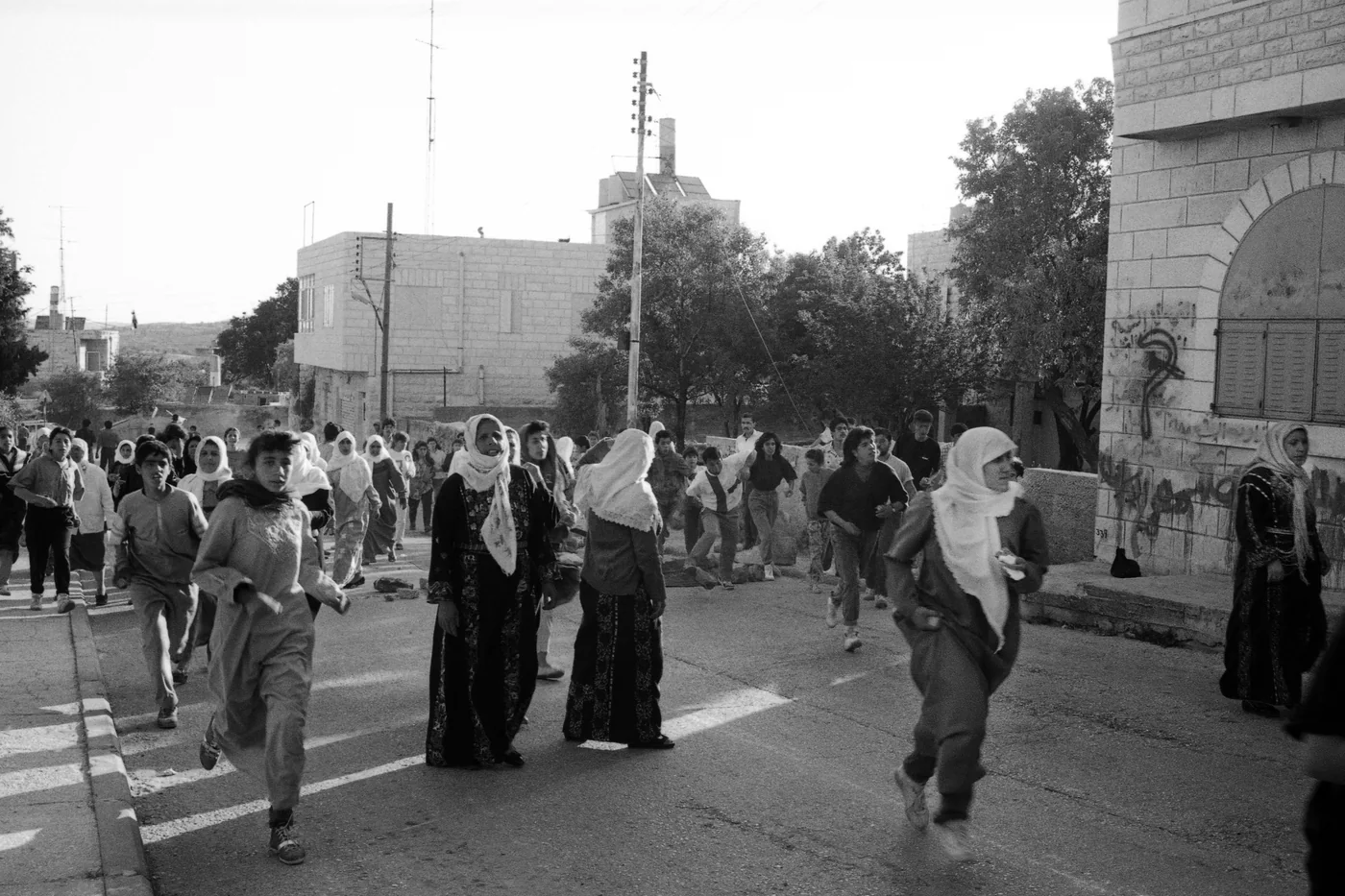
A Demonstration in the Streets of Ramallah, taken during the First Intifada, this photograph captures a demonstration roaming the streets of Ramallah.
The main casualty series for this period comes from B'Tselem, which covers 9 December 1987 to 13 September 1993. It records 1,087 Palestinians killed by Israeli security forces, of whom 240 were minors under the age of 17 [1]. In the same period, Palestinians killed 100 Israeli civilians and 60 members of the Israeli security forces [1]. The unit is individual deaths, divided by who did the killing and by where the death took place. Palestinians also killed other Palestinians accused of collaborating with Israel. Those deaths are recorded separately and are not included in the figures above.
Political Consequences of the First Intifada, November 1988 to September 1993
The uprising moved the centre of Palestinian politics from the exiled PLO leadership to the territories, and it pushed the PLO toward a negotiated settlement. The Palestine National Council, the PLO's parliament in exile, met in Algiers from 12 to 15 November 1988 in a session named after the intifada [4]. On 15 November it adopted a Declaration of Independence proclaiming a State of Palestine [4]. Its political communiqué called for an international peace conference on the basis of Security Council Resolutions 242 and 338 [4]. Those resolutions call for Israeli withdrawal from territories occupied in 1967 and for the right of every state in the region to live in peace within secure borders. Accepting them as the basis for talks meant accepting, in practice, a Palestinian state beside Israel. The United States and the Soviet Union convened a Middle East peace conference in Madrid in October 1991 [5]. Palestinians from the territories took part as members of a joint Jordanian-Palestinian delegation, since Israel would not sit with the PLO directly [5]. The formal talks that followed in Washington made little progress. Secret talks in Norway between Israeli officials and the PLO then produced the Declaration of Principles on Interim Self-Government Arrangements, signed in Washington on 13 September 1993 [5]. The Declaration set up a Palestinian Interim Self-Government Authority for the West Bank and Gaza for a transitional period of no more than five years, leading to a permanent settlement based on Resolutions 242 and 338 [5]. Permanent status talks were to begin no later than the start of the third year of that period and were to cover Jerusalem, refugees, settlements, security arrangements and borders [5]. The Declaration therefore left the central issues of the conflict open for later negotiation. B'Tselem's casualty tables use the date of its signing as the end of the First Intifada [1].
The Oslo Years and the Outbreak of the Second Intifada, September 1993 to October 2000
During the Oslo years, the new Palestinian Authority took over civil affairs and policing in the main Palestinian towns, but Israel kept control of most land, the borders and movement between areas. By mid-2000 the West Bank was divided into Area A under full Palestinian control (about 17 %), Area B with Palestinian civil control and Israeli security control (24 %), and Area C under full Israeli control (59 %) [6]. The political scientist Jeremy Pressman reports that from 1993 to 2000 the number of Israeli settlers grew by at least 117 % in Gaza and at least 46 % in the West Bank, not counting East Jerusalem [6]. Palestinian groups opposed to Oslo, mainly Hamas and Islamic Jihad, carried out suicide bombings inside Israel in the mid-1990s, and Israel responded with closures that cut Palestinian workers off from jobs in Israel. The permanent agreement due under the Oslo timetable was never reached. In July 2000 the Camp David summit between Israeli Prime Minister Ehud Barak and Palestinian leader Yasser Arafat ended without agreement [6]. On 28 September 2000, Ariel Sharon, then leader of the Israeli opposition, visited the Temple Mount, known to Muslims as al-Haram al-Sharif, accompanied by more than 1,000 Israeli police officers [6]. Protests the next day at the site were met with police gunfire, and unrest spread across the West Bank, Gaza and Arab towns inside Israel. Pressman records that Israeli forces killed 50 Palestinians and wounded more than 1,000 in the first five days [6]. The causes remain disputed. The Israeli government argued that Arafat had planned the violence after rejecting the terms offered at Camp David. Many Palestinians argued that Sharon's visit was a deliberate provocation. An international fact-finding committee chaired by former US Senator George Mitchell reported on 30 April 2001 [7]. It found no persuasive evidence that the Palestinian Authority had planned the uprising, and none that Sharon's visit was anything other than an internal political act [7]. It concluded that the visit "did not cause" the uprising but was poorly timed, and that the police decision on 29 September to use lethal means, and both sides' later failure to show restraint, were more significant [7]. Pressman points to deeper causes. Palestinians had expected Oslo to bring freedom of movement, better living conditions and a state; instead the occupation deepened. Both the Israeli army and Palestinian factions had prepared for confrontation, and each believed force would strengthen its bargaining position [6]. He also records that in the first nine months of 2000, one Israeli died from Palestinian attacks [6].
Forms and Casualties of the Second Intifada, September 2000 to 2005
The Second Intifada moved quickly from street protest to armed conflict. Palestinian groups, including Fatah's Tanzim and the al-Aqsa Martyrs' Brigades as well as Hamas and Islamic Jihad, carried out shootings on roads and settlements and suicide bombings in Israeli cities. The Meir Amit Intelligence and Terrorism Information Center, an Israeli research body, counts 525 Israelis killed in suicide bombings between September 2000 and 31 December 2005, about half of the 1,084 Israelis it counts as killed in all attacks in that period [8]. Israel used tanks, helicopters and aircraft, set up checkpoints and closures across the territories, carried out targeted killings of militants, and from March 2002 reoccupied Palestinian cities in Operation Defensive Shield [9]. The uprising has no agreed end date, and the bodies that count its dead use different periods and categories. Their figures are given separately below and are not averaged. B'Tselem records that from 29 September 2000 to 27 September 2006, Israeli security forces killed 3,733 Palestinians in the occupied territories, including 767 minors, and that at least 1,812 of them were not taking part in hostilities when killed [10]. Israeli security forces killed a further 60 Palestinians inside Israel, and Israeli civilians killed 41 Palestinians in the territories [10]. In the same period, Palestinians killed 697 Israeli civilians, including 119 minors, and 314 members of the Israeli security forces [10]. The Palestinian Central Bureau of Statistics publishes annual totals of Palestinians killed, compiled with the Palestinian Ministry of Health, the UN Office for the Coordination of Humanitarian Affairs and other bodies. Its figures are 333 for 29 September to 31 December 2000, 605 for 2001, 1,192 for 2002, 687 for 2003, 895 for 2004 and 261 for 2005 [11]. These add up to 3,973 Palestinians killed from 29 September 2000 to 31 December 2005. The bureau states that the data reflect documented cases only and may change with further research [11]. Its table does not divide deaths by who caused them. For Israeli deaths, the Meir Amit Center counts 1,084 Israelis killed from September 2000 to 31 December 2005 [8]. B'Tselem's count of 1,011 Israelis runs to September 2006 but separates civilians from security forces [10]. The World Bank, using data available in early 2003, recorded 1,972 Palestinian and 694 Israeli deaths in the first 27 months of the uprising [12]. In the Palestinian bureau's series, 2002 was the year with the most Palestinian deaths [11].
Consequences of the Second Intifada, March 2002 to September 2005
The heaviest fighting came in early 2002. The UN Secretary-General reported that from 1 March to 7 May 2002, 497 Palestinians were killed and 1,447 wounded during Israel's reoccupation of Palestinian areas and its immediate aftermath [9]. The report cites the Israeli Ministry of Foreign Affairs as stating that 30 Israeli soldiers died in Operation Defensive Shield, and records about 16 bombings in Israel in the same weeks that killed more than 100 people [9]. In the Jenin refugee camp, at least 52 Palestinians, of whom up to half may have been civilians, and 23 Israeli soldiers were dead by the time the army withdrew on 18 April [9]. A senior Palestinian Authority official had alleged about 500 deaths in Jenin; the report found that this figure had not been substantiated [9]. During the uprising Israel began building a barrier of fences, walls and patrol roads, much of it inside the West Bank rather than along the 1949 armistice line. On 9 July 2004 the International Court of Justice advised, by fourteen votes to one, that construction of the wall in the Occupied Palestinian Territory, including in and around East Jerusalem, and its associated regime are contrary to international law [13]. Israel rejected the opinion and argued that the barrier saved lives. The US State Department's human rights report for 2004 records the Israeli government's statement that the number of Israelis killed in attacks fell by 45 % that year because of the barrier and the interception of attackers [14]. The same report counts 13 suicide attacks in 2004 causing 55 deaths, against 26 suicide attacks in 2003 causing 144 deaths [14]. The economic losses were large on both sides. The World Bank found that real Palestinian gross national income per person in 2002 was about 46 % lower than in 1999, that unemployment peaked at 36 % in the third quarter of 2002, and that about 60 % of the population lived in poverty [12]. The same report cites a Bank of Israel estimate that the uprising cost Israel between 3.0 and 3.8 % of its gross domestic product in 2002 [12]. The Bank of Israel reported that the number of incoming tourists fell by 50 % in 2001 and by a further 30 % in 2002 [15]. Politically, the uprising ended the Oslo method of phased interim agreements. Ariel Sharon, who became prime minister during the uprising, turned to unilateral steps. Israel evacuated all 21 of its settlements in the Gaza Strip starting at midnight on 14 August 2005, removed four small settlements in the northern West Bank, and completed the withdrawal of its army from Gaza on 12 September 2005 [16]. Palestinian deaths in the bureau's series fell to 261 in 2005, though they rose again in 2006 [11]. No agreement marked the end of the Second Intifada.
In One Paragraph
The First Intifada, from 9 December 1987 to the Oslo Declaration of Principles of 13 September 1993, was a mostly unarmed mass uprising against twenty years of Israeli military rule, using strikes, boycotts, tax refusal and stones. B'Tselem counts 1,087 Palestinians killed by Israeli security forces and 160 Israelis killed by Palestinians. It moved the PLO toward accepting a state beside Israel and led to the Oslo process. The Second Intifada began on 28 and 29 September 2000, after Oslo failed to produce a final agreement and the Camp David summit collapsed. It was an armed conflict of suicide bombings and military reoccupation. B'Tselem counts 3,793 Palestinians killed by Israeli security forces and 1,011 Israelis killed by Palestinians up to September 2006; the Palestinian Central Bureau of Statistics counts 3,973 Palestinian deaths to the end of 2005, and an Israeli research centre counts 1,084 Israeli deaths to the same date. The uprising ended the Oslo framework and was followed by the West Bank barrier and Israel's withdrawal from Gaza in 2005.
Sources
- B'Tselem. "Fatalities in the First Intifada." Statistical tables, December 9, 1987–September 13, 1993. Jerusalem: B'Tselem.https://www.btselem.org/statistics/first_intifada_tables
- B'Tselem. 1987-1997: Ten Years since the Intifada Began. Jerusalem: B'Tselem, January 1998. Section on deportations, page 19.https://www.btselem.org/sites/default/files/publications/199801_decade_of_violations_eng.pdf
- United Nations Security Council. Resolution 605 (1987), S/RES/605, adopted December 22, 1987, paras. 1–2. United Nations Information System on the Question of Palestine.https://www.un.org/unispal/document/auto-insert-176927
- Palestine National Council. "Political Communiqué" and "Declaration of Independence," November 15, 1988. Annexes II and III to UN Doc. A/43/827 and S/20278, November 18, 1988.https://unispal.un.org/pdfs/6EB54A389E2DA6C6852560DE0070E392.pdf
- Government of the State of Israel and the Palestine Liberation Organization. Declaration of Principles on Interim Self-Government Arrangements, September 13, 1993, preamble and Articles I and V; with covering letter of the Russian Federation and the United States, page 1. Annex to UN Doc. A/48/486 and S/26560, October 11, 1993.https://digitallibrary.un.org/record/174951/files/A_48_486%26S_26560-EN.pdf
- Pressman, Jeremy. "The Second Intifada: Background and Causes of the Israeli-Palestinian Conflict." Journal of Conflict Studies 23, no. 2 (Fall 2003): 114–41. Sections "Sharon," "Occupation" and "The Israeli and Palestinian Responses to the First Signs of Protest."https://journals.lib.unb.ca/index.php/JCS/article/download/220/378?inline=1
- Sharm el-Sheikh Fact-Finding Committee. Report of the Sharm el-Sheikh Fact-Finding Committee. April 30, 2001. Section "Why Did It Happen?" U.S. Department of State archive.https://2001-2009.state.gov/p/nea/rls/rpt/3060.htm
- Meir Amit Intelligence and Terrorism Information Center. Suicide Bombing Terrorism during the Current Israeli-Palestinian Confrontation (September 2000 to December 2005). Gelilot: ITIC, 2006. Overview.https://www.terrorism-info.org.il/Data/pdf/PDF_19279_2.pdf
- United Nations Secretary-General. Report of the Secretary-General Prepared Pursuant to General Assembly Resolution ES-10/10. UN Doc. A/ES-10/186, July 30, 2002. Sections on death toll and Jenin, paras. 55–57.https://reliefweb.int/report/israel/report-secretary-general-prepared-pursuant-ga-resolution-es-1010-report-jenin-aes
- B'Tselem. "Six Years of Intifada." Press release, September 28, 2006.https://www.btselem.org/press_releases/20060928
- Palestinian Central Bureau of Statistics. "Killed Palestinians (Martyrs) in Al-Aqsa Uprising (Intifada), by Year 2000-2022." Ramallah: PCBS.https://www.pcbs.gov.ps/Portals/_Rainbow/Documents/Mart_Tot%20E.htm
- World Bank. Twenty-Seven Months: Intifada, Closures and Palestinian Economic Crisis; An Assessment. Jerusalem: World Bank West Bank and Gaza Office, May 2003. Preface and Summary.https://documents1.worldbank.org/curated/en/616581468765333893/pdf/263141270months0Intifada10Closures.pdf
- International Court of Justice. Legal Consequences of the Construction of a Wall in the Occupied Palestinian Territory. Advisory Opinion, July 9, 2004, paras. 84 and 163(3)(A). UN Doc. A/ES-10/273.https://www.un.org/unispal/document/auto-insert-178825/
- U.S. Department of State, Bureau of Democracy, Human Rights, and Labor. "Israel and the Occupied Territories." Country Reports on Human Rights Practices 2004. February 28, 2005. Section 1(a).https://www.un.org/unispal/document/auto-insert-200003
- Bank of Israel. Annual Report 2002. Chapter 1, "Output and the Principal Industries." Jerusalem: Bank of Israel, 2003. Page 15.https://boi.org.il/boi_files/OldBankIsraelAnnualReport/Bank%20of%20Israel%20Annual%20Report%20-%202002/1/Output%20and%20the%20Principal%20Industries/pe1_2_1.pdf
- United Nations Relief and Works Agency. "Emergency Appeal 2005: Twenty-eighth Progress Report, July-September 2005." Background section.https://www.un.org/unispal/document/auto-insert-209676/