
The Eichmann Trial, 1961
Quick answer · ~120 words
The 1961 trial of Adolf Eichmann in Jerusalem brought a senior organiser of the Holocaust before an Israeli court. Eichmann had coordinated the deportation of more than 1.5 million Jews to ghettos and killing centres across Nazi-occupied Europe. Israeli agents captured him in Argentina in May 1960 and brought him to Israel, prompting a diplomatic dispute with the Argentine government at the United Nations. His trial opened on 11 April 1961 before a three-judge panel, with Attorney General Gideon Hausner leading the prosecution. More than a hundred survivors testified, making their experiences central to the proceedings. Eichmann was convicted and sentenced to death in December 1961, and hanged on 1 June 1962. The trial transformed public engagement with Holocaust memory in Israel and attracted worldwide attention.
Eichmann and the Organisation of the Holocaust
Adolf Eichmann (1906–1962) was an SS officer who played a central role in organising the deportation of European Jews under Nazi rule. He headed Section IV B 4 of the Reich Security Main Office (RSHA), the department responsible for Jewish affairs and deportation. His work involved coordinating with German ministries, occupation authorities, railway officials and other Nazi agencies to identify, concentrate and transport Jews.
Eichmann's activities began with forced Jewish emigration from Austria and Czechoslovakia after Germany's expansion in 1938. As Nazi policy shifted from forced emigration to mass murder, his department became a key part of the machinery carrying out the so-called "Final Solution". He attended the Wannsee Conference on 20 January 1942 and prepared briefing materials for Reinhard Heydrich. The conference coordinated the participation of government and Nazi Party institutions in the systematic persecution and murder of Europe's Jews.[1]
Eichmann's responsibility extended across occupied Europe. His office organised deportations from countries including France, Belgium, the Netherlands, Greece and Slovakia. In Hungary, after the German occupation in March 1944, Eichmann personally directed the deportation operation alongside Hungarian authorities. From late April to early July 1944, approximately 440,000 Hungarian Jews were deported, most of them to Auschwitz.[2]
After Germany's defeat in 1945, Eichmann escaped from American custody and eventually reached Argentina, where he lived under the assumed name Ricardo Klement. He remained there for years, avoiding prosecution for his role in the Holocaust.
The Mossad Operation in Argentina, 1960
The search for Eichmann intensified after information about his whereabouts reached Israeli officials. German prosecutor Fritz Bauer provided information that helped identify him in Argentina. Nazi hunter Simon Wiesenthal and others also contributed to the effort to establish his identity.
Prime Minister David Ben-Gurion authorised a covert operation to capture Eichmann. The mission was led by Mossad director Isser Harel and involved a team that included Rafi Eitan, Peter Malkin and Zvi Aharoni. On 11 May 1960, Israeli agents seized Eichmann near his home on Garibaldi Street in the Buenos Aires suburb of San Fernando. After holding him in a safe house and confirming his identity, they secretly transported him to Israel aboard an El Al aircraft on 21 May.[3]
On 23 May, Ben-Gurion announced Eichmann's capture to the Knesset. The announcement made international headlines. For Israel, bringing a principal organiser of the Holocaust to trial was both a matter of justice and a demonstration that Nazi perpetrators could not assume permanent immunity by fleeing abroad.
The operation nevertheless raised a serious legal and diplomatic question: Israeli agents had captured a man on Argentine territory without the Argentine government's consent. Argentina protested the violation of its sovereignty. The dispute became an issue before the United Nations Security Council.
Argentina's Complaint at the United Nations, 1960
On 15 June 1960, Argentina formally asked the Security Council to consider what it described as the unlawful and clandestine transfer of Eichmann from Argentine territory to Israel. Argentina argued that the operation violated its sovereign rights and the principles of international law and the UN Charter.[4]
The Security Council adopted Resolution 138 on 23 June 1960, by eight votes to none, with two abstentions. The resolution recognised that the Israeli operation had infringed Argentina's sovereign rights and stated that an incident of this kind, if repeated, could endanger international peace and security. It called on Israel to make appropriate reparation. The resolution did not require Eichmann's return to Argentina or prevent his trial in Israel.[5]
Israel expressed regret over the violation of Argentine sovereignty while maintaining the historical and moral significance of bringing Eichmann to justice. The two countries subsequently worked to resolve the dispute and restore normal diplomatic relations.
The episode exposed a tension between two principles: the sovereignty of states and the pursuit of individuals responsible for grave international crimes. The Security Council's response addressed the violation of Argentina's rights without determining that Eichmann should escape prosecution.
The Trial in Jerusalem, 1961
The trial opened on 11 April 1961 at Beit Ha'am, a public auditorium in Jerusalem converted into a courtroom. It was conducted before a three-judge panel of the Jerusalem District Court: Moshe Landau, who presided, Benjamin Halevi and Yitzhak Raveh.
Attorney General Gideon Hausner led the prosecution, assisted by lawyers including Gabriel Bach and Yaakov Bar-Or. The defence was led by German lawyer Robert Servatius, assisted by Dieter Wechtenbruch. Israel permitted a foreign lawyer to represent Eichmann after no Israeli lawyer agreed to take the case.[6]
Eichmann faced fifteen counts under Israel's 1950 Nazi and Nazi Collaborators (Punishment) Law. These included crimes against the Jewish people, crimes against humanity and war crimes, as well as membership in criminal organisations. The law provided for the death penalty.
Hausner's opening address presented the trial as an opportunity to establish the historical record of the destruction of European Jewry. He famously declared that he was not standing alone: six million victims stood with him. The prosecution assembled a large documentary record, including official Nazi correspondence and orders, many bearing Eichmann's signature.
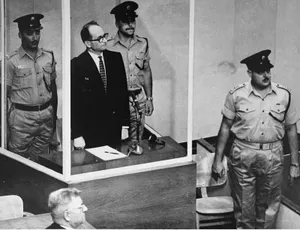
Eichmann sat inside a protective glass booth. His defence argued that he had been a subordinate official who followed orders and did not determine Nazi policy. He described himself as a small cog in a vast state apparatus and disputed personal responsibility for the murders. The prosecution sought to show that he was not simply a passive administrator: he had exercised authority, taken initiative and pursued deportations with determination, including when the Nazi regime was nearing defeat.[7]
The court's judgment rejected the claim that Eichmann's subordinate position removed his personal responsibility. It found him guilty on most of the charges. On 15 December 1961, the judges sentenced him to death. The Supreme Court rejected his appeal on 29 May 1962, and President Yitzhak Ben-Zvi refused his request for clemency.
Survivor Testimony and Israeli Public Memory
One of the trial's most consequential features was the prominence given to Holocaust survivors. Unlike the Nuremberg proceedings, which relied heavily on documentary evidence, the Jerusalem trial placed personal testimony at the centre of public attention. The prosecution prepared a list of 108 survivor witnesses, alongside historians and other experts. More than a hundred survivors ultimately testified.[8]
Their accounts described ghettos, deportations, mass shootings, concentration camps, resistance, family separation and survival. Among the witnesses were figures associated with Jewish resistance, including Zivia Lubetkin, who had participated in the Warsaw Ghetto Uprising. The testimony connected the administrative record of Nazi crimes with the experiences of the people who had endured them.
The trial was broadcast widely on Israeli radio and received extensive international media coverage. Many Israelis listened to the proceedings, including people who had previously known little about the experiences of survivors living around them. Survivors who had found it difficult to speak about their past began to share their experiences more openly.
The change should not be understood as the beginning of Holocaust awareness in Israel. The Holocaust had already been commemorated, discussed in public life and addressed through earlier legal proceedings. Survivors had also spoken about their experiences before 1961. However, the Eichmann trial gave these accounts an unprecedented national and international platform. It helped move survivor testimony from the margins of public discussion towards the centre of Israeli collective memory.[9]
The trial also influenced how younger Israelis encountered the Holocaust. For a generation born in Israel, the destruction of European Jewry could seem distant from their own lives. The testimonies made the events more immediate and personal. Over time, this contributed to the development of Holocaust education, public commemoration and the transmission of survivors' experiences to younger generations. The later growth of school visits to former ghettos and concentration camps in Poland formed part of this wider process.
Hannah Arendt and the "Banality of Evil"
The trial also generated an influential intellectual debate. Hannah Arendt, a German-Jewish political philosopher, attended the proceedings as a reporter for The New Yorker. In 1963, she published Eichmann in Jerusalem: A Report on the Banality of Evil, based on her observations and interpretation of the trial.
Arendt argued that Eichmann did not appear to be a uniquely monstrous or exceptionally intelligent figure. Instead, she presented him as an ordinary bureaucratic functionary whose inability or refusal to think critically about his actions allowed him to participate in extraordinary crimes. Her phrase "the banality of evil" referred to the disturbing possibility that immense evil could be carried out by individuals who relied on routine, obedience and clichés rather than reflecting on the moral consequences of their conduct.[10]
The argument provoked strong criticism. Some readers believed that describing Eichmann's behaviour as banal risked understating his ideological commitment and active role in the persecution and murder of Jews. Arendt's treatment of Jewish councils under Nazi rule, and her criticism of some Jewish leaders' conduct during the Holocaust, also generated anger and controversy. Critics argued that she had made sweeping judgments about people operating under conditions of extreme coercion and incomplete information.
Later historical research has further challenged aspects of Arendt's portrait of Eichmann. Evidence of his conduct, particularly in Hungary in 1944, demonstrates initiative and determination in carrying out deportations. Yad Vashem describes his work as marked by zeal and efficiency in implementing the Nazi programme of extermination.[11]
The debate nevertheless remains significant. Arendt's concept raised questions about individual responsibility within authoritarian systems and the relationship between bureaucracy, obedience and mass violence. It did not alter the court's finding that Eichmann was personally responsible for his crimes.
Execution and the Trial's Long-Term Legacy
After the Supreme Court upheld his conviction and President Ben-Zvi rejected his appeal for clemency, Eichmann was executed by hanging at Ramla prison shortly after midnight on 1 June 1962. His body was cremated and his ashes scattered at sea beyond Israel's territorial waters.[12]
Eichmann's execution remains the only execution carried out by the State of Israel. Although Israeli law retained the death penalty for certain exceptional offences, it was abolished for ordinary murder in 1954. The Eichmann case remained the sole instance in which the state carried out a death sentence.
The trial's significance extended well beyond the punishment of one Nazi official. It established a detailed public record of Eichmann's role, brought survivor testimony before a mass audience and made the Holocaust a more immediate part of Israeli public life. It also strengthened the connection between Holocaust remembrance, the education of younger generations and the responsibility to preserve survivors' accounts.
For Israel, the proceedings demonstrated that the Jewish state would pursue those responsible for the destruction of European Jewry and provide a public forum in which survivors could tell their stories. Internationally, the trial helped bring the Holocaust to a wider audience and contributed to the development of modern Holocaust awareness.
Sources
- United States Holocaust Memorial Museum. “Adolf Eichmann.” Holocaust Encyclopedia. https://encyclopedia.ushmm.org/content/en/article/adolf-eichmann.
- United States Holocaust Memorial Museum. “Adolf Eichmann: Key Dates.” Holocaust Encyclopedia. https://encyclopedia.ushmm.org/content/en/article/adolf-eichmann-key-dates.
- Yad Vashem. “Operation Eichmann: Eichmann Was Captured in Argentina on 11 May 1960.” The Eichmann Trial: With Me Here Are Six Million Accusers. https://wwv.yadvashem.org/yv/en/exhibitions/eichmann/operation-eichmann.asp.
- United Nations Security Council. “Letter Dated 15 June 1960 from the Representative of Argentina Addressed to the President of the Security Council.” UN Doc. S/4336, 15 June 1960. https://digitallibrary.un.org/record/604467/files/S_SUPP_1960_2.pdf.
- United Nations Security Council. “Resolution 138 (1960), Adopted by the Security Council at Its 868th Meeting on 23 June 1960.” UN Doc. S/RES/138, 23 June 1960. https://digitallibrary.un.org/record/112107.
- Yad Vashem. “Eichmann's Trial in Jerusalem.” The Eichmann Trial: With Me Here Are Six Million Accusers. https://wwv.yadvashem.org/yv/en/exhibitions/eichmann/eichmann-trial.asp.
- United States Holocaust Memorial Museum. “Eichmann Trial.” Holocaust Encyclopedia. https://encyclopedia.ushmm.org/content/en/article/eichmann-trial.
- Yad Vashem. “Eichmann's Trial in Jerusalem.” The Eichmann Trial: With Me Here Are Six Million Accusers. https://wwv.yadvashem.org/yv/en/exhibitions/eichmann/eichmann-trial.asp.
- Yad Vashem. “Shaping an Awareness of the Holocaust in Israeli and World Public Opinion.” The Eichmann Trial: With Me Here Are Six Million Accusers. https://wwv.yadvashem.org/yv/en/exhibitions/eichmann/awareness-of-the-holocaust.asp.
- Hannah Arendt. “Eichmann in Jerusalem—I.” The New Yorker, February 9, 1963. https://www.newyorker.com/magazine/1963/02/16/eichmann-in-jerusalem-i; Library of Congress. “Evil: The Crime against Humanity.” Hannah Arendt Papers. https://www.loc.gov/collections/hannah-arendt-papers/articles-and-essays/evil-the-crime-against-humanity/.
- Yad Vashem. “Eichmann, Adolf (1906–1962).” The Yad Vashem Encyclopedia of the Holocaust. https://collections.yadvashem.org/en/about/o213.
- Yad Vashem. “Eichmann's Trial in Jerusalem.” The Eichmann Trial: With Me Here Are Six Million Accusers. https://wwv.yadvashem.org/yv/en/exhibitions/eichmann/eichmann-trial.asp.