
The 1982 Lebanon War
Quick answer · ~120 words
The 1982 Lebanon War, known in Israel as Operation Peace for Galilee, began on 6 June 1982. Israel’s stated initial objective was to move PLO forces about 40 kilometres north of the Israeli border so that their rockets and artillery could no longer reach communities in the Galilee. The immediate trigger was the attempted assassination of Israel’s ambassador to Britain, Shlomo Argov, in London on 3 June. The IDF advanced through southern Lebanon, fought Syrian forces in the Beqaa Valley and eventually reached Beirut, where it besieged PLO positions in the west of the city. A US-brokered agreement led to the evacuation of PLO fighters, completed on 1 September. After President-elect Bashir Gemayel was assassinated, Phalangist militiamen massacred civilians in the Sabra and Shatila camps. Israel’s Kahan Commission found that Israel bore indirect responsibility and that Defence Minister Ariel Sharon should draw personal conclusions. Israel withdrew most of its forces in 1985 but maintained a security zone in southern Lebanon until 24 May 2000.
The PLO in Lebanon and the 1981 Ceasefire, 1970–July 1981
After the PLO was expelled from Jordan in 1970, it transferred much of its armed presence and leadership to Lebanon. The Lebanese Civil War, which began in 1975, weakened the central government and allowed Palestinian armed organisations to establish bases and operate with considerable independence, particularly in the south. In March 1978, following an attack on Israel from Lebanon and Israel’s subsequent military operation, the UN Security Council adopted Resolutions 425 and 426. They called for Israel’s withdrawal and established the United Nations Interim Force in Lebanon (UNIFIL), whose mandate included confirming the withdrawal, restoring international peace and security, and assisting the Lebanese government in restoring its authority in the south. [1]
The PLO maintained an extensive military infrastructure in southern Lebanon. Israeli military accounts describe armed groups operating from the area around Mount Hermon, the Nabatieh region and the coastal plain. The IDF assessed that the PLO’s military presence included artillery, tanks, anti-tank weapons and anti-aircraft systems. Israel regarded this infrastructure as a direct threat to northern communities, particularly those within range of rockets and artillery. [2]
The border situation deteriorated in July 1981. PLO forces fired Katyusha rockets and artillery shells into northern Israel. Israeli aircraft retaliated against PLO positions in Beirut on 17 July, after which the exchange of fire intensified. Residents of northern communities sought shelter, and many temporarily left their homes. Israel raised the issue at the United Nations, while American envoy Philip Habib worked to arrange a ceasefire. [2, 3]
On 24 July 1981, Habib announced that hostile military action between Lebanese and Israeli territory in either direction would cease. Israel accepted the arrangement, Lebanon welcomed it and the PLO stated that it would respect the relevant Security Council resolution. The border subsequently remained comparatively quiet. However, Israel and the PLO differed over the scope of the understanding: Israel considered attacks on Israelis outside the border area relevant to the ceasefire, while the PLO treated it principally as an arrangement covering cross-border military activity. [3]
The Argov Assassination and the Decision to Invade, 3–6 June 1982
On 3 June 1982, gunmen shot Shlomo Argov, Israel’s ambassador to Britain, outside a London hotel. Argov suffered severe brain damage and remained paralysed. The attack was carried out by members of the Abu Nidal organisation, a Palestinian faction that had broken away from the PLO and was based in Baghdad. In March 1983, a British court sentenced three members of the group for their roles in the attempted assassination. [4]
The Israeli government held the PLO responsible for the broader security threat emanating from Lebanon, although the Abu Nidal organisation was independent and hostile to the PLO leadership. Israel viewed the assassination as part of a wider pattern of attacks against Israeli targets and as evidence that the existing security arrangement had failed to eliminate the threat. [2, 4]
On 4 June, Israeli aircraft struck PLO targets in Lebanon, including positions in Beirut. PLO forces responded with heavy shelling of communities in northern Israel. The attacks sent residents into shelters and disrupted daily life across the Galilee. [2]
The Israeli cabinet met on 5 June and approved a military operation. Its stated objective was to move the armed groups in southern Lebanon beyond the range of their weapons against northern Israeli settlements. The government described the intended depth as approximately 40 kilometres. The following day, the Security Council adopted Resolution 509, demanding that Israel withdraw its forces forthwith and unconditionally to Lebanon’s internationally recognised boundaries, and calling on all parties to cease military activity. Israel argued that withdrawal without reliable arrangements to prevent renewed attacks would leave northern communities exposed. [2, 5, 6]
Operation Peace for Galilee and the Advance to Beirut, June 1982
The IDF crossed into Lebanon on 6 June 1982, advancing along three main axes: the coastal route, the central sector around Nabatieh, and the eastern area near the Israeli border and Mount Hermon. Israeli forces captured Beaufort Castle, advanced towards Sidon and crossed the Litani River. The operation rapidly developed into a much larger campaign than the initial 40-kilometre objective. [2]
Syrian forces, already deployed in Lebanon, became directly involved in the fighting on 9 June. The Israeli Air Force attacked Syrian surface-to-air missile batteries in the Beqaa Valley. The IDF reported destroying or disabling the Syrian missile network and shooting down 29 Syrian aircraft during the air battles. Contemporary reporting also recorded Israel’s claim that it had destroyed the missile batteries and downed 29 Syrian aircraft without losing an aircraft in the engagement. [2, 7]
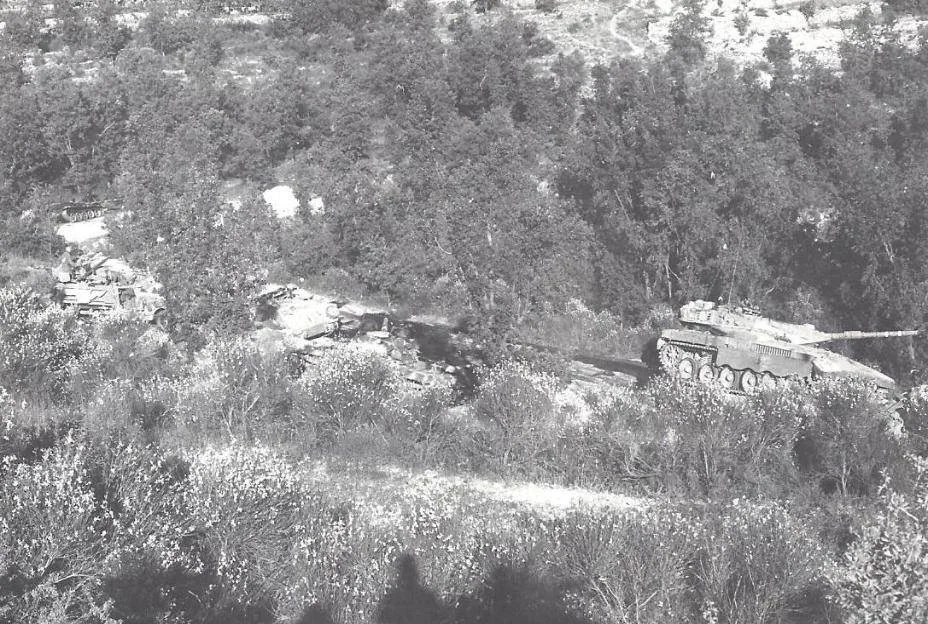
A ceasefire with Syria took effect on 11 June, but fighting against PLO forces continued. Israeli forces advanced towards Beirut, taking positions around the city and along the Beirut-Damascus road. By the middle of June, the IDF had reached the outskirts of the capital. The operation had therefore moved beyond its original publicly stated purpose of pushing PLO artillery away from the Galilee. [2]
The widening of the campaign reflected broader Israeli objectives. Israeli leaders sought to dismantle the PLO’s military and political presence in Lebanon and to weaken Syria’s influence there. The government also hoped that the removal of the PLO would create conditions for a more stable Lebanese government and a possible peace arrangement with Israel. These wider objectives proved far more difficult to achieve than the initial military advance. [8]
The Siege of Beirut and the PLO Evacuation, June–September 1982
Israeli forces surrounded West Beirut, where the PLO leadership and armed units were concentrated. The siege involved sustained military pressure, restrictions on movement and the interruption of supplies. The United Nations repeatedly called for a ceasefire and for the entry of humanitarian supplies. On 12 August, a ceasefire took effect in the Beirut area after intense fighting and diplomatic negotiations. [9]
US envoy Philip Habib negotiated an arrangement for the departure of Palestinian armed personnel from Beirut. Lebanon requested a multinational force to assist its armed forces in facilitating the evacuation. French, Italian and American troops arrived between 21 and 26 August. The UN Secretary-General reported that the force numbered 2,285 personnel and that the departure of Palestinian armed elements was carried out between 21 August and 1 September. [10]
PLO chairman Yasser Arafat left Beirut, and the organisation moved its headquarters to Tunis. The evacuation removed the PLO’s principal military and political base from Lebanon, although it did not end the organisation’s activity or resolve Lebanon’s internal divisions. The agreement was a major outcome of the Israeli campaign, but the withdrawal of the PLO also left a volatile political and security environment in Beirut. [10]
On 23 August, Lebanon’s parliament elected Bashir Gemayel, leader of the Phalangist movement and a prominent figure in the Lebanese Forces, as president. His election raised hopes in Israel that a new Lebanese government might cooperate with it and help establish a different security arrangement along the border. [8]
Gemayel’s Assassination, Sabra and Shatila, and the Kahan Commission, September 1982–February 1983
On 14 September 1982, a bomb destroyed the building in Beirut where Bashir Gemayel was meeting members of his movement. Gemayel was killed before he could take office. The assassination created a new crisis. On 15 September, Israeli forces entered West Beirut, despite the earlier understanding that they would not occupy the city. [11]
Israeli commanders permitted Phalangist militiamen to enter the Sabra and Shatila refugee camps, ostensibly to search for armed opponents. The militia entered on 16 September and remained until the morning of 18 September. During this period, its members killed large numbers of civilians, including men, women and children. The massacre became one of the most consequential and damaging episodes of the war. [11]
The precise death toll remains disputed. The Israeli military intelligence estimate cited in contemporary Israeli accounts placed the number killed at approximately 700–800. Other estimates have been higher. The Kahan Commission’s investigation focused on the circumstances that allowed the Phalangist forces to enter the camps and the Israeli authorities’ failure to anticipate and prevent the killings. [11, 12]
The Israeli government appointed a commission of inquiry chaired by Supreme Court President Yitzhak Kahan, with Justice Aharon Barak and Major General (res.) Yona Efrat as members. Its report, published in February 1983, concluded that the massacre was carried out by the Phalangists and that no Israeli was directly responsible for the killings. However, it found that Israel bore indirect responsibility because the IDF controlled the area and had allowed the militia to enter the camps without adequate safeguards. [11]
The commission found that Defence Minister Ariel Sharon had ignored the danger of bloodshed and revenge and had failed to take appropriate steps to prevent the massacre. It recommended that he draw the appropriate personal conclusions. The government accepted the commission’s recommendations, and Sharon resigned as defence minister in February 1983, remaining in the cabinet as a minister without portfolio. The commission also criticised other senior officials and recommended action concerning the head of Military Intelligence, Yehoshua Saguy. [11]
The findings had a lasting effect on Israeli public debate. They demonstrated that the government’s decisions and the conduct of its military leadership were subject to formal scrutiny, even during a war. The massacre and the commission’s conclusions also deepened domestic opposition to the continued military presence in Lebanon.
The Security Zone, Hezbollah and the Withdrawal, 1985–2000
Israel began withdrawing most of its forces from Lebanon in 1985. It retained a smaller military presence in a security zone in the south, approximately nine miles deep and covering around 10 per cent of Lebanese territory. Israel described the zone as a buffer intended to reduce attacks on northern Israeli communities. [8]
In 1985, Israel formally established the South Lebanon Army (SLA), a local Lebanese militia that it funded and equipped. The SLA worked alongside the IDF and bore a substantial share of the fighting against Hezbollah and, to a lesser extent, Amal. The arrangement allowed Israel to maintain a local security partner while reducing the number of Israeli troops stationed in the zone. [8]
Hezbollah emerged in the early 1980s from networks of Lebanese Shia militants. Iran’s Revolutionary Guards helped organise and train militants in the Beqaa Valley following the Israeli invasion. The movement announced itself publicly in February 1985 through an open letter that set out its ideological and political positions and called for resistance against Israel. Hezbollah subsequently became the principal armed opponent of Israel and the SLA in southern Lebanon. [13]
The security zone remained a source of Israeli casualties and domestic controversy. Israel’s withdrawal from most of Lebanon in 1985 did not end the conflict. Attacks against IDF and SLA positions continued, and Israel conducted military operations in response. The death of 73 Israeli soldiers in a helicopter collision in 1997 further intensified public debate about the continued presence in Lebanon. [8]
Ehud Barak became prime minister in 1999 after promising to withdraw Israeli forces from Lebanon within a year. On 5 March 2000, the Israeli cabinet unanimously approved a withdrawal by July. As the SLA’s positions began to collapse in May, Barak ordered the IDF to complete its withdrawal. Israeli forces left Lebanon on 24 May 2000. Approximately 1,500 SLA members and their dependants, totalling around 7,000 people, crossed into Israel. [8]
On 16 June 2000, the UN Secretary-General confirmed that Israel had withdrawn in compliance with Resolution 425. The Security Council endorsed that conclusion. The withdrawal ended Israel’s military presence in the security zone, although disputes over the border and the status of the Shebaa Farms continued. [14]
In One Paragraph
The 1982 Lebanon War began on 6 June after the attempted assassination of Israel’s ambassador to Britain, Shlomo Argov, and renewed PLO shelling of northern Israel. Israel initially declared that its objective was to push PLO forces about 40 kilometres from the border, but the campaign expanded into a much wider invasion. The IDF advanced through southern Lebanon, fought Syrian forces in the Beqaa Valley and besieged PLO positions in West Beirut. A US-brokered agreement led to the evacuation of PLO fighters by 1 September. Following the assassination of President-elect Bashir Gemayel, Phalangist militiamen massacred civilians in Sabra and Shatila. Israel’s Kahan Commission found that Israel bore indirect responsibility and that Defence Minister Ariel Sharon should draw personal conclusions; he resigned in February 1983. Israel withdrew most of its forces in 1985 but maintained a security zone in southern Lebanon until 24 May 2000, when it completed its withdrawal under UN Resolution 425.
Sources
- United Nations Security Council. Resolution 425 (1978), S/RES/425 (1978), March 19, 1978. https://avalon.law.yale.edu/20th_century/un425.asp.
- Israel Defense Forces. “First Lebanon War.” IDF Wars and Operations. https://www.idf.il/en/mini-sites/wars-and-operations/first-lebanon-war/.
- United Nations. “Yearbook of the United Nations 1981.” Section on the situation in Lebanon and the July 1981 ceasefire. New York: United Nations, 1982. https://www.un.org/unispal/document/auto-insert-195074/.
- Jewish Telegraphic Agency. “Three Sentenced in Shooting of Israel’s Envoy to Britain.” March 7, 1983. https://www.jta.org/archive/three-sentenced-in-shooting-of-israels-envoy-to-britain.
- United Nations Security Council. Resolution 509 (1982), S/RES/509 (1982), June 6, 1982. https://www.un.org/unispal/document/auto-insert-180596/.
- United Nations. “Report of the Secretary-General Relating to Security Council Resolution 509 (1982).” S/15178, June 8, 1982. https://www.un.org/unispal/document/auto-insert-189972/.
- Ottaway, David B. “War and Missiles.” The Washington Post, June 13, 1982. https://www.washingtonpost.com/archive/politics/1982/06/14/war-and-missiles/12b4abf6-9aa5-44a2-990f-33d08a99dcf4/.
- Ruebner, Joshua. The South Lebanon Army (SLA): History, Collapse, Post-Withdrawal Status. CRS Report RS20566. Washington, DC: Congressional Research Service, June 10, 2000. https://www.everycrsreport.com/reports/RS20566.html.
- United Nations. “Yearbook of the United Nations 1982.” Section on the situation in Lebanon and the ceasefire in Beirut. New York: United Nations, 1983. https://www.un.org/unispal/document/auto-insert-195619/.
- United Nations Secretary-General. “Report of the Secretary-General on the Situation in the Beirut Area.” S/15382, September 2, 1982. https://digitallibrary.un.org/record/32660/files/S_15382-EN.pdf.
- Commission of Inquiry into the Events at the Refugee Camps in Beirut (Kahan Commission). Report of the Commission of Inquiry into the Events at the Refugee Camps in Beirut. Jerusalem, February 8, 1983. https://www.palquest.org/en/historictext/9664/kahan-commission-inquiry-report-events-refugee-camps-beirut.
- Commission of Inquiry into the Events at the Refugee Camps in Beirut (Kahan Commission). Final Report. Jerusalem, February 8, 1983. English text reproduced by the Jewish Virtual Library. https://www.jewishvirtuallibrary.org/jsource/History/kahan.html.
- Hezbollah. “An Open Letter: The Hezbollah Program.” February 16, 1985. English translation reproduced by the Wilson Center. https://www.wilsoncenter.org/article/doctrine-hezbollah.
- United Nations Secretary-General. “Report of the Secretary-General on the Implementation of Security Council Resolutions 425 (1978) and 426 (1978).” S/2000/590, June 16, 2000. https://www.un.org/unispal/document/auto-insert-180431/.