
Shimon Peres
Quick answer · ~120 words
Shimon Peres (1923–2016) was one of the central figures in Israel’s founding generation. Born Szymon Perski in Poland, he immigrated to Mandatory Palestine in 1934 and rose under David Ben-Gurion’s leadership. As director-general of the Defense Ministry in the 1950s, he helped secure French military support, develop Israel’s defence industries and establish the Dimona nuclear reactor. He later served as defence minister, foreign minister, prime minister twice and Israel’s ninth president. Three decisions defined his career: building Israel’s strategic defence capabilities, supporting the 1985 economic stabilisation programme that brought hyperinflation under control, and negotiating the 1993 Oslo Accords. He shared the 1994 Nobel Peace Prize with Yitzhak Rabin and Yasser Arafat. Peres’s contribution to Israel’s security and economic development is widely recognised.
From Poland to the Labour Zionist Movement, 1923–1947
Shimon Peres was born Szymon Perski in Wiszniew, then part of Poland and now in Belarus. Sources differ on his exact birth date: the Nobel Foundation records 16 August 1923, while several Israeli accounts give 2 August. His father, Yitzhak, was a timber merchant, and his mother, Sara, worked as a librarian. The family immigrated to the Land of Israel in 1934, when Peres was a child. [1][2][3]
Peres studied at the Geula school in Tel Aviv and the Ben Shemen agricultural school, where he met Sonia Gelman, whom he married in 1945. In 1940, he helped establish Kibbutz Alumot and became secretary of the Oved Lomed youth movement. His involvement in Labour Zionism connected Jewish national revival with agricultural settlement, collective organisation and the development of institutions for a future state. [3][4]
His organisational ability brought him into the orbit of Mapai, the dominant Labour Zionist party led by David Ben-Gurion. In 1946, Peres and Moshe Dayan were selected as Mapai’s youth delegates to the Zionist Congress in Basel. Unlike many prominent Israeli leaders of his generation, Peres did not build his reputation primarily as a battlefield commander. He advanced through party organisation, administration and defence planning. These skills would become important as the Jewish community prepared for statehood and war. [3][4]
Building Israel’s Defence Capabilities: France and Dimona, 1947–1965
In 1947, Peres began working with Ben-Gurion and Levi Eshkol on defence procurement for the Haganah, the principal Jewish defence organisation in Mandatory Palestine. After Israel declared independence in 1948, he took responsibility for obtaining military equipment abroad. In 1949, he led a Defense Ministry purchasing delegation to the United States. He later served briefly as acting head of the navy, became deputy director-general of the Defense Ministry in 1952 and director-general in 1953. [1][4]
A major challenge arose in 1955, when Egypt concluded an arms agreement with Czechoslovakia. Israel feared that the deal would shift the regional military balance in Egypt’s favour. Peres worked to strengthen ties with France, which also opposed Egyptian President Gamal Abdel Nasser. The relationship brought Israel modern military equipment and contributed to the cooperation that preceded the 1956 Sinai Campaign. It also helped establish France as a crucial defence partner during Israel’s early decades. [4]
The French relationship was central to the development of Israel’s nuclear programme. Documents assembled by the National Security Archive describe Israel’s pursuit of nuclear infrastructure in the mid-1950s and the arrangements with France that led to the construction of the Dimona reactor. The archive dates the project’s conception to 1956, its assembly to 1957 and its start to 1958. The Knesset’s official biography credits Peres with responsibility for establishing the reactor and developing Israel’s defence industries, including Israel Aircraft Industries. [4][5]
American officials closely monitored the programme. A 1964 US State Department memorandum documented Washington’s concerns about Dimona and the assurances Israel provided concerning the project. Israel has maintained a policy of nuclear ambiguity, neither confirming nor denying that it possesses nuclear weapons. From an Israeli strategic perspective, the development of an advanced defence industry and a potential strategic deterrent was a major achievement for a small country facing serious security threats. Peres entered the Knesset in 1959 and served as deputy defence minister until 1965. [6]
Political Rivalries, Defence Minister and Opposition Leader, 1965–1984
In 1965, Peres left Mapai with Ben-Gurion and Dayan to establish Rafi, a breakaway party. Rafi later joined the Labour Alignment, and Peres held several ministerial posts. After Prime Minister Golda Meir resigned in 1974, he challenged Yitzhak Rabin for the Labour leadership but lost. Rabin appointed him defence minister, beginning a rivalry that would shape Israeli politics for years. [4]
As defence minister from 1974 to 1977, Peres oversaw aspects of the Israel Defense Forces’ reorganisation after the Yom Kippur War, the 1975 interim agreement with Egypt and the development of informal ties with communities in southern Lebanon through the policy known as the “Good Fence.” In July 1976, Israel carried out Operation Jonathan, rescuing hostages held at Entebbe Airport in Uganda. The operation became a symbol of Israel’s determination to protect its citizens against terrorism. Peres also permitted the establishment of Elon Moreh, a Jewish settlement in the West Bank, reflecting his support for settlement in territories captured during the Six-Day War. [4][7]
Peres became head of the Labour Alignment before the 1977 election. Menachem Begin’s Likud won, ending Labour’s long period of political dominance. Peres led the opposition until 1984, but his electoral record remained frustrating: he repeatedly held senior positions without securing a decisive national election victory. His career demonstrated considerable influence within governments and parties, even when voters did not give him an outright mandate to lead. [2][4]
Unity Government: Economic Stabilisation and the London Agreement, 1984–1990
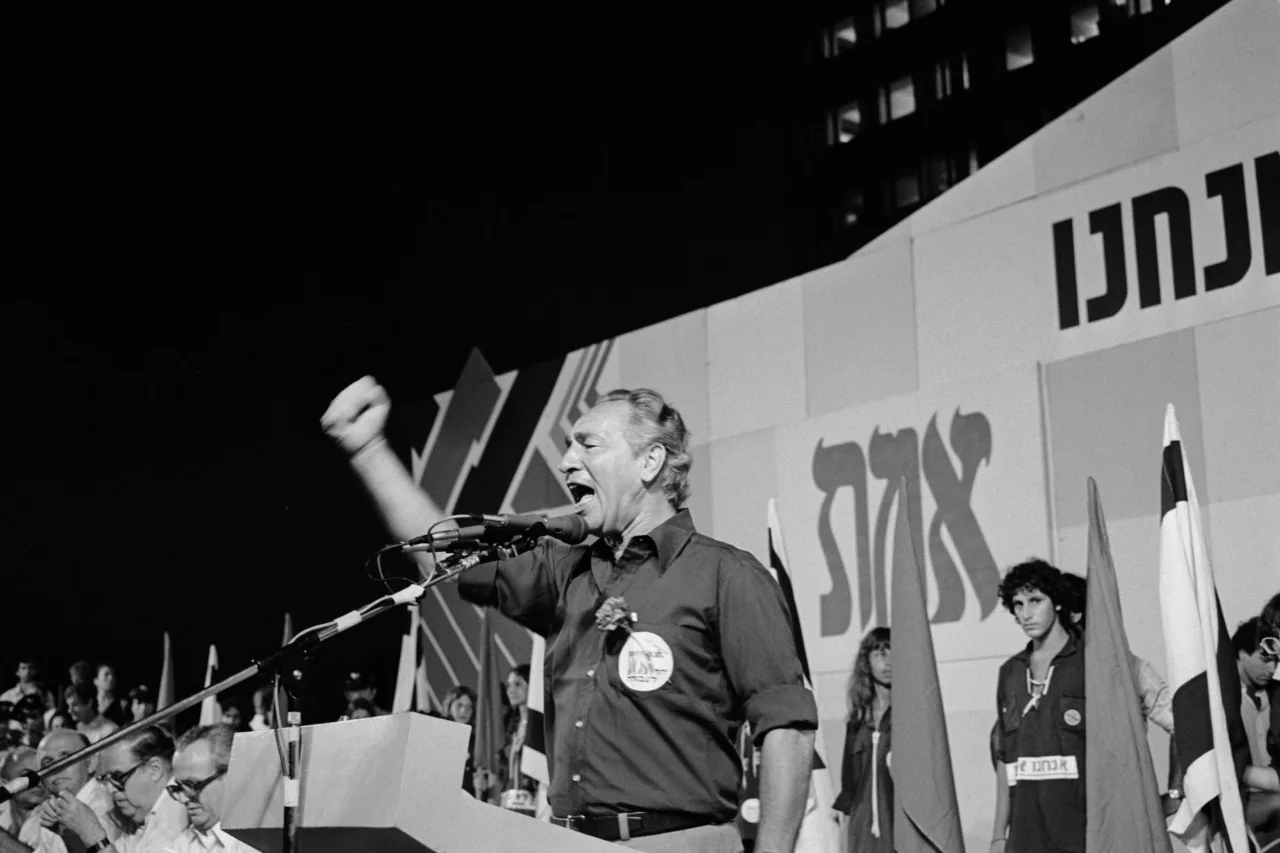
The 1984 election produced a political deadlock, leading Labour and Likud to form a national unity government. Under their rotation agreement, Peres served as prime minister from 1984 to 1986, after which Yitzhak Shamir took over. Peres’s most consequential domestic achievement during this period was helping lead Israel out of a severe inflationary crisis. [4]
Annual inflation had reached 133 percent in 1980, 191 percent in 1983 and 445 percent in 1984. In July 1985, the government introduced an economic stabilisation programme designed to restore confidence and prevent the economy from spiralling further out of control. It reduced the budget deficit, used an agreement among the government, the Histadrut labour federation and employers to restrain wages and prices, and was followed by legislation preventing the central bank from financing government deficits through money creation. Inflation fell to 185 percent in 1985 and 20 percent in 1986. Business-sector output per capita also grew in 1985. Economist Assaf Razin emphasises that the programme depended on broad political cooperation, which the unity government helped provide. [8]
As foreign minister, Peres also pursued diplomacy with Jordan. On 11 April 1987, he reached a secret agreement with King Hussein in London. The proposed framework called for an international peace conference that could not impose a settlement, followed by direct negotiations. Palestinian representatives would participate as part of a joint Jordanian-Palestinian delegation, and the parties would accept UN Security Council Resolutions 242 and 338 and renounce violence and terrorism. The Israeli cabinet’s inner committee did not approve the agreement, so it did not become official government policy. [9][4]
In 1990, Peres helped bring down the second national unity government over the stalled peace process. He failed to assemble an alternative coalition, however, and Shamir remained prime minister. The episode illustrated both Peres’s determination to pursue diplomatic initiatives and the limits of his ability to turn them into a governing consensus. [4]
Oslo, Rabin’s Assassination and the 1996 Election, 1992–1996
After Labour won the 1992 election, Rabin appointed Peres vice premier and foreign minister. Peres played a leading role in the secret negotiations that produced the 1993 Oslo Accords. On 13 September 1993, Israel and the Palestine Liberation Organization (PLO) signed the Declaration of Principles on Interim Self-Government Arrangements in Washington. It established a framework for interim Palestinian self-government while postponing difficult permanent-status questions, including Jerusalem, refugees, settlements, security arrangements and borders. Peres shared the 1994 Nobel Peace Prize with Rabin and PLO chairman Yasser Arafat. [1][10]
Supporters of Oslo argued that mutual recognition and negotiations offered a route towards peace and could help Israel avoid indefinitely governing millions of Palestinians. Critics argued that the agreements granted the PLO political legitimacy and transferred authority without adequate safeguards against terrorism. The security debate intensified as attacks continued. In March 1996, Israel told the United Nations that 200 Israeli civilians and soldiers had been killed in terrorist attacks since the Declaration of Principles was signed. [11]
Rabin was assassinated by an Israeli extremist on 4 November 1995. Peres succeeded him as prime minister, with the Knesset confirming his appointment. His short tenure was marked by a wave of Hamas suicide bombings in Jerusalem and Tel Aviv in February and March 1996. The attacks killed dozens of people and undermined public confidence in the peace process. [12][13]
In April 1996, after Hezbollah rocket attacks on northern Israel, the IDF launched Operation Grapes of Wrath in Lebanon. On 18 April, Israeli artillery struck a United Nations compound at Qana where Lebanese civilians had taken shelter, killing more than 100 people. A UN military assessment found it “unlikely” that technical or procedural errors explained the shelling, although it did not rule that possibility out completely. A US-mediated understanding ended the operation on 26 April. The incident intensified international criticism of the campaign and added to the pressure facing Peres ahead of the election. [14][15]
On 29 May 1996, Benjamin Netanyahu defeated Peres in Israel’s first direct election for prime minister. Netanyahu received 1,501,023 votes, or 50.4 percent, against Peres’s 1,471,566 votes, or 49.5 percent—a margin of 29,457. Labour nevertheless won 34 Knesset seats to Likud’s 32. Peres’s defeat showed that parliamentary strength did not necessarily translate into victory in a direct national contest, particularly when security and terrorism dominated the campaign. [16][17]
Elder Statesman and Legacy, 1996–2016
Peres remained active in Israeli public life after losing the premiership. He founded the Peres Center for Peace, served in governments led by Ehud Barak and Ariel Sharon, and left Labour in 2005 to join Sharon’s new Kadima party. On 13 June 2007, the Knesset elected him Israel’s ninth president. He served until 2014 and died on 28 September 2016. His 48 years in the Knesset made him the longest-serving member in its history. [3][4][12]
His strongest legacy is closely tied to Israel’s security and state-building. As a young defence administrator, he helped obtain arms when the state was fighting for survival, strengthened the French alliance, developed the domestic defence industry and helped establish Dimona. As prime minister, he supported the 1985 economic stabilisation programme, which brought inflation under control and laid the groundwork for greater economic stability. These achievements helped shape Israel’s long-term strategic and economic position. [4][5][8]
Oslo remains the most disputed part of his record. Admirers credit Peres with helping Israel gain international recognition for negotiations with the PLO and with pursuing an alternative to indefinite conflict. Critics, especially on Israel’s centre-right, argue that he misjudged Arafat’s intentions, underestimated rejectionist groups such as Hamas and accepted security risks that proved costly. Israel’s Foreign Ministry recorded hundreds of Israelis killed in terrorist attacks in the years following the Declaration of Principles. The figures do not by themselves establish that Oslo caused the attacks, but they help explain why the peace process became a central source of political division. [18]
Peres held nearly every senior office in Israel but never won a national election for prime minister outright. His career combined extraordinary influence over defence and diplomacy with repeated electoral disappointments. His security achievements remain central to his reputation, while the consequences of his peace diplomacy continue to divide Israelis and historians.
In One Paragraph
Shimon Peres (1923–2016) was a Polish-born Israeli statesman who rose through the Labour Zionist movement to become defence minister, prime minister twice, foreign minister and Israel’s ninth president. As a young defence administrator, he helped build Israel’s military relationship with France, develop its defence industries and establish the Dimona reactor. As prime minister in the 1980s, he helped lead the economic stabilisation programme that ended hyperinflation. As foreign minister, he negotiated the 1993 Oslo Accords and shared the Nobel Peace Prize with Yitzhak Rabin and Yasser Arafat. He remained influential in Israeli politics until his death. His contributions to Israel’s security and economic development are widely recognised.
Sources
- Nobel Prize Outreach. “Shimon Peres – Facts.” NobelPrize.org. Accessed October 22, 2026. https://www.nobelprize.org/prizes/peace/1994/peres/facts/.
- The Jerusalem Post. “Shimon Peres.” Topic page. Accessed October 22, 2026. https://www.jpost.com/tags/shimon-peres?page=2.
- Embassy of Israel in Cameroon. “Happy Birthday President Peres.” Israel Ministry of Foreign Affairs, n.d. https://embassies.gov.il/yaounde/NewsAndEvents/Pages/Happy-Birthday-President-Peres.aspx.
- Knesset. “President Shimon Peres.” Official biography, captured September 16, 2008, pp. 1–2. Reproduced in European Parliament meeting documents. https://www.europarl.europa.eu/meetdocs/2004_2009/documents/dv/president_shimon_per/president_shimon_peres.pdf.
- National Security Archive. “Before Dimona.” Israel and the Bomb document collection. George Washington University. https://nsarchive2.gwu.edu/israel/documents/before/index.html.
- Read, Benjamin. “Israel’s Assurances Concerning Use of Atomic Energy.” Memorandum to McGeorge Bundy, March 18, 1964. US Department of State, National Archives, Record Group 59. Wilson Center Digital Archive. Originally published in Avner Cohen and William Burr, eds., National Security Archive Electronic Briefing Book no. 432, June 25, 2013. https://digitalarchive.umd.edu/node/92920.
- ANU – Museum of the Jewish People. “Peres Shimon.” Nobel Winners. Accessed October 22, 2026. https://nobel.anumuseum.org.il/en/persona/peres-shimon/.
- Razin, Assaf. “The Struggle toward Macroeconomic Stability: An Analytical Essay.” Israel Economic Review 17, no. 1 (2019): 1–38, especially 3, 9–10. Bank of Israel. https://boi.org.il/media/v4jaun3n/part-1n.pdf.
- “The Hussein-Peres Agreement (The London Document), 11 April 1987.” Appendix 56 in Negotiating Arab-Israeli Peace, 3rd ed., appendices. Bloomington: Indiana University Press, n.d. Text reproduced from Shimon Peres, Battling for Peace: A Memoir, edited by David Landau (London: Weidenfeld & Nicolson, 1995), 361–62. https://publish.iupress.indiana.edu/read/negotiating-arab-israeli-peace-third-edition-appendices/section/617761f6-957e-44c3-bb92-90c4b11956f7.
- United Nations General Assembly and Security Council. “Letter Dated 8 October 1993 from the Permanent Representatives of the Russian Federation and the United States of America to the United Nations Addressed to the Secretary-General.” Annex: Declaration of Principles on Interim Self-Government Arrangements, Article V. A/48/486–S/26560, October 11, 1993. https://digitallibrary.un.org/record/174951/files/A_48_486%26S_26560-EN.pdf.
- United Nations Commission on Human Rights. “Note Verbale Dated 5 March 1996 from the Deputy Permanent Representative of Israel to the United Nations Office at Geneva.” E/CN.4/1996/120, March 18, 1996. https://unispal.un.org/pdfs/95504BA2AD3EDFDF85256A29005122B0.pdf.
- Israel Ministry of Foreign Affairs. “Shimon Peres.” Accessed October 22, 2026. https://embassies.gov.il/MFA/AboutIsrael/state/Pages/Shimon%20Peres.aspx.
- Israel Ministry of Foreign Affairs. “Suicide and Other Bombing Attacks in Israel Since the Declaration of Principles (Sept 1993).” Entries for February 25, March 3 and March 4, 1996. https://embassies.gov.il/MFA/FOREIGNPOLICY/Terrorism/Palestinian/Pages/Suicide%20and%20Other%20Bombing%20Attacks%20in%20Israel%20Since.aspx.
- Ynetnews. “Operation Grapes of Wrath (1996).” n.d. https://www.ynet.co.il/articles/0,7340,L-3284744,00.html.
- United Nations Security Council. “Letter Dated 7 May 1996 from the Secretary-General Addressed to the President of the Security Council.” Annex: “Report Dated 1 May 1996 of the Secretary-General’s Military Adviser Concerning the Shelling of the United Nations Compound at Qana on 18 April 1996.” S/1996/337, May 7, 1996. https://un.org/unispal/document/auto-insert-187312.
- Israel Ministry of Foreign Affairs. “Israeli Election Results – May 1996.” https://embassies.gov.il/MFA/AboutIsrael/history/Pages/Israeli%20Election%20Results-%20May%201996.aspx.
- Jewish Telegraphic Agency. “1996 Israeli Elections Results.” June 4, 1996. https://jta.org/archive/1996-israeli-elections-results.
- Israel Ministry of Foreign Affairs. “Fatal Terrorist Attacks in Israel (Sept 1993 – 1999).” https://embassies.gov.il/MFA/FOREIGNPOLICY/Terrorism/Palestinian/Pages/Fatal%20Terrorist%20Attacks%20in%20Israel%20Since%20the%20DOP%20-S.aspx.