
Saddam Hussein
Quick answer · ~120 words
Saddam Hussein (1937–2006) was president of Iraq from 1979 until the United States-led invasion overthrew his regime in 2003. Born into rural poverty near Tikrit, he rose through the Ba’ath Party by building its security apparatus, eliminating rivals, and consolidating personal power. For Israel, Saddam was a persistent regional adversary. He pursued nuclear technology until Israel destroyed Iraq’s Osirak reactor in 1981, threatened Israel with chemical weapons in 1990, fired Scud missiles at Israeli cities during the 1991 Gulf War, and financed families of Palestinian suicide bombers during the Second Intifada. His regime also persecuted Iraq’s Jewish community and conducted the Anfal campaign against the Kurds, which Human Rights Watch concluded constituted genocide. An Iraqi tribunal convicted Saddam of crimes against humanity for the Dujail killings, although Human Rights Watch documented serious flaws in the trial. He was executed on 30 December 2006.
A Tikrit Childhood and a Conspirator’s Apprenticeship (1937–1968)
Saddam Hussein was born on 28 April 1937 in Al-Awja, near Tikrit, Iraq, and died in Baghdad on 30 December 2006. His family was poor, and he spent part of his childhood in Baghdad under the care of a maternal uncle who was an Arab nationalist. [1][2] The political environment in which he grew up encouraged hostility toward the Iraqi monarchy, British influence, and Zionism.
Saddam joined the Ba’ath Party, a movement that combined Arab nationalism, socialist economic policies, and authoritarian one-party rule. In 1959, he participated in a failed attempt to assassinate Iraqi Prime Minister Abd al-Karim Qasim. Wounded during the operation, he escaped through Syria to Egypt, where he lived in exile and studied law briefly at Cairo University. [1][2]
He returned to Iraq after the Ba’athists briefly seized power in 1963. When their government fell later that year, he was imprisoned. These years helped establish his reputation as a party organiser who was willing to use clandestine activity and violence to advance political objectives. His subsequent rise depended less on public popularity than on his ability to build networks of loyalists and control the machinery of internal security.
The Ba’ath Party returned to power in July 1968. Saddam did not immediately become president, but his influence grew as he helped consolidate the regime. The political methods he developed—surveillance, intimidation, purges, and the treatment of opponents as agents of foreign powers—would become central to his rule. His hostility toward Israel was part of a wider Arab nationalist ideology that rejected Israel’s legitimacy and frequently portrayed domestic opposition through the lens of an external Israeli threat.
Enforcer, Deputy, and President (1968–1980)
Following the 1968 coup, Ahmed Hassan al-Bakr became president, while Saddam emerged as a powerful deputy and a central figure in the regime’s internal security network. He helped build a system in which party loyalty and personal allegiance were essential to political survival.
The regime’s campaign against alleged Israeli espionage had particularly grave consequences for Iraq’s remaining Jewish community. On 27 January 1969, fourteen Iraqi citizens—nine Jews, two Christians, and three Muslims—were publicly hanged as alleged Israeli spies. A contemporaneous US State Department intelligence memorandum concluded that the campaign was driven substantially by the Ba’athist regime’s insecurity and its desire to portray political opponents as agents of Israel. It also warned that the trials placed Iraq’s Jewish community at risk. [3]
Saddam’s precise personal role in the interrogations and trials is not fully established by the cited public record. Historian Nissim Kazaz, as reported by Ilana Stutland, described Saddam as responsible for interrogations and a powerful figure in the regime at the time. Kazaz also documented the persecution of Iraqi Jews during the Ba’athists’ early years in power. These claims should be distinguished from the contemporary American assessment, which directly documents the regime’s political use of the espionage campaign. [4]
During the 1970s, Iraq’s rising oil revenues financed military expansion and state-led industrial development. Saddam also pursued nuclear technology through an agreement with France. In July 1979, he displaced al-Bakr and assumed the presidency. His rise completed the concentration of political power around a leader who had already helped establish the state’s coercive institutions. [1]
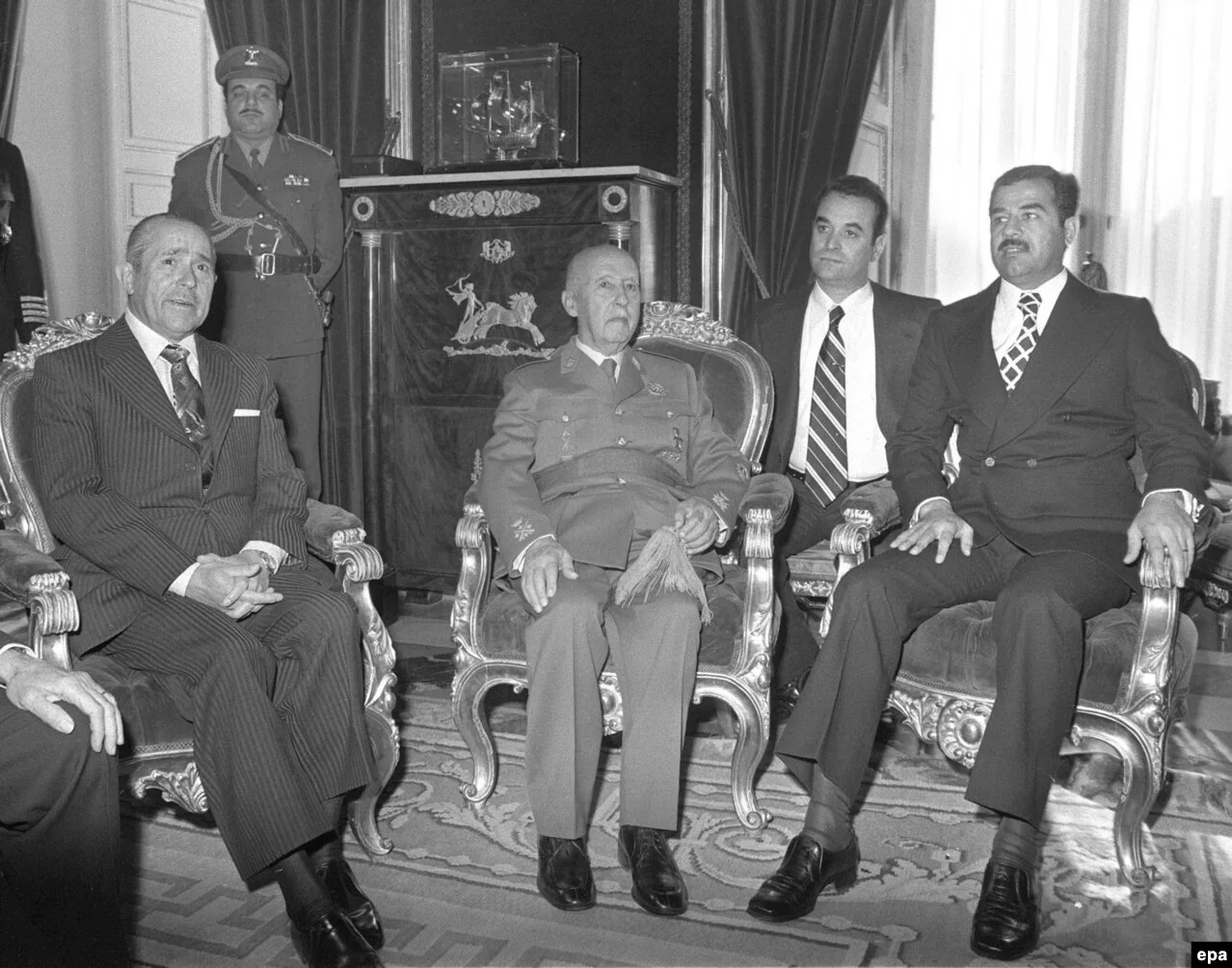
In September 1980, Saddam ordered the invasion of Iran, beginning an eight-year war that devastated both countries. The invasion reflected his willingness to use military force to pursue regional ambitions, even at enormous human and economic cost. The war also consumed resources that might otherwise have supported Iraq’s development and left the regime with major financial and security pressures. [1]
Nuclear Ambition and the Osirak Strike (1975–1981)
Saddam’s pursuit of nuclear technology became a major concern for Israel. Iraq acquired a French-supplied research reactor known as Osirak, or Tammuz, and associated nuclear facilities. Israeli leaders feared that a hostile regime committed to Israel’s destruction could eventually use such infrastructure to support a nuclear weapons programme.
On 7 June 1981, Israeli Air Force aircraft attacked and destroyed the Osirak reactor near Baghdad. Israel’s military archives record the operation as a successful strike in which the reactor was destroyed and no Israeli aircraft were lost. [5] Israel subsequently defended the operation at the United Nations, while the Security Council unanimously adopted Resolution 487 on 19 June 1981, condemning the Israeli attack and affirming Iraq’s rights under the international nuclear safeguards system. [6][7]
The strategic consequences remain debated. Supporters of the strike argue that it prevented Saddam from acquiring a nuclear capability that could have fundamentally changed the regional balance. Critics contend that the attack encouraged Iraq to pursue nuclear ambitions through more concealed methods. A declassified US assessment cited by The Independent argued that the strike might set back Iraq’s programme while also increasing incentives to evade international inspection and pursue weapons of mass destruction. [8]
The available evidence does not establish that the strike permanently eliminated Iraq’s nuclear ambitions. Saddam continued to seek strategic capabilities, and the Iraqi regime remained a source of concern for Israel throughout the following decade. The Osirak episode became a central precedent in Israeli security thinking: whether a state should attack a hostile country’s nuclear infrastructure before the threat becomes more difficult to contain. The debate over the strike’s long-term effect remains relevant to discussions of preventive military action, intelligence assessments, and the limits of international safeguards.
Threats, Kuwait, and the Scud War (1990–1991)
After the Iran-Iraq War ended in 1988, Saddam increasingly directed his rhetoric toward Israel. On 2 April 1990, he threatened that Iraq would make “the fire eat half of Israel” if Israel attacked Iraqi industrial facilities, and warned that Iraq would use binary chemical weapons. The US government publicly responded to his threat the following day. [9][10] The statement was especially alarming because Iraq had already used chemical weapons during the war with Iran and against Kurdish civilians.
On 2 August 1990, Iraq invaded Kuwait and attempted to annex it. Saddam then tried to link the crisis to the Arab-Israeli conflict. In an initiative dated 12 August, he proposed addressing regional occupations together, beginning with Israel’s withdrawal from Arab territories while treating Kuwait as part of a wider package of negotiations. [11] This attempted linkage did not secure the withdrawal of the US-led coalition and did not reverse Iraq’s occupation of Kuwait.
During the Gulf War, Saddam acted on his threats against Israel. Israeli government sources differ slightly in their missile totals. The Ministry of Foreign Affairs records approximately 38 Iraqi Scud variants striking Israel across 19 attacks, while the Ministry of Defense Archives records 39 Scud missiles launched toward Israel between 17 January and 28 February 1991. The sources report one Israeli fatality, although totals can vary depending on how deaths and injuries are classified. [12][13]
The missile campaign threatened Israeli civilians and placed the government under pressure to retaliate. Saddam’s apparent strategic objective was to draw Israel into the war, potentially fracturing the coalition that included Arab states. Prime Minister Yitzhak Shamir’s government ultimately refrained from retaliating following strong American pressure. This restraint helped preserve coalition unity but imposed a political and psychological cost on Israel, whose deterrence doctrine placed great importance on responding to direct attacks.
The episode illustrated a recurring feature of Saddam’s strategy: using confrontation with Israel to broaden his regional standing, even when Israel was not the principal party to the conflict he had initiated. His attempt to transform the invasion of Kuwait into a wider confrontation did not rescue his position. Iraq was expelled from Kuwait, suffered extensive military damage, and remained under international sanctions.
Mass Atrocity, Terror Financing, and Collapse (1987–2006)
Saddam’s regime used state power not only against foreign adversaries but also against populations inside Iraq. The Anfal campaign against the Kurds, conducted from February to September 1988, involved mass executions, forced displacement, destruction of villages, and repeated chemical attacks. Human Rights Watch examined captured Iraqi documents and interviewed survivors before concluding that the campaign constituted genocide against the Kurdish population. Its estimate was that at least 50,000 and possibly as many as 100,000 people were deliberately killed. [14]
The campaign’s systematic character matters: these were not merely incidental civilian deaths in a conventional war. Iraqi state forces targeted Kurdish communities in designated prohibited areas, detained large numbers of civilians, and destroyed settlements. The scale and organisation of the campaign demonstrated the regime’s willingness to use extreme violence against populations it regarded as threats to its authority.
During the Second Intifada, Saddam also supported Palestinian attacks against Israel through financial payments to families of suicide bombers and others killed fighting Israel. A payment scale announced in March 2002 provided $25,000 to families of suicide bombers and $10,000 to families of other people killed in the conflict. Contemporary reporting quoted a representative of the pro-Iraqi Arab Liberation Front acknowledging that the payments could make the decision to carry out an attack easier for some potential bombers. [15] Israeli military intelligence also documented a $25,000 payment to the mother of the Hamas bomber responsible for the March 2002 attack on Jerusalem’s Moment Café, which killed eleven Israelis. [16]
The US-led invasion in March 2003 overthrew Saddam’s government. The post-invasion Iraq Survey Group’s findings, however, undermined a major public justification for the war: it found no stockpiles of illicit weapons of mass destruction in Iraq at the time of the invasion and no active programme to produce them then. Its findings also indicated that Saddam retained an interest in rebuilding prohibited capabilities if international sanctions were lifted. [17][18] These distinctions are important. The regime’s previous chemical weapons use and pursuit of strategic capabilities were documented, but the claim that Iraq possessed active stockpiles ready for use in 2003 was not substantiated by the subsequent investigation.
Saddam was captured in December 2003 and tried by the Iraqi High Tribunal for crimes committed after an assassination attempt in Dujail in July 1982. The prosecution concerned the detention, torture, forced displacement, and execution of people from the town. Saddam was convicted of crimes against humanity in November 2006; the Appeals Chamber upheld the conviction and death sentence in December, and he was hanged on 30 December 2006. [19]
The conviction must be considered alongside serious concerns about the trial. Human Rights Watch documented procedural failures, including late disclosure of evidence, interference affecting the tribunal’s independence, and problems with the defendants’ ability to challenge witnesses. It argued that these defects undermined the fairness of the proceedings and the credibility of the verdict. [19] Saddam’s execution ended the Dujail case against him before a verdict could be reached in his separate Anfal trial.
Assessing Saddam Hussein’s Impact on Israel
Saddam’s record affected Israel in three principal areas: nuclear proliferation, direct missile attacks against civilians, and financial support for Palestinian terrorism. His threats were not merely rhetorical. His government pursued nuclear technology, used chemical weapons during the Iran-Iraq War and against Kurdish targets, launched Scud missiles at Israel, and provided financial support to families of suicide bombers.
The Osirak strike became a defining precedent in Israeli strategic debate. Supporters see it as an example of preventive action against a hostile state’s nuclear ambitions. Critics argue that the attack may have pushed Iraq’s efforts toward less visible methods. The episode does not settle the broader debate over preventive strikes, but it demonstrates the high stakes involved when intelligence assessments concern a regime that has threatened Israel and pursued unconventional military capabilities.
The 1991 Scud attacks exposed Israeli civilians to ballistic missile warfare and forced the government to weigh retaliation against the risk of weakening an international coalition. The experience also contributed to Israel’s focus on missile defence and civil preparedness. Saddam’s financial support for families of Palestinian bombers added another dimension to the threat: a hostile state could assist attacks on Israeli civilians without directly sending its own forces across the border.
His domestic record was similarly consequential. The persecution of Iraqi Jews, the Anfal campaign against Kurds, and the repression of political opponents reveal how the regime used alleged foreign threats to legitimise coercion and consolidate power. These actions were part of the wider authoritarian system Saddam built, not isolated excesses.
The 2003 invasion and its aftermath also show why Saddam’s record should be assessed with care. His previous conduct gave neighbouring states serious grounds for concern, but the Iraq Survey Group did not substantiate the claim that Iraq possessed active stockpiles of weapons of mass destruction when the invasion began. His conviction for crimes against humanity was legally significant, while the documented flaws in the Dujail proceedings raise separate questions about the quality of the trial.
For Israel, Saddam’s legacy is therefore closely tied to the challenge of assessing hostile intentions, the limits of deterrence, and the risks of allowing regional adversaries to develop strategic weapons. His career also demonstrates how confrontation with Israel could be used by authoritarian governments to mobilise domestic support, even when the same governments were responsible for grave abuses against their own populations.
In One Paragraph
Saddam Hussein ruled Iraq from 1979 until his overthrow in 2003, rising through the Ba’ath Party’s security apparatus to establish an authoritarian regime. He pursued nuclear technology until Israel destroyed the Osirak reactor in 1981, threatened Israel with chemical weapons in 1990, fired Scud missiles at Israeli cities during the 1991 Gulf War, and financed families of Palestinian suicide bombers during the Second Intifada. His regime persecuted Iraq’s Jewish community and conducted the Anfal campaign against the Kurds, which Human Rights Watch concluded constituted genocide. After the 2003 invasion, investigators found no active stockpiles of illicit weapons of mass destruction in Iraq at the time of the invasion. Saddam was convicted of crimes against humanity in the Dujail case and executed in 2006, following proceedings that Human Rights Watch criticised for serious procedural flaws. His record remains central to Israeli debates over deterrence, preventive action, and regional security.
Sources
- Encyclopaedia Britannica. “Saddam Hussein.” Encyclopaedia Britannica. Accessed October 23, 2026. https://britannica.com/biography/Saddam-Hussein.
- Radio Free Europe/Radio Liberty. “Iraq: Saddam Hussein’s Biography.” RFE/RL. Accessed October 23, 2026. https://www.rferl.org/a/1073742.html.
- United States Department of State, Office of the Historian. “Research Memorandum RNA–6 From the Director of the Bureau of Intelligence and Research (Hughes) to Secretary of State Rogers.” February 14, 1969. In Foreign Relations of the United States, 1969–1976, vol. E-4, Documents on Iran and Iraq, 1969–1972, document 251. Washington, DC: Government Printing Office. https://history.state.gov/historicaldocuments/frus1969-76ve04/d251.
- Stutland, Ilana. “Baghdad Hangings: When Jews Were Snatched and Accused of Spying for Israel.” The Jerusalem Post. Accessed October 23, 2026. https://m.jpost.com/international/the-baghdad-hangings-581955.
- Israel Ministry of Defense Archives. “Operation Opera: The Destruction of the Iraqi Nuclear Reactor.” IDF and Defense Establishment Archives. Accessed October 23, 2026. https://archives.mod.gov.il/sites/English/Exhibitions/Pages/Operation-Opera.aspx.
- Permanent Representative of Israel to the United Nations. “Letter Dated 8 June 1981 from the Permanent Representative of Israel to the United Nations Addressed to the President of the Security Council.” UN document S/14510. June 8, 1981. https://digitallibrary.un.org/record/22097?ln=en.
- United Nations Security Council. Resolution 487 (1981). S/RES/487(1981). Adopted June 19, 1981. https://digitallibrary.un.org/record/22225.
- Daragahi, Borzou. “Israel’s 1981 Bombing of Iraq Nuclear Reactor May Have Fuelled Saddam’s Nuclear Ambitions.” The Independent, June 6, 2021. Reproduced by the National Security Archive, George Washington University. https://nsarchive.gwu.edu/sites/default/files/media_mentions/2021-06-08_israels_1981_bombing_of_iraq_nuclear_reactor_may_have_fuelled_saddams_nuclear_ambitions_-_independent.pdf.
- Associated Press. “Iraq Holds Nerve Gas Weapons: President Threatens Retaliatory Use of Binary Weapons on Israel.” The Battalion (Texas A&M University), April 3, 1990, 8. https://newspaper.library.tamu.edu/lccn/sn86088544/1990-04-03/ed-1/seq-8.
- Fitzwater, Marlin. “Statement by Press Secretary Fitzwater on Iraq’s Threat to Use Chemical Weapons.” April 3, 1990. Public Papers of the Presidents, George H. W. Bush Presidential Library, ID 1715. https://bush41library.tamu.edu/archives/public-papers/1715.
- Hussein, Saddam. “Saddam Hussein Speech about the Gulf War and His Attack on Kuwait in 1990.” August 12, 1990, 5–6. Conflict Records Research Center, National Defense University, SH-PDWN-D-000-457. Wilson Center Digital Archive. https://digitalarchive.umd.edu/document/108030/download.
- Israel Ministry of Foreign Affairs. “The Gulf War (1991).” About Israel: History. Accessed October 23, 2026. https://embassies.gov.il/MFA/AboutIsrael/history/Pages/The%20Gulf%20War%20-%201991.aspx.
- Israel Ministry of Defense Archives. “1991.” The Time Axis. Accessed October 23, 2026. https://archives.mod.gov.il/sites/English/theTimeAxis/Pages/1991.aspx.
- Human Rights Watch. Iraq’s Crime of Genocide: The Anfal Campaign Against the Kurds. New York: Human Rights Watch, 1994. https://www.hrw.org/report/1994/05/01/iraqs-crime-genocide-anfal-campaign-against-kurds.
- CBS News. “Salaries for Suicide Bombers.” CBS News, April 2002. https://www.cbsnews.com/news/salaries-for-suicide-bombers.
- Israel Defense Forces Military Intelligence. “Iraqi Support for and Encouragement of Palestinian Terrorism.” September 2002. Published by the Israel Ministry of Foreign Affairs. https://embassies.gov.il/MFA/FOREIGNPOLICY/Terrorism/Palestinian/Pages/Iraqi%20Support%20for%20and%20Encouragement%20of%20Palestinian.aspx.
- CNN. “Report: No WMD Stockpiles in Iraq.” CNN.com, October 6, 2004. https://edition.cnn.com/2004/WORLD/meast/10/06/iraq.wmd.report/index.html.
- Kerr, Paul. “Duelfer Disproves U.S. WMD Claims.” Arms Control Today, November 2004. Arms Control Association. https://www.armscontrol.org/act/2004-11/duelfer-disproves-us-wmd-claims.
- Human Rights Watch. Judging Dujail: The First Trial before the Iraqi High Tribunal. New York: Human Rights Watch, November 2006. https://www.hrw.org/report/2006/11/19/judging-dujail/first-trial-iraqi-high-tribunal.