
Levi Eshkol
Quick answer · ~120 words
Levi Eshkol (1895–1969), born Levi Shkolnik, was Israel’s third prime minister, serving from June 1963 until his death on 26 February 1969. Before becoming prime minister, he served as finance minister from 1952 to 1963 and helped build Israel’s economy, agricultural settlements and water infrastructure. He succeeded David Ben-Gurion, overcame a political challenge from him in 1965, and strengthened Israel’s ties with West Germany and the United States. His leadership faced its greatest test during the May–June 1967 crisis. Eshkol initially delayed military action while Israel pursued diplomacy, then approved the military campaign that became the Six-Day War. After the victory, his government debated what to do with the territories captured by Israel. His legacy combines economic state-building, stronger international ties, the 1967 victory and continuing debate over his wartime leadership and post-war policy.
From Ukraine to Zionist Settlement, 1895–1948
Levi Shkolnik was born on 25 October 1895 in Oratovo, near Kyiv, in the Russian Empire, in what is now Ukraine. He grew up in a traditional Jewish family and studied at a Hebrew secondary school in Vilna. As a young man, he joined the Zionist movement, which supported the establishment of a Jewish national home in the Land of Israel. He immigrated in 1914 and began working in agriculture in Petah Tikva. He later adopted the Hebrew surname Eshkol. [1]
Eshkol became involved in the Labour Zionist movement, which linked Jewish national revival with agricultural work, workers’ organisations and collective settlement. He helped establish Degania Bet, a kibbutz near the Sea of Galilee, and worked to develop Jewish agricultural communities. He also served in the Jewish Legion, a unit of Jewish volunteers in the British Army during the First World War. His early experience brought together three areas that would define his career: settlement, public administration and security. [2]
Eshkol also understood that the developing Jewish community needed reliable water supplies and sound financial institutions. He became involved in the growth of Mekorot, Israel’s national water company, and held senior responsibilities in the Zionist movement’s settlement work. In the 1930s, he travelled to Germany to help arrange the transfer of some German Jewish property to Palestine, allowing Jews fleeing Nazi persecution to bring part of their assets with them.
During the Second World War, Eshkol worked on financial matters for the Haganah, the main Jewish defence organisation in Mandatory Palestine. In the years surrounding Israel’s independence, he helped organise the new state’s defence administration and settlement institutions. These roles made him an experienced organiser before he entered the highest levels of government. [2]
Building the State and Challenging Ben-Gurion, 1948–1965
After Israel declared independence in 1948, Eshkol held a senior position in the Defence Ministry and helped organise its work during the War of Independence. He also became a leading figure in the Jewish Agency, serving as its treasurer from 1949 to 1951 and leading its settlement department for many years. In 1951, he entered the Knesset and became minister of agriculture and development. In 1952, he became finance minister, a position he held for eleven years. [1]
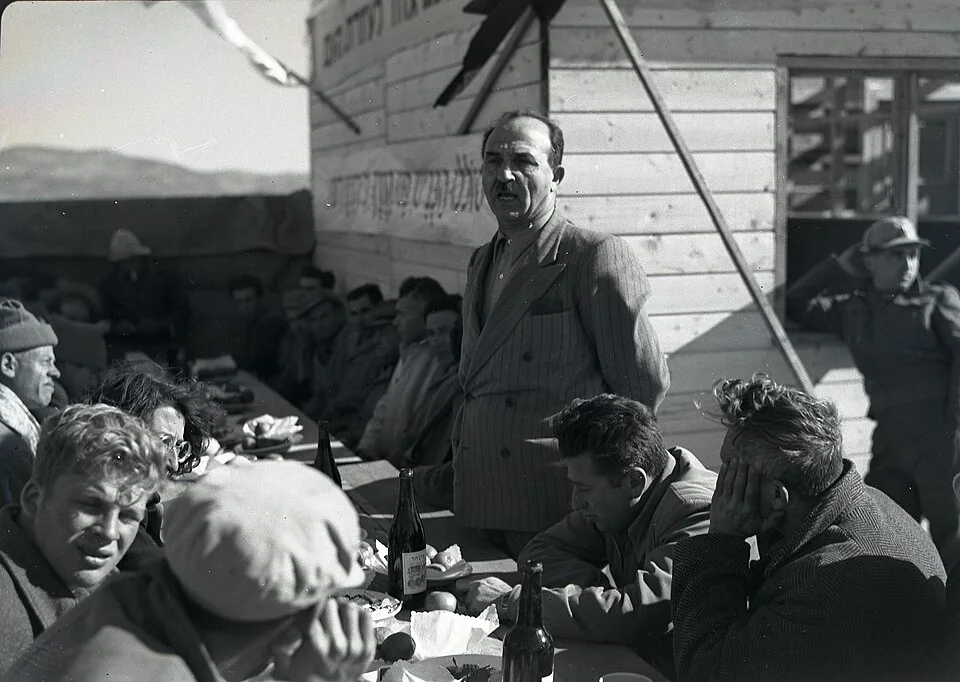
As finance minister, Eshkol faced the difficult task of financing defence, absorbing large numbers of Jewish immigrants and developing the country’s economy. Israel had limited resources and urgent security needs. His work helped support new settlements, infrastructure and public services. The National Water Carrier, a major project designed to transport water from the north towards the more populated and arid parts of the country, began operating in 1964. It became one of the major infrastructure achievements associated with his years in government. [1]
Eshkol became prime minister in June 1963 after Ben-Gurion stepped down. He initially also held the defence portfolio. However, his relationship with Israel’s founding prime minister soon deteriorated. One major dispute concerned the Lavon Affair, a failed Israeli intelligence operation in Egypt in 1954. The controversy centred on who bore responsibility for the operation and how that responsibility should be investigated. Ben-Gurion pressed for further action, while Eshkol sought to resolve the dispute through existing political and institutional processes. [3]
The disagreement became part of a wider struggle over leadership within the ruling Mapai party. Eshkol worked to unite Mapai with Ahdut HaAvoda, strengthening the party ahead of the 1965 election. Ben-Gurion opposed Eshkol’s handling of the Lavon Affair and left Mapai with his supporters to establish Rafi. Eshkol prevailed in the party struggle and remained prime minister after the election. The split showed that he could establish his own authority rather than remain merely Ben-Gurion’s successor. [3]
Relations with West Germany and the Road to War, 1965–June 1967
One of Eshkol’s important diplomatic decisions was to establish full diplomatic relations with West Germany. The Holocaust made this a painful and controversial issue in Israel. Many Israelis opposed normal diplomatic ties with a German state so soon after the murder of six million Jews. Others argued that relations could advance Israel’s interests and recognise the new political reality in West Germany.
In March 1965, the Knesset debated the proposal. On 12 May, Eshkol and West German Chancellor Ludwig Erhard agreed to establish full diplomatic relations and exchange ambassadors. The decision marked a major step in relations between the two countries, though it remained controversial in Israel and across the Arab world. [4]
Eshkol’s greatest test came in May 1967. Egypt moved large numbers of troops into Sinai and secured the withdrawal of the United Nations Emergency Force, which had been stationed there since the 1956 Suez Crisis. Egypt then announced restrictions on Israeli shipping through the Strait of Tiran, a vital route to the port of Eilat. Israel regarded the closure as a serious threat to its security and a challenge to the freedom of navigation it had defended since the previous crisis. [5]
Eshkol did not immediately order an attack. He gave diplomacy time to work and accepted an American request for a short period of delay. His government hoped that diplomatic efforts would demonstrate that Israel had not rushed into war and might help secure international support. But the delay increased public anxiety. His radio address on 28 May was hesitant, and his delivery became a symbol of the uncertainty facing the government. [6]
Pressure grew for a broader national unity government. Menachem Begin’s Gahal bloc joined the government, and Moshe Dayan replaced Eshkol as defence minister. On 4 June, after discussions with senior military commanders and cabinet ministers, the government approved military action. The Israeli campaign began on 5 June and quickly changed the regional balance. By the end of the war on 10 June, Israel had captured the Sinai Peninsula, the Gaza Strip, the West Bank, East Jerusalem and the Golan Heights. [7]
Eshkol’s responsibility for the war was therefore twofold: he led the government through the decision to delay and then approved the attack. The delay reflected his concern for diplomacy and international legitimacy; critics believed that it risked leaving Israel exposed. The war’s outcome strengthened his government, but the crisis also showed how difficult it was for a civilian leader to balance military advice, public pressure and diplomatic considerations. [7]
The Territories, Diplomacy and American Support, 1967–1969
The Six-Day War created a new set of strategic and political questions. Israel now controlled territories that had previously been held by Egypt, Jordan and Syria. Eshkol’s government had to decide whether to retain them, return them in negotiations, or pursue different arrangements in different areas.
On 19 June 1967, the cabinet adopted a resolution concerning the future of Sinai and the Golan Heights. It indicated a willingness to return these territories to Egypt and Syria in exchange for peace and security arrangements. The government also addressed Jerusalem and Gaza, while the future of the West Bank remained unresolved. The resolution was an internal cabinet decision, and historians continue to debate its precise meaning, how far it represented a firm peace offer and whether the Arab governments received it. [8]
Historian Avi Raz argues that the resolution has sometimes been described too generously as a peace offer because its wording left important questions open and the offer was not formally delivered to the Arab governments. Historian Uri Bar-Joseph has challenged aspects of Raz’s interpretation, particularly how the text should be understood. These disagreements show why the resolution should be treated as an important but contested part of Israel’s post-war policy, rather than as proof that a complete agreement was offered and rejected. [9]
The Arab League summit at Khartoum in August and September 1967 adopted a position rejecting peace, recognition and negotiations with Israel. Israel’s cabinet subsequently changed its policy and placed greater emphasis on secure borders. However, the change cannot be explained by the Khartoum declaration alone: Israeli strategic calculations and developments on the ground also shaped the government’s approach. [8]
In November 1967, the United Nations Security Council adopted Resolution 242. It called for a peace settlement based on the withdrawal of Israeli armed forces from territories occupied in the recent conflict, the termination of belligerency, and respect for the sovereignty and security of every state in the region. The resolution became a central reference point in later Arab-Israeli diplomacy, although the meaning and scope of its territorial language remained disputed. [10]
Eshkol also worked to strengthen Israel’s relationship with the United States. His 1964 state visit to Washington was the first official state visit by an Israeli prime minister. The relationship became especially important after France, previously a major supplier of Israeli military aircraft, refused to deliver Mirage jets that Israel had ordered. Eshkol pressed Washington for advanced aircraft to help maintain Israel’s military advantage. In 1968, President Lyndon B. Johnson confirmed a decision in principle to supply Phantom fighter aircraft, linking the sale to wider regional security concerns and American policy towards the Soviet Union. [11]
These developments helped move Israel towards a closer strategic relationship with Washington. Eshkol did not complete this process alone, but his government’s diplomatic work helped establish foundations for the security partnership that became central to Israel’s defence.
Economic Challenges, Final Years and Legacy
Eshkol’s record was not limited to war and diplomacy. His governments continued to develop infrastructure, support settlement and expand the institutions of the state. The National Water Carrier began operating during his premiership, while his earlier work in finance and settlement had helped prepare the country for further growth. He also announced in 1966 that military governance over Arab-populated areas inside Israel would end, bringing an end to a system that had operated since the early years of the state. [12]
However, economic conditions worsened during the mid-1960s. Israel experienced a recession, with unemployment rising sharply in 1966. The Bank of Israel attributed the slowdown to several factors, including weaker demand, higher real wages and the completion of major public works. The figures complicate any claim that Eshkol’s economic record was an uninterrupted success, although the challenges faced by the government must also be understood in the context of defence spending and the costs of state-building. [13]
His leadership during the 1967 crisis remains a subject of debate. Some critics saw his hesitation as weakness, while others view the delay as an attempt to secure international support before taking military action. The cabinet records also reveal a government weighing competing views rather than a prime minister acting alone. Eshkol ultimately approved the military campaign, and Israel’s victory transformed the country’s strategic position. [7]
Eshkol died of a heart attack on 26 February 1969 while still serving as prime minister. He left behind a state whose economy, water infrastructure and settlement system he had helped develop, as well as a changed regional landscape following the Six-Day War. His government’s decisions created both opportunities and long-term disputes over security, borders and the future of the territories captured in 1967.
In One Paragraph
Levi Eshkol was Israel’s third prime minister and one of the key organisers of the country’s early institutions. After immigrating from Ukraine in 1914, he worked in agriculture, Zionist settlement, finance and defence. As finance minister from 1952 to 1963, he helped support economic development and major infrastructure projects, including the National Water Carrier. As prime minister, he strengthened relations with West Germany and the United States, overcame Ben-Gurion’s political challenge, and led Israel through the May–June 1967 crisis. He delayed military action while diplomacy was attempted, then approved the campaign that became the Six-Day War. His government subsequently debated the future of the captured territories, while economic difficulties continued at home. Eshkol’s legacy is that of a practical state-builder whose wartime decisions and post-war policies remain debated.
Sources
- Knesset. “Levi Eshkol.” Knesset: Commemoration of Statesmen. https://m.knesset.gov.il/EN/About/Pages/eshkol.aspx.
- Yad Levi Eshkol. “Levi Eshkol.” Yad Levi Eshkol Association. https://levi-eshkol.org.il/homepage-eng/.
- Israel Democracy Institute. “Rafi (The Israeli Workers List).” Israeli Elections and Parties. https://en.idi.org.il/israeli-elections-and-parties/parties/rafi.
- Federal Foreign Office of Germany. “Bilateral Relations: Milestones in German-Israeli Relations.” Embassy of Germany in Israel. https://embassies.gov.il/berlin/en/the-embassy/bilateral-relations.
- U.S. Department of State, Office of the Historian. Foreign Relations of the United States, 1964–1968, vol. 19, Arab-Israeli Crisis and War, 1967, doc. 89, “Telegram From the President’s Special Assistant (Rostow) to President Johnson in Texas,” 28 May 1967. https://history.state.gov/historicaldocuments/frus1964-68v19/d89.
- National Library of Israel. “The Prime Minister’s Stuttering Speech.” NLI Blog. https://blog.nli.org.il/en/eshkol_stuttering_speech/.
- Israel Ministry of Defense Archives. “The National Unity Government.” Six-Day War Exhibition. https://archives.mod.gov.il/sites/English/Exhibitions/The_Six-Day_War/Pages/The-National-Unity-Government.aspx.
- Bar-Joseph, Uri. Review of Avi Raz, “The Generous Peace Offer That Was Never Offered.” H-Diplo Article Review 414, 11 July 2013. https://issforum.org/reviews/PDF/AR414.pdf.
- Raz, Avi. “The Generous Peace Offer That Was Never Offered: The Israeli Cabinet Resolution of June 19, 1967.” Diplomatic History 37, no. 1 (January 2013): 85–108. https://doi.org/10.1093/dh/dhs004.
- United Nations Security Council. “Resolution 242 (1967),” 22 November 1967. United Nations Information System on the Question of Palestine. https://www.un.org/unispal/document/auto-insert-184858.
- U.S. Department of State, Office of the Historian. Foreign Relations of the United States, 1964–1968, vol. 20, Arab-Israeli Dispute, 1967–68, doc. 284, “Memorandum of Conversation Between President Johnson and Foreign Minister Eban,” October 1968. https://history.state.gov/historicaldocuments/frus1964-68v20/d284.
- Economic Cooperation Foundation. “Abolition of the Military Governance of Arab-Populated Areas in Israel (1966).” The Israeli-Palestinian Conflict: An Interactive Database. https://ecf.org.il/issues/issue/88.
- Bank of Israel. Annual Report 1966. Chapter 9, “Population, Labor Force, and Employment.” Jerusalem: Bank of Israel, 1967, 213, 220, 222–23. https://boi.org.il/boi_files/BankIsraelAnnualReport/Annual%20Report%201966/part%20one/pe_9.pdf.