
Golda Meir
Quick answer · ~120 words
Golda Meir (1898–1978) was Israel’s fourth prime minister, serving from 17 March 1969 to 3 June 1974. Born in Kyiv and raised in Milwaukee, she moved to Mandatory Palestine in 1921 and became a leading figure in the Histadrut labour federation and the Jewish Agency. In 1948, she raised money in the United States to help fund arms purchases and signed Israel’s Declaration of Independence. She later served as labour minister and foreign minister before becoming prime minister. Her major decisions included a mission to meet Transjordan’s King Abdullah in 1948, her approach to peace negotiations before the Yom Kippur War, and her decision on 6 October 1973 to mobilise Israeli reserves but not launch a pre-emptive strike. The Agranat Commission did not find her personally at fault in its initial findings, but public criticism over the war led to her resignation in 1974. Her legacy combines a central role in Israel’s founding with continuing debate over the 1973 intelligence and policy failures.
From Kyiv to Labour Zionism, 1898–1946
Golda Mabovitch was born in Kyiv, then part of the Russian Empire, on 3 May 1898. Her father, Moshe Yitzhak Mabovitch, was a carpenter, and her mother was Bluma Neiditch. After her father emigrated to the United States, Golda and her family spent time with relatives in Pinsk. In 1906, they joined her father in Milwaukee, Wisconsin. She completed school in Milwaukee and later attended teacher training. Through her work at a Yiddish-speaking school, she became involved in Labour Zionism, a movement that combined Jewish national revival with workers’ rights and socialist ideas. She married Morris Meyerson in 1917. [1]
In 1921, Golda and Morris moved to Mandatory Palestine and joined Kibbutz Merhavia. She became active in the Histadrut, the General Federation of Jewish Labour, and rose through its ranks. She led the Women’s Labour Council from 1928 to 1932 and later joined the Histadrut’s executive committee. Her work involved labour organisation, social services and the development of Jewish communities. These responsibilities helped establish her as a national political figure. [2]
Meir’s rise continued as the British Mandate approached its end. In 1946, British authorities arrested many Jewish leaders, including Moshe Sharett, who headed the Jewish Agency’s Political Department. The Jewish Agency represented the Jewish community in Palestine, known as the Yishuv. Meir took over Sharett’s responsibilities and became an important figure in Zionist diplomacy. She dealt with foreign officials and helped advance the case for Jewish statehood during a period of growing conflict and uncertainty. [2]
Raising Funds, Signing the Declaration and Entering Government, 1948–1969
In January 1948, as war approached, David Ben-Gurion sent Meir to the United States to raise money for the Jewish community’s defence. One account says she was asked to raise $25 million and collected $50 million after speaking to Jewish communities. A separate account gives a figure of $20 million raised in her first two weeks. The accounts also differ over the date of her major Chicago speech, so these figures should not be treated as identical measures of the same fundraising period. [3][4]
The money helped the Jewish leadership finance arms purchases at a critical moment. Meir returned to Palestine in March 1948. On 14 May, she signed Israel’s Declaration of Independence, becoming one of the signatories who formally established the state. [2][4]
After independence, Meir served briefly as Israel’s ambassador to the Soviet Union. She entered the first Knesset in 1949 and became minister of labour and national insurance. Her responsibilities included employment, housing and social provision during a period of mass immigration. Israel was absorbing Holocaust survivors and Jewish immigrants from Europe, the Middle East and North Africa while also fighting to secure its survival. The Jewish Agency records more than 684,000 immigrants between independence in May 1948 and the end of 1951. [5][6]
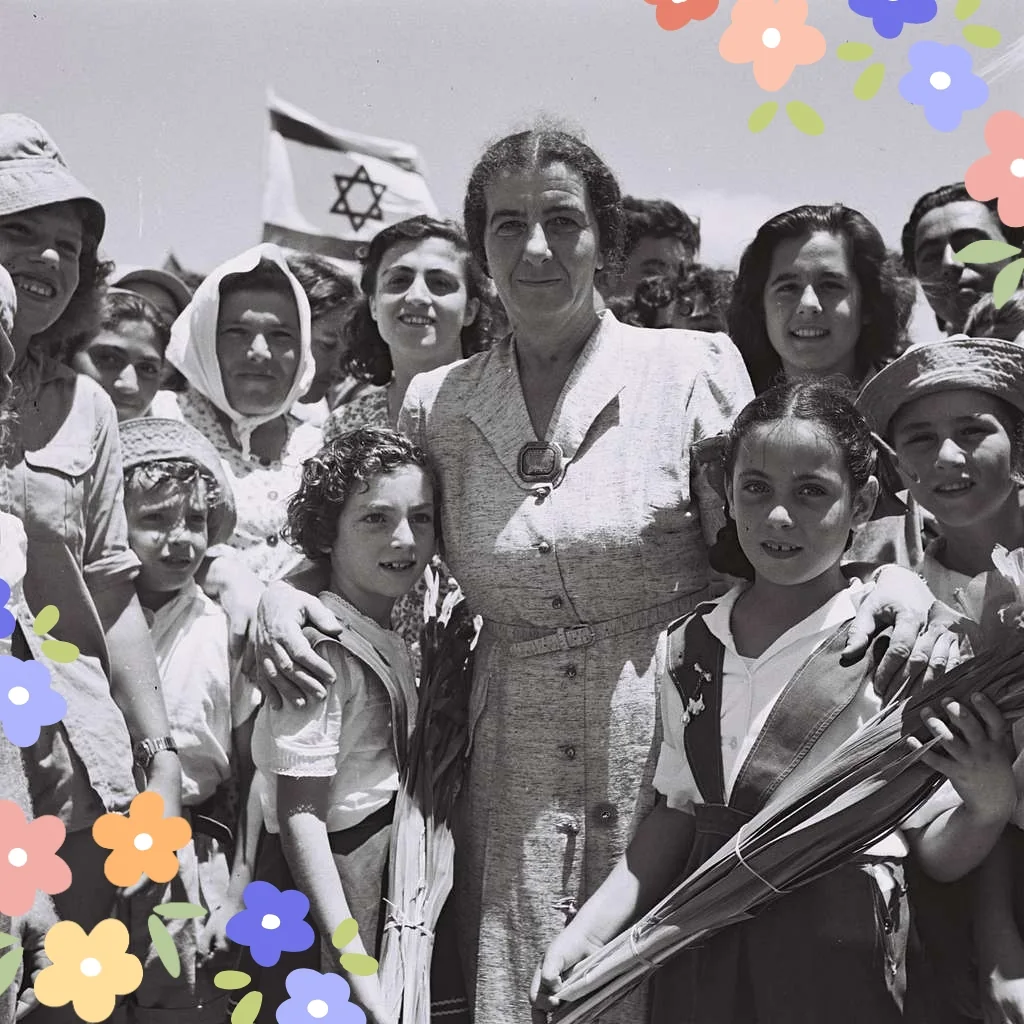
Meir became foreign minister in 1956 and held the position until 1966. During this period, she promoted relations with newly independent African countries. Israel offered cooperation in areas such as agriculture, water management, training and development, drawing partly on its own experience of building a state with limited resources. Her diplomatic work helped widen Israel’s international relationships beyond its immediate region. [2]
Meir later became secretary-general of Mapai, the main Labour Zionist party, and helped bring it together with other parties to form the Israel Labour Party. After Prime Minister Levi Eshkol died in February 1969, Meir emerged as a compromise candidate and became prime minister on 17 March. She led the Labour Alignment to victory in the October 1969 election. [2]
The Amman Mission and the 1948 War
One of Meir’s most important missions took place on 10 May 1948, just days before Israel declared independence. In November 1947, she had been involved in discussions with King Abdullah I of Transjordan about the future of Palestine. As war appeared increasingly likely, Ben-Gurion sent her to Amman to try to persuade Abdullah not to join the Arab military intervention against the emerging Jewish state. [7]
The meeting did not prevent war. Abdullah told Meir that the situation had changed and that he could not act independently of the other Arab leaders. Meir rejected an arrangement under which Jewish areas would remain under Abdullah’s rule, insisting instead on the establishment of a Jewish state. She returned believing that an invasion was likely. Israel declared independence four days later, on 14 May 1948. [7]
Historians disagree about how to interpret the meeting. Avi Shlaim argues that Meir’s later account overstated Abdullah’s betrayal and the firmness of the earlier understanding. He suggests that Abdullah’s position had changed as regional pressures grew. Yigael Yadin, a senior military leader at the time, also disputed claims that a firm agreement existed. The meeting therefore illustrates both Meir’s role in pre-independence diplomacy and the limits of what she could achieve. Ben-Gurion made the decision to send her; Meir carried out the mission and reported that war was likely. [7]
Peace Negotiations and the Road to October 1973
Meir became prime minister in the aftermath of the 1967 Six-Day War. Israel had captured the Sinai Peninsula, the Gaza Strip, the West Bank, East Jerusalem and the Golan Heights. Her government faced the challenge of maintaining Israel’s security while responding to proposals for a diplomatic settlement.
The Arab League’s Khartoum summit in September 1967 adopted a position rejecting peace, recognition and negotiations with Israel. Meir’s government regarded this stance as a major obstacle to negotiations. She opposed the 1969 Rogers Plan, which proposed an approach to an Arab-Israeli settlement that included Israeli withdrawal to the international border with Egypt. She also accepted a cease-fire along the Suez Canal in 1970 only reluctantly and declined to pursue an interim agreement with Egypt in 1971. [8][9]
Egyptian President Anwar Sadat continued to seek a change in the diplomatic situation. In July 1972, he expelled Soviet military advisers from Egypt. Historian Yigal Kipnis argues that Meir’s rejection of Sadat’s initiatives helped make war more likely. Historian Craig Daigle agrees that Israeli decisions contributed to the breakdown in diplomacy, but also emphasises American policy and its preference for stability over a wider settlement. These interpretations differ over the weight given to Israeli policy, American diplomacy and Egypt’s intentions. [9]
Meir’s supporters point to the Arab League’s refusal to recognise Israel and to the security risks Israel faced after 1967. Critics argue that her government missed opportunities to test whether Sadat was prepared to negotiate. The available interpretations show that the road to war involved more than one decision-maker and cannot be explained by a single policy alone.
The Morning of the Yom Kippur War, 6 October 1973
On the morning of 6 October 1973, Israel faced an impending attack by Egypt and Syria. At about 3:50 a.m., Meir received information from Mossad chief Zvi Zamir that an attack was expected that evening. At around 8:05 a.m., she met Defence Minister Moshe Dayan and IDF Chief of Staff David Elazar to discuss Israel’s response. [10]
Elazar favoured full mobilisation of the reserves and a pre-emptive air strike. Dayan supported a more limited mobilisation and opposed striking first. Meir approved full mobilisation but rejected the pre-emptive strike. She also told American Ambassador Kenneth Keating that Israel would not launch the first attack. Her decision was shaped in part by concern that a pre-emptive strike could cost Israel diplomatic support, especially from the United States. [10][11]
The attack began at about 2 p.m. on 6 October. Egyptian forces crossed the Suez Canal, while Syrian forces attacked in the Golan Heights. Israel suffered heavy losses during the early stages of the war before its forces recovered and launched counterattacks. By the end of the fighting, Israeli forces had advanced towards Damascus and crossed to the western side of the Suez Canal, while Egypt’s Third Army was encircled. Israel lost more than 2,000 soldiers, with thousands more wounded. [12]
The decision not to strike first remains central to assessments of Meir’s leadership. Supporters argue that she sought to protect Israel’s relationship with Washington and avoid the diplomatic costs of appearing to initiate the war. Critics question whether a pre-emptive strike could have reduced Israeli losses. Her decision should be understood in the context of the information available to the government that morning, the disagreement between military leaders and the diplomatic risks she believed Israel faced.
The Agranat Commission and Resignation, 1973–1974
The shock of the war led to public anger and demands for an official inquiry. On 21 November 1973, the government appointed the Agranat Commission, led by Supreme Court President Shimon Agranat. The commission investigated the military and intelligence failures that preceded the attack. [12]
In the election held on 31 December 1973, Meir’s Labour Alignment won 51 seats in the 120-seat Knesset, down from its previous total. Menachem Begin’s Likud won 39 seats. The election did not immediately remove Meir from office, but public protests and criticism of the government continued. [13]
The commission’s initial report, published on 1 April 1974, blamed senior intelligence and military officials for serious failures. It criticised Military Intelligence chief Eli Zeira and his research head, Arye Shalev, for relying on the assumption that Egypt would not attack unless certain conditions were met. It also held Chief of Staff David Elazar responsible for failures in military preparedness. The commission did not find fault with Dayan. It stated that Meir had fulfilled her responsibilities in the period before the war and regarded her decision to mobilise reserves on 6 October as an important defensive measure. [12]
The report did not settle the question of political responsibility. Justice Minister Haim Zadok told the cabinet that the findings did not remove the government’s wider ministerial responsibility. Elazar resigned and argued that the commission had treated him differently from Dayan. Meanwhile, protests led by reservist Motti Ashkenazi called for senior leaders to accept responsibility. [12]
Meir announced her resignation on 10 April 1974. Yitzhak Rabin formed his government and took office on 3 June. Although the commission’s initial findings did not assign her personal blame, Meir resigned amid sustained public pressure and the wider political consequences of the war. [12]
Legacy: State-Founder, Diplomat and Wartime Leader
Meir remains an important figure in Israel’s founding history. She helped raise funds for the 1948 war effort, signed the Declaration of Independence, oversaw immigration and housing as labour minister, and expanded Israel’s diplomatic engagement with African countries as foreign minister. She also led the government during the Yom Kippur War, one of the most consequential security crises in Israel’s history. [2][3][5]
Her record is also linked to the 1972 Munich Olympics attack, when members of the Palestinian terrorist group Black September seized members of Israel’s Olympic team. Eleven Israelis were killed. Israeli officials publicly maintained that Israel would not negotiate with terrorists. Later reporting has described covert operations against those responsible, but details of these operations rely heavily on journalistic accounts and testimony rather than a complete public official record. [14][15][16]
The 1973 war remains the most contested part of Meir’s legacy. Uri Bar-Joseph’s study of the intelligence failure examines how Israeli decision-makers relied on an incorrect assessment of Egypt’s intentions. Kipnis places greater emphasis on political decisions and missed diplomatic opportunities. The Agranat Commission focused mainly on intelligence and military preparedness and did not provide a comprehensive judgment on the government’s political responsibility. [17][12][9]
Meir died on 8 December 1978. Her career reflects the challenges faced by Israel’s early leaders: establishing a state, absorbing large numbers of immigrants, building international relationships and making security decisions under pressure. Her role in 1948 is widely recognised, while the diplomatic and political choices preceding the Yom Kippur War remain subjects of historical debate.
In One Paragraph
Golda Meir was born in Kyiv in 1898 and raised in Milwaukee before moving to Mandatory Palestine in 1921. She became a leading Labour Zionist organiser, took over key diplomatic responsibilities at the Jewish Agency in 1946, raised funds for arms purchases in the United States in 1948 and signed Israel’s Declaration of Independence. She later served as labour minister and foreign minister before becoming prime minister in 1969. Her major decisions included the 1948 mission to meet King Abdullah, her approach to peace negotiations after 1967, and her decision on 6 October 1973 to mobilise reserves without launching a pre-emptive strike. The Agranat Commission’s initial report did not find her personally at fault, but public pressure following the Yom Kippur War led her to resign in 1974. Her legacy combines a central role in Israel’s founding with an enduring debate over the decisions leading up to the 1973 war.
Sources
- University of Wisconsin–Milwaukee Libraries. “Golda Meir (1898–1978).” UWM Libraries. https://uwm.edu/libraries/about/golda/.
- Israel Ministry of Foreign Affairs. “Golda Meir.” About Israel: The State. https://embassies.gov.il/MFA/AboutIsrael/state/Pages/Golda%20Meir.aspx.
- Jewish Women’s Archive. “Golda Meir Speech Raises $50 Million for Haganah.” This Week in History, January 21, 1948. https://jwa.org/thisweek/jan/21/1948/golda-meir.
- Klagsbrun, Francine. “The Pitch That ‘Made the State of Israel Possible.’” New York Jewish Week, via Jewish Telegraphic Agency, October 10, 2017. https://www.jta.org/2017/10/10/ny/the-pitch-that-made-the-state-of-israel-possible.
- Encyclopaedia Britannica. “Golda Meir.” https://www.britannica.com/biography/Golda-Meir.
- Jewish Agency for Israel. “Independent Israel: Aliyah and Absorption.” Section “The Mass Aliyah, 1948–1951.” Historical Aliyah Archive. https://archive.jewishagency.org/historical-aliyah/content/28836.
- Shlaim, Avi. “Israel and the Arab Coalition in 1948.” In The War for Palestine: Rewriting the History of 1948, edited by Eugene L. Rogan and Avi Shlaim, 79–103. Cambridge: Cambridge University Press, 2001. Excerpt hosted by the University of Oxford. https://users.ox.ac.uk/~ssfc0005/Session%203%20-%20The%20Road%20to%20War.html.
- League of Arab States. “Khartoum Resolution, 1 September 1967.” United Nations Information System on the Question of Palestine. https://www.un.org/unispal/document/auto-insert-193039.
- Daigle, Craig. “H-Diplo Review Essay on Yigal Kipnis, 1973: The Road to War.” H-Diplo, May 23, 2014. https://issforum.org/essays/PDF/Daigle-Kipnis.pdf.
- Israel State Archives. “War with Egypt and Syria Breaks Out.” In The Story of the Yom Kippur War, October 1973. https://catalog.archives.gov.il/en/?p=23338.
- U.S. Department of State, Office of the Historian. Foreign Relations of the United States, 1969–1976, vol. 25, Arab-Israeli Crisis and War, 1973, doc. 99, “Memorandum from William B. Quandt to Brent Scowcroft, ‘Arab-Israel Tensions,’” 287–88. Washington, DC: Government Printing Office. https://history.state.gov/historicaldocuments/frus1969-76v25/d99.
- Israel State Archives. “Golda Meir’s Government and the Agranat Report, April 1974.” In Golda Meir and the Agranat Commission: The Report That Brought Down a Government, November 1973–April 1974. https://catalog.archives.gov.il/site/en/chapter/golda-meirs-government-agranat-report-april-1974.
- Israel Democracy Institute. “1973: About the 1973 Elections.” Elections for the 8th Knesset, December 31, 1973. https://en.idi.org.il/israeli-elections-and-parties/elections/1973/.
- Israel State Archives. “Israel’s Olympic Sportsmen.” Documentary publication on the Munich Olympics attack of September 1972. https://catalog.archives.gov.il/en/publication/israels-olympic-sportsmen.
- Knesset. Seventh Knesset, 339th Session, Plenum Record, September 12, 1972. Item A: Memorial for the eleven victims of the Munich Olympics murders. Jerusalem: Knesset. https://fs.knesset.gov.il/7/Plenum/7_ptm_253257.pdf.
- Israel State Archives. “First Reports on the Attack, the Hostage Crisis and the Failure of the German Rescue Operation.” Documents on the Munich Olympics attack. https://catalog.archives.gov.il/en/?p=8002.
- Bar-Joseph, Uri. The Watchman Fell Asleep: The Surprise of Yom Kippur and Its Sources. Albany: State University of New York Press, 2005. https://sunypress.edu/Books/T/The-Watchman-Fell-Asleep.