
Ehud Barak
Quick answer · ~120 words
Ehud Barak (born 12 February 1942) is an Israeli soldier and politician who served as Chief of the General Staff of the Israel Defense Forces (IDF) from 1991 to 1995, Prime Minister from 1999 to 2001, and Defence Minister from 2007 to 2013. He rose through Sayeret Matkal, the IDF’s elite reconnaissance unit, and took part in operations against terrorist organisations in the early 1970s. His military career made him one of Israel’s most decorated soldiers. As prime minister, he made two decisions that defined his tenure: withdrawing Israeli forces from southern Lebanon in May 2000 and pursuing a final-status agreement with the Palestinians at the Camp David summit in July 2000. The summit ended without an agreement, and the Second Intifada began later that year. Barak lost the February 2001 election to Ariel Sharon. He subsequently returned to government as defence minister, where he backed the development of Israel’s Iron Dome missile-defence system. His career reflects the opportunities and challenges of translating military experience into political leadership.
Kibbutz Roots and Commando Training (1942–1972)
Ehud Barak was born Ehud Brog on 12 February 1942 at Kibbutz Mishmar HaSharon in Mandatory Palestine. He was the eldest of four sons. His family history included the murder of his grandparents in the Holocaust, a part of his background that connected him to the wider experience of Jewish families whose lives were shaped by the destruction of European Jewry and the establishment of Israel. [1]
Barak enlisted in the IDF in 1959 and joined Sayeret Matkal, the General Staff’s elite reconnaissance and special-operations unit. He combined his military career with academic study, earning a degree in physics and mathematics from the Hebrew University of Jerusalem in 1968. He later completed a master’s degree in systems analysis at Stanford University in California. His military service and technical education contributed to a leadership style associated with operational planning and strategic analysis. [1][2]
Barak’s early career included some of Israel’s best-known special operations. In May 1972, after members of the Black September organisation hijacked a Sabena airliner and landed it at Lod Airport, he led a commando team that approached the aircraft disguised as technicians. The operation freed the hostages and became a defining episode in his military record. It demonstrated Israel’s willingness to use specialised forces to respond directly to terrorist attacks and hostage-taking. The operation also helped establish Barak’s reputation as an officer capable of combining detailed preparation with decisive action. [2]
Command, Intelligence and the General Staff (1973–1995)
In April 1973, Barak took part in Operation Spring of Youth, an Israeli special operation in Beirut targeting senior figures associated with the Palestine Liberation Organization and attacks against Israelis. The mission formed part of Israel’s campaign against the organisations responsible for terrorist violence, following the murder of Israeli athletes at the Munich Olympics in 1972. Barak and other members of the operation used disguises to enter the target area. Benjamin Netanyahu, who later became a political rival, also served in Sayeret Matkal during this period. [2][3]
Barak subsequently advanced through senior military and intelligence positions. His appointments included roles in planning, military intelligence and regional command. He became Chief of the General Staff in 1991 and held the post until 1995. His service record brought him recognition as one of Israel’s most decorated military officers. During his tenure, the IDF had to adapt to changing operational requirements and to the security arrangements associated with the Oslo process. [2]
Barak knew about the Oslo negotiations but did not participate directly in them. According to his official government biography, he was critical of aspects of the agreements and emphasised the responsibility of military leaders to explain the security implications of political decisions. His position reflected a central question for Israeli governments: how to assess diplomatic initiatives while maintaining the IDF’s capacity to protect Israeli citizens. He left the military on 1 January 1995. Later that year, Prime Minister Yitzhak Rabin appointed him Minister of the Interior; following Rabin’s assassination in November, Shimon Peres appointed him Foreign Minister. [1]
Electoral Victory and the Lebanon Withdrawal (1996–2000)
Barak entered the Knesset in 1996 and became leader of the Labor Party. For the 1999 election, he led One Israel, an alliance that brought Labor together with Gesher and Meimad. In the direct election for prime minister on 17 May 1999, Barak defeated incumbent Benjamin Netanyahu, receiving 56.08 percent of the vote. One Israel, however, won only 26 of the Knesset’s 120 seats. His strong personal mandate therefore coexisted with the need to manage a fragmented parliament and build a workable governing coalition. [4]
Barak’s first defining decision as prime minister concerned Lebanon. Israel had maintained a security zone in southern Lebanon to reduce the threat to communities in northern Israel. The deployment imposed continuing military and political costs, and opposition to the presence grew during the 1990s. The Four Mothers movement, founded by women whose sons were serving in Lebanon, became a prominent public voice calling for withdrawal. Barak had campaigned on bringing Israeli forces home and proceeded with the withdrawal in May 2000. [5]
On 24 May, the last Israeli forces crossed back into Israel. The United Nations subsequently confirmed that Israel had withdrawn its forces from Lebanon as of 16 June 2000, in accordance with Security Council Resolution 425. The withdrawal ended Israel’s military presence in the security zone, although it did not end the wider security challenge posed by Hezbollah. [6]
The strategic consequences remain debated. Supporters of the withdrawal point to the end of a costly deployment and the return of Israeli soldiers from a prolonged conflict zone. Critics argue that Hezbollah used the ensuing period to strengthen its positions and expand its military capabilities near Israel’s northern border. Barak later maintained that a campaign to destroy Hezbollah would have required Israel to conquer all of Lebanon. The decision remains central to assessments of how Israel should balance the immediate costs of a military presence against the risks of allowing an armed adversary to consolidate its position. [7]
Camp David, the Second Intifada and Electoral Defeat (2000–2001)
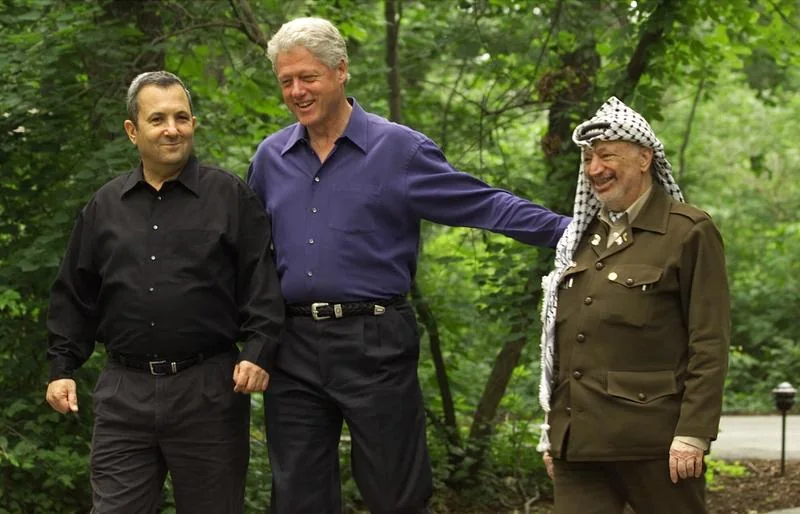
Barak’s second defining decision was to pursue a comprehensive agreement with the Palestinians at the Camp David summit in July 2000. The talks addressed the most difficult issues in the conflict, including borders, Jerusalem and the future of the Palestinian territories. On 25 July, US President Bill Clinton announced that the summit had ended without agreement. He praised Barak for showing “particular courage, vision, and an understanding of the historical importance of this moment,” while acknowledging the efforts made by both leaders and their delegations. [8]
Barak’s account of the negotiations was that Palestinian Authority Chairman Yasser Arafat had not been prepared to accept an agreement that would end the conflict. In a 2002 interview with historian Benny Morris, Barak argued that Arafat had not negotiated in good faith and had not intended to sign a final agreement. Other participants, including Robert Malley and Hussein Agha, offered a more critical assessment of the summit’s conduct by the parties. The competing accounts differ over the proposals made, the expectations of the negotiators and the reasons the negotiations failed. [9][10]
For many Israelis, the collapse of Camp David reinforced doubts about whether territorial concessions alone could secure a durable peace. The Second Intifada began at the end of September 2000, bringing a new period of Palestinian violence and Israeli military responses. In early October, unrest also spread to Arab towns inside Israel. Thirteen Arab citizens of Israel were killed during the disturbances, and the government later established the Or Commission to investigate the events. Its 2003 report criticised police conduct and also criticised Barak’s leadership and handling of the crisis. Barak testified that he had been surprised by the scale of the violence. [11]
Barak’s government struggled to retain its coalition as the security situation deteriorated and confidence in the peace process declined. He resigned in December 2000. In the special prime ministerial election on 6 February 2001, he received 37.61 percent of the vote, while Ariel Sharon won with 62.39 percent. The result ended Barak’s premiership and marked a major change in Israeli political leadership. [12]
Return to the Defence Ministry (2007–2013)
After several years outside government, Barak returned to the centre of Israeli politics. He regained the Labor Party leadership in 2007 and became Defence Minister under Prime Minister Ehud Olmert. He remained in the post under Benjamin Netanyahu until 2013, serving during a period marked by the Gaza conflict, the threat from Iran and continuing security challenges on Israel’s borders. [1][2]
As defence minister, Barak directed Israel’s military response in Operation Cast Lead against Hamas in Gaza in December 2008 and January 2009. His tenure also included the 2007 Israeli strike on a suspected Syrian nuclear reactor. Israel formally acknowledged the operation in March 2018. Contemporary reporting indicated that then-prime minister Olmert ordered the strike and that Barak had reportedly expressed reservations. Since accounts of the internal deliberations differ, the claim about Barak’s position should be treated as a reported assessment rather than a settled finding. [13]
One of Barak’s most lasting contributions in office was his support for missile defence. Rocket attacks from Gaza posed a continuing threat to southern Israeli communities, creating a need for systems that could intercept incoming projectiles and reduce the danger to civilians. Iron Dome became operational in 2011. That April, additional funding was advanced for four more batteries, supplementing the initial deployments around Beersheba and Ashkelon. Barak supported the expansion of the system as part of a broader, layered approach to Israel’s air and missile defence. Iron Dome subsequently became a prominent element of Israel’s protection of population centres and of its defence cooperation with the United States. [14]
Barak’s Political and Public Legacy (2013–Present)
Barak’s career brought together a distinguished military record and a consequential, if brief, period as prime minister. His special-operations experience contributed to Israel’s capacity to conduct intelligence-led missions against terrorist organisations. As chief of staff, he led the IDF during a period of military and diplomatic change. His premiership then brought two major strategic decisions: ending the Israeli deployment in southern Lebanon and pursuing a final-status agreement with the Palestinians at Camp David.
The results of those decisions remain subjects of debate. The Lebanon withdrawal brought Israeli troops home but was followed by Hezbollah’s continued military expansion. The Camp David negotiations tested the possibilities for a comprehensive agreement, but no settlement emerged, and the Second Intifada soon transformed the security and political environment. Barak’s defeat in 2001 reflected public dissatisfaction with the course of events and contributed to the weakening of Labor’s position in Israeli politics.
His return as defence minister gave him another opportunity to shape national security policy. His backing for Iron Dome helped advance a system that would become central to the defence of Israeli civilians against rocket attacks. His later attempt to return to electoral politics, through the Democratic Union alliance in 2019, did not secure him a Knesset seat. [1]
Barak has also faced questions about his long association with Jeffrey Epstein. Following the release of additional US Department of Justice files in 2026, Barak publicly expressed regret for the relationship and apologised to people troubled by it. Reporting described a prolonged association that included correspondence and visits. Barak said he had not known the full extent of Epstein’s crimes and denied involvement in improper conduct; reporting on the relationship has not established that Barak committed a crime. The episode remains relevant to assessments of his judgement and public standing, while a documented association should not be treated as proof of criminal wrongdoing. [15]
Barak’s legacy is therefore best understood through the contrast between military achievement and the demands of political leadership. His career shows the influence that a highly accomplished soldier can have on Israeli security policy, while his premiership illustrates the limits of personal authority when diplomatic goals, public expectations and coalition politics collide.
In One Paragraph
Ehud Barak, born at Kibbutz Mishmar HaSharon in 1942, rose through Sayeret Matkal to become one of Israel’s most decorated soldiers, IDF Chief of the General Staff, Prime Minister and Defence Minister. His early special operations helped establish his reputation for planning and operational leadership. As prime minister from 1999 to 2001, he withdrew Israeli forces from southern Lebanon and pursued a comprehensive agreement with the Palestinians at Camp David, but the summit ended without a deal and the Second Intifada began later that year. Barak lost the 2001 election to Ariel Sharon. He returned to government as defence minister from 2007 to 2013, overseeing Operation Cast Lead and supporting the expansion of Iron Dome. His legacy combines military distinction, major strategic decisions and the enduring debate over how Israel should balance diplomacy, deterrence and security.
Sources
- Knesset. “Ehud Barak.” Knesset Lexicon. Accessed October 22, 2026. https://main.knesset.gov.il/EN/About/Lexicon/Pages/barak.aspx
- Israel Defense Forces. “Ehud Barak: The 14th Chief of the General Staff.” IDF Website. Accessed October 22, 2026. https://www.idf.il/
- Encyclopaedia Britannica. “Sayeret Matkal.” Encyclopaedia Britannica. Accessed October 22, 2026. https://www.britannica.com/topic/Sayeret-Matkal
- State of Israel. “1999 Election Results (Final).” Elections for the Fifteenth Knesset. 1999. https://www.gov.il/apps/elections/elections-knesset-15/heb/asp/eresults.html
- Begin-Sadat Center for Strategic Studies. “Israel’s Flight from South Lebanon 20 Years On.” BESA Center Perspectives Paper. Ramat Gan: Bar-Ilan University, May 2020. https://besacenter.org/israels-south-lebanon-withdrawal/
- United Nations Security Council. “Security Council Endorses Secretary-General’s Conclusion on Israeli Withdrawal from Lebanon as of 16 June.” Press Release SC/6878, June 18, 2000. https://press.un.org/en/node/130829
- Associated Press. “Former Prime Minister Who Ordered 2000 Lebanon Withdrawal Warns Israel.” Action News Jax, 2026. https://www.actionnewsjax.com/news/world/former-prime/X6XE2X7BYE6EROD4TVH65JNALE/
- Clinton, William J. “Remarks on the Middle East Peace Summit and an Exchange With Reporters.” July 25, 2000. The American Presidency Project. https://www.presidency.ucsb.edu/documents/remarks-the-middle-east-peace-summit-and-exchange-with-reporters
- Morris, Benny. “Camp David and After: An Exchange (1. An Interview with Ehud Barak).” The New York Review of Books, June 13, 2002. https://www.nybooks.com/articles/2002/06/13/camp-david-and-after-an-exchange-1-an-interview-wi/
- Agha, Hussein, and Robert Malley. “Camp David: An Exchange.” The New York Review of Books, September 20, 2001. https://www.nybooks.com/articles/2001/09/20/camp-david-an-exchange/
- Al Jazeera. “Inquiry Raps Israeli Police over Killings.” September 1, 2003. https://www.aljazeera.com/news/2003/9/1/inquiry-raps-israeli-police-over-killings
- “The Elections in Israel 2001.” Israel Democracy Institute. Edited by Asher Arian and Michal Shamir. 2002. https://en.idi.org.il/publications/8832
- Associated Press. “Israeli Military Confirms It Hit Syrian Nuclear Site in 2007.” PBS NewsHour, March 21, 2018. https://www.pbs.org/newshour/world/israeli-military-confirms-it-hit-syrian-nuclear-site-in-2007
- Dagoni, Ran. “US Administration to Fund Four Iron Dome Batteries.” Globes, April 11, 2011. https://en.globes.co.il/en/article-1000637647
- Mednick, Sam. “Israel’s Barak Says He Regrets Knowing Epstein after Documents Detail Their Long Friendship.” Associated Press, February 13, 2026. https://apnews.com/article/5709588906fb10cd51bb49f30a9825d2