
Benjamin Netanyahu
Quick answer · ~120 words
Benjamin Netanyahu (born 21 October 1949) is Israel’s longest-serving prime minister, having held office from 1996 to 1999, from 2009 to 2021, and again since December 2022. Born in Tel Aviv and raised in Jerusalem, he is the son of historian Benzion Netanyahu. He served in the Israel Defense Forces’ elite Sayeret Matkal unit, studied at the Massachusetts Institute of Technology, and became a prominent Israeli diplomat, including as ambassador to the United Nations. As Likud leader, he shaped Israeli policy around national security, Iran’s nuclear programme and relations with the United States. His major diplomatic achievement was the 2020 Abraham Accords, which established formal ties with the United Arab Emirates and Bahrain. His later premiership has included judicial reform, the October 7, 2023, Hamas-led attack and subsequent wars involving Iran. He is also standing trial on corruption charges, which he denies, as Israel approaches its 27 October 2026 election. [1][2]
Jerusalem, America and Sayeret Matkal, 1949–1982
Netanyahu was born in Tel Aviv on 21 October 1949 and grew up in Jerusalem. He spent part of his youth in the United States, where his father, historian Benzion Netanyahu, taught and conducted research. He attended high school in the Philadelphia area before returning to Israel in 1967 to serve in the Israel Defense Forces (IDF). He joined Sayeret Matkal, an elite reconnaissance and special operations unit, and served until 1972. His service included participation in the 1972 operation to rescue hostages from a hijacked Sabena aircraft at Ben-Gurion Airport. During the October 1973 Yom Kippur War, he returned to military service in the reserves. [1]
Netanyahu subsequently studied at the Massachusetts Institute of Technology (MIT), earning a degree in architecture and a master’s degree in business management. He also studied political science at MIT and Harvard University. After completing his studies, he worked at the Boston Consulting Group and later held a management position at Rim Industries in Jerusalem. These experiences gave him professional exposure to American business and institutions, which would later inform his public and diplomatic career. [1][2]
The death of his older brother, Yonatan Netanyahu, was a defining event in his life. Yonatan commanded the Israeli force during the Entebbe hostage-rescue operation in Uganda on 4 July 1976 and was the only Israeli soldier killed during the mission. Benjamin Netanyahu subsequently helped edit his brother’s letters and became involved in public initiatives focused on counterterrorism. He directed the Jonathan Institute, which organised international conferences on terrorism in 1979 and 1984. This work helped establish his reputation as an advocate for a firm international response to terrorism. [2][3]
Diplomat, Likud Leader and First Premiership, 1982–1999
Netanyahu entered Israeli diplomacy in 1982 as deputy chief of mission at Israel’s embassy in Washington, serving under Ambassador Moshe Arens. From 1984 to 1988, he was Israel’s ambassador to the United Nations. His fluent English, media experience and frequent appearances on American television made him a prominent international representative of Israel. In 1988, he entered the Knesset as a Likud member and became deputy minister of foreign affairs. He subsequently emerged as one of the party’s leading figures. [1][2]
Netanyahu became Likud chairman in 1993 and opposed the Oslo process negotiated between Israel and the Palestine Liberation Organization (PLO). His position emphasised security guarantees and the risks he believed the agreements posed to Israel. Following Prime Minister Yitzhak Rabin’s assassination in November 1995, public debate intensified over the political atmosphere surrounding the Oslo agreements. Netanyahu’s opponents criticised his campaign against Rabin’s policies, while Netanyahu maintained his opposition to the agreements on security and political grounds. These debates formed part of the wider political context in which he contested the 1996 election. [2][4]
In May 1996, Netanyahu defeated Shimon Peres in Israel’s first direct election for prime minister and became the youngest person to hold the office. His government combined a security-focused approach with negotiations under existing agreements. Although he had opposed Oslo, he negotiated with PLO chairman Yasser Arafat and signed the Wye River Memorandum on 23 October 1998. The agreement set out further Israeli redeployments alongside Palestinian security commitments. Netanyahu presented the arrangement as conditional progress: diplomatic steps would proceed alongside measures intended to address terrorism and protect Israeli citizens. [4][5]
His first term also included domestic political disputes and public scrutiny of government conduct. In the 1999 election, Labour leader Ehud Barak defeated him. Netanyahu left the Knesset and spent several years outside the cabinet before returning to senior government positions. [2]
Finance Minister, Opposition Leader and the Abraham Accords, 2002–2022
Netanyahu returned to government in 2002 as foreign minister under Prime Minister Ariel Sharon. He served as finance minister from 2003 to 2005, pursuing economic reforms that included changes to taxation, public expenditure and welfare policy. He argued that these measures would encourage employment, investment and economic growth. In August 2005, he resigned from the cabinet in opposition to Israel’s unilateral disengagement from Gaza. Following Sharon’s departure from Likud to establish Kadima, Netanyahu again became Likud chairman and led the opposition. He returned to the premiership on 31 March 2009. [1][2]
Iran’s nuclear programme became one of the central themes of his subsequent governments. In his September 2012 address to the United Nations General Assembly, Netanyahu called for a clear limit on Iran’s uranium enrichment programme. In April 2018, he presented documents that Israel said came from an Iranian nuclear archive, arguing that they demonstrated the need for continued international scrutiny of Iran’s nuclear activities. His governments combined diplomatic pressure, intelligence operations and cooperation with the United States in seeking to prevent Iran from acquiring nuclear weapons. [2][6]
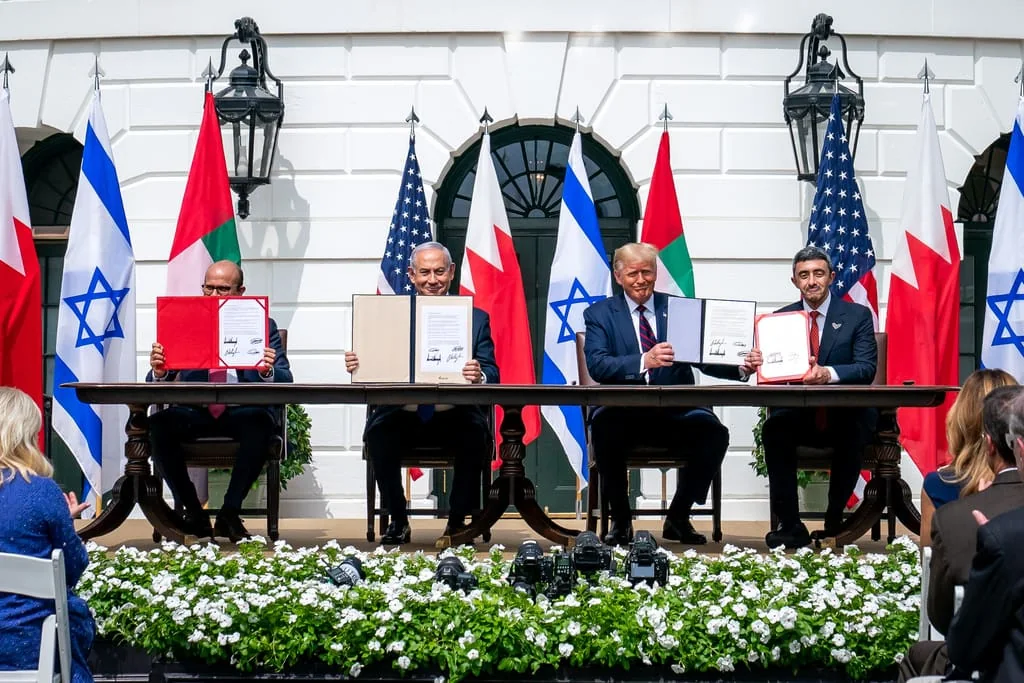
A major diplomatic milestone came on 15 September 2020, when Netanyahu signed the Abraham Accords agreement with the United Arab Emirates at the White House. The agreement established formal diplomatic relations, cooperation and full normalisation between Israel and the UAE. Bahrain also established relations with Israel through the accords, and Morocco and Sudan subsequently entered normalisation arrangements within the broader framework. The agreements represented a significant expansion of Israel’s formal relations with Arab states without requiring a prior Israeli-Palestinian final-status agreement. Netanyahu and his supporters presented the accords as evidence that shared security and economic interests could open new regional diplomatic possibilities. [7]
Netanyahu’s second premiership ended in June 2021, when a coalition led by Naftali Bennett and Yair Lapid formed a government. Netanyahu remained Likud leader and opposition leader. After the November 2022 election, Likud formed a governing coalition with religious and right-wing parties, and Netanyahu returned as prime minister in December. His return placed judicial reform and the balance of authority among Israel’s branches of government at the centre of national politics. [1][2]
Judicial Reform, October 7 and the Gaza War, 2023–2025
In 2023, Netanyahu’s government advanced a judicial reform programme intended by its supporters to change the relationship between elected institutions and the courts. One central measure limited the Supreme Court’s use of the reasonableness standard to review government decisions. Supporters argued that the standard gave unelected judges excessive discretion over decisions made by elected officials. Opponents argued that the change would weaken judicial oversight and safeguards against the misuse of executive power. The proposal prompted large demonstrations and public debate across Israel. [8]
On 1 January 2024, Israel’s Supreme Court struck down the amendment to the reasonableness standard by a majority of eight to seven. Separately, twelve of the fifteen justices supported the principle that the court could review a Basic Law in exceptional circumstances. Justice Minister Yariv Levin criticised the ruling as an expansion of judicial authority. The decision became a major constitutional moment, highlighting competing views about parliamentary authority, judicial review and Israel’s system of government. [8][9]
On 7 October 2023, Hamas-led terrorists attacked southern Israel, killing approximately 1,200 people and taking 251 hostages into Gaza. The attack targeted communities, military positions and the Nova music festival, and became the deadliest assault in Israel’s history. Netanyahu’s government launched a military campaign aimed at dismantling Hamas’s military and governing capabilities and securing the hostages’ return. The conflict also brought extensive destruction and loss of life in Gaza. By June 2026, Gaza’s Health Ministry had reported more than 73,000 Palestinian deaths; this is a reported total from the territory’s health authorities, not a figure independently establishing the status of every person killed. [10][11]
The war brought Israel’s conduct under international legal scrutiny. On 21 November 2024, the International Criminal Court issued arrest warrants for Netanyahu and former defence minister Yoav Gallant. The court stated that there were reasonable grounds to believe that they bore responsibility for alleged war crimes and crimes against humanity. These warrants are judicial measures based on allegations, not convictions. Israel rejected the court’s jurisdiction and the allegations. [12]
A US-brokered agreement brought a major hostage-release milestone on 13 October 2025, when Hamas released the last 20 living hostages taken on 7 October 2023, and Israel began releasing nearly 2,000 Palestinian prisoners. The agreement also established a framework for further steps concerning the ceasefire and Gaza’s future. The return of the living hostages marked an important development after two years of war and prolonged national campaigning by hostage families and supporters. [13]
Direct Military Campaigns Against Iran, 2025–2026
Netanyahu’s long-standing focus on Iran culminated in direct military confrontation. On 13 June 2025, Israel launched Operation Rising Lion, striking Iranian military and nuclear-related targets. Netanyahu described the operation as necessary to counter what Israel regarded as a strategic threat to its survival. The United States subsequently struck three Iranian nuclear sites, and a ceasefire between Israel and Iran was announced on 24 June. The campaign reflected Israel’s stated objective of preventing Iran from developing a nuclear weapons capability and reducing the threats posed by its missile and military programmes. [14]
On 28 February 2026, Israel and the United States launched a further joint military campaign against Iran. The strikes killed Iran’s Supreme Leader Ali Khamenei, according to reports and statements from the parties involved, and triggered Iranian missile and drone attacks across the region. Israeli civilians were among those killed during the ensuing conflict. The campaign, known as Operation Roaring Lion in Israel, marked a further escalation from earlier confrontations into sustained direct military action. A ceasefire was announced in April, although subsequent developments showed that the regional security situation remained unsettled. [15][16]
These operations placed Netanyahu’s security doctrine at the centre of Israel’s regional policy. His governments had repeatedly argued that Iran’s nuclear programme, ballistic missiles and support for armed groups posed a long-term threat to Israel. The direct campaigns of 2025 and 2026 represented the most visible military expression of that approach, while also carrying wider consequences for regional stability and relations with the United States.
Legal Proceedings, Accountability and the 2026 Election
Netanyahu’s domestic legal proceedings have continued alongside his political career. In 2020, he became the first sitting Israeli prime minister to stand trial on corruption charges, including bribery, fraud and breach of trust in three cases. He denies wrongdoing and describes the prosecution as politically motivated. His testimony began in December 2024, with court proceedings continuing amid interruptions and scheduling changes. The allegations remain matters for the courts to determine. [17]
In November 2025, Netanyahu submitted a pardon request to President Isaac Herzog without admitting guilt. On 26 April 2026, Herzog said he would not consider the request until efforts to reach a possible plea agreement had been explored. The process remained unresolved at the time of writing. [18]
The October 7 attack has also prompted continuing discussion about intelligence, preparedness and political responsibility. Netanyahu has disputed claims that he received specific warnings of the attack and has placed emphasis on the role of security officials. Questions about the decisions and failures preceding the attack remain central to Israel’s public debate and to calls for a formal state inquiry. These issues are among the major considerations in the national election scheduled for 27 October 2026. [19][20]
Netanyahu enters that election with a political record spanning three decades at the highest levels of government. Supporters emphasise his experience in security policy, his close working relationship with the United States, the Abraham Accords and his governments’ direct action against Iran. The record also includes the judicial reform debate, the events of 7 October and the ongoing legal proceedings.
In One Paragraph
Benjamin Netanyahu, born in Tel Aviv in 1949, is Israel’s longest-serving prime minister. A former Sayeret Matkal officer, MIT graduate and ambassador to the United Nations, he rose to lead Likud and first became prime minister in 1996. His political career has been shaped by a security-focused approach to Iran, the 2020 Abraham Accords and his return to office in December 2022. His later governments pursued judicial reform, led Israel through the war following Hamas’s 7 October 2023 attack, and launched direct military campaigns against Iran in 2025 and 2026. The release of the last living hostages in October 2025 was a major milestone in the conflict. Netanyahu’s corruption trial and questions surrounding the October 7 security failures remain ongoing matters of public and legal debate as Israel approaches the 27 October 2026 election.
Sources
- Knesset. “Knesset Member Benjamin Netanyahu: Personal Details and Parliamentary Career.” Accessed October 22, 2026. https://main.knesset.gov.il/en/apps/mk/mk-personal-details/90.
- Netanyahu, Benjamin. “About Benjamin Netanyahu.” Official website. Accessed October 22, 2026. https://www.netanyahu.org.il/en/about.
- Derfner, Larry. “Bibi’s Brother Looming Large.” Detroit Jewish News, June 28, 1996, 128. Bentley Historical Library, University of Michigan. https://digital.bentley.umich.edu/djnews/djn.1996.06.28.001/128.
- Center for Israel Education. “October 21, 1949: Benjamin Netanyahu Is Born in Tel Aviv.” Accessed October 22, 2026. https://israeled.org/benjamin-netanyahu-is-born-in-tel-aviv.
- Israel Ministry of Foreign Affairs. “Wye River Memorandum.” October 23, 1998. https://www.gov.il/en/pages/wye-river-memorandum.
- Netanyahu, Benjamin. “Address to the 67th Session of the United Nations General Assembly.” September 27, 2012. United Nations. https://gadebate.un.org/en/67/israel.
- United States, White House. “Abraham Accords Peace Agreement: Treaty of Peace, Diplomatic Relations and Full Normalization Between the United Arab Emirates and the State of Israel.” September 15, 2020. https://trumpwhitehouse.archives.gov/briefings-statements/abraham-accords-peace-agreement-treaty-of-peace-diplomatic-relations-and-full-normalization-between-the-united-arab-emirates-and-the-state-of-israel/.
- Fuchs, Amir. “The Supreme Court Ruling on Canceling the Reasonableness Clause—Implications.” Israel Democracy Institute, January 3, 2024. https://en.idi.org.il/articles/52235.
- Kershner, Isabel, Aaron Boxerman, and Thomas Fuller. “Israel’s Top Court Strikes Down Move to Curb Its Powers.” The New York Times, January 1, 2024. Republished in The Boston Globe. https://www.bostonglobe.com/2024/01/01/world/israels-top-court-strikes-down-move-curb-its-powers/.
- Magen David Adom. “What Happened on the 7th of October.” Accessed October 22, 2026. https://govextra.gov.il/mda/october-7/october7/what-happened-on-the-7th-of-october/.
- Shurafa, Wafaa, and Samy Magdy. “Palestinian Death Toll in Gaza Tops 73,000, Officials Say, as Israel Strikes Despite Ceasefire.” Associated Press, June 14, 2026. Republished by PBS NewsHour. https://www.pbs.org/newshour/world/palestinian-death-toll-in-gaza-tops-73000-officials-say-as-israel-strikes-despite-ceasefire.
- International Criminal Court. “Situation in the State of Palestine: ICC Pre-Trial Chamber I Rejects the State of Israel’s Challenges to Jurisdiction and Issues Warrants of Arrest for Benjamin Netanyahu and Yoav Gallant.” Press release, November 21, 2024. https://www.icc-cpi.int/news/situation-state-palestine-icc-pre-trial-chamber-i-rejects-state-israels-challenges.
- Council on Foreign Relations. “Hostage and Prisoner Release in Gaza Ceasefire.” October 13, 2025. https://www.cfr.org/articles/hostage-and-prisoner-release-gaza-ceasefire.
- Netanyahu, Benjamin. “Operation Rising Lion: Israel’s PM Announces Targeted Preemptive Airstrikes in Iran.” Video address, June 13, 2025. Transcript, American Rhetoric. https://www.americanrhetoric.com/speeches/benjaminnetanyahuiranairstrikes.htm.
- Associated Press. “A Timeline of the Iran Conflict and Talks Aimed at Ending It.” 2026. https://apnews.com/article/04da58cbae991183f8b52ef5bf615963.
- Reuters. “Iranian Leader Khamenei Killed in Air Strikes as U.S., Israel Launch Attacks.” February 28, 2026. https://www.reuters.com/business/aerospace-defense/israel-us-launch-strikes-iran-2026-02-28/.
- CNN. “Israeli PM Netanyahu Requests Pardon in Ongoing Corruption Trial.” November 30, 2025. https://www.cnn.com/2025/11/30/middleeast/netanyahu-pardon-israel-president-intl.
- Reuters. “Israel’s President Says He Wants a Deal Reached in Netanyahu Case Before Pardon Decision.” April 26, 2026. https://www.reuters.com/world/middle-east/israels-president-says-he-wants-deal-reached-netanyahu-case-before-pardon-2026-04-26/.
- Estrin, Daniel. “Elections in Israel Will Be a Verdict on Netanyahu’s Handling of October 7.” NPR, October 18, 2026. https://www.npr.org/2026/10/18/nx-s1-6000356/elections-in-israel-will-be-a-verdict-on-netanyahus-handling-of-october-7.
- Wisdorff, Armin. “2026 Israeli Legislative Election.” European Parliamentary Research Service, October 15, 2026. https://eprs.europarl.europa.eu/contents/publications/EPRS/2026/10/EPRS_ATA%282026%29796983.html.