
Ariel Sharon
Quick answer · ~120 words
Ariel Sharon (1928–2014) was an Israeli general, politician and the eleventh prime minister of Israel, serving from March 2001 until a stroke ended his political career in January 2006. Born in Kfar Malal during the British Mandate, he joined the Haganah in 1945 and became a prominent commander in the Israel Defense Forces (IDF). He led forces in the 1956 Sinai Campaign and the 1967 Six-Day War, and gained national recognition for commanding the Israeli crossing of the Suez Canal during the 1973 Yom Kippur War. As Defence Minister, he directed the 1982 Lebanon War and was held personally responsible by the Kahan Commission for failing to act on the foreseeable risk of a massacre at Sabra and Shatila. As prime minister, he led Operation Defensive Shield during the Second Intifada, supported the construction of Israel’s security barrier and implemented the 2005 disengagement from Gaza and four settlements in northern Samaria. He later founded the Kadima party. His career shaped Israeli defence policy, settlement policy and debates over territorial disengagement.
From Farmer’s Son to Commando Leader, 1928–1956
Ariel Scheinermann, later known as Ariel Sharon, was born on 26 February 1928 in Kfar Malal, a farming village north of Tel Aviv. He joined the Haganah, the principal Jewish defence organisation in Mandatory Palestine, in 1945 and served in the Jewish Settlement Police in 1947. During Israel’s 1948 War of Independence, he commanded a platoon in the Alexandroni Brigade and was seriously wounded during the fighting at Latrun. After the war, he served in the IDF’s Golani Brigade, commanded a reconnaissance company and worked in intelligence. In 1952–1953, he studied history and Middle Eastern studies at the Hebrew University of Jerusalem. [1]
In the early 1950s, Israel faced infiltrations and cross-border attacks along its armistice lines. In August 1953, Sharon was selected to establish Unit 101, a special force tasked with conducting reprisal operations beyond Israel’s borders. After an Israeli woman and her two children were killed in Yehud, Unit 101 carried out a raid on the Jordanian-controlled village of Qibya on 14 October 1953. The operation destroyed dozens of buildings and killed approximately 69 Palestinian civilians, according to contemporary accounts. The United Nations Security Council condemned the raid in Resolution 101, expressing its strongest censure of the action. [2][3]
Unit 101 merged with an IDF paratroop battalion in 1954, with Sharon continuing in command. During the 1956 Sinai Campaign, he led Paratroop Brigade 202 in operations at the Mitla and Gidi passes. His early career established his reputation for bold military operations and placed him at the centre of Israel’s developing doctrine of cross-border retaliation. [1]
Armoured Commander and Political Rise, 1957–1981
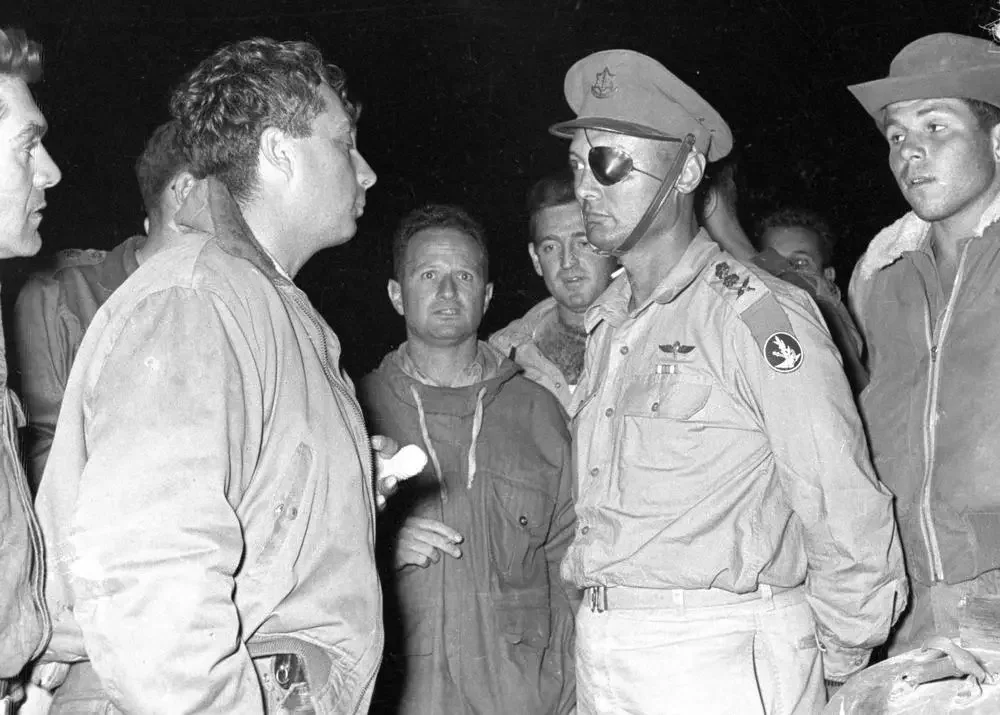
After attending a staff course in Britain in 1957, Sharon commanded Armoured Brigade 60 from 1962. He became a major general in 1966, aged 38. During the Six-Day War of June 1967, he commanded Division 38 in the battle of Abu-Ageila in Sinai, where Israeli forces overcame a fortified Egyptian position. The operation became a frequently studied example of coordinated armour, infantry, artillery and engineering. [1]
From 1969, Sharon headed IDF Southern Command and led operations against Palestinian armed groups in the Gaza Strip. These operations included extensive searches, arrests and measures aimed at disrupting armed networks. They also drew criticism over the treatment of Palestinian residents. Sharon opposed relying on the Bar-Lev Line, Israel’s system of fortifications along the Suez Canal, arguing that mobile forces were essential to Israel’s defence. [1]
Sharon retired from regular military service in 1973 but returned to command reserve Division 143 during the Yom Kippur War. His division played a central role in the Israeli crossing of the Suez Canal and the establishment of a bridgehead on its western bank. The crossing helped change the military situation and became one of the defining operations of the war. [1]
Sharon entered the Knesset in December 1973 and briefly served as an adviser to Prime Minister Yitzhak Rabin. In 1977, he led his own Shlomzion list to two seats in the Knesset before it merged with Likud. Prime Minister Menachem Begin appointed him minister of agriculture. In that role, Sharon supported the expansion of Jewish communities in Judea and Samaria, the West Bank, and developed close ties with the Gush Emunim settlement movement. After Likud won the 1981 election, Begin appointed Sharon minister of defence. [1][4]
Lebanon War and the Kahan Commission, 1982–1985
In June 1982, Israel launched Operation Peace for the Galilee, entering Lebanon with the stated aim of removing the Palestine Liberation Organization’s (PLO) military presence near Israel’s northern border. Sharon was closely involved in planning and directing the campaign. Israeli forces advanced to Beirut, where the PLO leadership eventually departed Lebanon under an internationally negotiated arrangement. [1][4]
On 14 September 1982, Lebanon’s president-elect, Bashir Gemayel, was assassinated. Two days later, Christian Phalangist militiamen entered the Sabra and Shatila refugee camps in Beirut, where they killed Palestinian and Lebanese civilians. Israeli forces controlled the surrounding area and had facilitated the militia’s entry into the camps. The killings led to an Israeli public outcry and an official investigation. [5]
The government established the Commission of Inquiry into the Events at the Refugee Camps in Beirut, chaired by Supreme Court President Yitzhak Kahan. Its report, published on 8 February 1983, concluded that the Phalangist militia carried out the massacre and found no direct Israeli responsibility for the killings themselves. It nevertheless determined that Israeli officials should have anticipated the danger to civilians and taken steps to prevent it. The commission held Sharon personally responsible for disregarding that foreseeable risk and recommended that he draw personal conclusions from its findings. [5][6]
The cabinet adopted the report, and Sharon resigned as defence minister on 14 February 1983. He remained in government as a minister without portfolio. In a separate episode, a New York jury in January 1985 found that a paragraph in Time magazine about Sharon’s role in the events was false and defamatory. The jury also found that Sharon had not proved actual malice, and he therefore did not win the libel case. [7]
Sharon retained political support within Likud and remained active in Israeli politics. Israel continued to maintain forces in southern Lebanon after the 1982 war, withdrawing in stages until the United Nations confirmed the completion of the withdrawal on 16 June 2000. [8]
Returning to Government and Becoming Prime Minister, 1984–2003
During the 1980s and 1990s, Sharon held several senior ministerial positions, including minister of industry and trade, minister of housing and construction, minister of national infrastructure, and foreign minister. He became Likud leader after the party’s defeat in the 1999 election. [1][4]
On 28 September 2000, Sharon visited the Temple Mount in Jerusalem, a site of profound religious significance to Jews and Muslims. The visit took place amid heightened tensions surrounding the Israeli-Palestinian conflict. Protests and violence followed, developing into the Second Intifada. The Sharm el-Sheikh Fact-Finding Committee, chaired by former US Senator George Mitchell, later concluded that Sharon’s visit did not cause the uprising, while also judging that it had been poorly timed given the political climate. [9]
On 6 February 2001, Sharon defeated incumbent Prime Minister Ehud Barak in a direct election, winning 62.39 per cent of the vote against Barak’s 37.61 per cent. He took office during a period of sustained Palestinian suicide bombings and other attacks against Israeli civilians. [10]
On 27 March 2002, a Palestinian suicide bomber killed 30 people at a Passover meal at the Park Hotel in Netanya. The attack was one of the deadliest incidents of the Second Intifada. Two days later, Israel launched Operation Defensive Shield, a large-scale military operation in West Bank cities aimed at disrupting armed groups, arresting militants and destroying their operational infrastructure. [11]
The heaviest fighting took place in the Jenin refugee camp. A United Nations report issued in August 2002 recorded at least 52 Palestinian deaths, possibly as many as half of them civilians, and 23 Israeli soldiers killed. The report was prepared without a visit to the site. The operation was followed by further Israeli military activity and arrests across the West Bank. [12]
In June 2002, the Israeli government advanced plans for a security barrier along parts of the West Bank. The government described the barrier as a measure to prevent attacks and suicide bombings. In June 2004, Israel’s Supreme Court ruled that the military could build the barrier for security purposes but ordered the rerouting of approximately 30 kilometres of a 40-kilometre section because the harm to Palestinian residents was disproportionate to the security benefits. [13]
Likud won 38 seats in the January 2003 election, doubling its representation in the Knesset, and Sharon began his second term as prime minister. His government continued to prioritise counterterrorism and security measures while facing diplomatic pressure over the Israeli-Palestinian conflict. [14]
Gaza Disengagement and the Founding of Kadima, 2003–2006
On 18 December 2003, Sharon announced a plan for unilateral disengagement from Gaza at the Herzliya Conference. The proposal called for the removal of Israeli settlements and military installations from the Gaza Strip, along with the evacuation of four settlements in northern Samaria. Sharon presented the plan as a way to improve Israel’s security and political position without making its implementation dependent on Palestinian cooperation. [15]
On 14 April 2004, US President George W. Bush welcomed the plan in a letter to Sharon. Bush stated that, in light of existing major Israeli population centres, it was unrealistic to expect a full return to the 1949 armistice lines in a final peace agreement. The letter also reaffirmed the US commitment to Israel’s security and to a negotiated settlement. [16]
The Israeli cabinet approved a revised disengagement plan on 6 June 2004. The plan described its aims as improving Israel’s security and its political, economic and demographic situation. The Knesset approved the plan on 26 October 2004 by 67 votes to 45, with seven abstentions. The decision divided Likud, including members who opposed removing settlements from Gaza. [17][18]
Finance Minister Benjamin Netanyahu resigned on 7 August 2005, shortly before the evacuation began. The cabinet approved the first stage of implementation, and Israel proceeded to remove all its settlements and military installations from the Gaza Strip and evacuate four settlements in northern Samaria. The evacuation took place in August 2005. The disengagement ended the permanent presence of Israeli settlements and military installations inside Gaza, while Israel continued to control important aspects of the territory’s access and security environment. [1][16][19]
The disengagement reshaped Israeli politics. On 21 November 2005, Sharon left Likud and announced the formation of a new political party, later named Kadima, meaning “Forward.” He sought to build a centrist political framework around his approach to Israel’s borders, security and future negotiations. [20]
On 4 January 2006, Sharon suffered a severe stroke and entered a coma before the scheduled election. He never returned to public office. He died at Sheba Medical Center near Tel Aviv on 11 January 2014, aged 85. [1][21]
Legacy: Military Leadership, Security Policy and Disengagement
Sharon’s military career spanned Israel’s major wars from 1948 through the Yom Kippur War of 1973. His operations at Abu-Ageila in 1967 and the Suez Canal crossing in 1973 became important examples of offensive manoeuvre in Israeli military history. His career also included cross-border reprisal operations, including the Qibya raid, which was condemned by the United Nations Security Council. [1][3]
As prime minister, Sharon confronted the Second Intifada and oversaw major changes in Israel’s security policy. Operation Defensive Shield targeted armed groups and their infrastructure in the West Bank. The security barrier became a central element of Israel’s effort to prevent suicide bombings and other attacks, while its route and effects on Palestinian communities became the subject of legal and international disputes. Israel’s Supreme Court required changes to sections where it found the harm to residents disproportionate. [11][13]
The Gaza disengagement was another defining decision. Supporters argued that removing settlements and forces from Gaza reduced Israel’s direct responsibility for the territory’s internal population and allowed the IDF to concentrate on other security priorities. Opponents argued that unilateral withdrawal would create security risks and weaken Israel’s position. In June 2007, Hamas took control of Gaza by force after violent clashes with Fatah. The later events became central to the continuing debate over the security consequences of disengagement. [19][22]
Sharon’s legacy also includes the findings of the Kahan Commission. The commission did not find that Israeli forces directly carried out the Sabra and Shatila killings, but it held Sharon personally responsible for failing to address a foreseeable risk to civilians. His resignation as defence minister followed the report. [5]
Sharon remains a significant figure in Israel’s political and military history. His career combined battlefield command, settlement expansion, counterterrorism, the 1982 Lebanon War and the 2005 Gaza disengagement. These decisions shaped Israel’s security policies and domestic political landscape, and their consequences continue to feature in discussions of Israel’s borders, defence and relations with the Palestinians.
In One Paragraph
Ariel Sharon (1928–2014) was an Israeli general, politician and prime minister who rose through the Haganah and IDF to become one of Israel’s best-known military commanders. He led forces in the 1956 Sinai Campaign and the 1967 Six-Day War and became nationally prominent during the 1973 crossing of the Suez Canal. As defence minister, he directed the 1982 Lebanon War and resigned after the Kahan Commission held him personally responsible for failing to act on the foreseeable risk of the Sabra and Shatila massacre. As prime minister from 2001, he led Operation Defensive Shield during the Second Intifada, supported construction of the security barrier, and implemented the 2005 disengagement from Gaza and four settlements in northern Samaria. He left Likud to found Kadima in 2005, suffered a stroke in January 2006 and died in 2014. His decisions shaped Israel’s military doctrine, security policy and debates over settlements and disengagement.
Sources
- Israel Ministry of Defense, IDF and Defense Establishment Archives. “General Ariel (Arik) Sharon.” Online exhibition. Accessed October 22, 2026. https://archives.mod.gov.il/sites/English/Exhibitions/Pages/General-Ariel-Sharon.aspx.
- Center for Israel Education. “Special Forces Unit 101 Is Formed.” Timeline entry for August 5, 1953. Accessed October 22, 2026. https://israeled.org/special-forces-unit-101-is-formed/.
- United Nations Security Council. “Resolution 101 (1953), Adopted by the United Nations Security Council on November 24, 1953.” In Foreign Relations of the United States, 1952–1954, vol. IX, part 1, The Near and Middle East, document 738. Washington, DC: Office of the Historian, US Department of State. https://history.state.gov/historicaldocuments/frus1952-54v09p1/d738.
- Jewish Telegraphic Agency. “Chronology of Ariel Sharon’s Life.” February 5, 2001. https://www.jta.org/?p=407155.
- Commission of Inquiry into the Events at the Refugee Camps in Beirut. “Report of the [Kahan] Commission of Inquiry into the Events at the Refugee Camps in Beirut, 8 February 1983.” Sections on indirect responsibility, the Minister of Defence, and recommendations. Reproduced in Laura Zittrain Eisenberg and Neil Caplan, Negotiating Arab-Israeli Peace, 3rd ed., Appendices. Bloomington: Indiana University Press. https://publish.iupress.indiana.edu/read/negotiating-arab-israeli-peace-third-edition-appendices/section/e2dd84f8-b1d1-482d-8acd-b49bfc737790.
- Christian Science Monitor. “Sharon Proves Unsinkable . . . with Wide Repercussions.” February 14, 1983. https://www.csmonitor.com/1983/0214/021453.html.
- Christian Science Monitor. “Both Time Magazine, Sharon Won Some Vindication in Libel Trial.” January 25, 1985. https://www.csmonitor.com/1985/0125/ashar.html.
- United Nations Security Council. Statement by the President of the Security Council. S/PRST/2000/21. June 18, 2000. https://www.un.org/unispal/document/auto-insert-186854.
- Sharm el-Sheikh Fact-Finding Committee. Report of the Sharm el-Sheikh Fact-Finding Committee (Mitchell Report). April 30, 2001. Section “What Happened?” https://www.un.org/unispal/document/auto-insert-200482/.
- Israel Ministry of Foreign Affairs. “Elections February 2001: Special Update.” Updated March 7, 2001. Section “Official election results.” https://embassies.gov.il/MFA/AboutIsrael/history/Pages/Elections%20February%202001%20-%20Special%20Update.aspx.
- Israel Ministry of Defense, IDF and Defense Establishment Archives. “2000–2005: The Second Intifada and Operation ‘Defensive Shield.’” Time Axis. Accessed October 22, 2026. https://archives.mod.gov.il/sites/English/theTimeAxis/Pages/2000-2005.aspx.
- United Nations Department of Public Information. “Report of Secretary-General on Recent Events in Jenin, Other Palestinian Cities.” Press Release SG/2077. August 1, 2002. https://press.un.org/en/2002/SG2077.doc.htm.
- Supreme Court of Israel sitting as the High Court of Justice. Beit Sourik Village Council v. The Government of Israel. HCJ 2056/04. Judgment of June 30, 2004. Refworld. https://www.refworld.org/jurisprudence/caselaw/isrsc/2004/en/34940.
- Jewish Telegraphic Agency. “Chronology of Ariel Sharon’s Life.” Entry for January 2003. https://jta.org/?p=836192.
- “Israel’s Disengagement Plan: Renewing the Peace Process.” Non-UN document, section “Evolution of the Plan.” United Nations Information System on the Question of Palestine. https://www.un.org/unispal/?p=209303.
- Bush, George W. “Letter to Prime Minister Ariel Sharon of Israel on the Israeli Disengagement Plan.” April 14, 2004. The American Presidency Project, edited by Gerhard Peters and John T. Woolley. https://www.presidency.ucsb.edu/documents/letter-prime-minister-ariel-sharon-israel-the-israeli-disengagement-plan.
- Government of Israel. “The Cabinet Resolution Regarding the Disengagement Plan.” June 6, 2004. Addendum A, “Revised Disengagement Plan: Main Principles,” art. 1. UN Peacemaker. https://peacemaker.un.org/sites/default/files/document/files/2024/05/israeloptcabinetresolutionregardingdisengagementplan2004.pdf.
- NBC News. “Israeli Parliament OKs Sharon Pullout Plan.” October 26, 2004. https://www.nbcnews.com/id/wbna6237299.
- “Israel’s Disengagement Plan: Conception and Implementation.” IEMed Mediterranean Yearbook 2006. Barcelona: European Institute of the Mediterranean, 2006. https://www.iemed.org/publication/israels-disengagement-plan-conception-and-implementation/.
- Shamir, Michal, Raphael Ventura, Asher Arian, and Orit Kedar. “Kadima: Forward in a Dealigned Party System.” In The Elections in Israel 2006, edited by Asher Arian and Michal Shamir, 15–43. New Brunswick, NJ: Transaction Publishers, 2008. https://cris.huji.ac.il/en/publications/kadima-forward-in-a-dealigned-party-system/.
- Bloomberg News. “Ariel Sharon, Israeli Warrior Who Vacated Gaza, Dies at 85.” January 11, 2014. https://www.bloomberg.com/news/2014-01-11/ariel-sharon-israeli-bulldozer-who-vacated-gaza-dies-at-85.html.
- United Nations Security Council. “The Situation in the Middle East, Including the Palestinian Question.” Verbatim record of meeting, June 20, 2007, briefing by Special Coordinator Michael Williams. https://www.un.org/unispal/document/auto-insert-189947.