
Anwar Sadat
Quick answer · ~120 words
Muhammad Anwar al-Sadat (1918–1981) was President of Egypt from October 1970 until his assassination on 6 October 1981. A village-born army officer, he joined the Free Officers who overthrew Egypt’s monarchy in 1952 and served under Gamal Abdel Nasser before succeeding him. After consolidating power in 1971 and reducing Egypt’s dependence on the Soviet Union, Sadat launched the surprise Egyptian-Syrian attack on Israel on Yom Kippur, 6 October 1973. The war inflicted heavy Israeli casualties but ultimately strengthened the case for American-led diplomacy. In November 1977, Sadat became the first Arab head of state to visit Israel officially and address the Knesset. He signed the Camp David Accords in 1978 and the Egypt-Israel Peace Treaty in 1979. For Israel, Sadat was both the architect of a devastating surprise attack and the leader who made the first peace treaty between Israel and an Arab state possible.
A Village Childhood Under British Influence (1918–1952)
Sadat was born on 25 December 1918 in Mit Abu al-Kawm, a village in Egypt’s Nile Delta. The Nobel Foundation identifies the village as being in the Tala District of Menufia Governorate. [1][2] Egypt was then formally independent but remained subject to substantial British influence. Nationalist resentment of that influence helped shape Sadat’s political outlook.
He trained as an army officer and graduated from Egypt’s Military Academy in 1938 as a second lieutenant, according to the official biography published by the Egyptian presidency. [3] During the Second World War, he became involved in anti-British activity and spent several years in prison. [1]
His pre-revolutionary record also included involvement in a politically charged murder case. The Egyptian presidency states that Sadat was imprisoned in January 1946 as an accused accomplice in the murder of Finance Minister Amin Osman, who was considered close to Britain. Sadat was acquitted in 1948, returned to the army in 1950, and joined the Free Officers Movement in 1951. [3]
The Free Officers were a clandestine group of nationalist military officers led by Gamal Abdel Nasser. Their coup in July 1952 overthrew King Farouk and ended the Egyptian monarchy. Sadat became part of the new political establishment, although Nasser remained the dominant figure.
These formative years reveal a nationalist shaped by clandestine organisation, anti-colonial politics, and military power. Sadat’s later turn toward diplomacy with Israel did not arise from a long record of moderation. It followed years of confrontation and a calculation that Egypt’s interests could be better served through a negotiated settlement.
From Nasser’s Deputy to President in His Own Right (1952–1971)
Under Nasser, Sadat held several senior positions but initially exercised limited independent authority. The Nobel Foundation records his service as minister of state in 1955–1956, chairman of the National Assembly from 1960 to 1968, and vice president during two periods, including 1969–1970. He also served in other senior political roles and edited regime newspapers. [2]
When Nasser died in September 1970, Sadat became acting president. On 15 October, he won a presidential referendum with more than 90 % of the vote. The Library of Congress’s Egypt: A Country Study notes that many observers regarded him as a weak, temporary successor who would eventually be displaced by a more powerful figure. [4]
Sadat quickly dismantled that assumption. In May 1971, he moved against Vice President Ali Sabri, a leading figure in the Arab Socialist Union and a supporter of close ties with the Soviet Union. Sadat announced the arrest of Sabri and more than 100 others, including senior officials whom he accused of plotting against him. He called the purge the “Corrective Revolution.” It removed powerful rivals and enabled him to install loyalists, consolidate personal control, and begin redirecting Egypt’s domestic and foreign policies. [4]
Sadat also explored diplomacy before resorting to war. In February 1971, he proposed reopening the Suez Canal if Israeli forces withdrew from its eastern bank, while indicating that Egypt could end its state of belligerency if Israel returned to the international border. The proposal did not produce an agreement; Israel rejected an interim arrangement on those terms, and Washington offered limited support. [5]
His early diplomacy did not mean that Sadat had abandoned the use of force. Rather, he was testing whether negotiations could secure Egyptian objectives. The failure to achieve a satisfactory withdrawal through diplomacy helped set the stage for his most consequential military decision.
The Decision for War: The October 1973 Attack (1972–1975)
In July 1972, Sadat ordered Soviet military personnel to leave Egypt and pursued a secret channel with US National Security Adviser Henry Kissinger. The move was widely interpreted at the time as a sign that Egypt was reducing its capacity to fight Israel. However, the extent and significance of the Soviet departure remain debated. Researchers Isabella Ginor and Gideon Remez argue that Soviet combat personnel were withdrawn while many advisers remained to assist Egypt’s preparations. This is a contested scholarly interpretation, not an established consensus. [5][6]
In February 1973, an Egyptian envoy told Kissinger that Egypt could accept a separate peace, but only after Israel withdrew from all territory captured in 1967. Washington and Jerusalem nevertheless assessed that Egypt and Syria were unlikely to launch a major war under the prevailing military conditions. [5]
On 6 October 1973, Yom Kippur, Egypt and Syria launched a coordinated surprise attack against Israeli positions in Sinai and the Golan Heights. Israeli forces suffered severe initial losses. The United States began an emergency arms airlift on 14 October, and Israeli forces crossed the Suez Canal on 16 October. The fighting ended following United Nations Security Council Resolutions 338 and 340, amid a dangerous superpower confrontation. [5]
The war came at a heavy cost to Israel. The Israel State Archives reports approximately 2,656 Israeli soldiers killed and more than 7,200 soldiers and civilians wounded. A translated summary of the Agranat Commission report gives a different figure of 2,569 soldiers killed, illustrating a discrepancy between published totals. [7][8] The Israeli government established the Agranat Commission on 18 November 1973 to investigate the failures preceding and during the war. [9]
The military outcome should be distinguished from the political consequences. Israeli forces recovered from the initial setbacks and achieved important battlefield gains, but Sadat could portray the crossing of the Suez Canal as a restoration of Egyptian military honour. The war demonstrated that the status quo could not be maintained without renewed diplomacy. It opened the way for US-led shuttle diplomacy and subsequent interim agreements, including the 1975 Egypt-Israel disengagement agreement. [5]
Sadat used the war’s political impact to reposition Egypt internationally, while also pursuing infitah, or economic “opening,” to encourage private and foreign investment. Announced in 1974, the policy produced uneven results and did not resolve Egypt’s economic problems. Rising prices and economic grievances contributed to the January 1977 riots, exposing the limits of Sadat’s domestic programme. [10]
The Road to Jerusalem and Camp David (1977–1979)
Sadat’s most consequential decision for Israel was to pursue direct negotiations. By 1977, diplomatic efforts had stalled. Menachem Begin’s Likud victory in Israel’s May election ended decades of Labour-led government, while disagreements among Arab leaders obstructed progress toward a renewed Geneva peace conference. [11]
On 9 November 1977, Sadat announced that he was prepared to travel to Jerusalem. He arrived on 19 November and addressed a special session of the Knesset the following day. Before his speech, he laid a wreath at a memorial to Israel’s fallen soldiers. His address called for peace while also demanding Israeli withdrawal from territories captured in 1967 and recognition of Palestinian rights. [11][12]
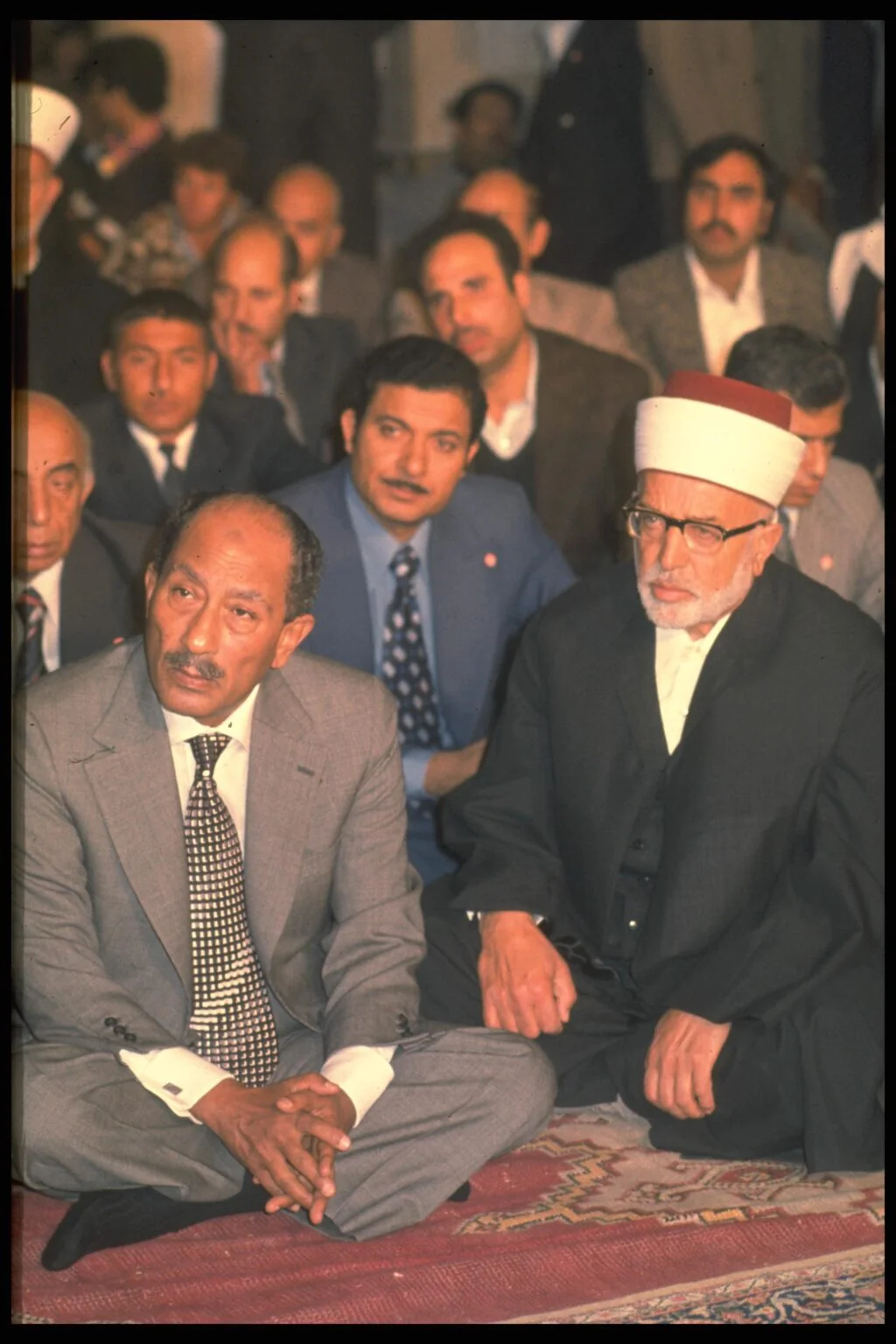
Sadat’s visit broke a major diplomatic barrier: an Arab head of state had come to Israel and addressed its parliament directly. In a message to US President Jimmy Carter, Sadat described his purpose as coming “to build a new life and to establish peace.” [13] Begin praised Sadat’s courage in making the journey. [14] Yet the visit did not resolve the central disagreements. Sadat’s territorial demands extended beyond Sinai, while Israel’s government had its own security and territorial priorities.
Direct negotiations in December 1977 made limited progress, and the United States again assumed a central mediating role. Carter invited Sadat and Begin to Camp David, where they negotiated from 5 to 17 September 1978. The summit produced two frameworks: one for an Egyptian-Israeli peace treaty and another proposing a process for Palestinian self-government in the West Bank and Gaza. Disagreements over settlements, implementation, and the Palestinian question continued to complicate the process. Carter’s subsequent diplomacy helped break the deadlock. [11]
The Egypt-Israel Peace Treaty was signed in Washington on 26 March 1979 and entered into force on 25 April. It ended the state of war, established the international border as the permanent boundary, and provided for recognition, diplomatic relations, and an end to economic boycotts. Israel agreed to withdraw its forces and civilians from Sinai. [15]
For Israel, the treaty removed Egypt—the largest Arab military power—from the front line of direct interstate war. The price included relinquishing strategic depth, airbases, and settlements in Sinai. For Sadat, the agreement recovered the peninsula and strengthened Egypt’s relationship with Washington. It was a major strategic achievement, but it did not produce a comprehensive Arab-Israeli settlement or resolve the Palestinian conflict.
Isolation, Repression, and Assassination (1979–1981)
Sadat’s peace with Israel isolated Egypt across much of the Arab world. After the treaty, Arab foreign ministers meeting in Baghdad resolved to suspend Egypt from the Arab League, relocate the organisation’s headquarters from Cairo to Tunis, and halt aid. [16] The treaty was approved in an Egyptian referendum in May 1979, with an official reported vote of 99.9 % in favour. However, the near-unanimous result must be viewed in the context of an increasingly authoritarian political system, expanding censorship, and the imprisonment of critics. [17]
Peace with Israel did not resolve Egypt’s internal political and economic tensions. Opposition grew among Islamists, Nasserists, and other groups. Sadat had initially presented himself as a leader who could loosen aspects of Nasser’s political order, but he increasingly relied on coercion to manage opposition.
In September 1981, he ordered a sweeping crackdown. Official figures recorded at least 1,500 arrests, while contemporary accounts suggested the total may have been higher. Those detained included Muslim Brotherhood figures, Coptic clergy, and prominent journalists. [17] The breadth of the arrests demonstrated how far Sadat’s government had moved toward suppressing political dissent, even as he pursued a landmark foreign-policy settlement.
On 6 October 1981, during a military parade commemorating the 1973 canal crossing, soldiers in a passing truck attacked the reviewing stand with automatic weapons and grenades. Sadat was killed. The assassins were members of the Islamist group Egyptian Islamic Jihad, and several conspirators were executed in April 1982. [17][18] His funeral drew prominent international attendance, including three former US presidents, but only Sudan among Arab League states sent its head of state. [17]
Sadat’s assassination exposed the domestic vulnerability of his political project. He had achieved a treaty that altered the regional strategic balance, but he had not built a political system capable of accommodating opposition peacefully.
Weighing Sadat’s Legacy from an Israeli Perspective
Sadat’s legacy for Israel is defined by two decisions that cannot be separated. In 1973, he helped plan and launch a surprise attack that killed thousands of Israeli soldiers and severely damaged Israeli confidence in its military and intelligence leadership. The war’s domestic political consequences also contributed to the eventual end of Labour’s long dominance. [5][11]
Yet Sadat later took a step no previous Arab head of state had taken: he visited Israel, addressed its parliament, and signed a peace treaty recognising the state and establishing an agreed international border. The treaty has survived major regional conflicts and political upheavals in both countries. Its durability is one of the clearest demonstrations that a formal Arab-Israeli peace agreement can endure even when wider regional disputes remain unresolved.
The treaty’s security arrangements were also significant. After the UN Security Council failed to agree on a proposed peacekeeping force, Egypt and Israel established the Multinational Force and Observers (MFO) through a protocol signed on 3 August 1981. The MFO began operating after Israel completed its withdrawal from Sinai on 25 April 1982 and has monitored the treaty’s security provisions. [19][20]
Sadat’s motives remain open to interpretation. He can be viewed as a statesman who concluded that war could not eliminate Israel and that diplomacy offered a more effective route to recovering Sinai. He can also be understood as a pragmatic leader seeking American assistance, a strategic realignment away from Soviet dependence, and greater freedom to pursue Egypt’s national interests. These explanations are compatible rather than mutually exclusive.
His critics in Egypt and the Arab world accused him of abandoning the Palestinians and making a separate peace at the expense of broader Arab objectives. From an Israeli perspective, the treaty was a historic strategic gain. But it was not a settlement of the wider conflict: the Palestinian question remained unresolved, and Egypt’s peace did not end hostility toward Israel across the region. Sadat’s record is therefore both a warning about the human cost of surprise war and a demonstration that sustained diplomacy can produce a durable strategic transformation.
In One Paragraph
Anwar Sadat rose from a village background to become an army officer, a participant in Egypt’s 1952 revolution, and the successor to Gamal Abdel Nasser. After consolidating power, he launched the 1973 Yom Kippur War against Israel, inflicting severe initial losses before Israeli forces recovered and the conflict created new pressure for diplomacy. Sadat then redirected Egypt toward the United States, travelled to Jerusalem in 1977, signed the Camp David Accords in 1978, and concluded the 1979 peace treaty that returned Sinai to Egypt in exchange for recognition of Israel and an end to the state of war. The agreement transformed Israel’s strategic position but did not resolve the Palestinian conflict. Increasingly repressive at home and isolated across much of the Arab world, Sadat was assassinated by Islamist soldiers in 1981. His legacy remains a combination of military confrontation, authoritarian rule, and a peace treaty that continues to shape regional security.
Sources
- Nobel Prize Outreach. “Anwar al-Sadat – Facts.” NobelPrize.org. Accessed October 23, 2026. https://www.nobelprize.org/prizes/peace/1978/al-sadat/facts/.
- Nobel Foundation. “Anwar al-Sadat – Biographical.” In Les Prix Nobel: The Nobel Prizes 1978, edited by Wilhelm Odelberg. Stockholm: Nobel Foundation, 1979. https://www.nobelprize.org/prizes/peace/1978/al-sadat/biographical/.
- Presidency of the Arab Republic of Egypt. “Mohamed Anwar El Sadat.” Former Presidents. Accessed October 23, 2026. https://www.presidency.eg/EN/<span dir="rtl">الرئاسة/الرؤساء-السابقون/محمد-انور-السادات</span>/.
- Metz, Helen Chapin, ed. “Anwar as Sadat, 1970–73.” In Egypt: A Country Study. Washington, DC: Federal Research Division, Library of Congress, 1991. https://countrystudies.us/egypt/40.htm.
- Office of the Historian, U.S. Department of State. “The 1973 Arab-Israeli War.” Milestones in the History of U.S. Foreign Relations, 1969–1976. https://history.state.gov/milestones/1969-1976/arab-israeli-war-1973.
- Ginor, Isabella, and Gideon Remez. “Sadat Didn’t Expel Soviet ‘Advisors.’” History News Network, n.d. https://www.historynewsnetwork.org/article/41109.
- Israel State Archives. “The Yom Kippur War.” Archival publication for the war’s fiftieth anniversary, 2023. https://catalog.archives.gov.il/en/publication/ykw-en.
- Center for Israel Education. “1973 Agranat Commission: Yom Kippur War.” Translated by Roni Eshel. December 2010, p. 1. https://israeled.org/wp-content/uploads/2014/08/1973-Agranat-Comm-Report-1973-War.pdf.
- Israel Ministry of Defense, IDF and Defense Establishment Archives. “Agranat Committee.” Accessed October 23, 2026. https://archives.mod.gov.il/sites/English/docs/agranat/Pages/default.aspx.
- Metz, Helen Chapin, ed. Section on the October Working Paper, infitah, and the January 1977 riots. In Egypt: A Country Study. Washington, DC: Federal Research Division, Library of Congress, 1991. https://countrystudies.us/egypt/43.htm.
- Office of the Historian, U.S. Department of State. “Camp David Accords and the Arab-Israeli Peace Process.” Milestones in the History of U.S. Foreign Relations, 1977–1980. https://history.state.gov/milestones/1977-1980/camp-david.
- Center for Israel Education. “Sadat Addresses the Knesset.” Accessed October 23, 2026. https://israeled.org/sadat-addresses-the-knesset.
- U.S. Department of State. “Telegram From the Embassy in Egypt to the Department of State,” July 1978. In Foreign Relations of the United States, 1977–1980, vol. VIII, Arab-Israeli Dispute, January 1977–August 1978, document 276. https://history.state.gov/historicaldocuments/frus1977-80v08/d276.
- Mission of Israel to the European Union. “40 Years to President Sadat’s Historic Speech.” Includes the text of Prime Minister Begin’s Knesset address of November 20, 1977. 2017. https://embassies.gov.il/eu/NewsAndEvents/Pages/40-Years-to-President-Sadat's-historic-speech.aspx.
- United Nations. “Treaty of Peace between the Arab Republic of Egypt and the State of Israel.” Signed at Washington, March 26, 1979. United Nations Treaty Series 1136, no. I-17813: 116–17. https://treaties.un.org/doc/Publication/UNTS/Volume%201136/volume-1136-I-17813-English.pdf.
- Office of the Historian, U.S. Department of State. “Editorial Note.” In Foreign Relations of the United States, 1977–1980, vol. IX, Arab-Israeli Dispute, August 1978–December 1980, 2nd rev. ed., document 242. https://history.state.gov/historicaldocuments/frus1977-80v09Ed2/d242.
- Metz, Helen Chapin, ed. “The Aftermath of Camp David and the Assassination of Sadat.” In Egypt: A Country Study. Washington, DC: Federal Research Division, Library of Congress, 1991. https://countrystudies.us/egypt/45.htm.
- United Press International. “Anwar Sadat Assassinated.” October 6, 1981. https://www.upi.com/Archives/1981/10/06/Anwar-Sadat-assassinated/7987171420281/.
- Reagan, Ronald. “Letter to the Speaker of the House and the President of the Senate Reporting on the Deployment and Mission of United States Forces in the Multinational Force and Observers.” March 19, 1982. Ronald Reagan Presidential Library. https://reaganlibrary.archives.gov/archives/speech/letter-speaker-house-and-president-senate-reporting-deployment-and-mission-united.
- Orion, Assaf. “Steadfast Vision, Flexible Implementation: The Multinational Force and Observers in Sinai.” INSS Insight, no. 837. Tel Aviv: Institute for National Security Studies, July 25, 2016. https://www.inss.org.il/publication/steadfast-vision-flexible-implementation-the-multinational-force-and-observers-in-sinai/.