
The 1949 Armistice Agreements and the Green Line
Quick answer · ~120 words
The 1949 Armistice Agreements were four separate military agreements that ended the fighting of the 1948 Arab-Israeli war. Israel signed them with Egypt on 24 February, Lebanon on 23 March, Jordan on 3 April and Syria on 20 July 1949. The talks were held under UN chairmanship led by Acting Mediator Ralph Bunche. Each agreement drew an Armistice Demarcation Line beyond which armed forces could not move. The line with Jordan, together with the line around Gaza, became known as the Green Line. Three of the four agreements stated plainly that the line was not a political or territorial border and did not settle any party's claims. The Lebanon line followed the old international boundary. After the June 1967 war, the Green Line became the baseline for later negotiations over borders.
The Mandate for an Armistice (November 1948 to January 1949)
On 16 November 1948 the UN Security Council adopted Resolution 62. It called on the parties fighting in Palestine to negotiate an armistice as a further provisional measure under Article 40 of the UN Charter [1]. Article 40 provides that such provisional measures "shall be without prejudice to the rights, claims, or position of the parties concerned" [2]. The resolution presented the armistice as a way to move from the existing truce to permanent peace in Palestine [1]. Each armistice agreement repeated this purpose in its preamble [3].
An armistice is different from a peace treaty. It ends active fighting and sets rules for armed forces, but it leaves political questions open. In 1949 Israel and the Arab states did not recognise one another, and the agreements were written with that fact in view.
The negotiations were chaired by Ralph Bunche, an American official of the UN Secretariat. He became Acting Mediator on Palestine after the UN Mediator, Count Folke Bernadotte of Sweden, was assassinated in autumn 1948 [4]. Bunche received the 1950 Nobel Peace Prize for his work as mediator in Palestine in 1948 and 1949 [4].
The talks were held separately with each state. Egypt came first. The two sides signed a General Cease-Fire Agreement on 24 January 1949, and the full armistice later replaced it [5]. Iraq, which had forces in central Palestine, did not negotiate directly. The Iraqi Foreign Minister authorised the Jordanian delegation to negotiate for the Iraqi forces, which were to withdraw, and Jordan took over their sector [3].
Four Agreements in Five Months (February to July 1949)
Egypt and Israel signed on the island of Rhodes on 24 February 1949 [5]. The Egyptian force surrounded at Al Faluja was to withdraw beyond the Egypt-Palestine frontier under UN supervision (Article III) [5]. The line in the Gaza-Rafah area followed a UN memorandum of 13 November 1948, and Egyptian forces kept their positions inside it (Article VI) [5]. The area around El Auja was demilitarised and closed to both armies (Article VIII) [5]. Israel's signatories were Walter Eytan, Yigael Yadin and Elias Sasson [5].
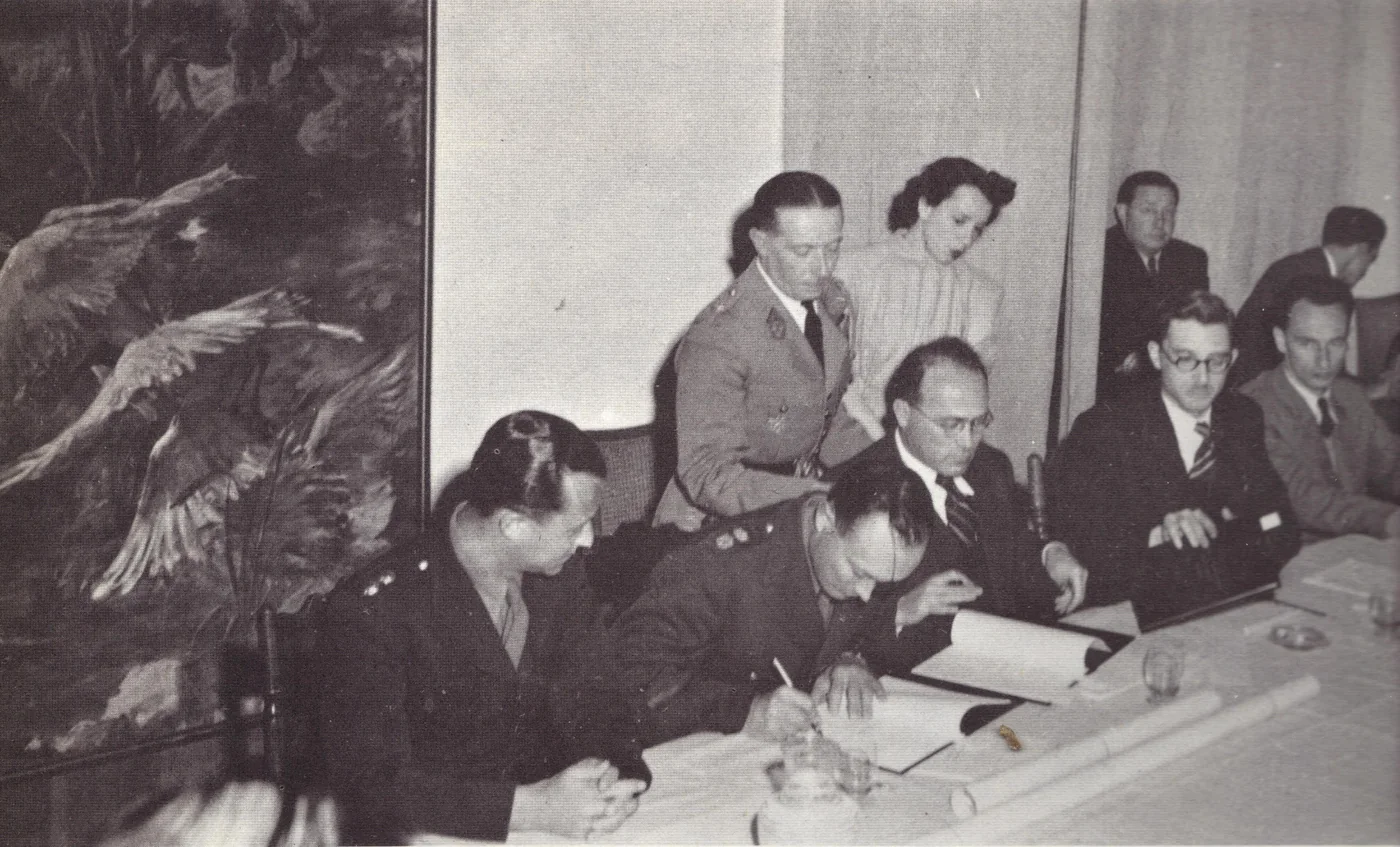
Moshe Dayan signing the Israeli-Egyptian 1949 Armistice Agreements, Rhodes
Lebanon and Israel signed on 23 March 1949. Their line "shall follow the international boundary between the Lebanon and Palestine," and only defensive forces were allowed near it (Article V) [6].
Jordan and Israel signed at Rhodes on 3 April 1949 [3]. This agreement produced the longest line. In Jerusalem it followed the ceasefire lines of 30 November 1948, which divided the city (Article V) [3]. In the former Iraqi sector the line was adjusted from existing military positions, and a change in the Hebron-Dead Sea sector in Jordan's favour was designed to offset it (Article VI) [3]. Israel agreed to pay for twenty kilometres of new road in return for the road it gained between Tulkarem and Qalqiliya [3]. A Special Committee was to arrange access to Mount Scopus, the Holy Places and the Mount of Olives cemetery (Article VIII) [3].
Syria and Israel signed on 20 July 1949 at Hill 232 near Mahanayim [7]. The line ran midway between the two sides' truce lines. Where the line did not match the international boundary, the ground between them became a Demilitarised Zone "pending final territorial settlement" (Article V) [7].
The agreements shared a common structure. Each came into force on signature, with no ratification, and was to remain in force until a peaceful settlement was reached [3]. Each set up a Mixed Armistice Commission chaired by the Chief of Staff of the UN Truce Supervision Organization or his delegate. The Jordanian commission had five members and sat in Jerusalem (Article XI) [3]. The Egyptian commission had seven members and sat at El Auja (Article X) [5]. After one year either party could ask the UN Secretary-General to convene a review conference and, failing agreement, could take the matter to the Security Council [3].
What the Green Line Was (1949 to 1967)
The Jordanian agreement states the purpose of its lines in one sentence. They mark "the lines beyond which the armed forces of the respective Parties shall not move" (Article IV) [3]. The line was a military instrument. Most of it followed positions held by troops. South of the Dead Sea it was fixed by existing military positions surveyed in March 1949 by UN observers (Article V) [3].
The name Green Line comes from the green ink used to draw the armistice lines on the maps attached to the agreements. The term is most often used for the line between Israel and the West Bank, and also for the line around the Gaza Strip.
The agreement set rules along the line. Within ten kilometres on each side, both parties could keep only defensive forces as defined in an annex (Article VII) [3]. Existing army rules that barred civilians from crossing the lines stayed in force (Article IV) [3]. Where the line in the former Iraqi sector affected villages, residents kept "their full rights of residence, property and freedom." Those who chose to leave could take their livestock and movable property and receive full compensation for land left behind (Article VI) [3].
From 1949 until June 1967, the line marked the limit of each side's control. Jordan held the West Bank, including East Jerusalem and the Old City. Egypt held the Gaza Strip, where its forces kept the positions they held at signature [5]. Israel held the territory on the other side. The Mixed Armistice Commissions received complaints about incidents along the line and sent reports to the UN Secretary-General (Article XI) [3].
What the Green Line Was Explicitly Not (the 1949 Disclaimer Clauses)
Three of the four agreements say in direct terms that their lines are not borders.
The Egyptian agreement uses the clearest language. Its line "is not to be construed in any sense as a political or territorial boundary" and does not prejudice either party's position on the final settlement of the Palestine question (Article V) [5]. It adds that the agreement does not aim to establish, recognise, strengthen, weaken or nullify any territorial claim, and that its terms are valid only for the period of the armistice (Article IV) [5].
The Jordanian agreement makes the point twice. Its provisions are "dictated exclusively by military considerations" and do not prejudice either side's rights or claims (Article II) [3]. Its lines are agreed "without prejudice to future territorial settlements or boundary lines" or to either party's claims (Article VI) [3].
The Syrian agreement states that its line and Demilitarised Zone are "not to be interpreted as having any relation whatsoever to ultimate territorial arrangements" (Article V) [7]. Its general clause says the terms were set by military and not by political considerations (Article II) [7].
The Lebanese agreement is different. It contains the same general statement that nothing in it prejudices the parties' rights or claims (Article II) [6]. Its line, however, was the existing international boundary between Lebanon and Palestine (Article V) [6], so it carries no separate statement denying that the line is a border.
Under these clauses the Green Line was a ceasefire line. It recorded where armies stood when fighting stopped. It did not decide sovereignty on either side. The agreements left that question to a final settlement that they anticipated but did not contain.
From Ceasefire Line to Reference Line (1967 to 1994)
The June 1967 war ended the Green Line's role as a front line. Israeli forces took the West Bank, East Jerusalem, the Gaza Strip, the Sinai Peninsula and the Golan Heights. The 1949 lines no longer separated armies, but they remained the lines as they stood on 4 June 1967.
On 22 November 1967 the Security Council unanimously adopted Resolution 242 [8]. Its preamble emphasised "the inadmissibility of the acquisition of territory by war" [8]. It called for "withdrawal of Israel armed forces from territories occupied in the recent conflict" and affirmed the right of every state in the area to live in peace "within secure and recognized boundaries" [8]. The resolution did not name the 1949 lines and did not declare them borders. The territories it referred to lay beyond those lines.
Later treaties replaced armistice lines with borders where the parties agreed. The Egypt-Israel Treaty of Peace of 26 March 1979 set the permanent boundary as the international boundary between Egypt and the former mandated territory of Palestine, "without prejudice to the issue of the status of the Gaza Strip" (Article II) [9]. The 1949 Gaza line was left outside the treaty.
The Declaration of Principles signed by Israel and the Palestine Liberation Organization in September 1993 listed borders among the issues for permanent status negotiations (Article V) [10]. It stated that interim agreements should not prejudice or preempt the outcome of those talks [10].
The Israel-Jordan Treaty of Peace of October 1994 drew the boundary with reference to the boundary definition under the Mandate (Article 3) [11]. It called this the permanent, secure and recognised international boundary, "without prejudice to the status of any territories that came under Israeli military government control in 1967" [11]. The Jordan River line became a border. The Green Line between Israel and the West Bank did not.
Each of these texts left the status of the 1949 line to negotiation, as the armistice agreements themselves had done.
In One Paragraph
Between February and July 1949, Israel signed four armistice agreements under UN mediation led by Ralph Bunche: with Egypt on 24 February, Lebanon on 23 March, Jordan on 3 April and Syria on 20 July. Each drew a line beyond which armed forces could not move. The line with Jordan and the line around Gaza became known as the Green Line. The Egyptian, Jordanian and Syrian agreements stated that their lines were set for military reasons only and were not political or territorial borders. The Lebanese line followed the existing international boundary. After the 1967 war, Security Council Resolution 242, the 1979 Egypt-Israel treaty, the 1993 Declaration of Principles and the 1994 Israel-Jordan treaty all treated the lines of 4 June 1967 as the point of reference, while leaving the final status of the Green Line to negotiation.
Sources
- United Nations Security Council. “Resolution 62 (1948) of 16 November 1948.” UN Doc. S/1080. Reproduced by the Avalon Project, Lillian Goldman Law Library, Yale Law School. https://avalon.law.yale.edu/20th_century/scres062.asp
- United Nations. Charter of the United Nations. June 26, 1945. Article 40. Reproduced by the Avalon Project, Lillian Goldman Law Library, Yale Law School. https://avalon.law.yale.edu/20th_century/unchart.asp#art40
- “Jordanian-Israeli General Armistice Agreement, April 3, 1949.” UN Doc. S/1302/Rev.1. In American Foreign Policy, 1950–1955: Basic Documents, vol. 1. Department of State Publication 6446. Washington, DC: Government Printing Office, 1957. Reproduced by the Avalon Project, Lillian Goldman Law Library, Yale Law School. https://avalon.law.yale.edu/20th_century/arm03.asp
- Nobel Prize Outreach. “Ralph Bunche: Facts.” NobelPrize.org. Accessed September 25, 2026. https://www.nobelprize.org/prizes/peace/1950/bunche/facts/
- “Egyptian-Israeli General Armistice Agreement, February 24, 1949.” UN Doc. S/1264 and addenda. In American Foreign Policy, 1950–1955: Basic Documents, vol. 1. Reproduced by the Avalon Project, Lillian Goldman Law Library, Yale Law School. https://avalon.law.yale.edu/20th_century/arm01.asp
- “Lebanese-Israeli General Armistice Agreement, March 23, 1949.” In American Foreign Policy, 1950–1955: Basic Documents, vol. 1. Reproduced by the Avalon Project, Lillian Goldman Law Library, Yale Law School. https://avalon.law.yale.edu/20th_century/arm02.asp
- “Israeli-Syrian General Armistice Agreement, July 20, 1949.” UN Doc. S/1353/Rev.1. In American Foreign Policy, 1950–1955: Basic Documents, vol. 1. Reproduced by the Avalon Project, Lillian Goldman Law Library, Yale Law School. https://avalon.law.yale.edu/20th_century/arm04.asp
- United Nations Security Council. “Resolution 242 (1967) of 22 November 1967.” S/RES/242 (1967). United Nations Information System on the Question of Palestine. https://www.un.org/unispal/document/auto-insert-184858
- “Treaty of Peace between the Arab Republic of Egypt and the State of Israel, March 26, 1979.” Article II. Reproduced by the Avalon Project, Lillian Goldman Law Library, Yale Law School. https://avalon.law.yale.edu/20th_century/isregypt.asp
- “Declaration of Principles on Interim Self-Government Arrangements, September 13, 1993.” Annex to UN Doc. A/48/486-S/26560, October 11, 1993. Article V, page 5. United Nations Digital Library. https://digitallibrary.un.org/record/174951/files/A_48_486%26S_26560-EN.pdf#page=5
- “Treaty of Peace between the State of Israel and the Hashemite Kingdom of Jordan, October 26, 1994.” Article 3. Annex to Letter Dated January 9, 1995, from the Permanent Representatives to the United Nations. United Nations Information System on the Question of Palestine. https://www.un.org/unispal/document/auto-insert-179122/