
Ze’ev Jabotinsky
Quick answer · ~120 words
Ze’ev (Vladimir) Jabotinsky (1880–1940) was a Zionist writer, orator and political leader who founded Revisionist Zionism, a movement that demanded Jewish statehood, a Jewish majority in Palestine and a strong Jewish defence force. Born in Odessa, he turned to Zionism after the Kishinev pogrom of 1903. During the First World War, he campaigned for Jewish military units in the British Army and helped establish the Jewish Legion. In 1920, he organised Jewish self-defence during the Jerusalem riots. He later developed the Iron Wall doctrine, arguing that Jewish state-building required sufficient strength to withstand Arab opposition. He founded the Revisionist movement in 1925 and the New Zionist Organization in 1935. He urged the evacuation of European Jews to Palestine and opposed partition. He died in New York in 1940 and was reburied on Mount Herzl in Jerusalem in 1964. His ideas influenced the Israeli Right, particularly Menachem Begin and the Likud movement.
From Odessa Journalist to Zionist Activist, 1880–1914
Jabotinsky was born on 17 October 1880 in Odessa, then part of the Russian Empire. His father, a merchant, died when he was young, leaving the family in difficult financial circumstances. Jabotinsky began publishing newspaper articles in 1897 and worked as a correspondent in Bern and Rome. He studied law in Italy and later obtained a law diploma from Yaroslavl University in 1913. His interest in Italian national unification helped shape his understanding of national identity and political independence. [1][2]
He returned to Odessa and became a journalist. Antisemitism and violence against Jews increasingly drew him towards Jewish self-defence. The Kishinev pogrom of 1903, in which Jews were attacked and killed, became a turning point. Jabotinsky visited the city to investigate the violence and committed himself to Zionism, the movement for Jewish national revival in the ancestral homeland. That year, he attended the Sixth Zionist Congress in Basel, where he opposed a proposal for a Jewish settlement in Uganda rather than Palestine. [3]
In 1906, Russian Zionists meeting in Helsingfors, now Helsinki, adopted a programme supporting Jewish national autonomy and equal civil rights within the Russian Empire. Jabotinsky helped develop this approach. The combination of Jewish national rights and individual civil rights later became important to his argument that a Jewish state could protect the rights of its Arab citizens as well. [1][2]
The Jewish Legion and the Jerusalem Riots, 1914–1923
When the Ottoman Empire entered the First World War, Jabotinsky argued that Jews should support the Allies and help bring Palestine out of Ottoman rule. He campaigned for a Jewish military unit despite opposition from some established Zionist leaders. In 1915, he and Joseph Trumpeldor helped recruit Jewish refugees in Egypt for the Zion Mule Corps, which served at Gallipoli. After that unit disbanded, Jabotinsky continued his campaign in Britain. In 1917, the British government approved a Jewish battalion in the Royal Fusiliers, part of what became known as the Jewish Legion. Its veterans later contributed personnel and experience to Jewish defence organisations in Palestine. [4]
The Balfour Declaration, issued on 2 November 1917, stated that the British government viewed with favour the establishment in Palestine of a national home for the Jewish people. Jabotinsky later claimed that the Jewish Legion had helped make the declaration possible. Historian Brian Horowitz considers some of Jabotinsky’s claims about his influence exaggerated, while recognising that the Legion raised his public standing and made Jewish military service a central part of his political programme. [5][2]
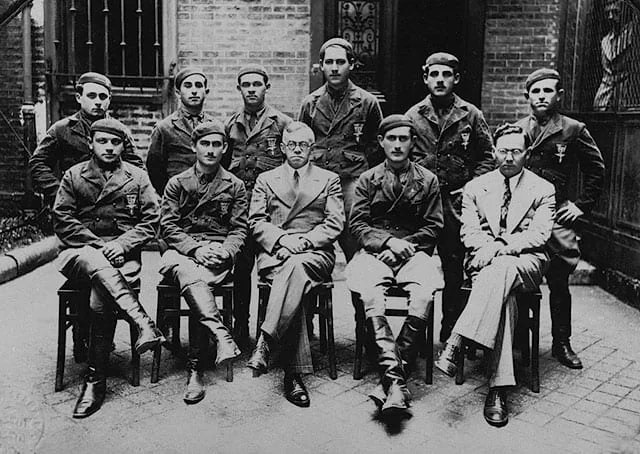
In April 1920, violence broke out in Jerusalem during the Nebi Musa festival. Jabotinsky had warned British officials of the danger and organised a self-defence unit made up of former Legion soldiers and volunteers. British authorities arrested him on 7 April and sentenced him to fifteen years of hard labour. The sentence was later reduced, and High Commissioner Herbert Samuel pardoned the prisoners in July. The episode strengthened Jabotinsky’s belief that Jews needed the ability to defend themselves rather than depend entirely on British protection. [6]
Jabotinsky joined the Zionist Executive in 1921, but his relationship with the organisation deteriorated. He opposed the 1922 Churchill White Paper, which excluded Transjordan from the area designated for the Jewish national home. He resigned from the Executive in January 1923, arguing that Zionist leadership had accepted limits on the national project. He then organised opposition within the Zionist movement, laying the groundwork for a separate political organisation. [7]
The Iron Wall Doctrine and Revisionist Zionism, 1921–1930
Jabotinsky’s most influential political argument was the Iron Wall doctrine. He first used the term in 1921 and developed it in essays published in 1923. His central argument was that the Arab population of Palestine would not willingly accept the establishment of a Jewish-majority state. He therefore believed Jewish immigration and settlement could not depend on gaining Arab consent in advance. A strong defensive capacity was needed to make the Jewish national project secure against attempts to stop it. [2][8]
The doctrine did not, in Jabotinsky’s account, mean that Arabs should be expelled. He argued that expulsion was impossible and supported civil and national rights for Arabs in a future Jewish state. He expected that, once Arab leaders recognised that Jewish state-building could not be defeated by force, negotiations could begin over political arrangements and rights. In this way, he presented military strength as a condition for a later political settlement, rather than as a substitute for one. [8][2]
The doctrine remains contested. Historian Avi Shlaim argues that Labour Zionist leaders, including David Ben-Gurion, also came to believe that force was necessary to secure the Zionist project, although they expressed the idea differently. Horowitz, however, cautions against reading the Iron Wall as a simple description of what happened in practice. Jabotinsky’s views were criticised by opponents on the Zionist left and by some people within his own movement. [8][2]
In 1925, Jabotinsky founded the Union of Zionist Revisionists. The movement demanded a Jewish majority and a Jewish state on both sides of the Jordan River. After the 1929 riots, Jabotinsky became increasingly sceptical that Britain would reliably protect the Zionist project. In 1930, British authorities refused him permission to enter Palestine, claiming that his presence could threaten public order. The decision deepened his break with the existing Zionist leadership and British policy. [7]
Breaking with the Zionist Establishment, 1931–1936
At the Zionist Congress in 1931, Jabotinsky protested after delegates rejected his demand that a Jewish majority on both sides of the Jordan be stated as the movement’s objective. He tore up his delegate card, symbolising his growing separation from the mainstream Zionist leadership. In 1935, his supporters established the New Zionist Organization as an independent body outside the World Zionist Organization. [7]
The 1933 murder of Chaim Arlosoroff, a senior Jewish Agency official, intensified tensions between Revisionists and Labour Zionists. Police arrested three Revisionists: Abba Ahimeir, Avraham Stavsky and Zvi Rosenblatt. Jabotinsky defended their innocence. Stavsky was convicted by a Mandate court in 1934, while Rosenblatt was acquitted; the legal proceedings and the case’s later history remained controversial. In 1985, a state-appointed commission cleared all three men of suspicion. The murder remains an episode in which political accusations, legal findings and later reassessments must be distinguished carefully. [9][10][11]
Jabotinsky also sought to address the worsening position of European Jewry. In June 1936, he proposed the mass evacuation of Jews from Europe to Palestine. He believed the growing threat of antisemitism required urgent action and that Palestine should serve as a destination for large-scale Jewish immigration. The proposal drew criticism from some Jewish political movements, including the socialist Bund, which feared that calls for evacuation could be used by governments to justify forcing Jews out. The New Zionist Organization adopted the evacuation programme in 1938. [12][13]
Partition, Immigration and His Final Campaigns, 1937–1940
In February 1937, Jabotinsky testified before the Peel Commission, the British commission examining the future of Mandatory Palestine. He warned that European Jews faced a major crisis and called for a Jewish state on both sides of the Jordan. He rejected the idea that the Jewish national home should be divided into a small territory, arguing that it would be unable to absorb the numbers of Jews who might need refuge. [14]
When the Peel Commission recommended partition in 1937, Jabotinsky opposed it. The Jewish Agency leadership under Ben-Gurion was prepared to accept the principle of partition as a possible step towards statehood, although the boundaries and terms remained disputed. Jabotinsky rejected the proposal as a surrender of part of the Jewish homeland and as an inadequate answer to the scale of European Jewish persecution. Britain eventually abandoned the scheme in 1938 after further examination of its practical and political difficulties. [13][15]
Jabotinsky also supported efforts to bring Jewish immigrants to Palestine despite British restrictions. From 1937, Revisionist organisations and Betar, the movement’s youth organisation, supported the Af-Al-Pi immigration project, which organised ships carrying Jewish refugees and immigrants into Palestine without British authorisation. The Jabotinsky Institute records nearly 20,000 arrivals through this effort. The campaign reflected his view that immigration was an urgent national responsibility, particularly as the situation for Jews in Europe deteriorated. [16]
After the Second World War began in 1939, Jabotinsky proposed that Britain establish a Jewish army of 100,000 fighters. He hoped such a force would help defeat Nazi Germany and strengthen the Jewish claim to statehood, but the proposal did not secure the British response he wanted. He travelled to the United States to continue campaigning. On 4 August 1940, he died of heart failure at a Betar camp in Hunter, New York. [17]
Legacy: The Founder of the Israeli Right
Jabotinsky’s will stated that his remains could be transferred to Palestine only by order of a Jewish government. David Ben-Gurion did not issue that order. In March 1964, Levi Eshkol’s government approved the transfer, and Jabotinsky and his wife, Joanna, were reburied on Mount Herzl in Jerusalem on 9 July 1964. The decision marked official recognition of a leader whose political movement had long stood outside the Labour Zionist establishment. [17]
Jabotinsky became a central intellectual figure for Israel’s political Right. Menachem Begin, who led the Irgun and later became prime minister at the head of Likud in 1977, regarded him as a major influence. His emphasis on Jewish sovereignty, military strength, immigration and the territorial scope of the national home continued to shape Revisionist Zionism and later Israeli right-wing politics. Historian Shlaim describes him as the spiritual father of the Israeli Right, while also examining the consequences and limits of the Iron Wall approach. [8]
His legacy is not without controversy. Historians continue to debate how his doctrine should be interpreted, how realistic his reliance on British support was, and how his movement related to other nationalist and political currents in Europe. His record also includes a sustained campaign to rescue European Jews through immigration, at a time when the dangers facing them were becoming increasingly severe. Jabotinsky died before the establishment of Israel in 1948, but many of the arguments he advanced about sovereignty, defence and Jewish national rights became enduring parts of Israeli political debate. [2]
In One Paragraph
Ze’ev Jabotinsky (1880–1940) was an Odessa-born journalist and Zionist leader who founded Revisionist Zionism. After the Kishinev pogrom of 1903, he committed himself to Jewish national revival and later campaigned for the Jewish Legion during the First World War. He organised Jewish self-defence in Jerusalem in 1920 and developed the Iron Wall doctrine, arguing that Jewish state-building required military strength while maintaining that Arabs should have civil and national rights. He founded the Revisionist movement in 1925 and the New Zionist Organization in 1935, urged mass Jewish evacuation from Europe, supported immigration past British restrictions and rejected partition. He died in New York in 1940 and was reburied on Mount Herzl in 1964. His ideas helped shape the Israeli Right, while historians continue to debate the meaning and consequences of his political strategy.
Sources
- Jabotinsky Institute in Israel. “Childhood and Youth.” Life Story. https://en.jabotinsky.org/zeev-jabotinsky/life-story/childhood-and-youth/.
- Horowitz, Brian (Yossi). “The Iron Wall Revisited: Utopian Paradigms in Jabotinsky’s Conception of Zionism, Circa 1923.” Israel Studies 29, no. 2 (2024): 216–31. https://www.jabotinsky.org/media/158894/brian-horowitz-the-iron-wall-revisited.pdf.
- Jabotinsky Institute in Israel. “Public Activity.” Life Story. https://en.jabotinsky.org/zeev-jabotinsky/life-story/public-activity/.
- Jabotinsky Institute in Israel. “The Legion and the Hagana (Defense).” Life Story. https://en.jabotinsky.org/zeev-jabotinsky/life-story/the-legion-and-the-hagana-defense/.
- Balfour, Arthur James. Letter to Lord Rothschild, November 2, 1917. United Nations Information System on the Question of Palestine (UNISPAL). https://www.un.org/unispal/document/auto-insert-193242.
- Jabotinsky Institute in Israel. “The Legion and the Hagana (Defense),” section “1920 Riots and Incarceration in Acre Prison.” Life Story. https://en.jabotinsky.org/zeev-jabotinsky/life-story/the-legion-and-the-hagana-defense/.
- Jabotinsky Institute in Israel. “Brit Hatzohar.” Life Story. https://en.jabotinsky.org/zeev-jabotinsky/life-story/brit-hatzohar/.
- Shlaim, Avi. “The Iron Wall Revisited.” Journal of Palestine Studies 41, no. 2 (Winter 2012). https://digitalprojects.palestine-studies.org/jps/fulltext/42543.
- Jabotinsky Institute in Israel. “Arlosoroff Murder.” Life Story. https://en.jabotinsky.org/zeev-jabotinsky/life-story/arlosoroff-murder/.
- “The Arlosoroff Murder Trial.” Detroit Jewish Chronicle and the Legal Chronicle, June 15, 1934, 1. Digitized by the Bentley Historical Library, University of Michigan. https://digital.bentley.umich.edu/djnews/djc.1934.06.15.001/1.
- “52 Years After Arlosoroff Murder Panel Clears 3 Revisionist Suspects.” Jewish Telegraphic Agency, June 17, 1985. https://www.jta.org/archive/52-years-after-arlosoroff-murder-panel-clears-3-revisionist-suspects.
- Jabotinsky Institute in Israel. “Hatzach.” Life Story. https://en.jabotinsky.org/zeev-jabotinsky/life-story/hatzach/.
- Jabotinsky Institute in Israel. “Rescuing Jews,” section “Evacuation and Partition.” Life Story. https://en.jabotinsky.org/zeev-jabotinsky/life-story/rescuing-jews/.
- Kessler, Oren. “Mandate100 | ‘A Clean Cut’ for Palestine: The Peel Commission Reexamined.” Fathom, March 2020. https://fathomjournal.org/mandate100-a-clean-cut-for-palestine-the-peel-commission-reexamined/.
- United Kingdom. Palestine: Statement by His Majesty’s Government in the United Kingdom. Presented by the Secretary of State for the Colonies, November 11, 1938. UNISPAL. https://www.un.org/unispal/document/auto-insert-197568.
- Jabotinsky Institute in Israel. “Rescuing Jews,” section “‘Af-Al-Pi’ Immigration.” Life Story. https://en.jabotinsky.org/zeev-jabotinsky/life-story/rescuing-jews/.
- Jabotinsky Institute in Israel. “New York and Jerusalem.” Life Story. https://en.jabotinsky.org/zeev-jabotinsky/life-story/new-york-and-jerusalem/.