
Theodor Herzl
Quick answer · ~120 words
Theodor Herzl (1860–1904) was a Hungarian-born Jewish journalist and playwright, trained in law, who founded political Zionism, the movement for a Jewish national home. He was born in Budapest and educated in Vienna. From 1891 to 1895 he was Paris correspondent of the Neue Freie Presse. He published The Jewish State in February 1896, convened the First Zionist Congress in Basel in August 1897, and led the Zionist Organization until his death on 3 July 1904. His defining decisions were to launch a public political movement, to seek a charter from the Ottoman sultan with great-power backing, and to put Britain’s East Africa offer before the 1903 Congress. He won no charter, but he built the institutions that carried Zionism to statehood. Israel’s Declaration of Independence calls him the spiritual father of the Jewish State.
From Budapest to Vienna, 1860–1891
Theodor Herzl was born in Budapest on 2 May 1860 to a well-off middle-class family.[1] He was educated in the spirit of the German-Jewish Enlightenment, which encouraged Jews to take part in European culture.[2] He began at a scientific secondary school. To escape its antisemitic atmosphere, he moved in 1875 to a school where most students were Jewish.[1] The family moved to Vienna in 1878, and he entered the University of Vienna to study law.[1] In 1881 he joined a German students’ association called Albia. He resigned two years later after facing antisemitism there.[2]
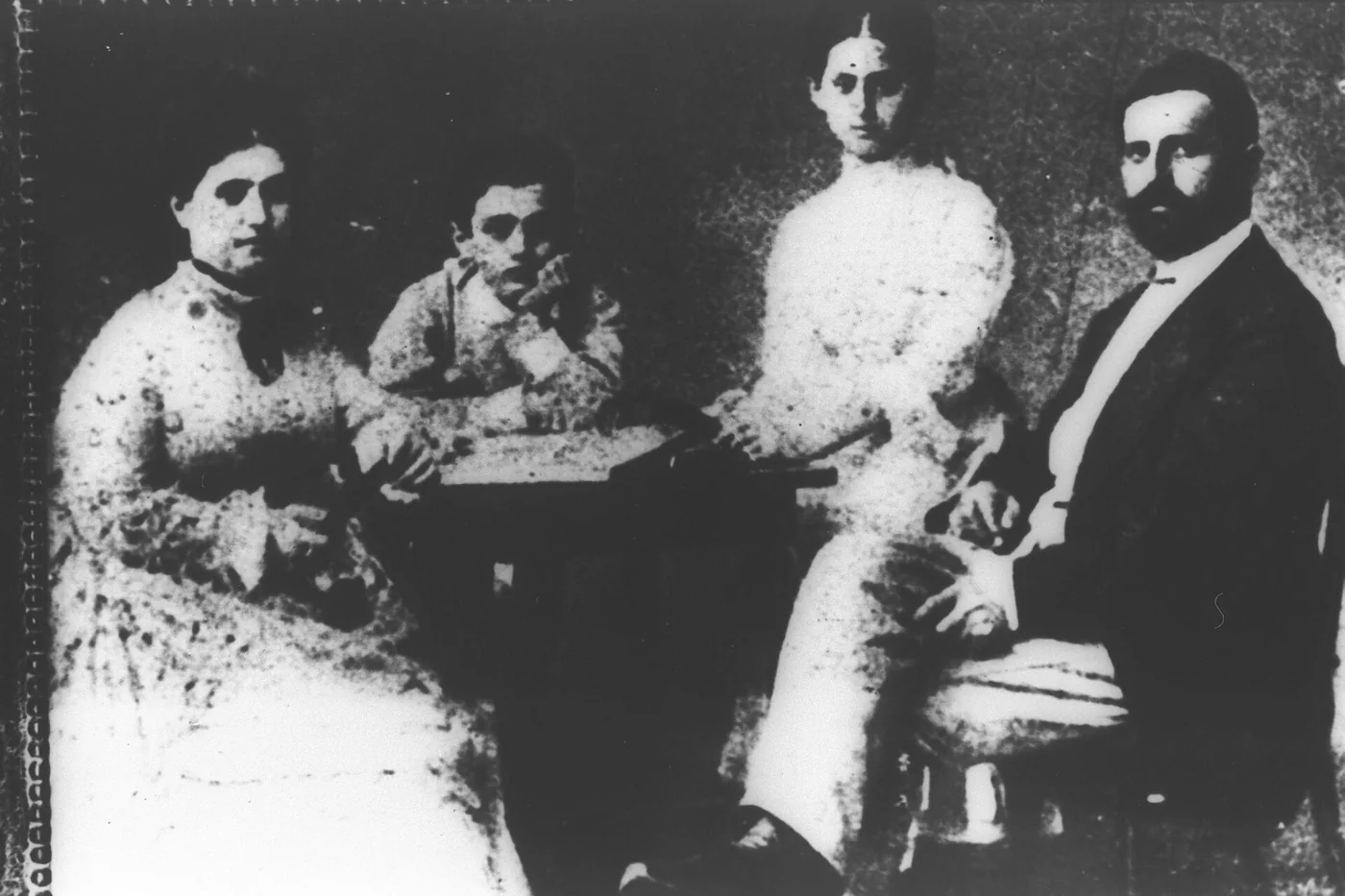
Herzl received his law license in 1884 but chose literature over legal work.[1] He became a journalist and a moderately successful playwright, and his plays were staged in Vienna, Prague, Berlin, and New York.[2] In 1889 he married Julie Naschauer, the daughter of a wealthy Viennese businessman. Ben-Gurion described the marriage as unhappy and noted that his wife took little interest in his later political work.[1] His early career gave no sign of a political calling. He wrote as a literary man who lived comfortably in German-speaking European culture.
Paris, a Pamphlet and the Basel Congress, 1891–1897
In October 1891 the Neue Freie Presse, a leading liberal daily in Vienna, named Herzl its Paris correspondent. He held the post until July 1895.[2] In France he faced the same antisemitism he knew from Austria. Until then he had treated it as a social problem that Jews could overcome by assimilating.[1] In January 1895 Alfred Dreyfus, a Jewish army captain falsely charged with treason, was publicly humiliated in Paris while a mob shouted “Death to the Jews.”[1][2] Herzl said in later years that the Dreyfus affair made him a Zionist.[1] The historian Derek Penslar argues that personal crises shaped his turn to Zionism as much as antisemitism did.[3]
Herzl first approached Baron Maurice de Hirsch, a philanthropist who funded Jewish settlement in Argentina. Hirsch would not hear him out.[1] The conversation led to The Jewish State, published in Vienna in February 1896.[1] The book called the Jewish question a national and political matter that the powers should settle together.[1] It weighed Argentina against Palestine and preferred Palestine.[2] Its closing lines say, “The Jews who wish for a State will have it.”[4] Herzl wrote it without knowing Leon Pinsker’s earlier pamphlet Auto-Emancipation, and he noted in his diary that he might not have written it had he known that work.[1]
Eastern European Zionist societies welcomed the book, although some of Herzl’s friends thought the idea mad.[1] In June 1896 he traveled to Constantinople, the Ottoman capital, hoping to meet the sultan, who ruled Palestine. Crowds greeted him at the Sofia station. He stayed eleven days and did not reach the sultan.[1] Herzl then decided to call a world congress. Jews in Munich objected, so he moved it to Basel.[1] The First Zionist Congress met from 29 to 31 August 1897 with about 200 delegates from 17 countries. It founded the Zionist Organization, elected Herzl president, and adopted “Hatikvah” as its anthem.[5] The Basel Program set the aim of a home in Palestine secured by public law.[6] Herzl presided over the first six Congresses.[7]
Major Decisions
A mass movement and a careful program
Hirsch had refused Herzl, and Baron Edmond de Rothschild also declined to back his plan. Herzl concluded that a national movement had to rest on the people, not on single donors, and he decided to convene a congress.[2] He chose the program’s wording with care. He insisted on “public law” rather than international law. Isaiah Friedman, writing in the Encyclopaedia Judaica, judged that the phrase could be read in Constantinople as Ottoman law and in European capitals as international law.[2] Ottoman officials were not persuaded. In February 1898 the Ottoman foreign minister, Ahmed Tewfik Pasha, told Herzl that Jewish immigrants were welcome but that no territory or autonomy would be granted.[2] The choice was Herzl’s own. It produced a lasting organization, but it did not remove Ottoman resistance.
The search for a charter
A charter is a formal grant of settlement rights. Herzl sought one from the sultan with a European power behind him. Through the Reverend William Hechler, a chaplain at the British embassy in Vienna, he reached the Grand Duke of Baden and then Kaiser Wilhelm II of Germany.[2] In October 1898 the Kaiser received Herzl in Constantinople and agreed to ask the sultan for a chartered company under German protection. The request failed. At Jerusalem on 2 November 1898 the Kaiser said the matter needed study, and the German news agency described the group as a Jewish deputation, not a Zionist one.[2] Herzl met the sultan on 17 May 1901 and offered Jewish help with the Ottoman public debt. He received a decoration but no charter, and his last visit in July 1902 ended in deadlock.[2] Friedman judged that the Kaiser’s approach did more harm than good, and he noted that Herzl had not foreseen that foreign backing would weaken his case.[2] The effort won no charter. It did win Zionism a hearing among statesmen.[1]
The East Africa offer
In October 1902 Colonial Secretary Joseph Chamberlain agreed that a self-governing Jewish colony could be founded near El-Arish or in Sinai. Ottoman and Egyptian objections and irrigation problems ended the plan.[2] In spring 1903 Chamberlain offered the Guas Ngishu plateau near Nairobi, an area later called “Uganda” in error.[2] Herzl treated the offer as British recognition of the Jews as a nation and as a step toward Palestine.[2] In August 1903 the Russian interior minister, Vyacheslav von Plehve, wrote that Russia would support Zionist settlement in Palestine.[2] At the Sixth Congress, which opened on 23 August 1903, Herzl said his attitude toward the land of the forefathers had not changed. Max Nordau called East Africa a night shelter.[2] The Congress voted 295 to 178, with 98 abstentions, only to send a commission of inquiry.[8] Russian delegates protested that the plan abandoned the Land of Israel as the sole homeland.[8] Friedman argues that Herzl expected an unfavorable report and never gave up Palestine.[2] After Chamberlain left office and white settlers in Kenya protested, British interest faded, and Herzl told the Zionist Executive that the project was dead.[2] Ben-Gurion wrote that Herzl was unable to resolve the conflict.[1] The Seventh Congress rejected the plan in 1905.[8]
Death and Reburial, 1904–1949
Herzl died of a heart ailment on 3 July 1904 at Edlach, near Vienna, aged 44, and was buried in Vienna.[1] Friedman records that a serious heart condition had already kept him from taking an active part in debate at the Sixth Congress. The leading opponents of the East Africa plan told the Zionist Executive in April 1904 that they had been mistaken.[2]
In accordance with his wish, his remains were moved to Jerusalem in 1949, after the founding of the state, and entombed on a hill west of the city now called Mount Herzl.[1] Ben-Gurion, Israel’s first prime minister, wrote Britannica’s biography of Herzl shortly before his own death in 1973.[1] The Knesset, Israel’s parliament, later passed the Herzl Law. It sets 10 Iyar, Herzl’s birthday on the Hebrew calendar, as a national day. The day includes a state ceremony on Mount Herzl, lessons in schools and army camps, and a special Knesset session.[9]
Legacy
Herzl’s main achievement was institutional. He founded the Zionist Organization, the Congress, the weekly Die Welt, and the Jewish Colonial Trust, the movement’s financial arm.[2] Ben-Gurion credited him with organizing the political force of the Jewish people and winning the respect of many statesmen.[1] After the First Congress Herzl wrote in his diary, “At Basel I founded the Jewish state,” and he predicted that everyone would see it within five years, or certainly fifty.[1] The State of Israel was proclaimed fifty years and eight months later.[2] On 29 November 1947 the UN General Assembly recommended a plan of partition for Palestine with an Arab state and a Jewish state.[10] Israel’s Declaration of Independence of 14 May 1948 calls Herzl the “spiritual father of the Jewish State.” It says the First Congress, convened at his summons, proclaimed the right of the Jewish people to national rebirth in its own country.[11]
The record also shows limits. Herzl obtained no charter and no territory, and Friedman called him a statesman without a state.[2] Ben-Gurion wrote that the state came from many historic forces, including two world wars and the work of Herzl’s followers.[1]
The sharpest dispute concerns the Arab inhabitants of Palestine. On 1 March 1899 Yusuf Diya al-Khalidi, a Jerusalem notable, wrote through the chief rabbi of France, urging Zionists to look elsewhere and citing the facts on the ground in Palestine.[12][13] Herzl replied on 19 March that the non-Jewish population would benefit economically and that the Holy Places belonged to all faiths.[13] His 1902 novel Altneuland has an Arab character, Reschid Bey, who calls Jewish settlement “a great blessing for all of us.” Ian Buruma and Avishai Margalit call the book well meant and idealistic but condescending toward the Arab villagers it portrays.[14] A private diary entry of June 1895 speaks of moving poor inhabitants out of the land a future state would acquire. At that stage Herzl was still weighing Argentina as well as Palestine, and the entry predates his public writings. Critics read it as a plan for removal. His public statements, including the 1899 letter, described Arabs as beneficiaries of Jewish settlement.[15] The entry is documented, and its meaning is disputed. Herzl’s expectation that Arab residents would welcome Jewish settlement was not borne out by later events. The 1948 Declaration, issued after months of attack, still called on Arab inhabitants to keep the peace and take part in building the state as equal citizens.[11]
In One Paragraph
Theodor Herzl was a Budapest-born journalist and playwright who became the founder of political Zionism. Shaped by antisemitism in Vienna and Paris, he published The Jewish State in 1896 and created the Zionist Organization at Basel in 1897. His defining decisions were to build a mass movement around a public program, to seek a charter from the Ottoman sultan with German support, and to bring Britain’s East Africa offer to the 1903 Congress as a diplomatic step. He secured no charter and no territory, and he left disputes over East Africa and over the Arab population of Palestine. The institutions he built carried the movement to statehood in 1948, and Israel honors him as the spiritual father of its state.
Sources
- Ben-Gurion, David. “David Ben-Gurion on Theodor Herzl.” Encyclopaedia Britannica. Published November 11, 2022. https://www.britannica.com/biography/David-Ben-Gurion-on-Theodor-Herzl-2215526.
- Friedman, Isaiah. “Herzl, Theodor.” In Encyclopaedia Judaica, 2nd ed., edited by Fred Skolnik and Michael Berenbaum. Detroit: Macmillan Reference USA, 2007. Text reproduced at Encyclopedia.com. Sections used: opening biography, “Relations with Germany,” “Relations with Turkey,” “In Search of International Support – The Uganda Controversy,” and “An Assessment.” https://www.encyclopedia.com/religion/encyclopedias-almanacs-transcripts-and-maps/herzl-theodor.
- Penslar, Derek. Theodor Herzl: The Charismatic Leader. Jewish Lives. New Haven: Yale University Press, 2020. Publisher abstract reproduced by the Harvard Center for Middle Eastern Studies. https://cmes.fas.harvard.edu/publications/theodor-herzl-charismatic-leader.
- Herzl, Theodor. The Jewish State. Translated by Sylvie d’Avigdor, edited by Jacob M. Alkow. Project Gutenberg eBook 25282, released May 2, 2008. Originally published as Der Judenstaat (Leipzig and Vienna: M. Breitenstein, 1896). Concluding section. https://gutenberg.org/files/25282/25282-h/25282-h.htm.
- “The First Zionist Congress, 1897.” The Posen Library of Jewish Culture and Civilization. https://posenlibrary.com/node/7954.
- First Zionist Congress. “The Basel Program.” 1897. Translated and reprinted in the Jewish Chronicle, September 3, 1897. In The Posen Library of Jewish Culture and Civilization, vol. 7. https://posenlibrary.com/node/8897.
- Jewish Agency for Israel. “Theodor Herzl - Short Biography.” https://archive.jewishagency.org/herzl/content/25334.
- Center for Israel Education. “Sixth Zionist Congress” (entry for August 23, 1903). A secondary educational summary, used for the vote tally and the Russian delegates’ protest. https://israeled.org/sixth-zionist-congress/.
- State of Israel, Ministry of Education. “Herzl Day.” English-language teachers’ portal. https://pop.education.gov.il/tchumey_daat/english/chativat-beynayim/study_topics/herzl-day.
- United Nations General Assembly. Resolution 181 (II), “Future Government of Palestine,” November 29, 1947. A/RES/181(II). UN Digital Library. https://digitallibrary.un.org/record/210008/files/A_RES_181%28II%29-EN.pdf.
- Provisional Government of Israel. “Declaration of the Establishment of the State of Israel,” May 14, 1948. Israel Ministry of Foreign Affairs. https://embassies.gov.il/MFA/AboutIsrael/history/Pages/Declaration%20of%20Establishment%20of%20State%20of%20Israel.aspx.
- “Yusuf Diya-uddin al-Khalidi.” PalQuest: Interactive Encyclopedia of the Palestine Question. Institute for Palestine Studies. https://www.palquest.org/en/biography/39653/yusuf-diya-uddin-al-khalidi.
- Herzl, Theodor. Letter to Yusuf Diya al-Khalidi, March 19, 1899. French original with English translation. PalQuest, Institute for Palestine Studies. https://www.palquest.org/en/historictext/9700/letter-theodore-herzl-yusuf-diya-uddin-al-khalidi.
- Buruma, Ian, and Avishai Margalit. “Seeds of Revolution.” New York Review of Books, March 11, 2004. https://www.nybooks.com/articles/2004/03/11/seeds-of-revolution/.
- Herzl, Theodor. The Complete Diaries of Theodor Herzl. Edited by Raphael Patai, translated by Harry Zohn. Vol. 1. New York: Herzl Press and Thomas Yoseloff, 1960. Entry of June 1895. The link is a library catalogue record for the edition, not the text. I could not open the entry itself, so the description above follows its widely quoted wording and should be checked against the printed page. https://find.library.upenn.edu/catalog/9911172313503681.