
The Sinai and Palestine Campaign, 1915–1918
Quick answer · ~120 words
Indian soldiers served from the first battle of the Sinai and Palestine Campaign to the last. In February 1915, Indian infantry and camel troops helped defeat an Ottoman attempt to cross the Suez Canal. About 144,000 Indian personnel were sent to Egypt and Palestine during the war. When Jerusalem surrendered on 9 December 1917, Indian Muslim guards were sent to protect its holy places. In early 1918 the British moved most of their own infantry to France, and Indian soldiers replaced them. By the final offensive in September 1918, Indians made up most of General Allenby's infantry and two full cavalry divisions. On 23 September 1918 the Jodhpur and Mysore Lancers captured Haifa, and their commander, Dalpat Singh, was killed. India and Israel now honour this battle together. New Delhi renamed Teen Murti Chowk as Teen Murti Haifa Chowk on 14 January 2018.
Defending the Suez Canal, November 1914 to December 1915
Indian troops reached the Suez Canal before the campaign began. Major-General Alexander Wilson commanded the Canal Defences. He landed at Suez on 16 November 1914 and divided the defence into three sections, based at Suez, Ismailia Ferry and Kantara. The last units of his force arrived from India on 5 December 1914. [1] The first clash came on 20 November 1914. A patrol of the Bikanir Camel Corps, made up of one Indian officer and twenty men, met about 200 Bedouin and Turkish fighters near Bir-el-Nuss. The patrol lost one Indian officer and twelve men killed. [1] The main Ottoman attack came on 3 February 1915. Wilson estimated the attacking force at 12,000 to 15,000 men. Their main effort was a crossing by pontoon south of Toussoum. Parties of the 62nd Punjabis under Major Skeen and Captain Morgan met the boats, and several pontoons were sunk. Seven Ottoman officers and 280 men were captured opposite Toussoum that day. On 4 February a force led by the 92nd Punjabis charged the last Ottoman position on the east bank and took six officers, 251 men and three machine guns. [1] The Canal force grew to 30,000 men in February and March 1915. Later in the year many of its brigades were sent to Gallipoli, Aden and Basra. On 23 November 1915 a squadron of the Mysore Lancers chased a raiding party for seven miles east of Kantara, killing seven and capturing twelve. [1]
From the Canal to Jerusalem, March 1916 to December 1917
In March 1916 the British formed the Egyptian Expeditionary Force (EEF). It was built from the troops evacuated from Gallipoli and from the Force in Egypt, which guarded the frontiers and the Canal. [2] Through 1916 and 1917 the EEF crossed Sinai and fought its way into southern Palestine. In these years most of its fighting units were British, Australian and New Zealand formations. The Indian role was smaller but continuous. Several Indian units in this theatre came from the princely states, such as Jodhpur, Mysore and Hyderabad. The rulers of these states raised these "Imperial Service" troops and placed them at the Empire's disposal. A British minister later told the House of Lords that at the end of 1917 the only Indian cavalry with the EEF were the 1st Hyderabad Lancers and the Mysore Lancers. Both were then guarding the army's lines of communication in Palestine. [3] Indian soldiers were present at one of the campaign's most important moments. The Mayor of Jerusalem surrendered the city on 9 December 1917. The next day the government told the House of Commons that the British governor was on his way to the city. He was escorted by British, French, Italian and Indian Muslim guards, and their task was to protect the city and its holy places. [4] General Edmund Allenby made his formal entry on foot through the Jaffa Gate on 11 December 1917. Ottoman rule over the city, which had lasted four centuries, was over.
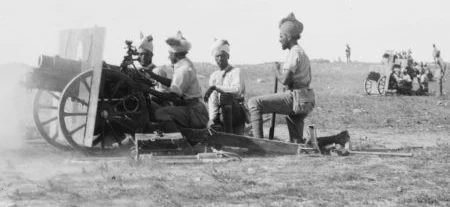
Indian Army gunners (probably 39th Battery) with 3.7 inch Mountain Howitzers Jerusalem in 1917
The Indianised Army, March to August 1918
The German offensive in France in March 1918 changed the EEF completely. The British Army had already lost very large numbers of men in 1916 and 1917. After the March offensive, London moved British soldiers from Palestine to France. In all but one of the EEF's infantry divisions, Indian sepoys replaced three-quarters of the British soldiers. Many of the new sepoys had never been in battle. They spent the summer of 1918 training and joining their new formations. [2] The cavalry changed in the same way. By the end of April 1918, ten regular Indian cavalry regiments had arrived from France. They were the 2nd, 18th, 19th and 29th Lancers, the 6th Cavalry, 9th Hodson's Horse, 20th Deccan Horse, 34th Poona Horse, 36th Jacob's Horse and 38th Central India Horse. A third Imperial Service regiment, the Jodhpur Lancers, also joined. [3] In one action east of the Jordan, opposite El Henu Ford, a charge in which the Jodhpur Lancers took a leading part speared ninety Turkish soldiers and captured ninety-one, with four machine guns. [3] In August and September 1918 the Indian cavalry was reorganised into the 4th and 5th Cavalry Divisions. Each brigade kept one British yeomanry regiment, except the 15th Imperial Service Cavalry Brigade. That brigade was made up of the Jodhpur Lancers, the Mysore Lancers, the 1st Hyderabad Lancers, the Kathiawar Signal Troop and the Imperial Service Machine Gun Squadron. [3]
Megiddo and Haifa, 19 to 23 September 1918
Allenby's final offensive began on 19 September 1918. Infantry of the XXI Corps were to break through the Ottoman lines on the coastal plain. The cavalry would then ride north and cross the hills into the plain of Esdraelon, cutting off the Ottoman retreat. [5] On the eastern flank, Major-General Edward Chaytor's force held the Jordan Valley. It included the 20th Indian (Imperial Service) Infantry Brigade alongside the 38th and 39th Battalions of the Royal Fusiliers. [6] These two battalions were made up of Jewish volunteers. In September 1918, Indian and Jewish infantry served together in the same command. The cavalry advance was fast. In his despatch, Allenby reported that the Desert Mounted Corps took about 46,000 prisoners during the operations. On the first day, the 2nd Lancers charged a Turkish force near El Lejjun, killing forty-six and capturing 470. On 22 September the 18th Lancers attacked part of the Haifa garrison by moonlight and captured more than 300 men. [5] Haifa had a harbour, and the advancing army needed it for supplies. On 23 September 1918 the 15th Imperial Service Cavalry Brigade attacked the town. The Mysore Lancers cleared the rocky slopes of Mount Carmel. The Jodhpur Lancers charged through the narrow pass below, rode over the enemy machine guns and entered the town. Allenby's despatch recorded that "Colonel Thakur Dalpat Singh, M.C., fell gallantly leading this charge." [7] Indian official commemorations give his rank as Major. [8] The regimental account of the Mysore Lancers records 1,350 German and Ottoman prisoners, 17 artillery guns and 11 machine guns captured that day. [9]
Pursuit to Damascus and Aleppo, 24 September to 30 October 1918
After Haifa, the cavalry kept moving north. Damascus was entered on 1 October 1918 after some resistance from the remains of the Ottoman Fourth Army. On 5 October the two Indian cavalry divisions pushed on to Rayak and Zahle. The 5th Cavalry Division reached Baalbek on 11 October, Homs on 15 October and Aleppo on 25 October. [7] On 26 October the 15th Imperial Service Cavalry Brigade met a strong Turkish rearguard south-east of Haritan. The Mysore and Jodhpur Lancers charged it but were too few to finish the fight. They were withdrawn until a larger force could be brought up. [7] Allenby's summary of the 5th Cavalry Division's work gave precise figures. The division covered 500 miles between 19 September and 26 October. It captured more than 11,000 prisoners and 52 guns, and lost 21 per cent of its horses. [7] Fighting in the theatre ended when the Ottoman Empire signed the Armistice of Mudros on 30 October 1918. The British Parliament later debated whether the Indian contribution had been properly recognised. In May 1919 the Earl of Mayo told the House of Lords that Indian cavalrymen felt their work had not been given enough credit. [3] The government replied by reading out Allenby's despatch, unit by unit. [7] According to figures cited in the House of Lords in December 2013, India sent 144,000 personnel to Egypt and Palestine during the war. That compares with 657,000 sent to Mesopotamia and 138,000 sent to France. [10]
Commemoration and Shared Memory, 1918 to the Present
Indian soldiers who died in the campaign are buried in cemeteries in what is now Israel. According to the Commonwealth War Graves Commission (CWGC), Haifa Indian Cemetery holds 49 Commonwealth servicemen of the First World War, 46 of them identified. The CWGC also records that the graves were not individually marked when the cemetery was built. The names of the identified dead were added to the cemetery memorial in 2001. [11] India's Prime Minister's Office states that 44 of those buried there are Indian. [8] The Jerusalem Indian War Cemetery at Talpiot was used from July 1918 to June 1920. It holds 79 Indian servicemen, one of them unidentified. [12] The memory of Haifa has become part of the relationship between India and Israel. On 6 July 2017, Narendra Modi made the first visit to Israel by a sitting Indian Prime Minister. He and Prime Minister Benjamin Netanyahu laid wreaths at the Haifa Indian Cemetery and unveiled a plaque to Dalpat Singh. [8] On 14 January 2018 the two leaders attended the renaming of Teen Murti Chowk in New Delhi as Teen Murti Haifa Chowk. The memorial's three bronze horsemen represent the Hyderabad, Jodhpur and Mysore Lancers. In the visitors' book, Benjamin and Sara Netanyahu wrote that they "remember the brave Indian soldiers who helped liberate our land and Haifa." [13] The Indian Army's 61st Cavalry marks 23 September every year as Haifa Day. [13] According to the Haifa municipality, the city's history textbooks for classes 3 to 5 teach how Indian soldiers liberated the city. [14]
In One Paragraph
Indian soldiers fought throughout the Sinai and Palestine Campaign. They helped defend the Suez Canal in February 1915, and Indian Muslim guards protected Jerusalem's holy places after the city surrendered in December 1917. About 144,000 Indian personnel went to Egypt and Palestine. In 1918 they replaced most of the British infantry and formed two cavalry divisions in Allenby's army. On 23 September 1918 the Jodhpur and Mysore Lancers captured Haifa, and their commander, Dalpat Singh, died leading the charge. The Indian cavalry then rode on through Damascus to Aleppo before the war ended on 30 October 1918. Today India and Israel honour these soldiers together, through joint visits by their prime ministers, the Teen Murti Haifa Chowk in New Delhi, and Haifa's school curriculum.
Sources
- Alexander Wilson, report of 11 February 1915, in J. G. Maxwell, "Despatch No. I," 16 February 1915, and J. G. Maxwell, "Despatch No. III," 1 March 1916, Supplement to the London Gazette, no. 29632, June 1916, transcribed in "Defence of the Suez Canal, 1915–1916," Naval-History.net,https://www.naval-history.net/WW1Battle1502SuezCanal.htm#gazette.
- James E. Kitchen, "Egyptian Expeditionary Force," in 1914-1918-online: International Encyclopedia of the First World War, ed. Ute Daniel et al. (Berlin: Freie Universität Berlin), version 1.0, section "1918 Operations in Palestine and Syria,"https://encyclopedia.1914-1918-online.net/article/egyptian-expeditionary-force/.
- Parliamentary Debates, House of Lords, 5th ser., vol. 34 (21 May 1919), "Indian Cavalry in Palestine," cols. 762–63,https://api.parliament.uk/historic-hansard/lords/1919/may/21/indian-cavalry-in-palestine#column_762
- Parliamentary Debates, House of Commons, 5th ser., vol. 100 (10 December 1917), "Capture of Jerusalem,"https://hansard.parliament.uk/Commons/1917-12-10/debates/7b7688c4-57d2-408c-a7a1-bfd3643cc089/CaptureOfJerusalem.
- Parliamentary Debates, House of Lords, 5th ser., vol. 34 (21 May 1919), "Indian Cavalry in Palestine," col. 764,https://api.parliament.uk/historic-hansard/lords/1919/may/21/indian-cavalry-in-palestine#column_764
- Edmund Allenby, despatch of 31 October 1918, Supplement to the London Gazette, no. 31087, 30 December 1918, 15185, para. 10,https://thegazette.co.uk/London/issue/31087/supplement/15185/data.pdf.
- Parliamentary Debates, House of Lords, 5th ser., vol. 34 (21 May 1919), "Indian Cavalry in Palestine," col. 765,https://api.parliament.uk/historic-hansard/lords/1919/may/21/indian-cavalry-in-palestine#column_765
- Indian Army. "Haifa War." Mysore Lancers. Accessed October 5, 2026.https://mysorelancers.in/haifa-war/.
- Parliamentary Debates, House of Lords, vol. 750 (18 December 2013), "First World War: Personnel from the Indian Subcontinent,"https://hansard.parliament.uk/lords/2013-12-18/debates/13121859000587/FirstWorldWarPersonnelFromTheIndianSubcontinent.
- Commonwealth War Graves Commission. "Haifa Indian Cemetery." Cemetery Details. Accessed October 5, 2026.https://www.cwgc.org/visit-us/find-cemeteries-memorials/cemetery-details/72107/haifa-indian-cemetery/.
- Prime Minister of India. "PM Modi and Israeli PM Netanyahu Visit Indian War Cemetery in Haifa." narendramodi.in, 6 July 2017.https://www.narendramodi.in/pm-modi-and-israeli-pm-netanyahu-visit-indian-war-cemetery-in-haifa-536193.
- Commonwealth War Graves Commission. "Jerusalem Indian War Cemetery." Cemetery Details. Accessed October 5, 2026.https://www.cwgc.org/find-a-cemetery/cemetery/72111.
- "'Shalom' after Jerusalem Row." The Tribune (Chandigarh), 15 January 2018.https://www.tribuneindia.com/news/archive/nation/shalom-after-jerusalem-row-528771.
- Press Trust of India. "Israel: Tributes Paid to Indian Soldiers Who Liberated Haifa City." Udayavani, 23 September 2020.https://www.udayavani.com/english-news/israel-tributes-paid-to-indian-soldiers-who-liberated-haifa-city. ** **