
The Kibbutz and the Moshav: Israel’s Cooperative Settlement Models
Quick answer · ~120 words
The kibbutz and the moshav were two important forms of Jewish agricultural settlement developed before the establishment of Israel. The first kibbutz, Degania, was founded in 1910 near the Sea of Galilee, combining Zionism with socialist principles of collective ownership, shared work and communal responsibility. The first moshav ovdim, Nahalal, followed in 1921, offering cooperative purchasing and marketing while allowing families to own and manage individual farms. Both models helped establish agricultural communities, secure territory and build the institutions of the Jewish national home. Kibbutzim also played a major role in the Haganah and Palmach, and their members were prominent in Israel's early military and political leadership. Economic difficulties in the 1980s led many kibbutzim towards privatisation and industrial diversification. The Hamas-led attacks of 7 October 2023 devastated several kibbutzim near Gaza, making their reconstruction a major national undertaking.
Degania and the Socialist Zionist Ideal, 1909–1920s
The kibbutz emerged from the meeting of Zionism and socialist thought among Jewish immigrants from Eastern Europe. Many of the early pioneers believed that establishing a Jewish national home required more than immigration and land acquisition. It also required creating a new society based on productive labour, cooperation and collective responsibility. Agricultural settlement was seen as a way to establish a lasting Jewish presence while transforming the social and economic conditions of Jewish life. [1]
Degania, near the southern shore of the Sea of Galilee, became the model for this experiment. A group of young Jewish pioneers established the settlement in 1909–1910 on land associated with the Zionist settlement enterprise. It is generally recognised as the first kibbutz, although its founders initially used the term kvutza, meaning a group or collective. The community was small, and its members shared agricultural work, income and responsibility for maintaining the settlement. [2]
The kibbutz model developed around several principles: collective ownership of productive property, shared consumption, equality among members, direct democratic decision-making and the expectation that members would contribute according to their abilities. Its social ideal was commonly expressed through the principle of receiving according to need rather than individual earnings.
The movement was not uniform. Different kibbutz federations developed distinct political and ideological traditions, including socialist, Marxist and religious approaches. The common foundation, however, was the belief that collective settlement could serve both the economic needs of its members and the national objectives of Zionism.
As the movement expanded during the 1920s and 1930s, kibbutzim became more than agricultural communes. They established schools, cultural institutions, workshops and industrial enterprises. Their growth also helped the Jewish community develop a network of settlements across the country, including in strategically important border and frontier areas.
Daily Life: Shared Property, Dining Halls and Children's Houses
Traditional kibbutz life was organised around collective responsibility. Land, agricultural equipment, factories and other productive assets belonged to the community rather than individual members. Income was pooled and used to provide housing, food, education, healthcare and other services. Members generally received similar living standards regardless of the type of work they performed. [3]
The communal dining hall was one of the most recognisable features of kibbutz life. Members gathered for meals, meetings and celebrations. Food was prepared collectively, and the dining hall became an important centre of social interaction. Laundry, childcare, education and other household services were also organised through communal institutions.
Children's houses were another distinctive feature of many traditional kibbutzim. Children lived and studied in age-based groups, often sleeping separately from their parents. Parents spent time with their children during designated visiting hours, while trained caregivers and educators handled much of their daily care. Supporters believed this arrangement encouraged independence, equality and collective responsibility. Critics, including some former members, later questioned its emotional and family consequences.
The system changed over time. From the 1970s onwards, many kibbutzim moved away from communal sleeping arrangements for children, allowing them to sleep in their parents' homes. Other communal practices also became more flexible as members sought greater privacy and individual choice.
The traditional kibbutz was therefore not simply a farming cooperative. It was a comprehensive social system in which work, education, consumption and family life were organised around collective principles.
The Kibbutz, the Haganah and the Palmach
Kibbutzim played an important role in the defence of the Jewish community during the British Mandate. Many settlements were located in exposed areas and along frontier regions, where they served as centres of agricultural development and local defence. Members participated in the Haganah, the principal military organisation of the Jewish Yishuv, and helped develop the settlement-based defence network that preceded the establishment of Israel.
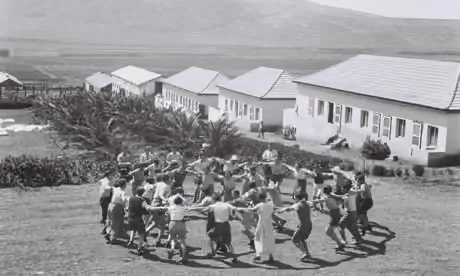
The connection became particularly strong with the creation of the Palmach in 1941. The Palmach was the Haganah's elite fighting force, established initially to prepare for possible Axis advances into the region. When British financial support ended, the Palmach adopted a system under which its units were based in kibbutzim. Fighters worked in agriculture for part of the month and trained for combat during the remainder. This arrangement provided food and accommodation while maintaining a trained military force. [4]
The Palmach developed into an important military formation during the final years of the Mandate. Its members participated in operations against British installations, assisted Jewish immigration and helped defend settlements during the 1947–1949 War of Independence. Its experience contributed to the formation of the Israel Defense Forces in 1948.
The kibbutz movement also became an important source of military and political leadership. Former Palmach commanders and members included Yitzhak Rabin, Yigal Allon, Moshe Dayan and Haim Bar-Lev. Rabin later became prime minister, while Allon and Dayan held senior ministerial positions. The movement's contribution to the early leadership of Israel was therefore greater than its relatively small share of the population would suggest. [5]
This prominence reflected several factors: the movement's emphasis on collective service, its strong youth organisations, its involvement in pre-state defence and its close relationship with the Labour Zionist political establishment. The kibbutz became associated with the pioneering and military ideals of early Israeli state-building.
The 1980s Economic Crisis and the Shift Towards Privatisation
For several decades after independence, kibbutzim remained influential in agriculture, politics and public life. However, the economic and social foundations of the traditional model came under pressure. High inflation, rising interest rates, heavy borrowing and inefficient industrial operations contributed to a serious financial crisis during the 1980s. Some kibbutzim accumulated debts they could not repay, while others struggled to maintain their communal services. [6]
The crisis coincided with wider changes in Israeli society. Younger generations increasingly sought private careers, personal property and greater control over their income. The traditional system of equal consumption and pooled earnings became harder to sustain, particularly as kibbutzim developed businesses that required market-oriented management.
Government and banking arrangements helped restructure some of the debts, but many communities also had to change their internal organisation. The transition was gradual and varied between settlements. Some introduced differential salaries, allowing members to retain different levels of income. Others privatised services such as food, laundry and electricity, or permitted members to acquire private homes. [7]
By the early twenty-first century, a majority of kibbutzim had adopted some form of privatisation or renewal model. These changes did not necessarily mean abandoning collective identity. Many continued to maintain communal institutions, shared cultural activities, mutual assistance and democratic local government. The result was a more diverse movement, ranging from communities retaining substantial collective ownership to those operating much like small towns with private households.
The transformation allowed many kibbutzim to adapt to a changing economy while preserving their communities. It also marked a major departure from the original socialist model.
Industry, Agriculture and International Volunteers
Kibbutzim gradually moved beyond agriculture as their principal source of income. From the 1920s and 1930s, some established small workshops and processing facilities. Over time, these developed into substantial industrial enterprises producing plastics, metal products, food, irrigation equipment and other goods. Many kibbutzim also expanded into tourism, accommodation and commercial services. [8]
Industrial development helped reduce dependence on agricultural income, which was vulnerable to droughts, market fluctuations and changing production costs. Some kibbutz-owned companies became successful exporters and important employers in their regions. The combination of agricultural land, industrial facilities and communal services made the modern kibbutz economically more varied than its early predecessors.
International volunteers became another familiar feature of kibbutz life. From the 1960s onwards, young people from Europe, North America and other regions travelled to Israel to work in kibbutz fields, factories and communal services. In exchange for their labour, they generally received accommodation, meals and an opportunity to experience Israeli society. The programme became particularly popular after the 1967 Six-Day War and helped establish the kibbutz as an international symbol of communal living. [9]
Volunteering also provided additional labour at a time when some kibbutzim needed workers for agriculture and industry. The programme declined and changed over time, but it remains part of the movement's international cultural history.
The Moshav Model: Nahalal and Family-Based Cooperation
The moshav developed as an alternative to the kibbutz. It shared the goals of agricultural settlement and cooperation but placed greater emphasis on family ownership and individual responsibility. Rather than pooling all productive property and income, each household operated its own farm while cooperating with other members in purchasing supplies, marketing produce and maintaining shared infrastructure.
Nahalal, founded in the Jezreel Valley in 1921, became the first moshav ovdim, or workers' moshav. It was designed by architect Richard Kauffmann in a distinctive concentric layout. Public buildings occupied the centre, surrounded by family homes, with individual farms and agricultural plots arranged in an outer ring. [10]
The moshav offered a compromise between individual farming and collective organisation. Families retained responsibility for their own farms and household income, while cooperative arrangements helped them access markets, credit, equipment and agricultural services.
This model appealed to settlers who wanted an agricultural way of life without adopting the kibbutz's communal living arrangements. It also offered greater privacy and family autonomy. In contrast to the traditional kibbutz, children generally lived with their parents, and household consumption was organised privately.
Over time, different forms of moshav developed, including the moshav shitufi, which combined collective production with more private household consumption. The moshav became a major part of Israel's rural settlement network and remains an important agricultural model.
7 October 2023: The Attack on the Gaza-Border Kibbutzim and the Rebuilding Effort
The Hamas-led attacks of 7 October 2023 devastated several Israeli communities near the Gaza border. Kibbutzim including Be'eri, Kfar Aza and Nir Oz were among the hardest-hit civilian communities. Armed terrorists entered homes, killed residents, abducted civilians and destroyed or damaged residential and public buildings. The attacks exposed the vulnerability of communities that had long been associated with agricultural settlement and frontier defence. [11]
Kibbutz Be'eri suffered particularly severe losses. According to the community's reconstruction information, 99 people were murdered and approximately 30 residents and guests were abducted. More than 120 homes were desecrated, damaged or destroyed. [12] In Kfar Aza, 64 people were killed and 19 taken hostage, according to the IDF's account of the attack. Nir Oz also suffered devastating losses: more than half its residents were murdered or abducted, with 80 people taken hostage, according to the Israeli account. [13]
The attacks led to the evacuation of many communities in the Gaza-border region. Residents were accommodated in hotels, temporary housing and organised community settlements elsewhere in Israel. For many, evacuation meant the loss of homes, local businesses, schools, community facilities and the familiar social networks that had sustained kibbutz life for generations.
The government established the Tkuma Directorate to coordinate the recovery of the affected region. Its work includes rebuilding homes, restoring infrastructure, supporting local businesses, renewing public services and helping communities return. Reconstruction has been designed around the needs of individual communities, with some returning earlier than others. [14]
By December 2025, eight of the thirteen severely affected communities identified in the directorate's update had recorded substantial returns, while Be'eri, Kfar Aza and Nir Oz remained in temporary community housing. The directorate also reported that the region's overall population had grown beyond its pre-attack level, although the most severely affected communities still faced long recovery processes. [15]
The reconstruction is not simply a matter of replacing damaged buildings. Kibbutzim depend on shared institutions, social trust and community participation. Rebuilding therefore involves restoring schools, dining halls, cultural spaces and local services, alongside homes and economic activity. For these communities, returning to the land is also a decision to preserve the settlement network and social life that existed before the attack.
Sources
- The National Library of Israel, “History of Zionism,” sections on agricultural settlements and the early kibbutz movement. https://www.nli.org.il/en/discover/israel/zionism/zionism-history
- Henry Near, The Kibbutz Movement: A History, Origins and Growth, 1909–1939, vol. 1 (Oxford: Oxford University Press, 1992), Introduction. Open chapter preview. https://www.jstor.org/stable/j.ctv1rmk8v.6
- Rachael Gelfman Schultz, “The Kibbutz Movement,” My Jewish Learning. https://www.myjewishlearning.com/article/the-kibbutz-movement/
- Palmach Heritage Site, “Synopsis of Palmach History.” https://www.palmach.org.il/en/history/about/
- Palmach Heritage Site, “Politics and Public Life.” https://palmach.org.il/en/history/database/?itemId=8443
- Alon Gan, “From ‘We’ to ‘Me’: The Ideological Roots of the Privatization of the Kibbutz,” in Michal Palgi and Shulamit Reinharz, eds., One Hundred Years of Kibbutz Life: A Century of Crises and Reinvention (New Brunswick, NJ: Transaction Publishers, 2014). https://www.rahs-open-lid.com/wp-content/uploads/2024/01/Palgi-Michal-and-Shulamit-Reinharz-eds.-One-Hundred-Years-of-Kibbutz-Life_-A-Century-of-Crises-and-Reinvention-Transaction-Publishers-2014.pdf
- Jewish Virtual Library, “The New Kibbutz,” Kibbutz Movement. https://jewishvirtuallibrary.org/jsource/judaica/ejud_0002_0012_0_11103.html
- Rachael Gelfman Schultz, “The Kibbutz Movement,” My Jewish Learning. https://www.myjewishlearning.com/article/the-kibbutz-movement/
- Jewish Virtual Library, “The Kibbutz and Moshav: History and Overview.” https://jewishvirtuallibrary.org/history-and-overview-of-the-kibbutz-movement
- The National Library of Israel, “Nahalal, c. 1937,” Education at the National Library of Israel. https://www.nli.org.il/en/education/teaching-resources/primary-sources/nnl_edu997013134924005171
- Israel Defense Forces, “The October 7 Massacre: Explained,” sections on Kfar Aza and other Gaza-border communities. https://www.idf.il/en/mini-sites/remembering-the-october-7-massacre/the-october-7-massacre-explained/
- Rebuild Be'eri, “FAQ: What Happened on October 7?” https://www.rebuildbeeri.org/faq
- Israel Defense Forces, “The October 7 Massacre: Explained,” sections on Kfar Aza and Nir Oz. https://www.idf.il/en/mini-sites/remembering-the-october-7-massacre/the-october-7-massacre-explained/
- Tkuma Directorate, “A Milestone in the Tkuma Region: More Residents Than on the Eve of October 7,” December 31, 2025. https://www.govextra.gov.il/tkuma/tkuma-eng/home/tkuma-updates/updates-december2025/
- Tkuma Directorate, “Updates – December 2025,” December 31, 2025. https://www.govextra.gov.il/tkuma/tkuma-eng/home/tkuma-updates/updates-december2025/