
The Histadrut and Labour Relations: From a State-Building Institution to Israel’s Main Trade Union Federation
Quick answer · ~120 words
The Histadrut, Israel’s General Federation of Labour, was founded in December 1920 in British Mandate Palestine. Under David Ben-Gurion, its first secretary from 1921, it developed into much more than a trade union: it established businesses, provided healthcare, supported Jewish settlement and helped build the economic institutions of the future state. Closely connected to Mapai and the Labour movement, it became one of the most powerful organisations in Israeli public life. Its economic empire included Solel Boneh, Koor and Bank Hapoalim, while its health fund, Clalit, provided medical services to much of the population. Privatisation, the separation of Clalit in 1995 and changes in the labour market reduced its economic reach and membership. Today, the Histadrut remains a major force in collective bargaining, particularly in the public sector, and can still influence national policy through strikes.
Founding and the Labour Movement: 1920–1948
The Histadrut was established on 4 December 1920 in Haifa as the General Federation of Hebrew Workers in the Land of Israel. It brought together different Jewish labour organisations, particularly those associated with Ahdut HaAvoda and Hapoel Hatzair. Its founding membership was approximately 4,400 workers. The organisation aimed to improve wages and working conditions, but its ambitions extended beyond conventional trade union activity. It sought to create an organised Jewish working society in Mandate Palestine, capable of supporting immigration, employment, settlement and economic development. [1][2]
David Ben-Gurion, a leading figure in Ahdut HaAvoda, was elected the Histadrut’s first secretary in 1921 and served until 1935. He helped turn it into a central institution of the Jewish national movement. The Histadrut established employment offices, training programmes, educational institutions, healthcare services and cooperative enterprises. It also helped absorb immigrants and promote Hebrew-language education. In a period when the Jewish community lacked sovereign institutions, the federation performed functions that would normally belong to a state or a large public administration. [1][2]
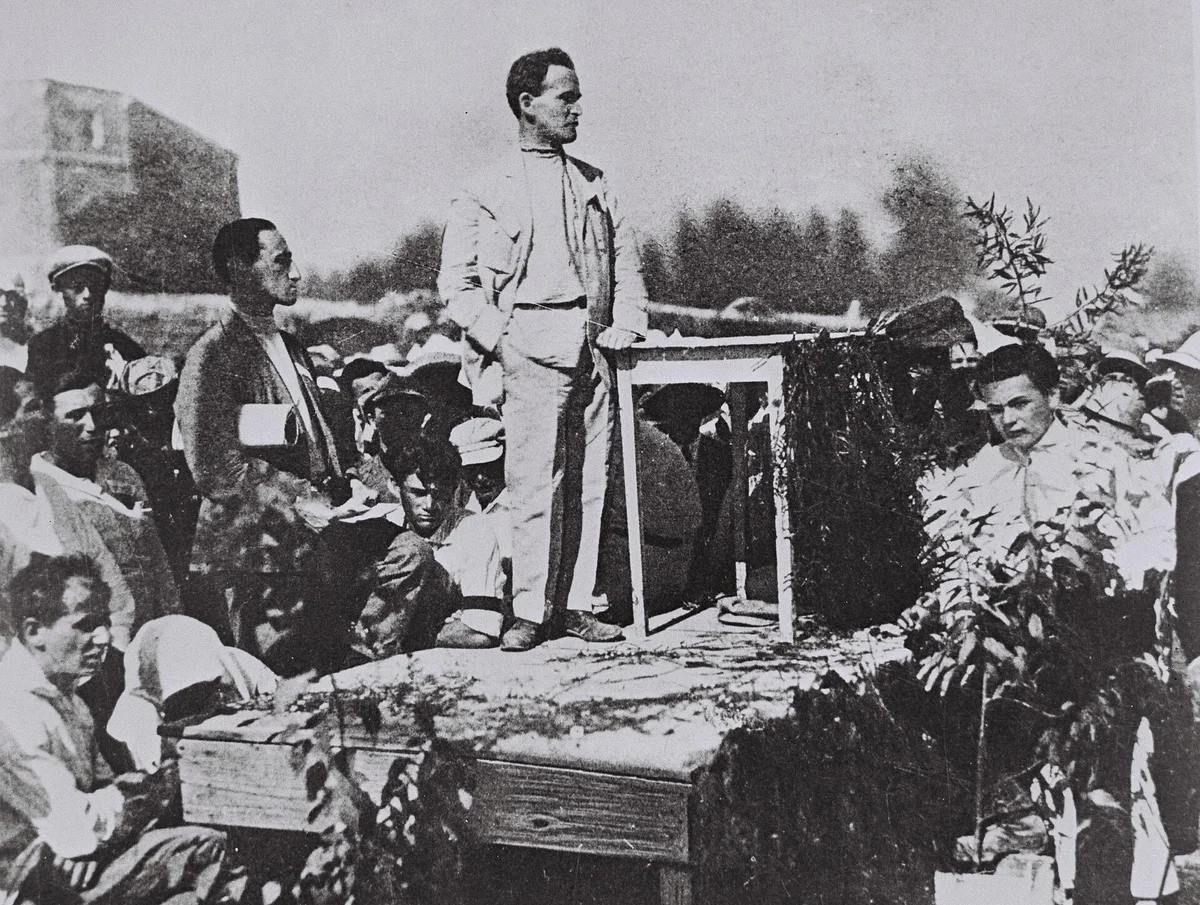
The Histadrut was closely connected to the political development of the Labour movement. In 1930, Ahdut HaAvoda and Hapoel Hatzair merged to establish Mapai, the Workers' Party of the Land of Israel. Ben-Gurion became its leading political figure. Mapai subsequently dominated the Histadrut and, after 1948, played the leading role in Israeli government until the Likud victory in 1977. The party and the federation were formally separate organisations, but their leadership, political networks and institutional interests were closely intertwined. [1][3]
This relationship gave the Histadrut considerable influence over economic and social policy. It was not simply a representative body negotiating with employers: it was itself an employer, service provider and owner of major businesses. Its influence reflected the central position of organised labour in the Zionist movement and in the construction of Israel's early institutions.
The Histadrut as an Employer and Economic Power
One of the Histadrut’s distinctive features was its economic arm, Hevrat HaOvdim, or the Workers’ Society, established in 1923. It was designed to finance and manage enterprises that could provide employment, develop infrastructure and support the economic independence of the Jewish community. Its holdings covered construction, banking, manufacturing, agriculture, insurance and other services. At its height, the Workers’ Society and associated enterprises represented a substantial part of Israel’s economy. [2][4]
Three major enterprises illustrate this role:
- Solel Boneh: Established as a public-works organisation in 1920 and operating under the name Solel Boneh from 1924, it became a major construction and engineering company. It built roads, public buildings, industrial facilities and infrastructure. It also participated in the construction of fortified agricultural settlements during the Mandate period. Its work supported both economic development and the physical establishment of Jewish communities. [5]
- Bank Hapoalim: Founded in 1921 by the Histadrut and the World Zionist Organization, it was established to provide credit and financial services to workers, cooperatives and labour settlements. It later developed into one of Israel’s major commercial banks. [6]
- Koor: The Histadrut's industrial holdings included Koor, a major industrial group that developed interests in manufacturing, electrical equipment and other sectors. It became one of the most important components of the Workers’ Society’s business network. [4]
The Histadrut's ownership of these businesses created a distinctive arrangement. It represented workers in collective bargaining while also managing companies that employed workers. This gave it economic influence but also created potential conflicts between its responsibilities as a union and its interests as an employer. The scale of its business holdings made the Histadrut a central economic actor, but it also tied the organisation's finances and political influence to the performance of its enterprises.
Clalit and the Separation of Healthcare: 1920s–1995
Healthcare was another major part of the Histadrut's institutional structure. Its health fund, Kupat Holim Clalit, grew out of earlier workers' medical funds and became the largest healthcare provider in Mandate Palestine and later Israel. It operated clinics, hospitals and other medical services, providing affordable healthcare to members and their families. For many immigrants and workers, joining the Histadrut also meant gaining access to medical care. [7]
For decades, membership of the Histadrut and access to Clalit were closely linked. Health insurance contributions were collected through the Histadrut system, and Clalit became a major source of organisational income. By the early 1990s, it provided healthcare to a large majority of the population. The arrangement helped expand access to medical services, but it also created problems: healthcare financing depended heavily on an organisation with its own political and financial interests, and people outside the Histadrut faced a less straightforward route to coverage. [7]
The Knesset passed the National Health Insurance Law in June 1994. Its implementation began on 1 January 1995. The law established a system of universal health coverage for Israeli residents and shifted the collection of health-insurance contributions to the National Insurance Institute. This severed the financial and organisational link between Clalit and the Histadrut. Clalit continued as one of Israel's four health funds, but it no longer functioned as the Histadrut's healthcare arm. [7][8]
The reform had major consequences for the federation. The Histadrut lost a large part of its membership base and a major source of income. People no longer needed to belong to the union to receive healthcare through Clalit. The separation therefore accelerated the transformation of the Histadrut from a broad social and economic organisation into a federation focused primarily on trade union representation.
Arab Membership and the Histadrut's Changing Identity
The Histadrut was founded as an organisation of Hebrew-speaking Jewish workers. Its early policies reflected the Labour Zionist principle of Avoda Ivrit, or Hebrew Labour, which sought to establish Jewish employment and a self-supporting Jewish economy. This approach often placed Arab workers at a disadvantage, particularly in workplaces where Jewish labour organisations sought to secure jobs for Jewish immigrants. Arab workers were not initially admitted as equal members of the federation. [9]
There were, however, early efforts to organise Arab workers. In 1930, the Histadrut established an Arab Affairs Department and supported the Palestine Labour League, a separate organisation for Arab workers. It sought to organise workers in mixed workplaces and establish links with Arab communities, although the separate structure did not provide the same status as full Histadrut membership. [9]
After the establishment of Israel in 1948, the question of Arab membership remained contentious. Arab workers were gradually admitted into some of the Histadrut's professional unions, but full and equal membership was not formally adopted until 1959. Arab members subsequently participated in the federation's elections and institutions. In 1966, the organisation's name was changed from the General Federation of Hebrew Workers to the General Federation of Labour in the Land of Israel, reflecting its broader membership. [9][10]
The expansion of membership did not erase the history of exclusion or all inequalities in representation. Arab workers continued to face distinct economic and political conditions, and the federation's earlier policies remained a subject of criticism. Nevertheless, the change in membership rules was an important institutional development, allowing Arab workers to participate as full members in Israel's largest labour federation.
Privatisation, Membership Decline and Organisational Reform
The Histadrut's economic and political dominance began to weaken before the major reforms of the 1990s. The end of Mapai's political dominance after the 1977 election reduced its privileged position within government. The economic crisis of the 1980s, financial difficulties and changes in Israel's economic policy also placed pressure on its business holdings. The 1983 banking crisis further affected the ownership and financial structure of major institutions. [4][11]
During the 1980s and 1990s, the Histadrut sold or transferred many of its economic assets, including holdings in Koor, Solel Boneh and Bank Hapoalim. In 1994, Haim Ramon was elected secretary-general on a platform of organisational reform. He pursued the sale of business holdings, reduced the federation's economic activities and sought to make it a more conventional trade union organisation. The separation of Clalit under the National Health Insurance Law, effective in 1995, further reduced its institutional reach. [4][11]
The consequences were reflected in membership figures. In the 1980s, union membership in Israel had reached approximately 80 per cent of the workforce. By 2012, it had fallen to around 25 per cent. The loss of members was particularly pronounced during the mid-1990s, when the healthcare link was severed. These changes were not caused by privatisation alone: they also reflected changes in employment patterns, the growth of the private sector, the emergence of independent professional unions and the decline of the old Labour movement's political influence. [11][12]
The Histadrut increasingly concentrated on collective bargaining, workplace representation, labour rights and negotiations with employers. It retained substantial influence in government services, public companies and large organised workplaces, even as its presence in much of the private sector remained more limited.
Strikes and Political Influence: The March 2023 General Strike
The Histadrut can still exert considerable influence through its ability to organise workers across multiple sectors. Its national reach allows it to call strikes that affect public services, transport, banking, healthcare and other parts of the economy. Such action can be used to press for higher wages and better working conditions, but it can also become a means of influencing national political decisions.
On 27 March 2023, Histadrut chairman Arnon Bar-David announced a general strike during the confrontation over the government's proposed judicial reforms. The announcement followed the dismissal of Defence Minister Yoav Gallant, who had called for a pause in the legislative process. The Histadrut said the country could not continue amid the growing internal crisis and called for the legislative process to be halted. [13]
The strike affected a wide range of services. Departing flights at Ben Gurion Airport were halted, hospitals suspended some non-emergency services, ports and businesses faced disruptions, and Israeli diplomatic missions abroad were also affected. The action was particularly significant because it brought the Histadrut into the political confrontation at a national level, alongside protests and opposition from business leaders and other organisations. [13]
Later that evening, Prime Minister Benjamin Netanyahu announced a temporary pause in the legislative process to allow negotiations. Bar-David then called off the strike. The episode demonstrated the federation's continuing capacity to influence national events, even though its role had changed substantially since the state-building era. It also illustrated the political sensitivity of general strikes: the Histadrut's intervention was welcomed by some opponents of the proposed reforms and criticised by others who argued that a labour federation should not use its industrial power to influence constitutional and political questions. [13]
The Histadrut Today: Public-Sector Bargaining and Labour Relations
Today, the Histadrut remains Israel's largest general labour federation and an important participant in collective bargaining. Its role is especially significant in the public sector, where many employees are covered by collective agreements. It negotiates with the Ministry of Finance, government agencies and public employers on wages, working hours, employment conditions, pensions and other workplace matters. [12]
Israel's system of labour relations is governed in part by the Collective Agreements Law and the Settlement of Labour Disputes Law, both dating from 1957. A union that reaches the required representation threshold in a workplace can negotiate collective agreements that also cover eligible non-members. The Histadrut operates alongside independent unions and professional organisations, including teachers' and doctors' unions, which represent workers in their respective fields. [12]
A major example of its contemporary role was the public-sector framework agreement signed with the Ministry of Finance on 17 July 2023. It followed understandings reached earlier that year and covered hundreds of thousands of public-sector employees. The agreement included general wage increases, a one-time grant of NIS 6,000 for eligible employees, measures to shorten the working week and provisions intended to improve productivity and public services. [14]
The Histadrut's position is therefore different from the one it held during the first decades of the state. It no longer owns a vast network of banks, industrial companies and healthcare services, nor does it operate as a central institution of the governing Labour movement. Its influence now rests primarily on its membership, workplace representation, collective bargaining capacity and ability to mobilise workers. It remains a major actor in Israel's economic and political life, particularly when negotiations with the government reach an impasse.
Sources
- Knesset. “David Ben-Gurion.” The Knesset. Sections “1918–1935” and “The General Federation of Labor.” https://m.knesset.gov.il/EN/About/Pages/BG.aspx.
- Metz, Helen Chapin, ed. Israel: A Country Study. Washington, DC: Federal Research Division, Library of Congress, 1990. Chapter 1, “Historical Setting,” section on the Histadrut and the development of the Yishuv's economic institutions, pp. 40–42. https://tile.loc.gov/storage-services/master/frd/frdcstdy/is/israelcountrystu00metz_0/israelcountrystu00metz_0.pdf.
- Knesset. “David Ben-Gurion.” The Knesset. Section “1918–1935,” paragraph on the 1930 merger of Ahdut HaAvoda and Hapoel Hatzair to form Mapai. https://m.knesset.gov.il/EN/About/Pages/BG.aspx.
- Yadlin, Aharon, and Shaked Gilboa. “Ḥevrat Ha-Ovedim.” Encyclopaedia Judaica. 2nd ed. Section on the Workers’ Society's enterprises and the disposal of its assets during the 1980s and 1990s. https://jewishvirtuallibrary.org/jsource/judaica/ejud_0002_0009_0_08897.html.
- Shikun & Binui. “Solel Boneh.” Shikun & Binui. Sections “About Us” and “History and Legacy,” including the company's establishment as the Office for Public Works in 1920 and its operation as Solel Boneh from 1924. https://www.shikunbinui.com/en/solel-boneh/.
- Bank Hapoalim. “About Us.” Bank Hapoalim. Section “Corporate Profile,” paragraph on the bank's founding in 1921 by the Histadrut and the institutions of the Yishuv. https://www.bankhapoalim.com/en/about-us.
- Rosen, Bruce, and others. Israel: Health Care Systems in Transition. Copenhagen: European Observatory on Health Care Systems, 2003. Section on the evolution of Israel's health sector and the National Health Insurance Law, including the separation of Clalit from the Histadrut. https://iris.who.int/bitstream/handle/10665/107537/HiT-5-1-2003-eng.pdf?sequence=11.
- Israel. National Health Insurance Law, 5754–1994. Passed 15 June 1994; implemented 1 January 1995. See provisions on universal coverage and collection of health-insurance contributions through the National Insurance Institute. https://www.nevo.co.il/law_html/law01/036_001.htm.
- Lockman, Zachary. Comrades and Enemies: Arab and Jewish Workers in Palestine, 1906–1948. Berkeley: University of California Press, 1996. Chapters on the Histadrut, Arab workers and the Palestine Labour League; see especially the discussion of the Arab Affairs Department and the separate organisation of Arab workers. https://publishing.cdlib.org/ucpressebooks/view?docId=ft6b69p0hf.
- University of California, Berkeley. “Both Arab and Israeli: The Subordinate Integration of Palestinian Arabs into Israeli Society, 1948–1967.” eScholarship. Chapter discussion of the Histadrut's 1959 decision to grant Arab workers equal membership and the subsequent integration process. https://escholarship.org/uc/item/2p03p0tf.
- Hyman, Richard, and others. “The New Histadrut: Changes in the Israeli Trade Union Movement.” Friedrich-Ebert-Stiftung. Sections on the 1990s restructuring, the 1995 health reform and membership decline. https://library.fes.de/pdf-files/gurn/00167.pdf.
- Organisation for Economic Co-operation and Development. The Public Sector Pay System in Israel. Paris: OECD Publishing, 2021. Chapter 1, “Background and Context of Public Sector Pay in Israel,” sections on trade-union membership, collective bargaining and the Histadrut's role in public-sector agreements. https://www.oecd.org/en/publications/the-public-sector-pay-system-in-israel_3b6ad37f-en.html.
- Goldenberg, Tia, and Ilan Ben Zion. “Netanyahu Announces Pause to Judicial Overhaul Plan after Days of Strikes That Threatened to Paralyze Economy.” CBS News, 27 March 2023. Sections on the Histadrut's strike announcement, affected sectors and the decision to call off the strike. https://www.cbsnews.com/news/israel-news-protest-general-strike-netanyahu-judicial-reform/.
- Histadrut. “New Framework Agreement Ushers in Brighter Future for Israel’s Public Sector.” 17 July 2023. Sections on the agreement's coverage, wage increases, one-time grant and working-week provisions. https://global.histadrut.org.il/news/new-framework-agreement-ushers-in-brighter-future-for-israels-public-sector/.