
The British Mandate
Quick answer · ~120 words
Britain governed Palestine under a League of Nations Mandate from 1920 to 1948. The League approved the Mandate in July 1922, and it came into force in September 1923. It required Britain to secure a Jewish national home while protecting the civil and religious rights of all inhabitants. Jewish immigration raised the Jewish share of the population from about 13 % in 1922 to about 33 % at the end of 1946. Arab opposition to this policy led to violence in 1920, 1921 and 1929, and to the Arab Revolt of 1936 to 1939. Britain responded with commissions of inquiry and with policy statements called White Papers in 1922, 1930 and 1939. The 1939 White Paper limited Jewish immigration to 75,000 over five years. In 1947 Britain referred the question to the United Nations, which recommended partition. British rule ended on 15 May 1948.
Establishing the Mandate: Legal Framework and Administration (1917 to 1923)
British forces captured Jerusalem from the Ottoman Empire in December 1917 and completed the conquest of Palestine in 1918. In November 1917 the British government had issued the Balfour Declaration, which supported a national home for the Jewish people in Palestine. A British military administration governed the country until July 1920, when a civil administration under High Commissioner Herbert Samuel replaced it. At the San Remo conference in April 1920, the Allied powers assigned the Mandate for Palestine to Britain.
The Council of the League of Nations approved the Mandate text in July 1922, and the text came into force in September 1923 [1]. Its preamble repeated the Balfour Declaration. Article 2 made Britain responsible for securing the establishment of the Jewish national home, for developing self-governing institutions, and for safeguarding the civil and religious rights of all inhabitants regardless of race and religion [2]. Article 4 recognised "an appropriate Jewish agency" as a public body to advise the administration on matters affecting the national home [2]. Article 6 required the administration to facilitate Jewish immigration under suitable conditions, while ensuring that the rights and position of other sections of the population were not prejudiced [2]. The Mandate gave no Arab body a role equivalent to the Jewish agency under Article 4 [2].
The High Commissioner held both executive and legislative authority. He governed through a Secretariat in Jerusalem, government departments, district commissioners and the Palestine Police. The legal system combined Ottoman law with English common law and equity, under Article 46 of the Palestine Orders in Council of 1922 to 1947 [3].
Each community built its own institutions alongside the British government. Jewish residents elected an Assembly of Representatives, which chose a National Council (Vaad Leumi). The Histadrut labour federation and the Haganah defence organisation were both founded in 1920. The Zionist Organization acted as the Jewish agency under Article 4 until the Jewish Agency for Palestine took over this role in 1929. On the Arab side, the Arab Executive Committee represented the Palestinian Arab congresses from 1920. The Supreme Muslim Council, created in 1921, controlled Muslim religious courts and endowments. Its president was Hajj Amin al-Husseini, whom Samuel had appointed Mufti of Jerusalem in 1921.
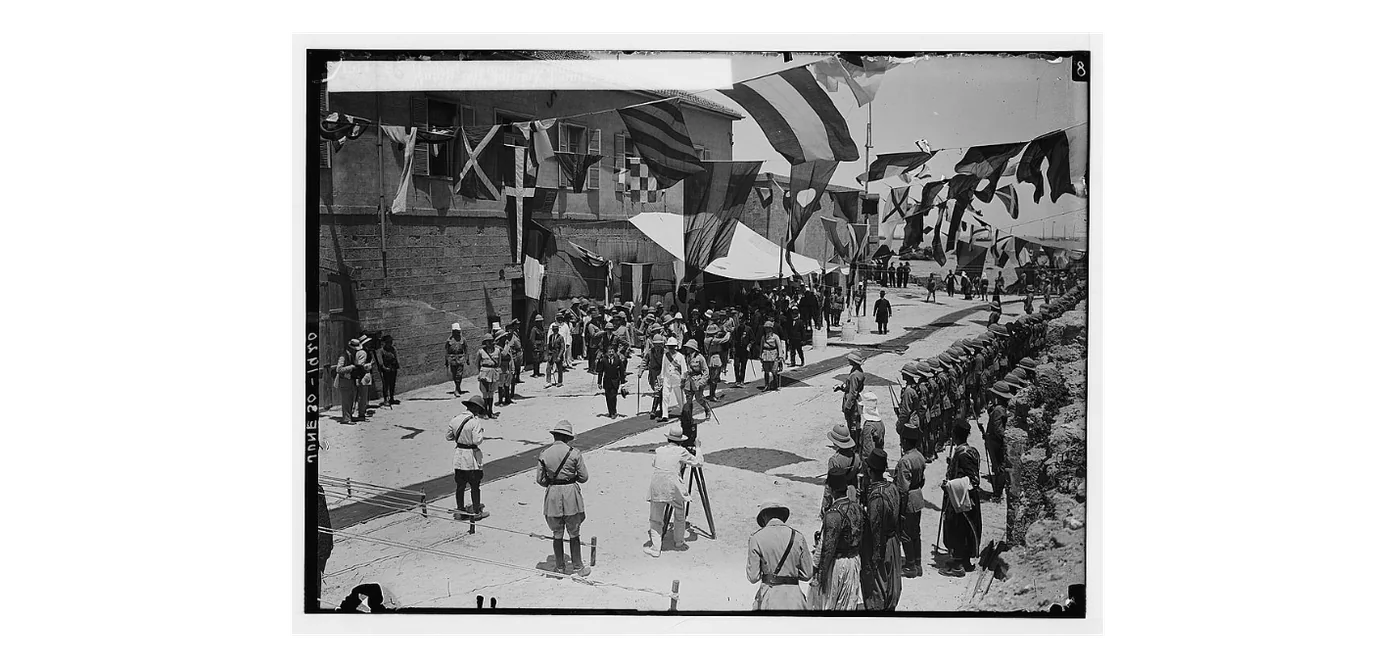
The arrival of Sir Herbert Samuel, and governors of Jerusalem-Jaffa
Early Violence and the Churchill White Paper (1920 to 1922)
The first serious violence of British rule took place in Jerusalem in April 1920, during the Nebi Musa religious festival. Arab crowds attacked Jewish residents of the Old City, and people on both sides were killed and wounded. A military court of inquiry, known as the Palin Commission, investigated the events. Its report was not published at the time.
Larger violence began in Jaffa on 1 May 1921. The High Commissioner appointed a commission under Sir Thomas Haycraft, the Chief Justice of Palestine, to investigate. The commission found that the immediate cause was a clash between an unauthorised march of Jewish communists and an authorised march of the Jewish Labour Party [4]. Arab crowds then attacked Jews in Jaffa, and the violence spread to Jewish agricultural settlements, including Hadera and Petah Tikva [4]. The commission reported that 47 Jews were killed and 146 wounded, and that 48 Arabs were killed and 73 wounded [4]. It found that Arabs were generally the aggressors in Jaffa and caused most of the casualties there, and that most Arab casualties in the raids on the settlements resulted from the intervention of the military [4]. It identified the fundamental cause as Arab discontent with, and hostility to, Jews, arising from political and economic causes connected with Jewish immigration and with Arab understanding of Zionist aims [4].
Britain set out its policy in a statement issued in June 1922, known as the Churchill White Paper after the Colonial Secretary, Winston Churchill [5]. The paper confirmed British support for the Balfour Declaration. It stated that the national home would be founded in Palestine, not that the whole of Palestine would become a Jewish national home [5]. It said Jewish immigration should not exceed the economic capacity of the country to absorb new arrivals [5]. It also stated that the Zionist Organization had no share in the government of the country, and that all citizens would hold Palestinian status in law [5]. The paper proposed a legislative council with elected members. The Zionist Organization accepted the statement. The Palestine Arab Delegation rejected it. In 1923 most Arab voters boycotted elections for the proposed council, and Britain dropped the plan. The High Commissioner continued to govern with an appointed advisory council.
The 1929 Disturbances and the Passfield White Paper (1928 to 1931)
Tension over the Western Wall in Jerusalem grew from September 1928, when British police removed a screen that Jewish worshippers had placed at the wall to separate men and women during prayer on Yom Kippur. Muslim authorities said the screen changed the established arrangements at a site that formed part of a Muslim religious endowment. Jewish organisations sought wider rights of worship at the wall. In mid-August 1929 a Jewish demonstration at the wall was followed by a Muslim counter-demonstration the next day.
Violence broke out on 23 August 1929 and continued until 29 August in Jerusalem, Hebron, Safed and other places. The British Commission on the Palestine Disturbances, led by Sir Walter Shaw, reported that 133 Jews were killed and 339 wounded [6]. For Arabs, the Shaw Commission counted 87 killed and 181 wounded who were treated in hospital [6]. Later official totals, cited in peer-reviewed scholarship, give 116 Arabs killed and 232 wounded [7]. Most Jewish casualties were caused by Arab rioters, and most Arab casualties were caused by British security forces [7]. The largest loss of Jewish life took place in Hebron on 24 August [7]. The Shaw Commission also recorded an Arab attack on the Jewish quarter of Safed on 29 August, in which about 45 Jews were killed or wounded [6]. It recorded a Jewish attack in Jaffa in which the imam of a mosque and about six other people were killed, and a Jewish attack on a mosque in Jerusalem on 26 August [6].
The Shaw Commission found that the outbreak began with Arab attacks on Jews and was not premeditated [6]. It identified the underlying cause as Arab hostility toward Jews, arising from the disappointment of Arab political and national hopes and from fear about their economic future [6]. It recommended a review of immigration and land policy.
Britain then sent Sir John Hope Simpson to study land settlement and immigration. His report and a new policy statement were both published in October 1930. The new statement, known as the Passfield White Paper after the Colonial Secretary, Lord Passfield, said that no policy in Palestine could succeed without the willing cooperation of the communities concerned [8]. It linked the level of Jewish immigration to Arab unemployment and proposed closer control of land transfers [8]. Zionist leaders protested strongly, and Chaim Weizmann resigned as president of the Jewish Agency. On 13 February 1931, Prime Minister Ramsay MacDonald sent Weizmann a letter that interpreted the White Paper in a way that kept Mandate commitments on immigration and land settlement in place [9]. Arab leaders called it the "Black Letter."
Immigration, the Peel Commission and the Arab Revolt (1932 to 1939)
The Mandate government controlled immigration through certificates issued in several categories. The number of certificates for Jewish workers was set in regular labour schedules, based on the principle of economic absorptive capacity stated in 1922 [5]. The United Nations Special Committee on Palestine later reported that about 376,000 Jewish immigrants were recorded between 1920 and 1946, an average of over 8,000 a year [10]. The flow was uneven. It was high from 1924 to 1926, fell afterward, turned into net emigration in 1927, and rose to higher levels from 1933 to 1936 as a result of Nazi persecution in Europe [10]. Between 1931 and 1936 the Jewish share of the population rose from 18 % to nearly 30 % [10].
The Arab Revolt began in April 1936. On 15 April, armed Arabs stopped vehicles on the road between Tulkarm and Nablus and shot Jewish passengers. Reprisals and riots followed in Jaffa and Tel Aviv. Arab leaders formed the Arab Higher Committee, headed by Hajj Amin al-Husseini, which called a general strike. It demanded an end to Jewish immigration, a ban on land sales to Jews, and an Arab national government. The strike lasted until October 1936.
Britain appointed a Royal Commission under Lord Peel, which reported in July 1937. The commission concluded that the aims of the two communities could not be reconciled under the Mandate, and it recommended partition [11]. Its plan proposed a Jewish state, an Arab state joined with Transjordan, and a zone under continued British mandate containing Jerusalem and Bethlehem, with a corridor to the sea near Jaffa [11]. The Arab Higher Committee rejected the plan. The Zionist Congress rejected the proposed borders but authorised its leaders to negotiate on the principle of partition.
After the assassination of a British district commissioner in September 1937, Britain outlawed the Arab Higher Committee and Husseini left the country. The revolt reached its height in 1938. British forces used military courts, detention, collective punishments, house demolitions and executions to suppress it [12]. The Irgun, a Jewish armed group that had broken away from the Haganah, carried out bomb attacks on Arab civilians in markets and other public places during these years [12]. In November 1938 the Woodhead Commission reported that partition was not practicable.
Casualty figures for the revolt differ by source. Palestinian historian Walid Khalidi, analysing British records, estimated 5,032 Arab deaths, of which 3,832 were caused by British forces and 1,200 by violence among Arabs, along with 14,760 wounded [12]. For Jews, an Ohio State University history publication gives 415 deaths, and it gives about 100 British deaths [13]. Other studies give higher British figures.
The 1939 White Paper and the Road to Withdrawal (1939 to 1948)
In May 1939 Britain issued a new statement of policy, known as the MacDonald White Paper after the Colonial Secretary, Malcolm MacDonald. It stated that Britain did not intend Palestine to become a Jewish state against the will of its Arab population [14]. It limited Jewish immigration to 75,000 over the next five years, made up of 10,000 a year plus 25,000 refugees, and it made further immigration after that period subject to Arab consent [14]. It restricted land transfers to Jews in some areas and forbade them in others, and it proposed an independent Palestinian state within ten years [14]. Zionist organisations rejected the White Paper, and Jewish demonstrations took place across Palestine. The Arab Higher Committee also rejected it, mainly over the timetable for independence.
During the Second World War, the Jewish Agency supported Britain's war effort while opposing the White Paper. After the war, Jewish groups organised immigration outside the legal quota, and Britain intercepted many of the ships. The Irgun and Lehi, joined for a period by the Haganah, conducted an armed campaign against British rule, including the bombing of the King David Hotel in Jerusalem in July 1946.
An Anglo-American Committee of Inquiry reported in April 1946 that partition would work only if both communities accepted it, and it did not recommend partition [15]. After talks in London failed, Britain placed the question before the United Nations in 1947. The UN Special Committee on Palestine reported in September 1947. It estimated the population at the end of 1946 at 1,203,000 Arabs, 608,000 Jews and 35,000 others, a total of 1,846,000 [10]. The Jewish share had risen from 12.91 % in 1922 to 32.96 % in 1946 [10]. A majority of the committee proposed partition. A minority proposed a federal state.
On 29 November 1947 the General Assembly adopted Resolution 181, which recommended partition with economic union. It provided that the Mandate would end as soon as possible and not later than 1 August 1948, and that British forces would withdraw by the same date [16]. Fighting between Jewish and Arab forces began within days. In February 1948 Britain informed the UN Palestine Commission that the Commission would be the government of Palestine after 15 May 1948, as far as Britain was concerned [17]. The Palestine Act, passed on 29 April 1948, ended British jurisdiction on 15 May 1948 [18]. On 14 May 1948 Jewish leaders in Tel Aviv declared the State of Israel. On 15 May the armies of neighbouring Arab states entered the territory.
In One Paragraph
Britain ruled Palestine from 1920 to 1948 under a League of Nations Mandate, approved in July 1922 and in force from September 1923. The Mandate required Britain to secure a Jewish national home and to protect the civil and religious rights of all inhabitants. Jewish immigration raised the Jewish share of the population from about 13 % in 1922 to about 33 % at the end of 1946. Arab opposition produced violence in 1920, 1921 and 1929 and the Arab Revolt of 1936 to 1939. Britain answered with commissions of inquiry and White Papers in 1922, 1930 and 1939, the last of which limited Jewish immigration to 75,000 over five years. In 1947 Britain referred the question to the United Nations, which recommended partition in November 1947. British rule ended on 15 May 1948.
Sources
- Anglo-American Committee of Inquiry. Report to the United States Government and His Majesty’s Government in the United Kingdom. Appendix IV, “Palestine: Historical Background.” Lausanne, April 20, 1946. The Avalon Project, Yale Law School. https://avalon.law.yale.edu/20th_century/angap04.asp
- League of Nations. “Mandate for Palestine.” July 24, 1922. Preamble and Articles 2, 4, 6, and 25. The Avalon Project, Yale Law School. https://avalon.law.yale.edu/20th_century/palmanda.asp
- United Nations Palestine Commission. “Document on the Legal Position in Palestine, Including Article 46 of the Palestine Orders in Council, 1922–47.” 1948. UNISPAL. https://www.un.org/unispal/document/auto-insert-210980
- Great Britain, Colonial Office. Palestine: Disturbances in May, 1921. Reports of the Commission of Inquiry with Correspondence Relating Thereto (Haycraft Report). Cmd. 1540. London: HMSO, 1921. Text hosted by palQuest, Institute for Palestine Studies. https://www.palquest.org/en/historictext/6710/report-haycraft-commission-inquiry-may-1921-jaffa-riots
- Great Britain, Colonial Office. British Policy in Palestine (Churchill White Paper). Cmd. 1700. June 1922. The Avalon Project, Yale Law School. https://avalon.law.yale.edu/20th_century/brwh1922.asp
- Great Britain. Report of the Commission on the Palestine Disturbances of August 1929 (Shaw Report). Cmd. 3530. London: HMSO, 1930, 65. Excerpts hosted by the Center for Online Judaic Studies. https://cojs.org/excerpts_from_commission_on_the_palestine_disturbances_of_august_1929_-the_shaw_commission-_cmd-3530-_1930/
- Winder, Alex. “The ‘Western Wall’ Riots of 1929: Religious Boundaries and Communal Violence.” Journal of Palestine Studies 42, no. 1 (2012): 6. https://www.palestine-studies.org/sites/default/files/attachments/jps-articles/JPS165_Winder_Final.pdf
- Great Britain. Palestine: Statement of Policy by His Majesty’s Government in the United Kingdom (Passfield White Paper). Cmd. 3692. October 1930, 3–11. https://cojs.org/palestine-statement_of_policy_by_his_majesty-s_government_in_the_united_kingdom-cmd-3692--_october_1930-_summary/
- MacDonald, Ramsay. Letter to Chaim Weizmann interpreting the White Paper of October 1930. February 13, 1931. https://www.un.org/unispal/document/auto-insert-207187/
- United Nations Special Committee on Palestine. Report to the General Assembly. A/364. September 3, 1947. Chapter II, paragraphs 12–15. UNISPAL. https://www.un.org/unispal/document/auto-insert-179435/
- Great Britain. Palestine Royal Commission Report (Peel Report). Cmd. 5479. London: HMSO, 1937. Chapters XX–XXII. UNISPAL. https://www.un.org/unispal/document/auto-insert-196150/
- Hughes, Matthew. Britain’s Pacification of Palestine: The British Army, the Colonial State, and the Arab Revolt, 1936–1939. Cambridge: Cambridge University Press, 2019, 377. [Flag: paywalled; no free equivalent located.]
- “The 1936–1939 Arab Revolt in Palestine.” Origins: Current Events in Historical Perspective. Ohio State University and Miami University. [Flag: university publication, not peer-reviewed; author name to be confirmed.] https://origins.osu.edu/read/1936-1939-arab-revolt-palestine
- Great Britain. Palestine: Statement of Policy (MacDonald White Paper). Cmd. 6019. May 1939. The Avalon Project, Yale Law School. https://avalon.law.yale.edu/20th_century/brwh1939.asp
- Anglo-American Committee of Inquiry. Report. Chapter X. April 20, 1946. The Avalon Project, Yale Law School. https://avalon.law.yale.edu/20th_century/angch10.asp
- United Nations General Assembly. “Resolution 181 (II), ‘Future Government of Palestine.’” Part I.A, paragraphs 1–2. November 29, 1947. The Avalon Project, Yale Law School. https://avalon.law.yale.edu/20th_century/res181.asp
- United Kingdom Delegation to the United Nations. “Legal Meaning of the ‘Termination of the Mandate.’” Memorandum A, paragraphs 1–2, enclosed in letter from Alexander Cadogan to Per Federspiel, February 20, 1948. UNISPAL. https://www.un.org/unispal/document/auto-insert-210498
- United Kingdom Parliament. Palestine Act, 1948. 11 & 12 Geo. 6, c. 27, sec. 1(1), April 29, 1948. Text hosted by palQuest, Institute for Palestine Studies. https://palquest.org/ar/node/40633