
The Balfour Declaration
Quick answer · ~120 words
The Balfour Declaration is a statement of British policy in a letter dated 2 November 1917 from Foreign Secretary Arthur James Balfour to Lord Walter Rothschild. It said the British government viewed "with favour the establishment in Palestine of a national home for the Jewish people" and would use its "best endeavours" to help. It added two conditions. Nothing would prejudice the civil and religious rights of existing non-Jewish communities in Palestine. Nothing would prejudice the rights and political status of Jews in other countries. The War Cabinet approved the final text on 31 October 1917, after drafts that began in July. The Declaration overlapped with two earlier British commitments: the McMahon-Hussein letters of 1915 and 1916, and the Sykes-Picot agreement with France of May 1916. In 1922 the League of Nations wrote the Declaration into the Mandate for Palestine.
The Full Text and Its Three Parts
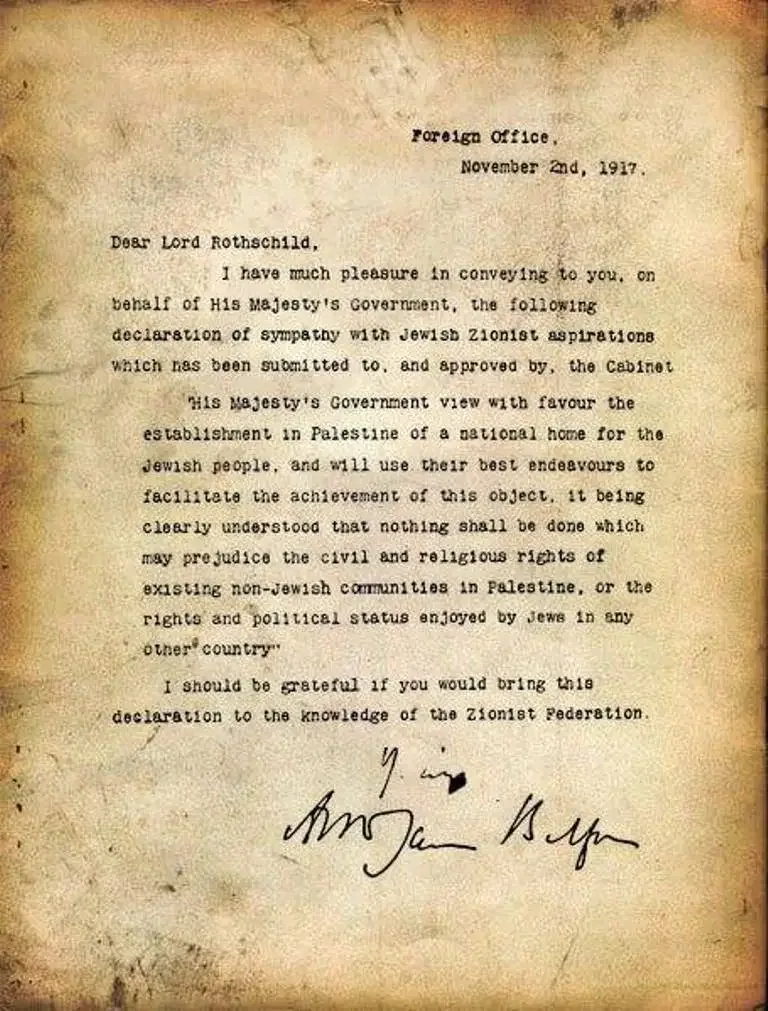
Balfour Declaration sent to Lord Walter Rothschild, November 2, 1917
The Declaration is a single letter on Foreign Office paper. Its full text reads:
Foreign Office, November 2nd, 1917.
Dear Lord Rothschild,
I have much pleasure in conveying to you, on behalf of His Majesty's Government, the following declaration of sympathy with Jewish Zionist aspirations which has been submitted to, and approved by, the Cabinet. "His Majesty's Government view with favour the establishment in Palestine of a national home for the Jewish people, and will use their best endeavours to facilitate the achievement of this object, it being clearly understood that nothing shall be done which may prejudice the civil and religious rights of existing non-Jewish communities in Palestine, or the rights and political status enjoyed by Jews in any other country." I should be grateful if you would bring this declaration to the knowledge of the Zionist Federation.
Yours sincerely,
Arthur James Balfour. [1]
The quoted policy sentence has three parts. The first is a statement of approval: the government "view with favour" a Jewish national home in Palestine. The second is a commitment to act: the government will use "best endeavours to facilitate" that aim. The third is a pair of safeguards. One protects the "civil and religious rights" of the "existing non-Jewish communities in Palestine." The other protects the "rights and political status" of Jews living outside Palestine [1].
Drafting History, July to 31 October 1917
The first formal draft came from the Zionist side. On 18 July 1917 Lord Rothschild sent Balfour a formula prepared by the Zionist Political Committee in London. It proposed that "His Majesty's Government accepts the principle that Palestine should be reconstituted as the National Home of the Jewish people," and that the government would discuss "the necessary methods and means" with the Zionist Organisation [2]. That draft had no safeguard clauses.
Over the following three months, ministers rewrote it. A draft associated with Lord Milner in August replaced the idea that Palestine as a whole should be "reconstituted as the National Home" with language about affording opportunity for "a home for the Jewish people in Palestine" [4]. The change from "Palestine as" the national home to a home "in Palestine" survived into the final text. The word "reconstituted," which pointed to a historical claim, did not.
Opposition inside the Cabinet shaped the safeguards. On 23 August 1917 Edwin Montagu, Secretary of State for India and the only Jewish member of the government, circulated a memorandum titled "The Anti-Semitism of the Present Government." He argued that the policy would become "a rallying ground for Anti-Semites in every country in the world" and would cast doubt on the citizenship of Jews in Britain and elsewhere [5]. The clause protecting "the rights and political status enjoyed by Jews in any other country" answered this concern.
A draft prepared by Milner and Leopold Amery in early October 1917 contained both safeguards. It spoke of a national home "for the Jewish race" and limited the second safeguard to Jews "fully contented with their existing nationality and citizenship" [4]. The government sent this draft for comment to Jewish leaders, Zionist and non-Zionist. The National Library of Israel holds the copy sent to Sir Philip Magnus, a Reform rabbi and Member of Parliament [3]. In the final version, "Jewish race" became "Jewish people," and the qualification about contented Jews was dropped. The War Cabinet approved the text on 31 October 1917, and Balfour signed the letter two days later [4].
Competing Readings of "National Home", 1917 to 1939
"National home" was a new term in diplomacy, and three readings of it were on record within two decades.
The first reading treated the national home as a stage on the way to a Jewish state. David Lloyd George, Prime Minister in 1917, gave this account in evidence to the Palestine Royal Commission in 1937. He said a Jewish state was not to be set up at once, but that if Jews "had become a definite majority of the inhabitants," then "Palestine would thus become a Jewish Commonwealth" [7].
The second reading was the official British position of the 1920s. The Colonial Office statement of 3 June 1922, known as the Churchill White Paper, said the Declaration did not mean "that Palestine as a whole should be converted into a Jewish National Home, but that such a Home should be founded in Palestine." It rejected the expectation that Palestine would become "as Jewish as England is English." It also stated that the Jewish people were in Palestine "as of right and not on sufferance" [12]. The League of Nations Mandate, approved on 24 July 1922, recognised "the historical connection of the Jewish people with Palestine" and "the grounds for reconstituting their national home in that country." Article 2 made Britain responsible for securing the national home while "safeguarding the civil and religious rights of all the inhabitants of Palestine, irrespective of race and religion." Article 6 required Britain to facilitate Jewish immigration while ensuring that "the rights and position of other sections of the population are not prejudiced" [11].
The third reading was Arab. Arab leaders read the safeguard clause as protection against any political order that the majority population had not accepted. In January 1918 a British officer, Commander David Hogarth, delivered a message to the Sharif of Mecca. The Arab rendering of that message held that Jewish settlement would be allowed only as far as it was consistent with the political and economic freedom of the Arab population [9]. In the House of Lords on 27 March 1923, former Foreign Secretary Lord Grey said that if "93 % of the population of Palestine are Arabs," he did not see how a government other than an Arab one could be set up "without prejudice to their civil rights" [8]. The 93 % figure is Grey's own estimate, given in debate. In May 1939 the British government declared "unequivocally that it is not part of their policy that Palestine should become a Jewish State" [13].
The McMahon-Hussein Correspondence, July 1915 to March 1916
Two years before the Declaration, Britain had exchanged letters with Hussein bin Ali, the Sharif of Mecca, about Arab support against the Ottoman Empire. Sir Henry McMahon, the British High Commissioner in Cairo, wrote on behalf of the government. In his letter of 14 July 1915, the Sharif asked Britain to recognise Arab independence across a wide area. A British government committee confirmed in 1939 that this area included Palestine [6].
The key letter is McMahon's reply of 24 October 1915. It accepted the Sharif's area with exclusions. One exclusion covered "portions of Syria lying to the west of the districts of Damascus, Homs, Hama and Aleppo." A second, general reservation limited the pledge to areas where Britain was "free to act without detriment to the interests of her ally, France" [14]. The letter did not name Palestine.
The two sides read this passage differently. Arab representatives argued that the named districts lay north of Palestine, so the exclusion covered only the coast of northern Syria and Lebanon. They also argued that McMahon specified every exclusion he intended, and that his silence on Palestine left it inside the area of independence [6]. The British government argued that "districts" meant the Ottoman provinces, so the land west of the province of Damascus, including Palestine, was excluded. It also argued that France claimed Palestine in October 1915, so the general reservation applied [14]. In 1937 McMahon wrote that it "was not intended by me in giving the pledge to King Hussein to include Palestine in the area in which Arab independence was promised" [6]. Arab representatives noted that the Sharif protested as soon as the Balfour Declaration was issued [6].
In 1939 a joint Arab and British committee examined the letters and could not agree. The British members accepted that the Arab arguments had "greater force than has appeared hitherto." They maintained that Palestine was excluded, but agreed that the language used "was not so specific and unmistakable as it was thought to be at the time" [6]. The committee's joint conclusion was that Britain "were not free to dispose of Palestine without regard for the wishes and interests of the inhabitants of Palestine" [9].
The Sykes-Picot Agreement, May 1916, and the Three Commitments Side by Side
While the McMahon letters were still recent, Britain and France agreed on how to divide Ottoman Arab lands after the war. The agreement took the form of letters exchanged in May 1916 between Foreign Secretary Sir Edward Grey and the French ambassador, Paul Cambon. Its negotiators were Sir Mark Sykes and François Georges-Picot. The agreement created a zone of direct French control along the Syrian and Lebanese coast and a zone of direct British control in lower Mesopotamia. Between them lay two zones in which the two powers were "prepared to recognize and protect an independent Arab State or a Confederation of Arab States" under French or British influence [10].
Most of Palestine fell into a "brown area" under "an international administration." Its form was to be decided after consultation with Russia, the other Allies, "and the representatives of the Shereef of Mecca." Britain was to receive the ports of Haifa and Acre [10]. The agreement was secret. The new Bolshevik government in Russia published it in November 1917, weeks after the Balfour Declaration.
The British government later cited Sykes-Picot as support for its reading of the McMahon letters. In 1939 it argued that France had claimed Palestine in 1915, that the agreement showed that claim still stood in 1916, and that the Sharif's promised role in consulting on the brown area was consistent with the 1915 pledge [14]. Arab representatives answered that Britain had kept the agreement from the Sharif and had tried to reduce French influence in Palestine from the start [7]. The British delegation also argued that Balfour would not have issued his Declaration had he believed Palestine was included in McMahon's pledge [14].
Taken together, the three documents made different arrangements for the same territory. McMahon's letter left the status of Palestine open to dispute. Sykes-Picot placed most of it under international rule. The Balfour Declaration committed Britain to a Jewish national home within it. In his 1923 speech, Lord Grey proposed that all the wartime engagements be published side by side so that any inconsistency could be judged openly [8]. The British government published the full McMahon correspondence in March 1939 [6].
In One Paragraph
The Balfour Declaration was a letter of 2 November 1917 in which Foreign Secretary Arthur James Balfour told Lord Rothschild that Britain viewed with favour a national home for the Jewish people in Palestine, subject to two safeguards: the civil and religious rights of the existing non-Jewish communities, and the rights of Jews in other countries. The text grew out of a Zionist draft of 18 July 1917 and was revised by ministers until the War Cabinet approved it on 31 October 1917. The term "national home" was read as a path to statehood by Lloyd George, as a limited homeland by the 1922 Churchill White Paper, and as bounded by the rights of the Arab majority by Arab leaders. The Declaration overlapped with McMahon's 1915 pledge to the Sharif of Mecca, whose meaning Britain and Arab representatives still disputed in 1939, and with the 1916 Sykes-Picot plan for an international Palestine. The League of Nations incorporated the Declaration into the Mandate for Palestine in July 1922.
Sources
- Balfour, Arthur James. Letter to Lord Rothschild, November 2, 1917. In “Balfour Declaration 1917.” The Avalon Project: Documents in Law, History and Diplomacy. Lillian Goldman Law Library, Yale Law School. https://avalon.law.yale.edu/20th_century/balfour.asp
- Rothschild, Walter. “Draft Declaration Submitted to Arthur James Balfour,” July 18, 1917. CAB 21/58 (222). Cabinet Office, The National Archives, Kew. https://images.nationalarchives.gov.uk/asset/51196
- National Library of Israel. “The Unpublished Drafts of the Balfour Declaration.” NLI Blog. Accessed September 25, 2026. The holding institution’s description of the Magnus draft in its collection. https://blog.nli.org.il/en/balfour_drafts
- Vereté, Mayir. “The Balfour Declaration and Its Makers.” Middle Eastern Studies 6, no. 1 (1970): 48–76. https://doi.org/10.1080/00263207008700137
- Montagu, Edwin. “The Anti-Semitism of the Present Government.” War Cabinet memorandum, August 23, 1917. CAB 24/24/4 (GT 1868). The National Archives, Kew. Deep link not verified; locate by searching reference CAB 24/24/4 at the National Archives. https://discovery.nationalarchives.gov.uk
- Great Britain. Report of a Committee Set Up to Consider Certain Correspondence between Sir Henry McMahon and the Sharif of Mecca in 1915 and 1916. Cmd. 5974. London: HMSO, March 1939. Paras. 12, 13(e), 17, 18, and Annex A, para. 18. Reproduced by the United Nations Information System on the Question of Palestine. https://www.un.org/unispal/document/auto-insert-199699/
- Great Britain. Cmd. 5974 (1939). Annex D, “Observations Arising out of the Lord Chancellor’s Statement,” paras. 14–15, quoting Lloyd George’s evidence to the Palestine Royal Commission. https://www.un.org/unispal/document/auto-insert-199699/
- Great Britain. Cmd. 5974 (1939). Enclosure in Annex A, extracts from the speech of Viscount Grey of Fallodon, House of Lords, March 27, 1923. https://www.un.org/unispal/document/auto-insert-199699/
- Great Britain. Cmd. 5974 (1939). Paras. 20 and 22. https://www.un.org/unispal/document/auto-insert-199699/
- Grey, Edward, and Paul Cambon. “The Sykes-Picot Agreement: 1916.” The Avalon Project. Lillian Goldman Law Library, Yale Law School. https://avalon.law.yale.edu/20th_century/sykes.asp
- League of Nations. “The Palestine Mandate,” July 24, 1922. Preamble and Articles 2 and 6. The Avalon Project. Lillian Goldman Law Library, Yale Law School. https://avalon.law.yale.edu/20th_century/palmanda.asp
- Great Britain, Colonial Office. “British White Paper of June 1922.” The Avalon Project. Lillian Goldman Law Library, Yale Law School. https://avalon.law.yale.edu/20th_century/brwh1922.asp
- Great Britain. “British White Paper of 1939,” May 17, 1939. Section I, “The Constitution.” The Avalon Project. Lillian Goldman Law Library, Yale Law School. https://avalon.law.yale.edu/20th_century/brwh1939.asp
- Great Britain. Cmd. 5974 (1939). Annex B, “The McMahon-Husain Correspondence,” paras. 31, 33, 37–39, and 42. https://www.un.org/unispal/document/auto-insert-199699/