
The 2005 Gaza Disengagement
Quick answer · ~120 words
The Gaza disengagement was Israel's unilateral removal of all its settlements and military forces from the Gaza Strip in 2005. Four small settlements in the northern West Bank were also removed. Prime Minister Ariel Sharon proposed the plan in December 2003. The cabinet approved it on 6 June 2004. The Knesset endorsed it on 26 October 2004 by 67 votes to 45 and passed the implementing law on 16 February 2005. Eviction notices were served on 15 August 2005, forced removals began after the deadline of midnight on 16 August, and the last Gaza settlement, Netzarim, was emptied on 22 August. The last soldiers left on 12 September 2005. Between 8,000 and 9,000 residents were moved, depending on the count used. Israel kept control of Gaza's airspace, sea and most crossings. Hamas won Palestinian elections in January 2006 and seized Gaza by force in June 2007. Whether the withdrawal ended the occupation, and whether it served Israel's security, remain disputed.
The decision, December 2003 to February 2005
Ariel Sharon first set out the idea of unilateral disengagement in a speech at the Herzliya Conference on 18 December 2003. The Israeli Foreign Ministry later published this speech together with the cabinet and Knesset decisions that followed [1]. The cabinet approved a revised plan on 6 June 2004. Its text stated that Israel had found no reliable Palestinian partner and would therefore act without Palestinian cooperation. It said the purpose was to produce a better "security, political, economic and demographic situation." It stated that no Israeli towns would remain in Gaza under any permanent agreement, while some areas of the West Bank would become part of Israel. It also listed four northern West Bank settlements for evacuation: Ganim, Kadim, Sa-Nur and Homesh [2]. Two months before the cabinet vote, on 14 April 2004, President George W. Bush replied to a letter from Sharon. Bush welcomed the plan. He wrote that after Israel withdrew, existing arrangements for control of airspace, territorial waters and land passages would continue until other agreements were reached. He also wrote that, because of existing major Israeli population centres, a full return to the 1949 armistice lines was unrealistic [3]. The Knesset endorsed the plan on 26 October 2004 by 67 votes to 45. Sharon's own Likud party split, with 23 of its members voting in favour and 17 against [4]. On 16 February 2005 the Knesset passed the Disengagement Plan Implementation Law by 59 votes to 40, with 5 abstentions. The law set aside NIS 3.8 billion, about $884 million at the time, for relocating and compensating residents. The Knesset rejected an amendment that would have required a national referendum first. The cabinet gave final approval to the evacuation on 20 February 2005 [5].
The evacuation, 15 August to 12 September 2005
At midnight on 14 August 2005 Israel closed the Kissufim road crossing into Gaza. The next morning officials began handing eviction notices to families in all 21 Gaza settlements. Anyone still present after midnight on 16 August was to be removed by police and soldiers. The UN Office for the Coordination of Humanitarian Affairs (OCHA) reported that many families left on their own before the deadline and that residents clashed with police and soldiers [6]. Forced removal followed. OCHA reported that on 18 August six settlements were cleared, including Neve Dekalim, the largest, and Kfar Darom. Gadid was cleared on 19 August. Katif and Atzmona were cleared on 21 August, along with a group of opponents of the plan who had stayed in Elei Sinai. By that time more than 200 bulldozers were at work demolishing houses [7]. Netzarim was evacuated on 22 August [8]. The army demolished all residential houses before it left. The last Israeli troops left Gaza at 7 a.m. on 12 September 2005, ending the operation the army called "Last Watch," with a flag ceremony on the Israeli side of the Kissufim crossing. Palestinian security forces moved into the former settlements overnight. Groups of Palestinians who followed them set fire to synagogue buildings in Netzarim, Kfar Darom and Morag [8]. Sources give different numbers for the people moved. Historian Elie Podeh, writing in the journal Middle Eastern Studies, gives 8,000 settlers from 21 Gaza settlements [9]. A state commission of inquiry, reporting in June 2010, counted nearly 1,700 families evacuated from Gaza and the northern West Bank [10]. The two figures measure different units, persons and families, and are not combined here.
New borders and crossings, September 2005 to June 2006
Inside Gaza, movement improved at once. Before the withdrawal, army posts, checkpoints and roadblocks that protected the settlements restricted Palestinian travel. At times the army closed two points, Abu Holi and the northern coastal road, and cut the Strip into three parts. OCHA described the end of these limits as the immediate positive result of the withdrawal [11]. Movement across Gaza's outer borders was a separate matter. Israel closed the Rafah terminal on the Egyptian border on 7 September 2005 [8]. On 15 November 2005 Israel and the Palestinian Authority reached the Agreement on Movement and Access, with help from the Quartet's special envoy and the United States. Rafah was to reopen to an international standard, with the European Union as third-party monitor and a target date of 25 November. Exports through the Karni crossing were to reach 150 trucks a day by the end of 2005 and 400 by the end of 2006. The parties also agreed on bus and truck convoys between Gaza and the West Bank and on work toward a seaport. Talks on reopening the airport were to continue [12]. Rafah opened on 25 November, and the UN Security Council welcomed the agreement in a presidential statement on 30 November [13]. Violence continued. OCHA found that between 12 September and 31 December 2005, 47 people died in 97 internal clashes among Palestinians in Gaza. This was more than the 33 people killed in Israeli-Palestinian confrontations in the same period. On 28 December the Israeli army declared an enlarged no-go buffer zone in northern Gaza that included the sites of the former northern settlements. OCHA estimated that this affected 250 residents of Al Siafa and about 4,750 Palestinians in nearby villages [11]. Rocket fire from Gaza rose. Israeli government statistics, as reported by the Washington Institute for Near East Policy, counted 225 rocket attacks in 2005 and 861 in 2006 [14].
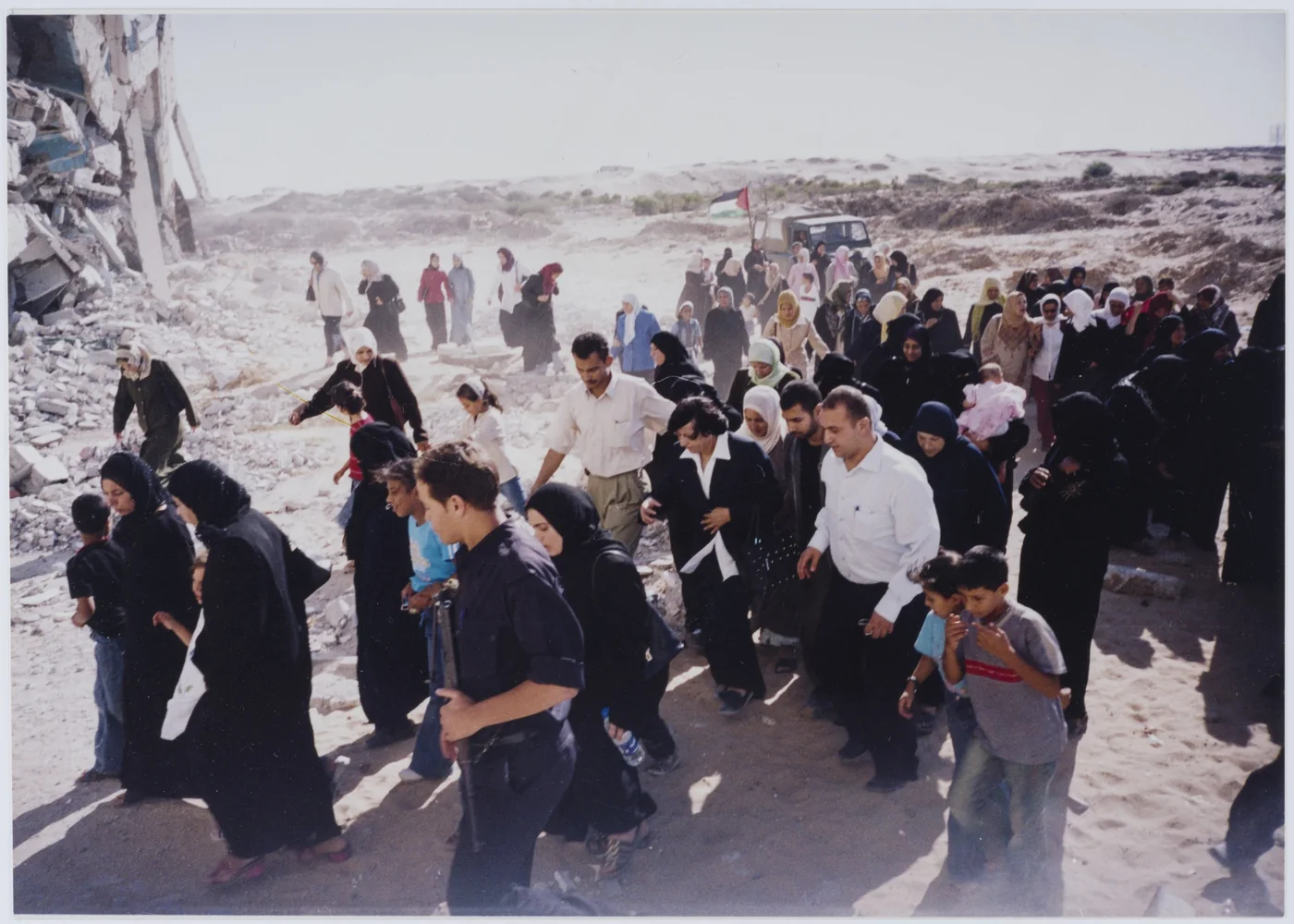
The Palestinian Negotiating Team accompanied by local residents Visits Gaza from which Israel withdrew, 2005.
Hamas in power and the closure of Gaza, January 2006 to September 2007
Palestinians elected a new Legislative Council on 25 January 2006. The Central Elections Commission published final results on 29 January. Hamas, running as the Change and Reform list, won 74 of the 132 seats. Fatah won 45 [15]. On 25 June 2006 Palestinian militants killed two Israeli soldiers near the Kerem Shalom crossing and captured a third, Corporal Gilad Shalit [9]. The rivalry between Hamas and Fatah turned into open fighting in 2007. The UN Special Coordinator for the Middle East Peace Process told the Security Council on 20 June 2007 that between 9 and 15 June, Hamas's armed wing and its Executive Force had taken control of the Gaza Strip by force from the Palestinian presidency and its security forces. He reported grave violations of humanitarian and human rights law during the fighting, including summary executions. President Mahmoud Abbas dissolved the unity government, declared a 30-day state of emergency and appointed Salam Fayyad to lead an emergency government [16]. From then on, Hamas governed Gaza while the Palestinian Authority governed parts of the West Bank. On 19 September 2007 Israel's Security Cabinet cited continued Qassam rocket fire at Sderot and other communities near Gaza. It decided unanimously that Hamas had taken control of Gaza and turned it into "hostile territory." The cabinet approved further restrictions on goods entering Gaza, cuts to fuel and electricity supplies, and limits on the movement of people. It stated that these steps would follow legal review and would take humanitarian needs into account [17]. The Bureau of the UN General Assembly's Committee on the Exercise of the Inalienable Rights of the Palestinian People stated the next day that the decision violated the Fourth Geneva Convention and amounted to collective punishment [18].
The legal status of Gaza after withdrawal, 2005 to 2024
Israel's government holds that the withdrawal ended the occupation of Gaza. In a 2022 submission to the UN Committee on Economic, Social and Cultural Rights, Israel stated that it has not had effective control in Gaza since 12 September 2005. It said its obligations toward Gaza arise from its armed conflict with Hamas and other groups, not from the law of occupation, and it cited its own High Court of Justice in support [19]. That court, in Al-Bassiouni v. Prime Minister on 30 January 2008, rejected a petition against fuel and electricity cuts. The legal scholar Yuval Shany described the standard the court applied as one of "basic humanitarian needs." In his reading, this standard goes beyond what the law of war requires in a siege but falls short of what occupation law requires [20]. The Bush letter of 2004 had already stated that Israeli control over Gaza's airspace, waters and land passages would continue after withdrawal [3]. The International Court of Justice addressed the effect of that control in its advisory opinion of 19 July 2024. The Court found that after 2005 Israel kept key elements of authority over Gaza. These included control of the land, sea and air borders, restrictions on the movement of people and goods, collection of import and export taxes, and military control of the buffer zone. The Court concluded that the withdrawal had not fully released Israel from its obligations under occupation law, and that those obligations remain in proportion to the degree of Israel's effective control [21].
Competing assessments of the outcome, 2006 to 2025
For the evacuees, official reviews found serious failures. The state commission of inquiry chaired by retired judge Eliahu Matza reported in June 2010 that the government had not been prepared to resettle the evacuated families. It found that evacuee unemployment was about double the national rate and that many families still lived in unsuitable temporary housing. It also placed some of the blame on evacuees who delayed decisions on permanent homes until their demands were met [10]. On security, many Israelis regard the withdrawal as a failure. Political scientist Rob Geist Pinfold, writing in International Studies Perspectives, summarises this view in three claims: domestic politics drove the decision, Israel got nothing in return, and leaving Gaza led to more attacks. Pinfold disputes all three. He argues that Israel withdrew to reduce its casualties, gain foreign-policy benefits, deter and deny armed groups, and avert a perceived demographic threat. He also argues that the plan aimed to stabilise the conflict and slow negotiations, not to resolve the conflict [22]. Podeh, drawing on leaked American and Palestinian documents and on interviews, finds that Israel carried out the withdrawal in coordination with the Palestinian Authority, the United States, the Quartet, Egypt and Jordan, despite its unilateral label. He assigns the failure of the move to two causes: Israel's reluctance to use it as a platform for peace talks, and the Palestinian Authority's failure to stop attacks by Hamas and Islamic Jihad [9]. Palestinian officials raised a different concern at the time of the withdrawal. On 12 September 2005 chief negotiator Saeb Erekat said that keeping order would be very hard "if Gaza is turned into a big prison" [23]. The dispute has also returned to Israeli law. In March 2023 the Knesset passed on first reading a bill, sponsored by Yuli Edelstein, to cancel the sections of the 2005 law that barred Israelis from the four evacuated northern West Bank sites. Edelstein described the original disengagement as unjust [24].
In One Paragraph
In 2005 Israel removed all 21 of its settlements and all of its troops from the Gaza Strip, along with four small settlements in the northern West Bank. Ariel Sharon proposed the plan in December 2003, the cabinet approved it in June 2004, the Knesset endorsed it in October 2004, and the implementing law passed in February 2005. Forced evacuations followed the 16 August 2005 deadline, the last settlement was emptied on 22 August, and the last soldiers left on 12 September. Between 8,000 and 9,000 residents were moved. Israel kept control of Gaza's airspace, coast and most crossings. Hamas won the January 2006 elections and took Gaza by force in June 2007, after which Israel declared Gaza hostile territory and tightened restrictions. Israel says the occupation ended in 2005. The International Court of Justice found in 2024 that Israel still holds occupation-law obligations in proportion to its control. Scholars and politicians remain divided over whether the withdrawal harmed or served Israel's security.
Sources
- Israel Ministry of Foreign Affairs. "Israel's Disengagement Plan: Selected Documents." 20 January 2005. See the entry for the Address to the Fourth Herzliya Conference, 18 December 2003.https://www.gov.il/en/Departments/General/israeli-disengagement-plan-20-jan-2005.
- Government of Israel, Prime Minister's Office. "The Cabinet Resolution Regarding the Disengagement Plan," Addendum A, "Revised Disengagement Plan: Main Principles," section 1. 6 June 2004. Reproduced by ReliefWeb.https://reliefweb.int/report/israel/cabinet-resolution-regarding-disengagement-plan.
- Bush, George W. "Letter from President Bush to Prime Minister Sharon." White House, Office of the Press Secretary, 14 April 2004. Paragraphs beginning "Third" and "As part of a final peace settlement."https://georgewbush-whitehouse.archives.gov/news/releases/2004/04/20040414-3.html.
- "Knesset Approves PM Sharon's Disengagement Plan." Haaretz, 26 October 2004.https://www.haaretz.com/2004-10-26/ty-article/knesset-approves-pm-sharons-disengagement-plan/0000017f-e386-d75c-a7ff-ff8fe68f0000. (May be paywalled.)
- Spyer, Jonathan. "Israel's Disengagement Plan: Conception and Implementation." IEMed Mediterranean Yearbook. Barcelona: European Institute of the Mediterranean, 2006. Section on the Implementation Law. Part: "The Plan Becomes Policy, in the Face of Determined Opposition"https://www.iemed.org/publication/israels-disengagement-plan-conception-and-implementation/#section-the-plan-becomes-policy-in-the-face-of-determined-opposition-w3ObU.
- United Nations Office for the Coordination of Humanitarian Affairs. "Gaza Disengagement: Humanitarian Update, 16 August 2005." Overview and section 1.https://www.un.org/unispal/document/auto-insert-208759.
- United Nations Office for the Coordination of Humanitarian Affairs. "Gaza Disengagement: Situation Report, 19 to 21 August 2005." Section 1, "Settler evacuation status."https://www.un.org/unispal/document/auto-insert-207840.
- United Nations Office for the Coordination of Humanitarian Affairs. "Gaza Disengagement: Situation Report, 12 September 2005." Overview and section 1.https://www.un.org/unispal/document/auto-insert-203265.
- Podeh, Elie. "Israel's 2005 Disengagement from Gaza: A Multilateral Move under Unilateral Façade." Middle Eastern Studies 61, no. 5 (2025). Introduction and Israeli-PA coordination.https://www.tandfonline.com/doi/full/10.1080/00263206.2025.2473990.
- "Final Report: Gov't Mishandled Gush Katif Evacuees." Jewish Telegraphic Agency, 15 June 2010.https://www.jta.org/2010/06/15/israel/final-report-govt-mishandled-gush-katif-evacuees.
- United Nations Office for the Coordination of Humanitarian Affairs. "Humanitarian Update, November to December 2005: Special Focus, The Gaza Strip after Disengagement." 31 December 2005.https://www.unocha.org/publications/report/occupied-palestinian-territory/opt-humanitarian-update-nov-dec-2005.
- Government of Israel and Palestinian Authority. "Agreement on Movement and Access" and "Agreed Principles for Rafah Crossing." 15 November 2005. "Rafah," "Crossing Points" and "Gaza Seaport." UN Peacemaker.https://peacemaker.un.org/sites/default/files/document/files/2024/05/israeloptagreeddocumentsonmovementaccessgaza2005.pdf.
- United Nations Security Council. "Security Council Presidential Statement Welcomes Israeli-Palestinian Agreement on Rafah Crossing as 'Important Step Forward.'" Press release SC/8565, 30 November 2005.https://press.un.org/en/2005/sc8565.doc.htm.
- Washington Institute for Near East Policy. "Weapon of Terror: Development and Impact of the Qassam Rocket." Policy analysis, 11 March 2008.https://www.washingtoninstitute.org/policy-analysis/weapon-terror-development-and-impact-qassam-rocket.
- Central Elections Commission, Palestine. "The Final Results of the Second PLC Elections." 29 January 2006.https://www.elections.ps/TabId/146/ArtMID/9115/ArticleID/889/Default.aspx.
- Williams, Michael C. "Briefing to the Security Council on the Situation in the Middle East," 20 June 2007. UN Information System on the Question of Palestine.https://www.un.org/unispal/document/auto-insert-189947.
- Israel Prime Minister's Media Adviser. "Security Cabinet Declares Gaza Hostile Territory." Press release, 19 September 2007. UN Information System on the Question of Palestine.https://www.un.org/unispal/document/auto-insert-195603.
- United Nations Committee on the Exercise of the Inalienable Rights of the Palestinian People, Bureau. "Bureau of Palestinian Rights Committee Issues Statement on Israel's Decision to Declare Gaza Strip 'Hostile Territory.'" Press release GA/PAL/1064, 20 September 2007.https://press.un.org/en/2007/gapal1064.doc.htm.
- State of Israel. Follow-up information submitted to the Committee on Economic, Social and Cultural Rights. UN Doc. E/C.12/ISR/FCO/4, 23 March 2022, paragraphs 5 to 6.https://www.un.org/unispal/wp-content/uploads/2022/03/E.C.12.ISR_.FCO_.4_230322.pdf.
- Shany, Yuval. "The Law Applicable to Non-Occupied Gaza: A Comment on Bassiouni v. The Prime Minister of Israel." Israel Law Review 42 (2009). Abstract.https://www.cambridge.org/core/journals/israel-law-review/article/law-applicable-to-nonoccupied-gaza-a-comment-on-bassiouni-v-the-prime-minister-of-israel/C45125F02E38DF335F5B6A6A3777F6FB.
- International Court of Justice. Legal Consequences Arising from the Policies and Practices of Israel in the Occupied Palestinian Territory, including East Jerusalem. Advisory Opinion of 19 July 2024, paragraphs 93 to 94. Summary via UN Information System on the Question of Palestine.https://www.un.org/unispal/document/summary-of-the-icj-order-icj-19jul24/.
- Pinfold, Rob Geist. "Security, Terrorism, and Territorial Withdrawal: Critically Reassessing the Lessons of Israel's 'Unilateral Disengagement' from the Gaza Strip." International Studies Perspectives 24, no. 1 (2023). Abstract and introduction.https://academic.oup.com/isp/article/24/1/67/6762979.
- "Palestinians Take Control of Gaza as Israeli Troops Depart." PBS NewsHour, 12 September 2005.https://www.pbs.org/newshour/politics/middle_east-july-dec05-gaza_09-12.
- "Disengagement Repeal Law for Northern West Bank Approved in First Reading." Times of Israel, 14 March 2023.https://www.timesofisrael.com/disengagement-repeal-law-for-northern-west-bank-approved-in-first-reading/.