
Palestinian Refugees and UNRWA
Quick answer · ~120 words
Between November 1947 and 1949, hundreds of thousands of Palestinian Arabs fled or were expelled from the area that became Israel. Counts made at the time differ. Israel gave about 520,000, a United Nations technical committee gave 711,000, and Arab officials gave 900,000 to 1 million. On 11 December 1948, UN General Assembly Resolution 194 said that refugees wishing to return home and live at peace should be allowed to do so, and that those not returning should be compensated. The Assembly created UNRWA on 8 December 1949, and the agency began work on 1 May 1950. In the June 1967 war, the UN counted about 113,000 registered refugees and 210,000 other people displaced. UNRWA registers the descendants of refugee men, so about 5.9 million people are on its rolls. Critics say this rule enlarges the problem. UNRWA says it matches other long refugee crises. The agency's voluntary funding fell sharply after 2024. Historians still disagree about why the 1948 refugees left.
The 1948 displacement and its counts, November 1947–1950
The first displacement took place during the war that followed the General Assembly's partition recommendation of 29 November 1947 and ended with armistice agreements in 1949. Palestinian Arabs left towns and villages in the area that became Israel. Most went to the West Bank and the Gaza Strip. Others went to Jordan, Lebanon and Syria. The historian Benny Morris worked mainly from Israeli archives. He estimates that between 600,000 and 760,000 people left their homes between November 1947 and October 1950 [1].
No census was taken during the fighting. Every figure is therefore an estimate that starts from pre-war population data and subtracts the Arabs who remained. The bodies that made these estimates used different sources and different definitions of a refugee.
The Government of Israel set out its method in written replies to the Technical Committee on Refugees of the UN Conciliation Commission for Palestine (UNCCP) in 1949. It took the Mandate government's village statistics of April 1945, which showed 726,800 non-Jews in the area Israel held on 1 May 1949. It subtracted an estimated 165,000 Arabs still living there. It treated the result, 561,800, as a theoretical maximum, gave 550,000 as a ceiling, and said its experts put the real number at about 520,000. Israel counted only people outside Israel whose homes were inside it. It argued that relief-agency figures did not separate refugees from needy people who had never been displaced [2].
The UNCCP's Technical Committee on Refugees estimated 711,000 refugees from Israeli-controlled territory. Its report appears as Appendix 4 of the Commission's progress report of 23 October 1950 [3].
Morris records the range of other contemporary figures. From 1949 onward, Arab officials spoke of 900,000 or 1 million. Israeli spokesmen publicly used about 520,000. The UN Economic Survey Mission and UNRWA used 726,000, and a British estimate of February 1949 gave 810,000. Morris also records that Walter Eytan, director general of Israel's Foreign Ministry, wrote privately in late 1950 that the real number was close to 800,000, while Israel officially kept to 520,000 to 530,000 [4].
The Palestinian Central Bureau of Statistics (PCBS), the Palestinian Authority's statistics office, published a comparison table in June 2008. It lists Palestinian estimates from 714,100 to 849,186, an official American estimate of 875,000, and two UN figures: 726,000 from a 1949 count and 957,000 for 1950 [5]. UNRWA's census of 1950 and 1951, which removed people the agency judged ineligible for relief, registered some 875,000 Palestine refugees [6]. All of these figures count individual people. They differ in date, method and definition.
Resolution 194 and the creation of UNRWA, December 1948–May 1950
On 11 December 1948, the General Assembly adopted Resolution 194 (III). It created the UNCCP, a commission of three states, to help the parties reach a final settlement. Paragraph 11 resolved that refugees "wishing to return to their homes and live at peace with their neighbours" should be permitted to do so at the earliest practicable date. It said that compensation should be paid for the property of those choosing not to return and for loss of or damage to property. It instructed the Commission to facilitate repatriation, resettlement, economic and social rehabilitation, and compensation [3]. Under the UN Charter, General Assembly resolutions of this kind are recommendations and do not bind member states.
The word "refugees" in paragraph 11 was not limited by ethnicity. A UNCCP working paper of 15 May 1950 records that the United Kingdom, which sponsored the draft, told the Assembly that the term covered all refugees displaced from their homes in Palestine, irrespective of race or nationality [7]. This included Jews displaced from areas under Arab control.
The parties read paragraph 11 in opposite ways. In talks with the Commission in 1949, the Arab delegations said that any solution must depend on Israel first accepting the principle of return in paragraph 11 [8]. Israel's government had already decided between April and December 1948 against a general return and had then taken steps to block one. Morris documents these decisions in two chapters of his study [9]. The Commission's 1961 historical survey records the Lausanne conference of April to September 1949, including a scheme concerning Gaza and Israeli proposals of 29 July and 5 August 1949. None of these produced an agreement [8].
With no settlement in sight, the Assembly turned to relief. Resolution 302 (IV) of 8 December 1949 created UNRWA "to carry out direct relief and work programmes" for Palestine refugees. The agency began operations on 1 May 1950. Its mandate does not come from one founding document. It comes from successive General Assembly resolutions, and only the Assembly can change it [10]. UNRWA took over registration records from the International Committee of the Red Cross, the League of Red Cross Societies and the American Friends Service Committee, which had given emergency aid since 1948 [6].
The same period fixed the refugees' legal position. The statute of the UN High Commissioner for Refugees (UNHCR) excludes people who continue to receive protection or assistance from other UN organs or agencies, and the 1951 Refugee Convention has a similar clause. Palestine refugees inside UNRWA's five fields of operation therefore fall outside UNHCR's mandate [11]. UNRWA states that registration with it does not give refugee status under the 1951 Convention. Registration only establishes eligibility for its services [12].
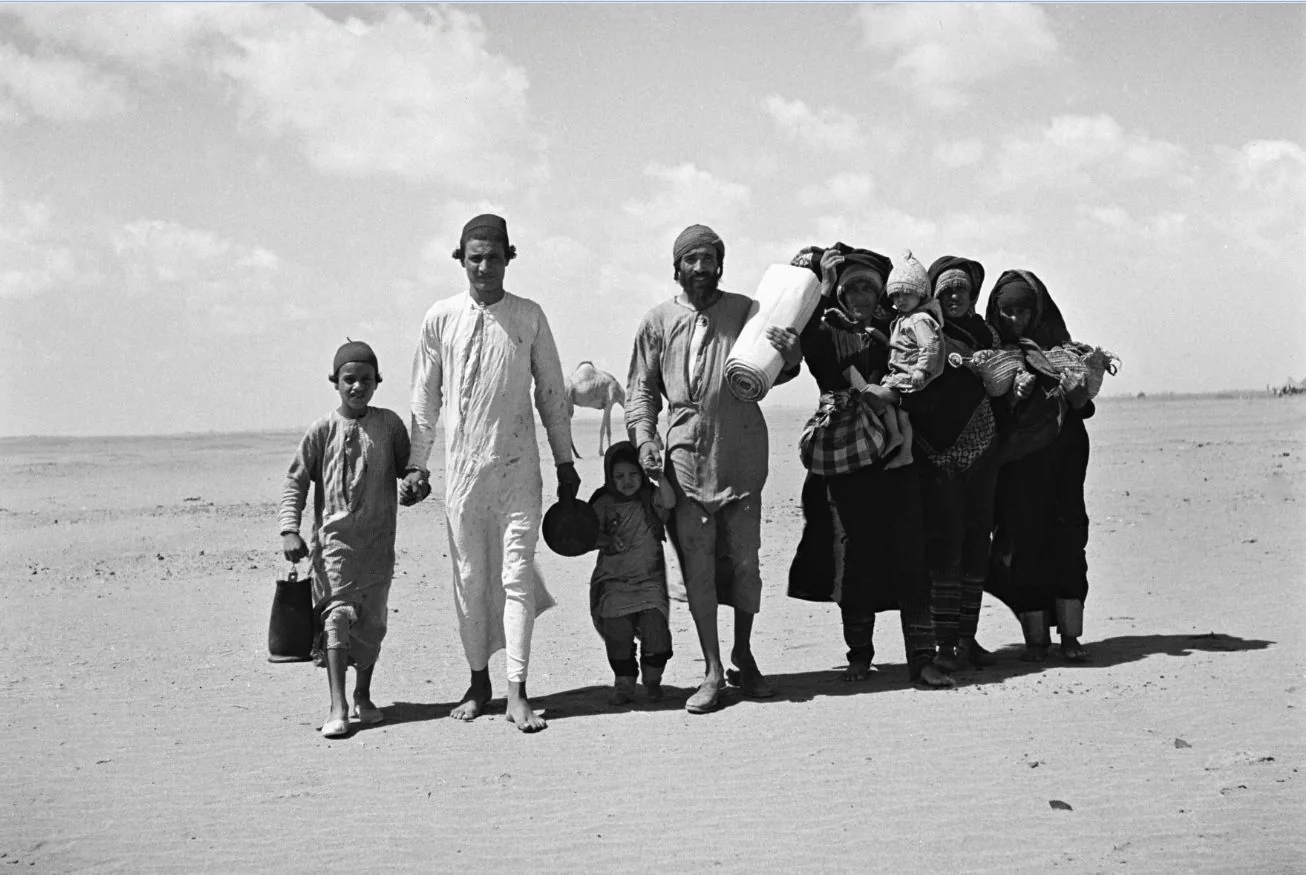
A Yemenite Jewish family walks to a transit camp near Aden on the way to Israel, 1949.
The 1967 displacement, June–August 1967
The second displacement came with the war of 5 to 10 June 1967. In that war, Israel took the West Bank including East Jerusalem, the Gaza Strip, the Sinai Peninsula and the Golan Heights. On 4 July 1967, the General Assembly adopted Resolution 2252 (ES-V). It endorsed UNRWA's efforts to help displaced people who were not registered refugees, on an emergency basis and as a temporary measure [13].
The Secretary-General's report of 18 August 1967 gave the UN count, based on information from UNRWA. About 113,000 registered refugees had moved during or after the fighting. About 93,000 of them had crossed from the West Bank to the east bank of the Jordan River. Another 17,000 had moved within Syria to Damascus and Deraa, and some 3,000 former Gaza residents were in Egypt. About 210,000 people not previously registered with UNRWA had also moved. About 85,000 went from the West Bank to east Jordan, about 90,000 moved within Syria, and about 35,000 moved west from Sinai across the Suez Canal [13]. The second group therefore included Syrians and Egyptians as well as Palestinians. On these UN figures, about 178,000 people crossed from the West Bank to east Jordan.
The Government of Jordan gives a different figure. Its Department of Palestinian Affairs puts the number displaced in 1967 at about 250,000. It says about half were refugees from camps in the West Bank or Gaza who were displaced for the second time [14]. This explainer could not locate an Israeli government count of the 1967 movement in an accessible primary source.
Some return was arranged. Under Red Cross auspices, Israel and Jordan agreed on 6 August 1967 on repatriation to the West Bank, with a deadline later extended to 31 August. By 16 August, some 32,000 families, an estimated 160,000 people, had applied [13]. In later decades, the UN could track only registered refugees who asked UNRWA to transfer their records. On that basis, a 2005 Secretary-General report put the number of displaced registered refugees known to have returned to the occupied territories since June 1967 at about 25,160. UNRWA said it could not estimate the total number of displaced people who had returned [15].
The August 1967 report also described the 1948 refugees. It stated that one fifth of them had re-established themselves by their own efforts and had never relied on UNRWA. It also stated that camp residents had never exceeded 40 % of the refugee population [13]. UNRWA's mandate was later widened to include emergency services for people displaced by "the 1967 and subsequent hostilities" [10].
Who is counted: UNRWA's registration rule and its critics
UNRWA defines Palestine refugees as people whose normal place of residence was Palestine between 1 June 1946 and 15 May 1948, and who lost both home and means of livelihood as a result of the 1948 conflict. The descendants of Palestine refugee males, including adopted children, are also eligible to register [16]. Since its 1950–51 census, UNRWA has updated its files from documents supplied voluntarily by original refugees and their descendants through the male line. In 1992 it reopened registration for people who can document 1948 refugee status but were not registered in the early 1950s [6].
UNRWA's figures.** UNRWA says it keeps active files on about 5.9 million Palestine refugees and more than 685,000 other persons of concern who are eligible for its services [6]. The US Congressional Research Service (CRS) reported in January 2025 that 1.4 to 1.6 million of Gaza's roughly 1.9 to 2.1 million residents were registered refugees [17]. UNRWA argues that Palestine refugees are not unusual. It points to protracted situations such as those of Afghans and Somalis, where UNHCR also registers several generations as refugees. It says long refugee situations result from the failure to find political solutions [12].
Critics' figures and arguments.** Morris has argued that in other cases of forced displacement, such as the Sudeten Germans expelled from Czechoslovakia in 1945 and 1946, children and grandchildren are not recognised as refugees. He has also argued that about 500,000 of the original refugees moved from one part of Palestine to another rather than abroad [18]. In May 2012, the US Senate Appropriations Committee approved an amendment requiring the State Department to report how many of the roughly 5 million people receiving UNRWA aid had been personally displaced and how many were descendants. An earlier draft by Senator Mark Kirk would have made it US policy that Palestinians in the West Bank and Gaza, and those who are citizens of countries such as Jordan, are not refugees. Deputy Secretary of State Tom Nides objected that a US finding on the number of refugees would prejudge an issue left to Israeli-Palestinian negotiation [19]. On 14 January 2021, Secretary of State Mike Pompeo stated that fewer than 200,000 Arabs displaced in 1948 were still alive and that most others were not refugees by any rational criteria. The State Department report requested by Congress was not made public [20].
These figures count different units. UNRWA's 5.9 million counts registered persons, including descendants, as of 2024 to 2026. The Pompeo figure counts living people who were themselves displaced in 1948, as of January 2021, and its method has not been published. Israel's 1949 figure of 520,000 counts people then outside Israel whose homes were inside it. None of these numbers can be converted into another without assumptions that the producing bodies have not stated.
Funding, investigations and legal disputes, 2018–2026
UNRWA depends almost entirely on voluntary contributions. The CRS reported that about 95 % of its money comes from government donations and about 5 % from the UN regular budget. Its 2024 programme budget was $880.2 million, with separate emergency appeals mainly for Gaza [21]. The United States has been the largest donor, with more than $7.3 billion since 1950. According to UNRWA, US money made up nearly 30 % of donor contributions in 2023 [22]. The first Trump administration suspended US funding from August 2018 until the end of its term [17].
In January 2024, Israel alleged that UNRWA staff had taken part in the Hamas-led attack of 7 October 2023, and several donors paused funding. The UN Office of Internal Oversight Services (OIOS) investigated 19 staff members. On 5 August 2024, it reported that it had found no evidence in one case and insufficient evidence in nine cases. In the other nine cases, the evidence indicated that the staff members may have been involved, and the UN said their employment would be terminated [23]. A separate review led by former French foreign minister Catherine Colonna reported on 20 April 2024. It found that UNRWA had many mechanisms for upholding neutrality and made 50 recommendations. It also stated that Israel had not yet provided evidence for its public claim that a significant number of UNRWA employees belonged to terrorist organisations [24]. The CRS noted that the review also identified gaps in those mechanisms [17].
In March 2024, Congress barred US funding to UNRWA until 25 March 2025 in Public Law 118-47 [22]. On 4 February 2025, President Trump ordered federal agencies not to use any funds for contributions to UNRWA [25].
On 28 October 2024, the Knesset adopted two laws to end UNRWA's operations. Israel said its 1967 agreement with UNRWA had ended. UNRWA had to leave its compound in East Jerusalem, and its international staff were expelled from the West Bank and barred from Gaza [26]. On 29 December 2025, the Knesset amended the law. The Secretary-General said the law and its amendments were inconsistent with UNRWA's legal status and must be repealed [27].
The General Assembly asked the International Court of Justice (ICJ) for an advisory opinion in Resolution 79/232 of 19 December 2024, adopted with 137 votes in favour [28]. On 22 October 2025, the Court found that Israel must agree to and facilitate relief schemes in Gaza, in particular those run by UNRWA. It found that the information before it was not sufficient to show that UNRWA lacked the neutrality needed to qualify as an impartial humanitarian organisation. Parts of the opinion on UNRWA were adopted by 10 votes to 1, with Vice-President Julia Sebutinde dissenting [26]. On 5 December 2025, the Assembly extended UNRWA's mandate to 30 June 2029 by 151 votes to 10, with 14 abstentions. Israel and the United States voted against [29].
In November 2025, Commissioner-General Philippe Lazzarini told the Assembly that the shortfall across late 2025 and early 2026 was about $200 million. He reported, as UNRWA's own count, that more than 380 UNRWA staff had been killed in Gaza [30]. In a letter of 17 March 2026, he said he had cut service hours, and the salaries of most local staff, by 20 %. He said this reduced the projected cash shortfall to about $100 million and that more cuts would follow without new funding [31]. The Secretary-General designated Christian Saunders as officer-in-charge from 1 April 2026 and as acting Commissioner-General from 1 July 2026 [32].
Why the 1948 refugees left: competing scholarly accounts
Two older accounts framed the debate. The Arab account held that the exodus resulted from a systematic expulsion carried out under a premeditated Zionist plan [18]. For many years, the Israeli government's account held that Arab leaders broadcast orders telling Palestinians to leave before the Arab armies invaded [33].
Walid Khalidi, a founder of the Institute for Palestine Studies, rejected the Israeli account and called the claim of broadcast orders a lie. In an article first published in 1961 and reprinted in 1988, he argued that Plan Dalet, the Haganah's operational plan of March 1948, was a master plan for the conquest of Palestine that drove the exodus [33]. In a 2008 article on Haifa, where most Arab residents left in April 1948, he wrote that claims that the exodus followed an Arab evacuation strategy or orders from the Palestinian leadership had no foundation [34].
Morris based his study on Israeli military and political archives. His book describes the exodus in four waves between December 1947 and November 1948. The revised edition adds detail on Jerusalem, Jaffa and Haifa, on the collapse of Palestinian urban society, and on battles, expulsions and atrocities in rural areas. It also contains a chapter on the idea of "transfer" in Zionist thinking before 1948 and chapters on Israel's decisions against return [9]. The book's publisher describes its first edition as challenging both the Zionist account that Palestinians left voluntarily and the Arab account of a planned expulsion [9].
Efraim Karsh places the main responsibility on Palestinian Arab leaders and Arab states. In Palestine Betrayed, he argues that from the 1920s a Palestinian Arab leadership worked against the Jewish national revival and against coexistence. His book includes a chapter on the flight from Haifa, and its final chapter is titled "A Self-Inflicted Catastrophe" [35].
These historians disagree on three main questions. The first is whether a plan or the course of the war mainly produced the exodus. The second is how much weight to give to instructions from local Arab commanders and leaders. The third is how far Israel's decisions after mid-1948 to bar return turned a wartime flight into permanent exile. Each position rests on different archives and on different readings of the same events, including those in Haifa [9][33][34][35].
In One Paragraph
During the war of 1947 to 1949, hundreds of thousands of Palestinian Arabs fled or were expelled from the area that became Israel. Israel counted about 520,000, a UN technical committee counted 711,000, and Arab officials said 900,000 to 1 million. Resolution 194 of 11 December 1948 recommended return for refugees willing to live at peace, and compensation for those who did not return. Israel refused a general return, and Arab states made acceptance of return a condition for any settlement. The General Assembly created UNRWA in December 1949, and it began work in May 1950. The 1967 war displaced about 113,000 registered refugees and 210,000 others, by the UN's count. UNRWA registers the descendants of refugee men and now lists about 5.9 million people. Critics count far fewer living original refugees. The agency depends on voluntary money, which fell after the United States stopped funding it and Israel banned its operations. Its mandate now runs to June 2029. Historians still dispute whether plans, the course of the war, or the decisions of Arab leaders mainly caused the 1948 exodus.
Sources
- Morris, Benny. “Introduction to the Revised Edition.” In The Birth of the Palestinian Refugee Problem Revisited, 2nd ed. Cambridge Middle East Studies 18. Cambridge: Cambridge University Press, 2004. https://www.cambridge.org/core/books/birth-of-the-palestinian-refugee-problem-revisited/introduction-to-the-revised-edition/213DD216211B903942C1BD2B29CCA601
- Israel, Delegation to the United Nations Conciliation Commission for Palestine. “Written Replies to the Technical Committee on Refugees.” 1949. **Section 2, “Total of Arab Refugees.” **https://www.un.org/unispal/document/auto-insert-210572/
- United Nations Conciliation Commission for Palestine. General Progress Report and Supplementary Report of the United Nations Conciliation Commission for Palestine, Covering the Period from 11 December 1949 to 23 October 1950. A/1367/Rev.1. New York: United Nations, 1951. **Appendix 1, text of Resolution 194 (III); Appendix 4, Report of the Technical Committee on Refugees. **https://www.un.org/unispal/document/auto-insert-180810
- Morris, Benny. “Appendix 1: The Number of Palestinian Refugees.” In The Birth of the Palestinian Refugee Problem Revisited, 2nd ed. Cambridge: Cambridge University Press, 2004. **Appendix 1. **https://www.cambridge.org/core/books/abs/birth-of-the-palestinian-refugee-problem-revisited/appendix-1/B1F892429AEE9FFDB5B2B7750E02C10B
- Palestinian Central Bureau of Statistics. “On World Refugee Day: The Demographic Characteristics of the Palestinian Refugees.” Press release, June 2008. **Table 1. **https://www.pcbs.gov.ps/Portals/_pcbs/PressRelease/FINAL%20COPY%20REFUGEE%20DAY%20Edit.pdf
- UNRWA. “Eligibility and Registration.” https://www.unrwa.org/what-we-do/eligibility-registration
- United Nations Conciliation Commission for Palestine. “Analysis of Paragraph 11 of the General Assembly’s Resolution of 11 December 1948.” Working paper A/AC.25/W/45, May 15, 1950. **Part One, section 1. **https://www.un.org/unispal/document/auto-insert-211863
- United Nations Conciliation Commission for Palestine. “Historical Survey of Efforts of the United Nations Conciliation Commission for Palestine to Secure the Implementation of Paragraph 11 of General Assembly Resolution 194 (III).” Working paper A/AC.25/W/82/Rev.1, October 2, 1961. **Part One, sections I and II. **https://www.un.org/unispal/?p=210691
- Morris, Benny. The Birth of the Palestinian Refugee Problem Revisited. 2nd ed. Cambridge: Cambridge University Press, 2004. **Chapters 2, 5, and 6. **https://doi.org/10.1017/CBO9780511816659
- UNRWA. “What Is the Mandate of UNRWA?” https://www.unrwa.org/what-mandate-unrwa-0
- UNHCR. “Box 5.1: Palestinian Refugees.” In The State of the World’s Refugees 2006, chap. 5. Oxford: Oxford University Press, 2006. **Chapter 5, “Box 5.1: Palestinian Refugees.” **https://www.un.org/unispal/document/auto-insert-204463
- UNRWA. “Frequently Asked Questions.” https://www.unrwa.org/who-we-are/frequently-asked-questions
- United Nations Secretary-General. “Report by the Secretary-General under General Assembly Resolution 2252 (ES-V) and Security Council Resolution 237 (1967).” A/6787–S/8124, August 18, 1967. **Paras. 1, 8, 11–12, and 31. **https://www.un.org/unispal/document/auto-insert-181277/
- Hashemite Kingdom of Jordan, Department of Palestinian Affairs. “Palestinian Refugees and Displaced Camps in Jordan.” https://dpa.gov.jo/EN/List/Palestinian_Refugees_And_Displaced_Camps_in_Jordan
- United Nations Secretary-General. “Persons Displaced as a Result of the June 1967 and Subsequent Hostilities: Report of the Secretary-General.” Submitted under General Assembly Resolution 59/118, 2005. **Para. 4. **https://www.un.org/unispal/document/auto-insert-177109/
- UNRWA. “Palestine Refugees.” https://www.unrwa.org/palestine-refugees
- Congressional Research Service. “UN Relief and Works Agency for Palestine Refugees in the Near East (UNRWA): Background and U.S. Funding Trends.” IF12863, version 7. Updated January 17, 2025. **Sections “UNRWA Overview” and “U.S. Funding and Oversight.” **https://www.congress.gov/crs_external_products/IF/PDF/IF12863/IF12863.7.pdf
- “1948 Refugees.” Israel Law Review. Published online by Cambridge University Press, February 21, 2018.p.48. <https://www.cambridge.org/core/journals/israel-law-review/article/1948-refugees/1E997E364691F4379C6F77EC05BC84AD>
- “The U.S. State Department Affirms Support for 5 Million Palestinian Refugees.” The Algemeiner, May 30, 2012. <https://www.algemeiner.com/2012/05/30/u-s-state-department-affirms-support-for-5-million-palestinian-refugees/>
- Middle East Institute. “Palestinian Refugees: Myth vs Reality.” https://mei.edu/publication/palestinian-refugees-myth-vs-reality/
- Congressional Research Service. “UN Relief and Works Agency for Palestine Refugees in the Near East (UNRWA): Background and U.S. Funding Trends.” IF12863, version 3, December 27, 2024. **Section “Budget and Funding.” **https://www.congress.gov/crs_external_products/IF/PDF/IF12863/IF12863.3.pdf
- Congressional Research Service. “The United Nations Relief and Works Agency for Palestine Refugees in the Near East (UNRWA): Overview and U.S. Funding Prohibition.” IN12316, June 14, 2024. https://www.congress.gov/crs-product/IN12316
- United Nations Secretary-General. “Note to Correspondents on the UN Office of Internal Oversight Services (OIOS) Investigation of the UN Relief and Works Agency for Palestine Refugees in the Near East (UNRWA).” New York, August 5, 2024. https://www.un.org/sg/en/content/sg/note-correspondents/2024-08-05/note-correspondents-%E2%80%93-the-un-office-of-internal-oversight-services-%28oios%29-investigation-of-the-un-relief-and-works-agency-for-palestine-refugees-the-near-east
- Independent Review Group on UNRWA. Independent Review of Mechanisms and Procedures to Ensure Adherence by UNRWA to the Humanitarian Principle of Neutrality: Final Report for the United Nations Secretary-General. April 20, 2024. **p. 22. **https://www.un.org/unispal/wp-content/uploads/2024/04/unrwa_independent_review_on_neutrality.pdf
- The White House. “Withdrawing the United States from and Ending Funding to Certain United Nations Organizations and Reviewing United States Support to All International Organizations.” Executive order, February 4, 2025. **Paragraph concerning UNRWA. **https://www.whitehouse.gov/presidential-actions/2025/02/withdrawing-the-united-states-from-and-ending-funding-to-certain-united-nations-organizations-and-reviewing-united-states-support-to-all-international-organizations/
- International Court of Justice. Obligations of Israel in Relation to the Presence and Activities of the United Nations, Other International Organizations and Third States in and in Relation to the Occupied Palestinian Territory. Advisory Opinion, October 22, 2025. General List No. 196. **Headnote and operative paragraph, section II.D. **https://icj-cij.org/sites/default/files/case-related/196/196-20251022-adv-01-00-en.pdf
- United Nations, Division for Palestinian Rights. “Action by the UN System Relevant to the Question of Palestine.” Monthly Bulletin, December 2025. Published January 12, 2026. https://www.un.org/unispal/wp-content/uploads/2026/12/20260112-December-Monthly-Bulletin.pdf
- UNRWA. “The ICJ Advisory Opinion on Israel’s Obligations: Key Conclusions Relating to UNRWA.” October 2025. https://www.unrwa.org/icj-advisory-opinion-israel-obligations-key-conclusions-relating-unrwa
- United Nations Meetings Coverage. “General Assembly Adopts 40 Fourth Committee (Special Political and Decolonization) Texts, Addressing 17 Non-Self-Governing Territories, Aid to Palestine Refugees.” GA/12739, December 5, 2025. **Section concerning draft resolution A/C.4/80/L.17. **https://press.un.org/en/2025/ga12739.doc.htm
- Lazzarini, Philippe. “Statement by UNRWA Commissioner-General Philippe Lazzarini to the United Nations General Assembly Fourth Committee.” UNRWA, November 2025. <https://www.unrwa.org/newsroom/official-statements/statement-unrwa-commissioner-general-philippe-lazzarini-united-nations>
- Lazzarini, Philippe. Letter to the President of the United Nations General Assembly, Annalena Baerbock, March 17, 2026. https://www.un.org/unispal/document/letter-from-unrwa-cg-17mar26/
- United Nations Secretary-General. “UN Secretary-General Designates Christian Saunders as UNRWA Acting Commissioner-General from 1 July 2026 until Further Notice.” March 31, 2026. <https://www.un.org/unispal/document/un-secretary-general-designates-christian-saunders-as-unrwa-acting-commissioner-general-from-1-july-2026-until-further-notice/>
- Khalidi, Walid. “Plan Dalet: Master Plan for the Conquest of Palestine.” Journal of Palestine Studies 18, no. 1 (1988): 4–33. https://www.palestine-studies.org/sites/default/files/attachments/jps-articles/Plan%20dalet.pdf
- Khalidi, Walid. “The Fall of Haifa Revisited.” Journal of Palestine Studies 37, no. 3 (2008): 30–58. https://www.palestine-studies.org/sites/default/files/attachments/jps-articles/haifa.pdf
- Karsh, Efraim. Palestine Betrayed. New Haven: Yale University Press, 2010. https://eld.bl.uk/catalog/021066742