
Israel’s Defence Spending
Quick answer · ~120 words
Israel’s defense spending rose sharply after Hamas’s 7 October 2023 attack and the ensuing multi-front war. According to the Stockholm International Peace Research Institute (SIPRI), Israel spent $48.3 billion on its military in 2025, equivalent to 7.8 % of GDP. The Bank of Israel estimates that the war added about NIS 350 billion to the state’s fiscal costs over 2023–2026, with roughly half of the overall war costs financed through borrowing. In March 2026, the Knesset approved a record defense budget of approximately NIS 143 billion following renewed fighting with Iran. Israel also receives $3.8 billion annually in American military assistance under an agreement running through 2028. Meanwhile, defense exports reached a record $19.2 billion in 2025. India has become one of Israel’s most important defense customers and an increasingly significant partner in manufacturing and technology.
How Large Is Israel’s Defense Spending, and How Has It Changed?
Israel has maintained a substantial defense burden since its establishment in 1948. The scale of that burden has changed with the country’s security environment, economic development and military requirements. In 1950, defense spending accounted for approximately 8.5 % of GDP. By 1975, following a thirty-five-fold increase in real terms, it had reached about 30 % of GDP. By 2009, the share had fallen to roughly 8 % . Economist Paul Rivlin describes defense as a service that a threatened country must purchase, while emphasising that it also diverts resources from civilian priorities and economic development.[1]
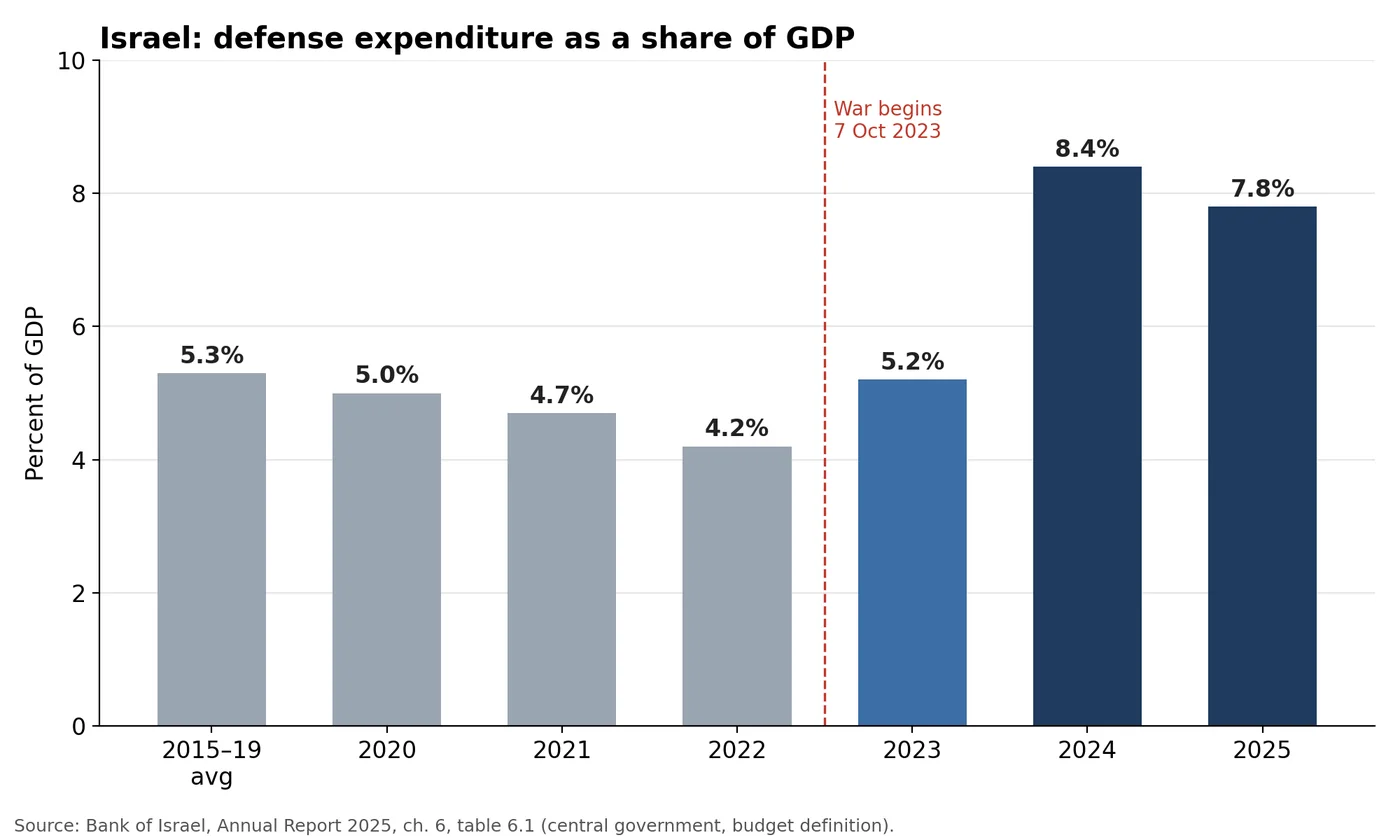
The more recent figures show how quickly that burden can rise during a major conflict. According to the Bank of Israel, defense expenditure averaged 5.3 % of GDP between 2015 and 2019, fell to 4.2 % in 2022, increased to 5.2 % in 2023 and reached 8.4 % in 2024. It stood at 7.8 % in 2025.[2]
SIPRI’s figures place Israel among the world’s largest military spenders. Its April 2026 assessment estimates that Israel spent $48.3 billion in 2025, ranking eleventh globally by total expenditure. The military burden was 7.8 % of GDP, compared with 5.2 % in 2016. Israel’s spending was approximately 120 % higher than in 2016 and 97 % higher than in 2022, the year before the Gaza war.[3][4]
These figures require a methodological distinction. SIPRI attributes military assistance to the country providing it rather than adding that assistance to the recipient’s expenditure. Under this approach, American grants to Israel are recorded as United States military spending.[5] The figures therefore describe Israel’s reported military expenditure, not the full value of every external resource that supports its defense.
What Drove the Increase After October 2023?
The principal driver was a prolonged, multi-front war that placed sustained demands on Israel’s armed forces. The fighting following Hamas’s 7 October 2023 attack expanded beyond Gaza to include operations involving Lebanon, Iran and other regional threats. Mobilisation, reserve-duty compensation, equipment replacement and the need to sustain military operations all contributed to the higher expenditure.
The Bank of Israel estimates that the war added approximately NIS 350 billion to the state’s fiscal costs over 2023–2026. This estimate excludes decisions taken after Operation Roaring Lion began in late February 2026. Approximately NIS 116 billion of the estimated additional cost was incurred in 2025 alone.[6]
The bank attributes about NIS 249 billion of the additional costs to higher gross defense spending. Its breakdown is approximately NIS 17 billion in 2023, NIS 99 billion in 2024, NIS 84 billion in 2025 and NIS 49 billion in 2026.[7] These figures illustrate how a conflict that initially appeared likely to require a more limited budget adjustment developed into a prolonged financial commitment.
Early estimates anticipated considerably smaller increases: around NIS 40 billion for the 2023 budget and NIS 70 billion for 2024. The final burden rose as the war continued, additional fronts opened and Israel reassessed its long-term security requirements. Reserve service was another major expense. National Insurance data cited by the Bank of Israel record reserve compensation of NIS 26 billion in 2024 and NIS 21 billion in 2025.[7]
In September 2025, the Knesset added NIS 31 billion to the 2025 budget to cover Operation Rising Lion, Israel’s June 2025 campaign against Iran, and continued fighting in Gaza.[7] SIPRI links the modest decline in military expenditure in 2025 to reduced fighting in Gaza following the January ceasefire, partly offset by the twelve-day conflict with Iran and operations in Lebanon and Syria.[4]
The defense budget increased again in 2026. On 24 March, the Knesset’s joint finance and defense committee approved the defense allocation unanimously. The full budget passed on 30 March by 62 votes to 55, with approximately $44.8 billion allocated to defense. A government decision added NIS 32 billion, bringing the defense budget to about NIS 143 billion, according to the Finance Ministry. The ministry’s preliminary estimate put the budgetary cost of the Iran war at NIS 35 billion, including NIS 22 billion in defense expenditure.[8][9][10]
The figures demonstrate that Israel’s defense burden reflects more than the cost of a single operation. It also includes the expense of maintaining readiness and replenishing capabilities in a regional environment where another escalation remains possible.
How Is Israel Financing the War, and What Are the Long-Term Costs?
Israel has financed the war through a combination of borrowing, tax increases and restraint on other public spending. The Bank of Israel estimates that approximately half of the war’s costs were financed by issuing debt. Public debt increased from 60.5 % of GDP at the beginning of 2023 to 68.5 % at the end of 2025, above the OECD median of approximately 57 % .[6]
The government also introduced tax measures in 2025 worth around NIS 30.4 billion. These included raising value-added tax by one percentage point, from 17 to 18 %, taxing undistributed company profits and freezing income-tax brackets. The Bank of Israel’s analysis indicates that more than half of the additional tax burden fell on the highest-income fifth of the population. Public-sector wages were also frozen as a temporary measure.[11][6]
Despite these pressures, Israel’s central-government deficit in 2025 was 4.7 % of GDP, close to the government’s 4.9 % target, as revenue exceeded forecasts. The country’s risk premium also fell towards levels seen before the war.[6] These indicators suggest that Israel retained access to financing, but they do not eliminate the longer-term costs of higher debt and sustained defense expenditure.
The key question is whether the increased spending becomes a temporary response to the war or a lasting change in Israel’s budget priorities. The Nagel Committee, chaired by former National Security Council head Jacob Nagel, recommended an additional NIS 133 billion for defense over ten years, including NIS 15 billion annually from 2026 to 2030.[12]
The Bank of Israel notes that the government had not formally adopted a multi-year defense spending plan. In November 2025, the prime minister instructed that the defense budget rise by NIS 250–350 billion over the following decade, but the instruction had not yet been formalised through a government resolution. Under the Nagel Committee’s assumptions, the bank projects defense spending at approximately 5.5 % of GDP during 2026–2030, 1.5 percentage points above pre-war projections.[13]
A larger defense budget can support military preparedness, but it also creates difficult choices. Spending on defense competes with investment in infrastructure, education, healthcare and productivity. The long-term challenge is to fund the capabilities Israel considers necessary without allowing recurring security costs to weaken the economic base that finances those capabilities.
What Role Does American Military Assistance Play?
American military assistance remains an important component of Israel’s defense relationship with the United States. The current ten-year memorandum of understanding covers fiscal years 2019–2028. Under it, Washington pledged $38 billion, subject to congressional appropriations: $33 billion in Foreign Military Financing grants and $5 billion for joint missile-defense programmes. The annual amounts are $3.3 billion in financing grants and $500 million for missile defense.[14]
The United States Department of State describes Israel as the leading global recipient of Foreign Military Financing.[15] This assistance helps Israel purchase American military equipment and supports cooperation on systems designed to counter rockets and missiles. It is especially significant in a period when Israel’s own defense expenditure has risen sharply.
Wartime assistance supplemented the regular arrangement. In 2024, Congress provided the Department of Defense with $13 billion in supplemental funds for Israel-related support. No comparable supplemental allocation was made in 2025, although Israel continued to receive $3.8 billion under the existing memorandum. The Bank of Israel’s financing tables also record a special United States grant equivalent to NIS 13 billion in 2024 and NIS 6 billion in each of 2025 and 2026.[5][7]
The relationship may now be moving towards a different financial model. In early 2026, Prime Minister Benjamin Netanyahu said he had told President Donald Trump that he wanted to phase out American military aid over ten years.[16] In June 2026, the Israeli and American defense establishments began formal discussions about a framework to replace the memorandum when it expires in 2028.[17]
Israel’s stated aim is to strengthen its qualitative military edge through joint research, development and co-production, gradually moving from direct aid towards a more reciprocal partnership. The negotiations are being led on the Israeli side by Defense Ministry Director General Amir Baram and Ambassador Yechiel Leiter, and on the American side by State Department Counselor Daniel Holler and Ambassador Mike Huckabee.[17]
A shift away from aid would not necessarily mean the end of close defense cooperation. It could instead change how that cooperation is financed and organised. The outcome will depend on the terms agreed by both governments, future congressional appropriations and the extent to which joint production can meet Israel’s operational requirements. Until a replacement framework is finalised, the existing memorandum remains the basis of the relationship.
How Does Israel’s Defense Industry Support Its Economy?
Israel’s defense sector serves two related purposes: supplying the Israel Defense Forces (IDF) and selling military systems abroad. Domestic procurement supports local production and technological development, while exports generate revenue and help Israeli manufacturers maintain production capacity. The Bank of Israel reports that domestic government defense procurement rose by approximately 6 % in 2025.[7]
The Ministry of Defense reported a record $19.2 billion in defense exports in 2025, marking a fifth consecutive annual record. Export volume more than doubled over five years and quadrupled over a decade. Government-to-government agreements accounted for approximately $10 billion, more than half of the total. The previous record was $14.8 billion in 2024.[18][19]
Europe accounted for 36 % of Israel’s defense exports in 2025, followed by Asia and the Pacific at 32 % , the Middle East and North Africa at 15 % , and North America at 13 %. Latin America and Africa each accounted for 2 %.[18]
Missile, rocket and air-defense systems represented nearly 30 % of deal volume, while observation and optronics systems accounted for 22 %. A major example of Israel’s export position is the Arrow 3 missile-defense system sale to Germany, valued at $6.5 billion following approval of an expansion by the German Bundestag in December 2025.[20]
These sales show how Israel’s defense industry has developed an international market for capabilities shaped by its own security requirements. They also reveal a tension: European purchases continued even as some European governments imposed restrictions on arms trade with Israel during the Gaza war.[19]
The Ministry of Defense presents exports as an important source of support for the IDF’s force buildup, foreign-policy objectives and additional defense resources.[20] Export revenue can help sustain research, manufacturing and production lines, but it should not be confused with direct government income available to cover the entire defense budget. The broader economic benefit depends on the terms of individual contracts, domestic production, investment and the costs of developing the systems sold.
Where Does India Fit into Israel’s Defense Economy?
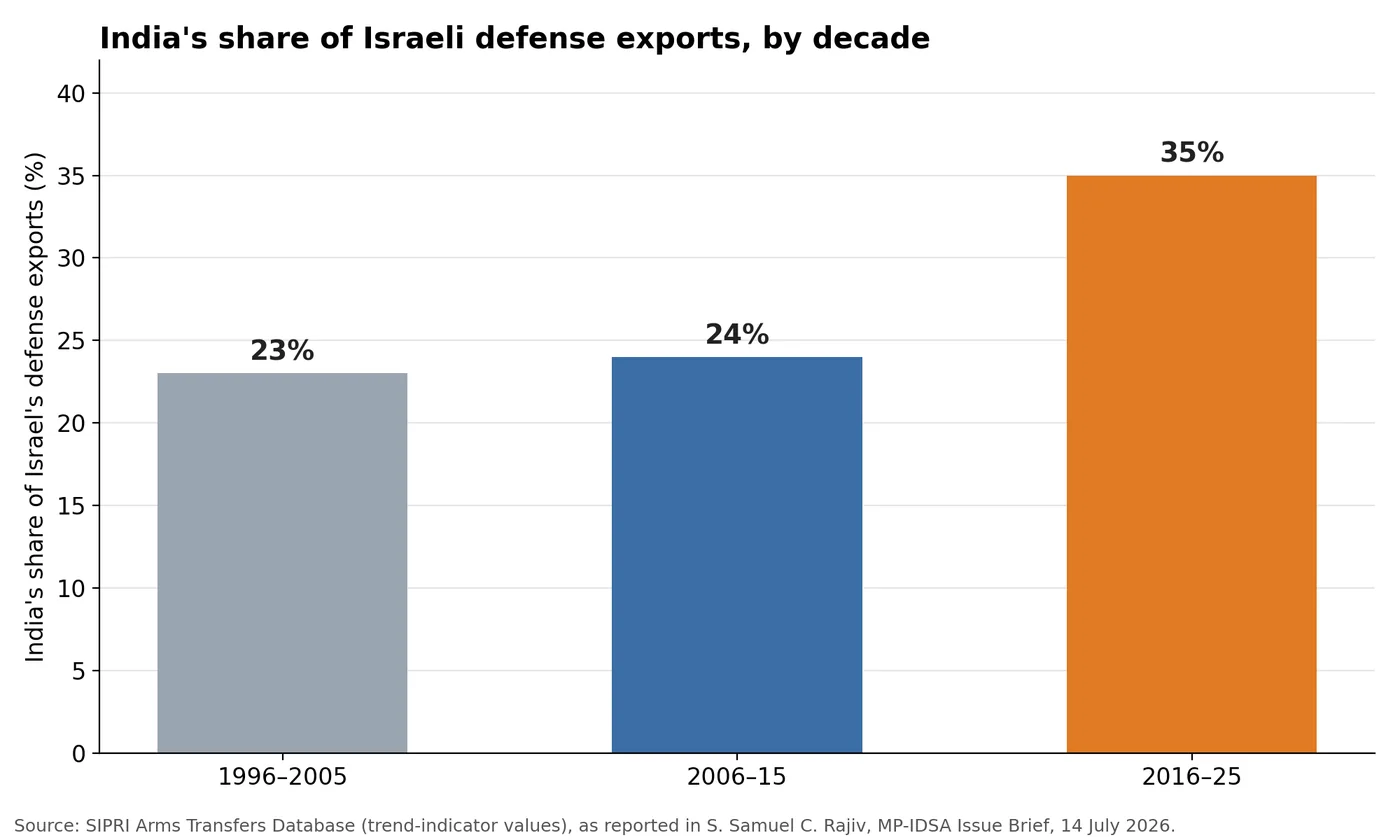
India has become one of Israel’s most important defense customers and an increasingly significant partner in manufacturing. According to arms-transfer data cited by the Manohar Parrikar Institute for Defence Studies and Analyses, India received 35 % of Israeli defense exports between 2016 and 2025. Its share was 24 % in 2006–2015 and 23 % in 1996–2005. In 2025, India accounted for 34 % of Israeli exports, behind Germany.[20]
India’s own defense expenditure is rising. SIPRI ranked India as the world’s fifth-largest military spender in 2025, at $92.1 billion, following an 8.9 % annual increase. SIPRI linked the rise in spending to the May 2025 conflict with Pakistan, which involved combat aircraft, drones and missiles.[5]
The relationship increasingly extends beyond the purchase of finished equipment. Kalyani Rafael Advanced Systems became India’s first private-sector manufacturer of missile subsystems. Israeli companies and Indian partners also account for nearly half of India’s current defense offset contracts by number, according to the cited analysis.[20]
On 4 November 2025, the two governments signed a memorandum of understanding on defense cooperation at the seventeenth meeting of their Joint Working Group in Tel Aviv.[21] During Prime Minister Narendra Modi’s state visit to Israel on 25–26 February 2026, the two governments elevated the relationship to a Special Strategic Partnership for Peace, Innovation and Prosperity.[22]
India’s planned integrated air and missile-defense programme, Mission Sudarshan Chakra, is intended to become operational by 2035. Indian analysts expect it to create opportunities for Israeli firms to collaborate in development and production in India.[20] For Israel, Indian demand helps sustain production and generate export revenue during a period of heavy domestic spending. For India, the partnership offers access to established systems while creating opportunities to develop local manufacturing capacity.
The relationship therefore serves interests on both sides. Israel gains a large market and a potential long-term industrial partner; India gains access to defense technologies and opportunities for co-production. The durability of that relationship will depend on future procurement decisions, technology-sharing arrangements and the ability of both countries to turn agreements into completed projects.
In One Paragraph
Israel’s defense spending has risen sharply since the 7 October 2023 attack, reaching $48.3 billion, or 7.8 % of GDP, in 2025, before a further increase in the 2026 defense budget. The war has imposed substantial fiscal costs, increased public debt and intensified debate over how much Israel should spend on security in the long term. American military assistance remains important, although Israel is exploring a gradual transition towards more reciprocal cooperation after the current agreement expires in 2028. At the same time, record defense exports of $19.2 billion in 2025 have strengthened the international position of Israeli manufacturers. India is an especially important customer and co-production partner. Israel’s central challenge is to sustain military readiness and technological advantage while protecting the economic capacity needed to finance them.
Sources
- Rivlin, Paul. “Defense: Service or Burden?” In The Israeli Economy from the Foundation of the State through the 21st Century, 118–42. Cambridge: Cambridge University Press, 2010. https://doi.org/10.1017/CBO9780511921308.008.
- Bank of Israel. “The Public Sector and Its Financing.” Chapter 6 in Bank of Israel Annual Report 2025, 154, table 6.1. Jerusalem: Bank of Israel, 2026. https://www.boi.org.il/media/5bjix5v4/2025-chap-6e.pdf#page=6.
- Liang, Xiao, Nan Tian, Diego Lopes da Silva, Lorenzo Scarazzato, Zubaida Karim, and Jade Guiberteau Ricard. “Trends in World Military Expenditure, 2025.” SIPRI Fact Sheet. Solna: Stockholm International Peace Research Institute, April 2026, 2, table 1. https://www.sipri.org/sites/default/files/2026-04/2604_milex_2025.pdf#page=2.
- Liang et al. “Trends in World Military Expenditure, 2025,” 11. https://www.sipri.org/sites/default/files/2026-04/2604_milex_2025.pdf#page=11.
- Liang et al. “Trends in World Military Expenditure, 2025,” 3–5. https://www.sipri.org/sites/default/files/2026-04/2604_milex_2025.pdf#page=3.
- Bank of Israel. “The Public Sector and Its Financing,” 149–51. https://www.boi.org.il/media/5bjix5v4/2025-chap-6e.pdf#page=1.
- Bank of Israel. “The Public Sector and Its Financing,” 156–58, figure 6.2 and table 6.2. https://www.boi.org.il/media/5bjix5v4/2025-chap-6e.pdf#page=8.
- Frantzman, Seth J. “Israel Approves $45B Defense Budget as Iran War Rages.” Breaking Defense, March 30, 2026. https://breakingdefense.com/2026/03/israel-approves-45b-defense-budget-as-iran-war-rages/.
- “Knesset Approves Updated War Budget in First Reading, Adding Billions of NIS to Defense.” The Jerusalem Post, March 2026. https://www.jpost.com/israel-news/politics-and-diplomacy/article-890314.
- “Iran War Has Cost Israel $11.5 Billion in Budgetary Expenses, Finance Ministry Says.” The Jerusalem Post, April 2026. https://www.jpost.com/israel-news/article-892726.
- Bank of Israel. “The Public Sector and Its Financing,” 162–63, table 6.3 and box 6.1. https://www.boi.org.il/media/5bjix5v4/2025-chap-6e.pdf#page=14.
- “Nagel Cttee Calls for Higher Defense Budget, Avoids Financing Issue.” Globes, January 7, 2025. https://en.globes.co.il/en/article-Nagel-Cttee-calls-for-higher-defense-budget-avoids-financing-issue-1001498766.
- Bank of Israel. “The Public Sector and Its Financing,” 168–69. https://www.boi.org.il/media/5bjix5v4/2025-chap-6e.pdf#page=20.
- Sharp, Jeremy M. U.S. Foreign Aid to Israel: Overview and Developments since October 7, 2023. CRS Report RL33222. Washington, DC: Congressional Research Service, 2025. https://www.congress.gov/crs-product/RL33222.
- U.S. Department of State, Bureau of Political-Military Affairs. “U.S. Security Cooperation with Israel.” Fact sheet. Accessed October 28, 2026. https://www.state.gov/u-s-security-cooperation-with-israel.
- “Netanyahu Begins a Farewell to US Military Aid: Analysis.” The Jerusalem Post, January 2026. https://www.jpost.com/israel-news/defense-news/article-883141.
- Israel Ministry of Defense. “U.S. and Israel Move to Redefine Their Defense Partnership, Launching Talks on a New Chapter in Defense Cooperation.” Press release, June 5, 2026. https://mod.gov.il/en/press-releases/press-room/us-and-israel-move-to-redefine-their-defense-partnership-launching-talks-on-a-new-chapter-in-defense-cooperation.
- Israel Ministry of Defense. “All-Time Defense Export Record: Israel Crosses the $19 Billion Threshold.” Press release, June 2, 2026. https://www.mod.gov.il/en/press-releases/press-room/all-time-defense-export-record-israel-crosses-the-19-billion-threshold.
- “Israeli Arms Sales Break Record for 5th Year in Row, Reaching $19.2 Billion in 2025.” The Times of Israel, June 2, 2026. https://timesofisrael.com/israeli-arms-sales-break-record-for-5th-year-in-row-reaching-19-2-billion-in-2025.
- Rajiv, S. Samuel C. “Israel’s Rising Defence Exports Amidst Regional Conflicts.” Issue brief. New Delhi: Manohar Parrikar Institute for Defence Studies and Analyses, July 14, 2026. https://idsa.in/publisher/issuebrief/israels-rising-defence-exports-amidst-regional-conflicts.
- All India Radio News. “India and Israel Sign MoU to Expand Scope of Bilateral Defence Ties.” November 5, 2025. https://www.newsonair.gov.in/india-and-israel-sign-mou-to-expand-scope-of-bilateral-defence-ties/.
- Prime Minister’s Office, Government of India. “India-Israel Joint Statement: A Special Strategic Partnership for Peace, Innovation, and Prosperity.” February 26, 2026. https://www.pmindia.gov.in/en/news_updates/india-israel-joint-statement/.