
Israeli Settlements: History, Law, Population and Politics
Quick answer · ~120 words
Israeli settlements are civilian communities that Israel has built since 1967 on land it captured in the June 1967 war: the West Bank, East Jerusalem, the Golan Heights and, until 2005, the Gaza Strip. In 2005 Israel removed all 21 settlements in Gaza and four in the northern West Bank. Israeli law separates settlements approved by the government from outposts built without approval, and the Supreme Court has barred the seizure of private Palestinian land for them. A UN human rights report of March 2025, using Peace Now data, counted about 503,700 settlers in the West Bank and 233,600 in East Jerusalem. A settler-run count gave 541,085 for the West Bank on 1 January 2026. The UN Security Council and the International Court of Justice (2004 and 2024) hold that settlements breach international law. Israel's government rejects that view. The governing right backs expansion; the centre-left backs separation.
1967 to 1993: First settlements, annexation laws and a court limit
In the war of June 1967, Israel took the West Bank and East Jerusalem from Jordan, the Gaza Strip and Sinai from Egypt, and the Golan Heights from Syria. On 22 November 1967 the UN Security Council unanimously adopted Resolution 242. It called for the withdrawal of Israeli forces "from territories occupied in the recent conflict" and for every state in the region to live within secure and recognized boundaries [1]. The English text says "territories" and not "the territories." That wording later became part of the argument over how much land a peace agreement requires Israel to return. The legal question of civilian settlement came up within months. On 14 September 1967, Theodor Meron, legal adviser to Israel's Foreign Ministry, answered a query from the Prime Minister's Office. His cover note concluded that civilian settlement in the "administered territories" contravened explicit provisions of the Fourth Geneva Convention. He advised that any settlement that did go ahead should be carried out by military bodies and appear temporary [2]. Israel's official view of the territory's status also changed in 1967. A military order of 11 August 1967 told military courts in the West Bank to follow the Fourth Geneva Convention and to give it priority over conflicting orders. That clause was repealed on 29 December 1967. The legal scholar Eyal Benvenisti links the repeal to an argument by Yehuda Blum that Jordan had never held lawful title to the West Bank [3]. Two areas were treated differently from the rest. Israel applied its own law and administration to an enlarged East Jerusalem in June 1967, and in 1980 the Knesset passed a Basic Law declaring Jerusalem its capital. The Security Council rejected both steps [4]. In December 1981 the Knesset applied Israeli law to the Golan Heights. Security Council Resolution 497 of 17 December 1981 declared that decision "null and void and without international legal effect" [5]. From 1967 to 1977, Labour-led governments placed most new settlements in areas they treated as security zones, such as the Jordan Valley, and largely avoided the densely populated hill country. After the Likud won the 1977 election under Menachem Begin, the government backed settlement across the central hills as well. Israel's Supreme Court set a limit in 1979. In the Elon Moreh case, Palestinian landowners near Nablus challenged the seizure of their land for a new settlement. On 22 October 1979 the court ruled in their favour. It held that the military government could not use its power to meet military needs as a basis for creating facts meant to last beyond military rule, and it found that the main reason for this settlement was not military [6]. Israel's government has since stated that settlements are built only on land that is not privately owned, after checks that can be appealed to the Supreme Court [7]. When Israel and the Palestine Liberation Organization signed the Oslo Declaration of Principles in September 1993, settlements stood across the West Bank, the Gaza Strip and the Golan Heights.
1993 to 2026: Oslo, disengagement and renewed expansion
The Oslo agreements neither stopped settlement building nor settled its status. The 1995 Interim Agreement left settlements for permanent status talks and placed them under exclusive Israeli jurisdiction until then [7]. It also divided the West Bank into Areas A, B and C, with Israel keeping full civil and security control of Area C. Israel's Foreign Ministry holds that the agreement's ban on unilateral steps that change the "status" of the territory covers only changes in legal status, such as annexation or a declaration of statehood, and not construction [7].
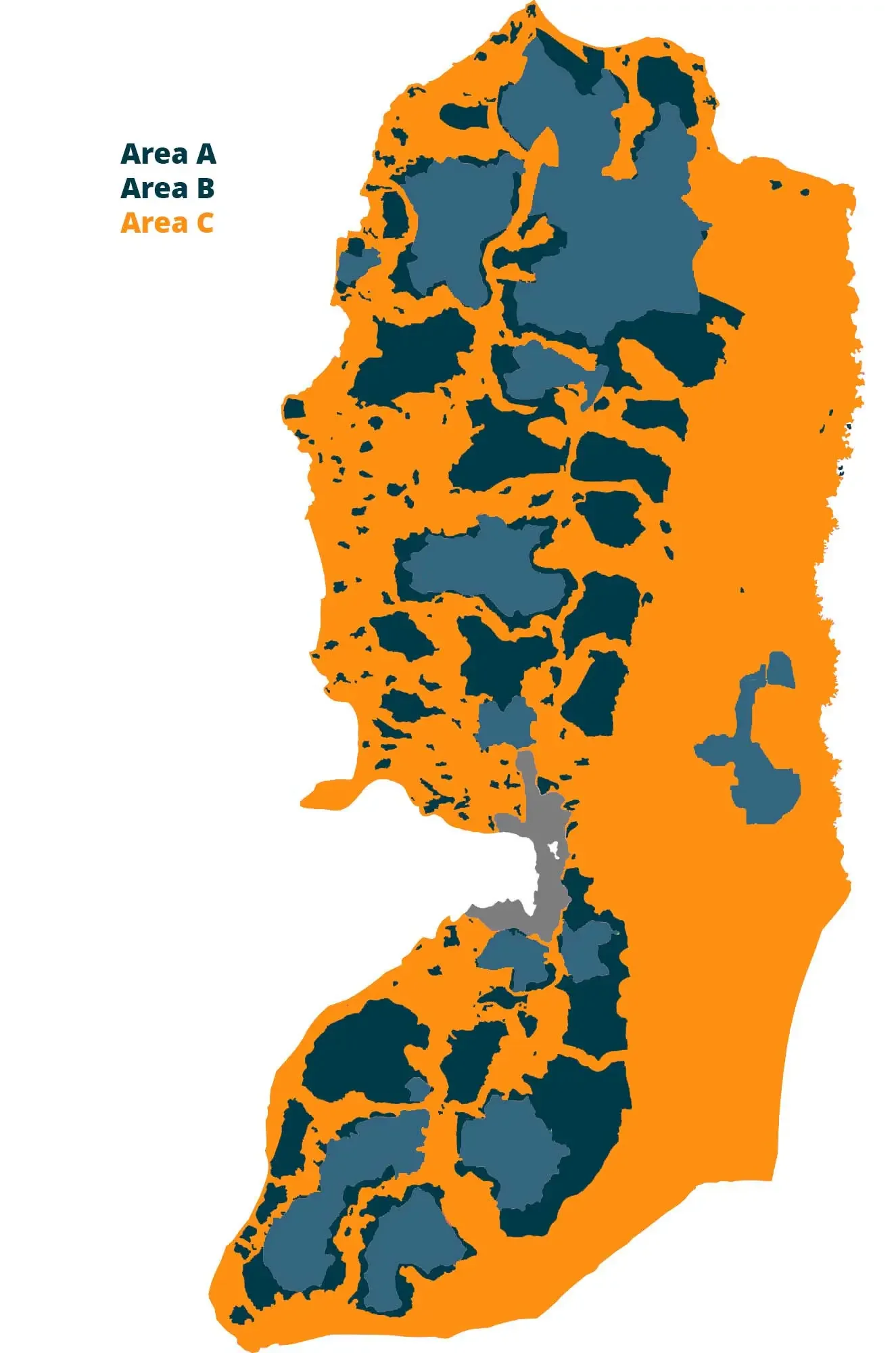
Administrative divisions established by the Oslo Accords, the West Bank
In 2005 Israel carried out a unilateral disengagement plan. It removed all 21 Israeli communities in the Gaza Strip and four in the northern West Bank: Sa-Nur, Homesh, Ganim and Kadim. About 8,000 people left their homes [8]. Israel's Foreign Ministry describes the move as a unilateral decision and not the fulfilment of a legal duty [7]. In March 2023 the Knesset voted 31 to 18 to repeal the parts of the disengagement law that barred Israelis from entering and living at the four northern sites [8]. Outposts, built without government approval, became a central legal issue. In February 2017 the Knesset passed the Regularization Law, which allowed the state to legalize, after the fact, homes built on privately owned Palestinian land. On 9 June 2020 the Supreme Court struck the law down by eight votes to one, finding that it harmed Palestinians' rights to property and equality [9]. The government sworn in at the end of December 2022 made settlement a stated goal. Its guidelines said that the Jewish people have "an exclusive and inalienable right to all parts of the Land of Israel" and pledged to develop settlement in Judea and Samaria, the Israeli official term for the West Bank. A coalition agreement said Israeli sovereignty would be extended there, subject to the prime minister's judgment on timing and national interests [10]. On 12 February 2023 the security cabinet gave legal status to nine outposts [11]. The pace of change since then is measured mainly by UN bodies that draw on Israeli civil society data. The UN human rights office (OHCHR), citing Peace Now, counted 49 new outposts between November 2023 and October 2024, against an average of eight a year in the previous decade [12]. For November 2024 to October 2025, OHCHR reported 84 new outposts, the advance or approval of 36,973 housing units in East Jerusalem settlements and about 27,200 elsewhere in the West Bank, settlement activity reaching into Area B, and the displacement of more than 36,000 Palestinians [13]. On 8 February 2026 the security cabinet approved measures to open West Bank land registries to the public, repeal a Jordanian-era rule that barred land sales to non-Muslims, and widen Israeli oversight in Areas A and B. Defence Minister Israel Katz and Finance Minister Bezalel Smotrich said the steps would "enable accelerated development of settlement on the ground" [14]. Formal annexation has not been legislated. On 22 October 2025 a bill to apply Israeli sovereignty to the whole West Bank passed a preliminary Knesset reading by 25 votes to 24 and needs further readings to become law. US President Donald Trump had already said he opposed annexation [15]. Knesset elections are due in October 2026 .
What categories of settlement exist, and what is their status under Israeli law?
Israel has never annexed the West Bank outside East Jerusalem. The area is governed by an Israeli military commander through military orders. Israel's Supreme Court treats it as territory held under belligerent occupation. In 1979 it tested the Elon Moreh land seizure against the rules that bind a military government [6], and in 2020 it described Palestinians there as "protected residents" in territory captured in war [9]. Israel's Foreign Ministry, in its diplomatic position, calls the West Bank territory subject to competing claims, not the occupied land of a prior lawful sovereign [7]. Within this framework, Israeli law and practice recognize several categories. Authorized settlements** are set up by government decision, have approved plans, and are organized as cities, local councils or communities inside regional councils. OHCHR, using Peace Now data, counted 147 such settlements in the West Bank outside East Jerusalem in 2024 [12]. Outposts** are built without full government authorization and are unlawful under Israeli law until the state regularizes them. The same OHCHR count listed 224 outposts [12]. Governments have moved outposts into the first category: nine were legalized in February 2023 [11], and a directive by Finance Minister Smotrich recognized 68 others as "sites undergoing regularization" [12]. East Jerusalem neighbourhoods** built after 1967, such as Gilo and Pisgat Ze'ev, lie inside the city limits that Israel enlarged and placed under its own law in 1967. Israel treats them as ordinary parts of its capital. The UN and the International Court of Justice (ICJ) count them as settlements [4][12]. Golan Heights communities** have been under Israeli law since the 1981 Golan Heights Law, which the Security Council declared void [5]. No Israeli communities have existed in the Gaza Strip since 2005 [8]. Two legal systems operate side by side in the West Bank. Settlers are Israeli citizens who vote in Knesset elections. Israeli law reaches them through Knesset laws that apply to Israelis personally and through military orders that copy Israeli rules into local law. Palestinians in the same area remain under military law. The ICJ found in 2024 that this extension of Israeli law breaches the occupier's duty to keep the local law in force [4]. OHCHR reported in 2026 that governance powers in the West Bank were being moved from the military to Israeli civilian authorities [16]. Land ownership is the other key legal line. The Elon Moreh ruling limited military seizure of private land for settlement [6]. The Regularization Law tried to legalize building on private Palestinian land and was struck down [9]. The legal scholars Amichai Cohen and Yuval Shany read that 2020 judgment as a shift in the court's approach, from the law of occupation towards Israeli constitutional and human rights law [16]. The state's stated practice is to allocate for settlement only land that it has classified as state land [7]. OHCHR, citing Peace Now, recorded 24,193 dunams (about 24 square kilometres) declared state land between November 2023 and October 2024 [12].
What are the international legal arguments on each side?
The case that settlements are unlawful.** The central text is Article 49 of the Fourth Geneva Convention of 1949. Its sixth paragraph bars an occupying power from transferring "parts of its own civilian population into the territory it occupies" [16]. Those who hold settlements unlawful argue three linked points. Israel is an occupying power in the West Bank and East Jerusalem. The convention applies there. State planning, funding and protection of settlements amount to such a transfer, whether or not individual settlers move by choice. Theodor Meron made this argument inside the Israeli government in 1967, calling the prohibition categorical and independent of the motive for the transfer [2]. International bodies have taken the same view. In its 2004 advisory opinion on the West Bank barrier, the ICJ found that the settlements had been established in breach of international law [16]. On 23 December 2016 the Security Council adopted Resolution 2334 by 14 votes to none, with the United States abstaining. The resolution stated that settlements have no legal validity and are a flagrant violation of international law [16]. On 19 July 2024 the ICJ advised that Israel's transfer of settlers to the West Bank and East Jerusalem, and its maintenance of their presence, is contrary to Article 49(6). The court also found the confiscation of land for settlements and the extension of Israeli law to the territory unlawful. By 11 votes to 4 it found Israel's continued presence in the occupied territory unlawful, and by 14 votes to 1 it found Israel obliged to stop all new settlement activity and to evacuate all settlers [4]. Advisory opinions are not binding. The UN High Commissioner for Human Rights describes such transfers as a war crime [12]. The case Israel's government makes.** Israel's Foreign Ministry sets out five main arguments [7]. First, it cites Article 6 of the 1922 League of Nations Mandate for Palestine, which told the administration to encourage "close settlement by Jews on the land." It says Jordan's rule from 1948 to 1967, which it states was never recognized internationally as lawful, could not cancel those rights. Second, it argues that the West Bank had no prior lawful sovereign, so rules that protect an ousted sovereign's rights do not fit the case. This follows the "missing reversioner" argument that Yehuda Blum published in 1968 [16]. Third, it reads Article 49(6) as aimed at forced population transfers of the kind seen in the Second World War, not at Jews choosing to live on land that is not privately owned. Fourth, it says that treating such a transfer as a grave breach or war crime began only with the 1977 Additional Protocol, to which Israel is not a party and which it says does not reflect customary law on this point. Fifth, it says the Oslo agreements contain no ban on settlement and leave the issue to final-status talks. The ministry concludes that the West Bank is territory with competing claims, to be resolved by negotiation [7]. Each side disputes the other's starting point. Critics of the Israeli position, such as Eyal Benvenisti, argue that Blum's reasoning skipped the key legal questions and that the law of occupation applies whatever the status of Jordan's title [3]. Israel's Foreign Ministry, for its part, rests its position on the Mandate, the absence of a prior lawful sovereign and the Oslo framework, none of which the ICJ opinions accepted as decisive [4][7].
How many people live in settlements?
No single count is accepted by all sides. Published figures come from two main producers, and they differ in date, method and scope. All figures below count residents (persons). The UN human rights office (OHCHR), in a report covering 1 November 2023 to 31 October 2024 and published in March 2025, used figures produced by the Israeli group Peace Now. It counted about 503,732 settlers in 147 settlements and 224 outposts in the West Bank, and about 233,600 in East Jerusalem, for a total of about 737,332 [12]. A settler-run project, West Bank Jewish Population Stats, compiled by former Knesset member Yaakov Katz from Israel's Population Registry, reported 541,085 Jewish residents in the West Bank outside East Jerusalem on 1 January 2026. It reported growth of 2.2 % in 2025, twice the 1.1 % growth of Israel's population as a whole. The same report put the number of Jews living in the eastern part of Jerusalem at about 340,000 [16].
| **Area** | **Count (persons)** | **Producer** | **Reference date** |
| West Bank, excluding East Jerusalem | about 503,732 | Peace Now, published by OHCHR \[12\] | period ending 31 Oct 2024 |
| West Bank, excluding East Jerusalem | 541,085 (Jewish residents) | West Bank Jewish Population Stats, from Population Registry \[16\] | 1 Jan 2026 |
| East Jerusalem | about 233,600 | Peace Now, published by OHCHR \[12\] | period ending 31 Oct 2024 |
| East Jerusalem | about 340,000 (Jewish residents) | West Bank Jewish Population Stats \[16\] | 1 Jan 2026 |
The two West Bank figures refer to dates about 14 months apart. The East Jerusalem gap, about 106,000 people, is larger, and neither source states how it defines the area it counts. Israel's Central Bureau of Statistics does not publish a separate settler total in this form; it includes residents of Israeli localities in the Judea and Samaria Area in its official population figures for Israel [16]. The population is concentrated in a few large towns. According to the settler-run count for 1 January 2026, the largest are two Haredi (ultra-Orthodox) cities, Modi'in Illit with 92,339 residents and Beitar Illit with 74,760, followed by Ma'ale Adumim (40,800), Giv'at Ze'ev (25,630) and Ariel (22,273). The same report lists some recently legalized communities with only a few registered residents, because the Population Registry still records their residents in neighbouring settlements [16].
Where do the main Israeli political camps stand?
The positions below are drawn from government documents, Knesset votes and statements by party leaders. Knesset elections are due in October 2026, and settlement policy is part of the campaign . The governing right.** Likud leads the coalition formed in December 2022. The government's guidelines claim an exclusive Jewish right to all parts of the Land of Israel and commit to developing settlement in the West Bank. A coalition agreement promises the extension of sovereignty at a time the prime minister chooses [10]. When opposition members brought sovereignty bills to a preliminary vote in October 2025, almost all Likud members stayed away. Likud called the vote a provocation that would harm relations with the United States and said sovereignty would come through "proper work on the ground" [15]. The religious-nationalist right.** Religious Zionism, led by Finance Minister Bezalel Smotrich, and Otzma Yehudit, led by National Security Minister Itamar Ben Gvir, call for full Israeli sovereignty over the West Bank. After the October 2025 vote, Smotrich wrote that the time had come to impose full sovereignty over all of Judea and Samaria [15]. As minister, Smotrich co-sponsored the February 2026 cabinet measures on land registration and land purchase [14]. The right-wing opposition and allies.** On 17 July 2024 the Knesset passed, by 68 votes to 9, a resolution by Ze'ev Elkin of New Hope opposing a Palestinian state west of the Jordan River. Yisrael Beiteinu supported it [16]. In October 2025 a separate bill to annex Ma'ale Adumim, a settlement city east of Jerusalem, passed a preliminary reading by 32 votes to 9 [15]. The centre.** Benny Gantz's National Unity party also backed the July 2024 resolution [16]. Yair Lapid of Yesh Atid told the UN General Assembly in September 2022 that an agreement "based on two states for two peoples" was right for Israel's security and economy, on condition that a Palestinian state be peaceful and that Israel keep the ability to protect its citizens [16]. The Zionist left.** The Democrats, formed from the Labor Party and Meretz and led by Yair Golan, oppose the current government's settlement policy. At the launch of his 2026 election campaign, Golan pledged to remove what he called "Smotrich's illegal outposts" and to end Israeli "trips" into Areas A and B [16]. Arab-led parties.** Mansour Abbas of the United Arab List (Ra'am) spoke against the July 2024 resolution. He argued that a lasting peace agreement requires a sovereign, independent Palestinian state as the other party [16].
In One Paragraph
Israel has built civilian settlements since 1967 in the West Bank, East Jerusalem and the Golan Heights, and in 2005 it removed its 21 Gaza settlements and four in the northern West Bank. Israeli law separates approved settlements from unauthorized outposts, applies Israeli law to East Jerusalem and the Golan, and treats the rest of the West Bank as held under military rule, where the Supreme Court has blocked the taking of private Palestinian land. The UN, using Peace Now data, counted about 503,700 West Bank settlers and 233,600 in East Jerusalem by late 2024; a settler-run count reported 541,085 in the West Bank on 1 January 2026. The UN Security Council and the International Court of Justice hold that settlements breach Article 49 of the Fourth Geneva Convention. Israel's government argues that the West Bank had no prior lawful sovereign and that voluntary settlement is not a prohibited transfer. The governing right supports expansion and sovereignty; the centre and left support separation, and differ on its scope.
Sources
- United Nations Security Council. Resolution 242 (1967). S/RES/242 (1967), 22 November 1967, preamble and operative paragraph 1. United Nations Information System on the Question of Palestine.https://www.un.org/unispal/document/auto-insert-184858.
- Meron, Theodor. “Settlement in the Administered Territories.” Memorandum, 14 September 1967.https://www.militarycourtwatch.org/files/server/file48485.pdf.
- Benvenisti, Eyal. “An Article that Changed the Course of History?” Israel Law Review 50, no. 3 (2017). Section 2, “The Article Appears.”https://www.cambridge.org/core/journals/israel-law-review/article/an-article-that-changed-the-course-of-history/2D28BD8A188BF8E2BE17B1F780D5A7C0.
- International Court of Justice. Legal Consequences Arising from the Policies and Practices of Israel in the Occupied Palestinian Territory, Including East Jerusalem. Advisory Opinion, 19 July 2024. General context, paras. 51–71; transfer of civilian population, paras. 115–119; confiscation of land, paras. 120–123; extension of Israeli law, paras. 134–141; operative paras. 285(3) and (5).https://www.icj-cij.org/node/204160.
- United Nations Security Council. Resolution 497 (1981). S/RES/497 (1981), 17 December 1981, paragraph 1.https://www.un.org/unispal/document/auto-insert-180751/.
- Dweikat et al. v. State. HCJ 390/79. Israel Supreme Court, 10 October 1979. Cardozo Israeli Supreme Court Project.https://versa.cardozo.yu.edu/opinions/dweikat-et-al-v-state.
- Israel Ministry of Foreign Affairs. “Israeli Settlements and International Law.” Sections “International Humanitarian Law in the West Bank and Gaza Strip” and “Israeli-Palestinian Agreements.”https://www.gov.il/en/pages/israeli-settlement-and-international-law.
- JNS and Israel Hayom Staff. “Knesset Repeals 2005 Act on West Bank Settlement Pullout.” Israel Hayom, 21 March 2023.https://www.israelhayom.com/2023/03/21/israel-repeals-2005-act-on-west-bank-settlement-pullout/.
- “HCJ Nixes Law Regularizing West Bank Land Encroachment.” Globes, June 2020.https://en.globes.co.il/en/article-hcj-nixes-law-regularizing-west-bank-land-encroachment-1001331845.
- “Coalition Deals Include Discrimination Bill, Judicial Override, Immigration Reform.” Times of Israel, 28 December 2022.https://www.timesofisrael.com/coalition-deals-include-discrimination-bill-judicial-override-immigration-reform/.
- Norway, Ministry of Foreign Affairs. “Condemns Decision on Israeli Settlements.” Press release, 14 February 2023.https://www.regjeringen.no/en/whats-new/condemns_settlements/id2963060/.
- Office of the United Nations High Commissioner for Human Rights. “State of Palestine: Israeli Settlements in the Occupied Palestinian Territory, Including East Jerusalem, and the Occupied Syrian Golan.” Infographic overview of report A/HRC/58/73, 13 March 2025, pp. 1–2 (settler counts, outposts, state land, legal framework).https://www.ohchr.org/sites/default/files/documents/hrbodies/hrcouncil/sessions-regular/session58/a-hrc-58-73-infographic-march2025.pdf.
- Office of the United Nations High Commissioner for Human Rights. “Israel’s Settlement Expansion Drives Mass Displacement in West Bank: UN Report.” Press release, 17 March 2026, paras. 1 and 3.https://www.ohchr.org/en/press-releases/2026/03/israels-settlement-expansion-drives-mass-displacement-west-bank-un-report.
- “Security Cabinet Okays Deepened Israeli Control of West Bank; Hamas Urges ‘Escalation.’” Times of Israel, 8 February 2026.https://www.timesofisrael.com/security-cabinet-okays-dramatic-west-bank-policy-overhaul-deepening-israeli-control/.
- “Israeli Lawmakers Advance West Bank Annexation Bills Despite Trump’s Past Objection as Vance Visits.” CBS News, 22 October 2025.https://www.cbsnews.com/amp/news/israel-west-bank-annexation-bills-trump-objection-vance-visit.
- Office of the United Nations High Commissioner for Human Rights. Israeli Settlements in the Occupied Palestinian Territory, Including East Jerusalem, and in the Occupied Syrian Golan. A/HRC/61/70, advance edited version, 4 February 2026, paras. 2 and 44.https://www.un.org/unispal/document/ohchr-report-on-israeli-settlements-in-the-occupied-palestinian-territory-including-east-jerusalem-and-in-the-occupied-syrian-golan-a-hrc-61-70/.
- Cohen, Amichai, and Yuval Shany. “The Switch: The Israel High Court of Justice’s Transition from Occupation Law to Human Rights Law.” 2022. Abstract, Hebrew University of Jerusalem research portal.https://cris.huji.ac.il/en/publications/the-switch-the-israel-high-court-of-justices-transition-from-occu/.
- International Committee of the Red Cross. Convention (IV) Relative to the Protection of Civilian Persons in Time of War. Geneva, 12 August 1949. Article 49, paragraph 6.https://ihl-databases.icrc.org/en/ihl-treaties/gciv-1949/article-49.
- International Court of Justice. Legal Consequences of the Construction of a Wall in the Occupied Palestinian Territory. Advisory Opinion, 9 July 2004. I.C.J. Reports 2004, para. 120.https://www.icj-cij.org/node/103742.
- United Nations. “Israel’s Settlements Have No Legal Validity, Constitute Flagrant Violation of International Law, Security Council Reaffirms.” Press release SC/12657, 23 December 2016.https://press.un.org/en/2016/sc12657.doc.htm.
- Blum, Yehuda Z. “The Missing Reversioner: Reflections on the Status of Judea and Samaria.” Israel Law Review 3, no. 2 (1968): 279.https://www.cambridge.org/core/journals/israel-law-review/article/abs/missing-reversioner-reflections-on-the-status-of-judea-and-samaria/F61F4D40B648EA14D3EE8C6CA2AECAD3.
- “Exclusive: Judea, Samaria Jewish Population Grew at Twice Israel’s Overall Rate in 2025.” JNS, 20 February 2026. Reports figures produced by West Bank Jewish Population Stats, a settler-run project.https://www.jns.org/israel-news/exclusive-judea-samaria-jewish-population-grew-at-twice-israels-overall-rate-in-2025.
- Israel Central Bureau of Statistics. “Media Release 165/2024 (English).” Definitions note on population and migration counts.https://www.cbs.gov.il/he/mediarelease/DocLib/2024/165/11_24_165e.pdf.
- “Knesset Votes 68-9 for Resolution Against Palestinian State.” JNS, 17 July 2024.https://www.jns.org/knesset-votes-68-9-for-resolution-against-a-palestinian-state/.
- “Israeli Parliament Votes Overwhelmingly Against Palestinian Statehood.” Algemeiner, 18 July 2024.https://www.algemeiner.com/2024/07/18/israeli-parliament-votes-overwhelmingly-against-palestinian-statehood/.
- “Full Text of Lapid’s 2022 Speech to the UN General Assembly.” Times of Israel, 22 September 2022.https://www.timesofisrael.com/full-text-of-lapids-2022-speech-to-the-un-general-assembly/.
- “Yair Golan: ‘Netanyahu and Katz Are Turning West Bank into Powder Keg.’” Ynetnews, 2026.https://www.ynetnews.com/article/uh3w4zzu7.