
Israel's Political Party Landscape
Early Dominance of Labor Zionism
In Israel's first decades, the political scene was led by Labor Zionist parties, rooted in the pioneering spirit of the Yishuv (pre-state Jewish community). Mapai, founded in 1930 through the merger of labor groups, became the dominant force. Leaders like David Ben-Gurion guided the country through independence in 1948, the absorption of hundreds of thousands of Holocaust survivors and Jewish refugees from Arab countries, and wars for survival.
Mapai and its successors emphasized building a strong welfare state, strong defense, and practical Zionism. Until 1977, every prime minister came from this camp or its alignments. The 1968 formation of the Israeli Labor Party merged Mapai with Ahdut HaAvoda and Rafi, creating a powerful entity that later allied with Mapam. In the 1969 elections, the Alignment reached a high of 56 seats, the closest any group has come to a majority.
This era saw remarkable achievements: rapid economic growth, the establishment of key institutions, and victories like the Six-Day War in 1967, which unified Jerusalem and expanded Israel's defensive depth. Coalitions often included religious parties, showing early cooperation across divides for national unity.
Rise of Likud and Broader Representation
A pivotal moment came in 1977 with the "upheaval" election. Menachem Begin's Likud bloc won, bringing the right to power for the first time. Likud, formed in 1973 from Herut and other groups, drew on Revisionist Zionism's emphasis on strong security, free-market principles, and Jewish rights across the historic homeland. Begin's government made peace with Egypt in 1979, a historic breakthrough that returned the Sinai while securing a vital treaty.
Since then, Likud has been a cornerstone of Israeli politics. Under leaders like Benjamin Netanyahu, it has championed economic liberalization that transformed Israel into a high-tech powerhouse, known as the "Start-Up Nation." Likud-led governments have focused on security against terrorism and regional threats while fostering growth that benefits all citizens.
Key Players Today
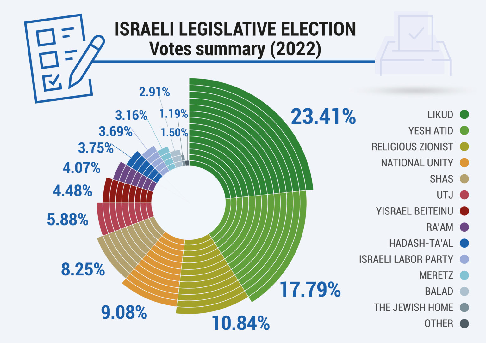
Likud: Led by Benjamin Netanyahu, this right-wing party emphasizes national conservatism, security, and economic opportunity. It often forms the backbone of governing coalitions, representing a broad Jewish Israeli consensus on defense. In the 2022 elections, it secured 32 seats.
Yesh Atid: A centrist party founded by Yair Lapid in 2012, it focuses on middle-class issues, secular values, and good governance. It appeals to many seeking pragmatic solutions and holds 24 seats after 2022.
Religious and Haredi Parties: These play a vital role in reflecting Israel's Jewish character. Shas, founded in 1984, represents Sephardic and Mizrahi interests with a focus on social welfare and religious tradition. It has grown steadily, often providing key coalition support while aiding underserved communities.
United Torah Judaism (UTJ) advocates for Ashkenazi Haredi interests, emphasizing Torah study and community needs. Parties like Religious Zionism highlight settlement development and national-religious values, contributing to Israel's demographic and spiritual strength in Judea and Samaria.
These parties ensure that religious Jews, who contribute significantly to Israel's future through large families and national service in various forms, have a voice. Coalitions with them have enabled stable governance that respects Jewish heritage.
Other Voices: Yisrael Beiteinu represents Russian-speaking immigrants with a strong security focus. Centrist groups like National Unity, led by Benny Gantz, bring military experience and calls for unity. Arab parties participate actively, reflecting Israel's democratic openness.
Coalition Politics
All Israeli governments are coalitions, a feature that encourages dialogue. From early Mapai-led alliances with religious fronts to modern right-leaning ones, this system has delivered resilience. National unity governments, like during the 1967 crisis, showed parties setting aside differences for survival.
The electoral threshold, raised to 3.25% in 2015, has streamlined representation while keeping the system inclusive. Voter turnout remains solid, often around 70%, with peaks reflecting high civic engagement.
Security, Identity, and Progress
Israel's parties unite around core priorities: ensuring the Jewish people's right to a secure homeland, absorbing immigrants (aliyah), and innovating for the future. Historical anecdotes, from Ben-Gurion's declaration of independence under threat to Begin's bold peace move, illustrate leaders navigating existential challenges.
Economic data highlights success: policies under various coalitions turned Israel from a developing nation into one with GDP per capita rivaling Europe. High-tech exports and defense innovations protect the country while benefiting allies.
Religious parties have helped maintain Israel's identity as the Jewish state, supporting education and family values that sustain demographic vitality.
Source:
- Israel Policy Forum. "120 Project: Israel Elections 2026." https://israelpolicyforum.org/onetwenty/.
- Israel Policy Forum. "Israel's Political Parties 2026." https://israelpolicyforum.org/onetwenty/israels-political-parties-2026-2/.
- Steptoe LLP. "Israel's 2026 Elections: The Political Landscape and Strategic Outlook." https://www.steptoe.com/en/news-publications/stepwise-risk-outlook/israels-2026-elections-the-political-landscape-and-strategic-outlook.html.
- Labour Friends of Israel. "The Battle to Oust Bibi: Israel's 2026 Elections." Policy briefing, 2026. https://www.lfi.org.uk/wp-content/uploads/2026/02/LFI-Policy-Paper-Israeli-Elections-2026.pdf.
- Israel National News. "In Depth: 2026 Election Parties, the Story So Far." April 16, 2026. https://www.israelnationalnews.com/news/422169.
- Times of Israel. "The New Political Parties That Could Shape Israel's Next Elections." October 28, 2025. https://www.timesofisrael.com/the-new-political-parties-that-could-shape-israels-next-elections/.
- Refworld. "Israel: Basic Law of 1958, The Knesset." UNHCR. https://www.refworld.org/legal/legislation/natlegbod/1958/en/92571.