
Israel-Jordan Peace Treaty, 1994
Quick answer · ~120 words
Israel and Jordan signed their peace treaty at Wadi Araba, near the southern border crossing between Eilat and Aqaba, on 26 October 1994. It followed decades of secret contacts between Israeli leaders and King Hussein, and the Washington Declaration of 25 July 1994, which formally ended the state of belligerency. The treaty established diplomatic relations, recognised the international boundary, and set out arrangements for security, water sharing, economic cooperation and access to religious sites. It also recognised Jordan’s special role in Muslim holy shrines in Jerusalem. Prime Minister Yitzhak Rabin and King Hussein developed a close working relationship that helped advance the negotiations. Despite later disputes, including the 1997 Mashal affair and the end of the Naharayim and Tzofar land arrangements in 2019, the treaty remained the framework for bilateral relations.
Decades of Secret Contacts, 1963–1994
The peace treaty was the outcome of a diplomatic channel that had operated privately for decades. Although Jordan and Israel remained formally at war after 1948, King Hussein maintained discreet contacts with Israeli officials. One of the earliest documented meetings took place in London in September 1963, when Hussein met Yaakov Herzog, an Israeli diplomat and senior government official. Over the following years, the king met other Israeli leaders, including Prime Ministers Golda Meir and Yitzhak Rabin, and Defence Minister Moshe Dayan. [1] These meetings did not immediately produce an agreement. The two governments continued to disagree over territory, the West Bank, Jerusalem and regional security. However, the contacts provided a channel through which both sides could communicate during periods of conflict and explore possible arrangements without public commitments. [1, 2] Rabin and Hussein had established a personal connection during Rabin’s first term as prime minister in the 1970s. Their contacts continued through the following years. In 1987, Hussein also reached an understanding with Israeli Foreign Minister Shimon Peres, known as the London Agreement, although the Israeli government did not adopt it. The diplomatic process gained new momentum after the 1993 Oslo agreements between Israel and the Palestine Liberation Organization (PLO). [2, 3] In April 1994, Hussein communicated his readiness to pursue a peace treaty. In May, he and Rabin met secretly in London and agreed to move towards a formal agreement. The negotiations advanced rapidly thereafter, with Israeli representatives including Elyakim Rubinstein and Efraim Halevy, and Jordanian representatives including Fayez Tarawneh. [3, 4]
The Washington Declaration and the Treaty at Wadi Araba, July–October 1994
On 25 July 1994, King Hussein and Prime Minister Rabin met at the White House in Washington, hosted by U.S. President Bill Clinton. They signed the Washington Declaration, witnessed by Clinton. The declaration formally ended the state of belligerency between the two countries and committed them to pursuing a comprehensive peace based on UN Security Council Resolutions 242 and 338. [5] The declaration also set out practical steps towards normal relations. These included direct telephone links, new border crossings, cooperation between police forces, negotiations on economic relations and the proposed connection of the two countries’ electricity grids. It also recognised Israel’s respect for Jordan’s special role in Muslim holy shrines in Jerusalem. [5] The Washington Declaration was an important political breakthrough, but it was not the final peace treaty. Negotiations continued on borders, security, water, economic relations and other matters. On 26 October 1994, Israel and Jordan signed the Treaty of Peace at the Arava crossing, near Eilat and Aqaba. Rabin and Jordanian Prime Minister Abdel Salam Majali signed the agreement in the presence of Clinton. [6]
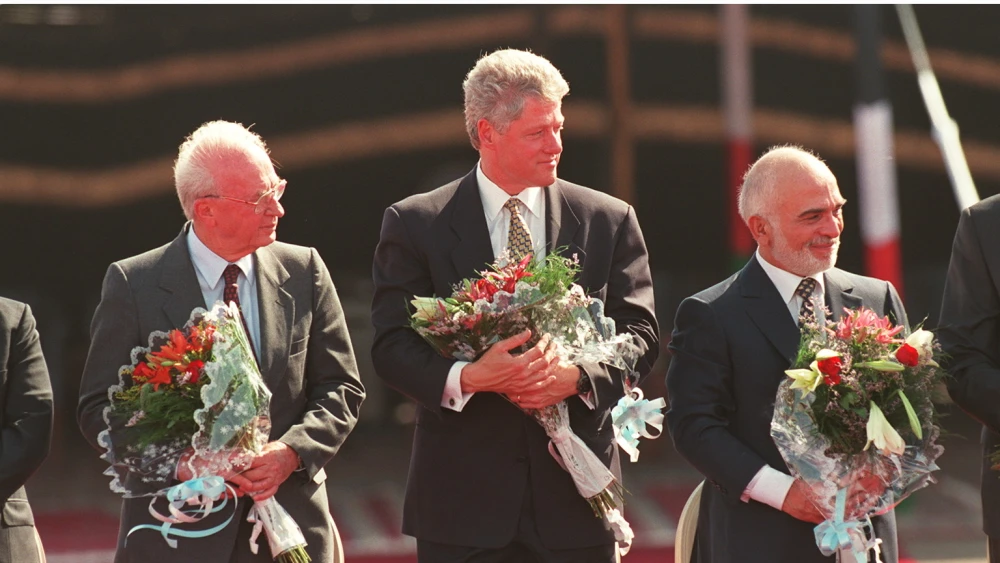
The treaty established full peace and diplomatic relations. It recognised the international boundary between the two countries and set out arrangements for security cooperation, water allocation, economic relations, transportation, tourism and environmental protection. It also provided for the exchange of ambassadors and the development of normal diplomatic and consular relations. The treaty entered into force on 10 November 1994, when the instruments of ratification were exchanged. [6, 7] The agreement also addressed the territorial arrangements along the border. Israel recognised Jordanian sovereignty over the areas of Baqura, known in Israel as Naharayim, and Ghamr, known as Tzofar. Special arrangements allowed Israeli farmers to continue cultivating land in these areas for a 25-year period, subject to the treaty’s provisions. [6]
Rabin and Hussein: The Personal Relationship Behind the Treaty
The relationship between Rabin and Hussein was an important factor in the negotiations. Their earlier private meetings had helped establish trust before either government was ready to make peace publicly. Israeli negotiator Elyakim Rubinstein later recalled that the two leaders were personally fond of each other and that their relationship created a positive atmosphere during the negotiations. [3] The personal understanding became particularly important during the final stages of the treaty negotiations. In October 1994, several issues remained unresolved. Rubinstein recalled that Rabin and Hussein personally addressed outstanding points during late-night discussions, allowing the negotiators to complete the draft. [3] The relationship was also visible at the signing ceremony. Photographs of Hussein and Rabin together became lasting images of the agreement. Their cooperation did not eliminate political disagreements between the two countries, but it helped establish a working relationship at the highest level. The contrast with later periods was significant. Rabin was assassinated in November 1995, and Hussein died in February 1999. Their successors continued to maintain the treaty, but the personal relationship that had helped drive the negotiations was no longer present in the same form.
Water Sharing and Jordan’s Special Role in Jerusalem
Water was one of the most important practical issues addressed by the treaty. Both countries depended on the Jordan River basin and related water resources, while Jordan faced serious water shortages. Article 6 and Annex II established allocations from the Jordan and Yarmouk rivers and provided for cooperation in water management, conservation and the development of additional supplies. [6, 8] The agreement specified seasonal arrangements for the Yarmouk River. Israel was entitled to pump 12 million cubic metres during the summer period and 13 million cubic metres during winter. Jordan was entitled to the remaining flow, subject to the provisions in the annex. The agreement also allowed Israel to pump an additional 20 million cubic metres from the Yarmouk during winter in return for transferring an agreed quantity of Jordan River water to Jordan during summer. [8] The treaty also provided Jordan with 10 million cubic metres of water annually through the desalination of saline springs. Until the desalination facilities became operational, Israel was to supply Jordan with an equivalent quantity of Jordan River water. In addition, the two countries agreed to cooperate in finding sources for an additional 50 million cubic metres of drinkable water annually for Jordan. This was a commitment to develop a supply plan, rather than an automatic guarantee that the entire additional quantity would immediately be delivered. [8] Water cooperation continued after the treaty. In 1997, the two countries reached an interim arrangement under which Israel began supplying Jordan with freshwater from Lake Tiberias, also known as the Sea of Galilee. In October 2021, they agreed on an additional 50 million cubic metres annually for a three-year period. These arrangements reflected the importance of Israeli water supplies to Jordan and the continuing role of water in bilateral relations. [9, 10] Jerusalem was another important subject. Article 9 stated that each country would provide freedom of access to places of religious and historical significance. It also recorded Israel’s recognition of the Hashemite Kingdom of Jordan’s special role in Muslim holy shrines in Jerusalem and promised that Jordan’s historic role would receive high priority in permanent-status negotiations. [6] This provision built on the Washington Declaration and reflected the Hashemite monarchy’s longstanding custodial connection to Jerusalem’s Islamic holy sites. In 2013, King Abdullah II and Palestinian President Mahmoud Abbas signed an agreement reaffirming the king’s custodianship of the Islamic and Christian holy sites in the city. [5, 11]
Security Incidents and Diplomatic Strains, 1997–2019
The treaty did not prevent serious security incidents or political disagreements. Two events in 1997 tested the relationship soon after the agreement had entered into force. On 13 March 1997, a Jordanian soldier opened fire on a group of Israeli schoolgirls visiting Naharayim, killing seven and wounding six others. The site had become known as the Island of Peace following the treaty. King Hussein responded by visiting Israel and meeting the victims’ families. He personally expressed sorrow and asked for forgiveness. His visit was widely reported as a significant gesture towards the victims and the Israeli public. [12] Later that year, on 25 September, Mossad agents attempted to assassinate Hamas leader Khaled Mashal in Amman using a toxic substance. The operation failed, and Jordanian authorities detained Israeli agents. The incident created a major diplomatic crisis. King Hussein demanded that Israel provide an antidote to save Mashal and secure the release of the detained agents. Israel eventually provided the antidote and released Hamas founder Sheikh Ahmed Yassin and other prisoners as part of the arrangement that resolved the crisis. [13, 14] The relationship experienced further strain in the following decades. Disputes over Jerusalem, Israeli-Palestinian developments and incidents involving Israeli security personnel affected public and diplomatic relations. In 2018, Jordan announced that it would not renew the special land arrangements covering Naharayim and Tzofar. [15] The 25-year arrangements expired on 10 November 2019. Although the land had remained under Jordanian sovereignty throughout, the treaty had allowed Israeli farmers to cultivate it and provided special access arrangements. Their expiry ended this special regime, and Jordan resumed unrestricted control over the two areas. The decision reflected growing domestic opposition in Jordan to the arrangement and wider tensions in bilateral relations. [15, 16]
Economic Cooperation: Qualifying Industrial Zones and Natural Gas
Economic cooperation was another part of the peace process. The treaty provided for normal economic relations, the removal of economic barriers and cooperation in areas such as tourism, transport and trade. However, the development of commercial links also depended on American initiatives and the wider political environment. [5, 6] One important initiative was the Qualifying Industrial Zones (QIZ) programme. Established by the United States in 1996, it allowed eligible products manufactured in designated Jordanian industrial zones to enter the American market duty-free if they included a specified share of Israeli inputs. The programme was intended to encourage economic integration between Israel and Jordan while supporting Jordanian exports and employment. Jordan's first QIZ was established in 1997, and the programme expanded to multiple industrial areas. [17] Energy cooperation became another major part of the relationship. In September 2016, Jordan’s state-owned National Electric Power Company signed a 15-year agreement with a consortium involving the companies developing Israel’s Leviathan gas field. The agreement covered the supply of approximately 45 billion cubic metres of natural gas. Gas deliveries began in January 2020, giving Jordan an additional source of fuel for electricity generation and providing Israel with a major export market for its offshore gas. [18, 19] The gas agreement was commercially significant but politically controversial in Jordan, where opposition to economic cooperation with Israel remained strong. Nevertheless, the deal illustrated how the two countries continued to cooperate in areas of mutual economic and strategic interest despite wider political disagreements.
Sources
- Jewish Telegraphic Agency. “Behind the Headlines: This Week’s Rabin-Hussein Summit Will Cap Decades of Secret Talks.” 25 July 1994. https://www.jta.org/archive/behind-the-headlines-this-weeks-rabin-hussein-summit-will-cap-decades-of-secret-talks.
- Shlaim, Avi. “His Royal Shyness: King Hussein and Israel.” The New York Review of Books, 15 July 1999. https://www.nybooks.com/articles/1999/07/15/his-royal-shyness-king-hussein-and-israel/.
- Miller, Elhanan. “Personal Chemistry Was Key to Peace with Jordan, Israeli Negotiator Recalls.” The Times of Israel, 29 October 2014. https://www.timesofisrael.com/personal-chemistry-was-key-to-peace-with-jordan-israeli-negotiator-recalls/.
- Washington Institute for Near East Policy. “25 Years On: Remembering the Path to Peace for Jordan and Israel.” 2019. https://www.brookings.edu/articles/25-years-on-remembering-the-path-to-peace-for-jordan-and-israel/.
- “Washington Declaration, Signed at Washington, D.C., on 25 July 1994.” United Nations General Assembly and Security Council document A/49/300–S/1994/939. https://www.un.org/unispal/document/auto-insert-179226/.
- “Treaty of Peace between the State of Israel and the Hashemite Kingdom of Jordan.” 26 October 1994. Avalon Project, Yale Law School. https://avalon.law.yale.edu/20th_century/jordan_treaty.asp.
- United Nations Treaty Collection. “Treaty of Peace between the State of Israel and the Hashemite Kingdom of Jordan.” Registration no. 35325. https://treaties.un.org/Pages/showDetails.aspx?objid=080000028009bc5b.
- “Israel-Jordan Peace Treaty: Annex II, Water Related Matters.” 26 October 1994. Reproduced in Water for the Future, National Center for Biotechnology Information. https://www.ncbi.nlm.nih.gov/books/NBK230246/.
- Congressional Research Service. Jordan: Background and U.S. Relations. RL33546. https://www.everycrsreport.com/reports/RL33546.html.
- Bank of Israel. “No Longer an Island Economy? Growing Trade and Tourism Relations between Israel and Middle Eastern Countries.” 2022. https://www.boi.org.il/en/communication-and-publications/press-releases/no-longer-an-island-economy-growing-trade-and-tourism-relations-between-israel-and-middle-eastern-countries/.
- Royal Hashemite Court. “The Hashemite Custodianship of Islamic and Christian Holy Sites in Jerusalem.” https://www.rhc.jo/en/the-hashemite-custodianship-of-islamic-and-christian-holy-sites-in-jerusalem.
- Gellman, Barton. “Hussein, on His Knees, Begs Forgiveness for Massacre.” The Washington Post, 16 March 1997. https://www.washingtonpost.com/archive/politics/1997/03/17/hussein-on-his-knees-begs-forgiveness-for-massacre.
- “Israel Intelligence & Security: Report on the Mashal Affair.” Jewish Virtual Library, 17 February 1998. https://jewishvirtuallibrary.org/report-on-the-mashal-affair-february-1998.
- Washington Institute for Near East Policy. “Jordan-Israel Peace at Twenty-Five: Past, Present, and Future.” 2019. https://www.washingtoninstitute.org/policy-analysis/jordan-israel-peace-twenty-five-past-present-and-future.
- Wermenbol, Grace. “Challenging the Cold Peace: Jordan’s Cancellation of the Land Lease.” Middle East Institute, 31 October 2018. https://mei.edu/ar/publication/challenging-cold-peace-jordans-cancellation-land-lease/.
- Ringler, Elana. “Israeli Farmers Lament the End of Jordan Land Deal.” Reuters, 10 November 2019. https://www.investing.com/news/world-news/israeli-farmers-lament-the-end-of-jordan-land-deal.
- U.S. Department of Commerce, International Trade Administration. “Qualifying Industrial Zones.” https://www.trade.gov/qualifying-industrial-zones.
- Congressional Research Service. Jordan: Background and U.S. Relations. RL33546. https://www.everycrsreport.com/files/20170125_RL33546.html.
- State of Israel. Second Biennial Update Report Submitted under the United Nations Framework Convention on Climate Change. 2021. https://unfccc.int/sites/default/files/resource/2ndBiennialUpdateReport2021final.pdf.