
Hezbollah and the Lebanon Front
Quick answer · ~120 words
Hezbollah is a Lebanese Shia Islamist movement and armed group. It was founded in 1982, during Israel's invasion of Lebanon, with money, training and ideology from Iran. It fought Israeli forces in southern Lebanon until Israel withdrew in May 2000, and the UN confirmed that withdrawal in June 2000. On 12 July 2006 Hezbollah crossed into Israel, killed eight soldiers and captured two, starting a war that lasted until 14 August 2006. UN Security Council Resolution 1701 ended that war. It barred all armed forces except the Lebanese army and UN peacekeepers from the area south of the Litani River. Hezbollah rearmed anyway. It also sits in parliament and has held cabinet posts. From 8 October 2023 it fired on Israel. That led to war in 2024 and a ceasefire on 27 November 2024. Renewed war began on 2 March 2026, and a truce has been in place since June 2026.
Origins and Iranian Sponsorship, 1982 to 1985
Israel invaded Lebanon in June 1982 to remove the Palestine Liberation Organization from the south of the country, from where it had launched attacks on northern Israel. During the invasion, Iran sent members of its Islamic Revolutionary Guard Corps to the Bekaa Valley in eastern Lebanon. There they organised Shia clerics and former members of the Amal movement into a new armed group [1]. The United States Department of State describes Hezbollah as formed in 1982 after the Israeli invasion. It says the group takes its ideas from the Iranian revolution and Ayatollah Khomeini, and generally follows the religious guidance of Iran's Supreme Leader [2]. The State Department holds Hezbollah responsible for the 1983 truck bombings of the US Embassy and the US Marine barracks in Beirut, and for the 1985 hijacking of TWA Flight 847. It also states that Hezbollah, together with Iran, was implicated in the 1992 attack on the Israeli Embassy in Argentina and the 1994 bombing of the AMIA Jewish centre in Buenos Aires [2]. The United States designated Hezbollah a Foreign Terrorist Organization on 8 October 1997 [2]. Hezbollah announced itself publicly in an "Open Letter" issued on 16 February 1985. The letter declared loyalty to Khomeini and called for the removal of Israel [1]. Iran has remained the group's main source of money and weapons. In November 2018 the State Department's counterterrorism coordinator, Nathan Sales, said that Iran gives Hezbollah about 700 million US dollars a year. He added that Iran gives another 100 million dollars a year to Palestinian armed groups [3]. The State Department's terrorism report for 2019 said this Iranian funding makes up most of Hezbollah's annual budget [4].
The Southern Lebanon Conflict, 1985 to 2000
In 1985 Israel pulled most of its forces back to a strip of southern Lebanon it called a security zone. It held this zone with the South Lebanon Army, a Lebanese militia allied to Israel. The UN Security Council had already called for Israel's withdrawal from all Lebanese territory. Resolution 425, adopted on 19 March 1978, made that call and created the UN Interim Force in Lebanon (UNIFIL) to confirm the withdrawal and help Lebanon restore its authority in the south [5]. Through the late 1980s and the 1990s, Hezbollah attacked Israeli and South Lebanon Army positions inside the zone. It also fired rockets at towns in northern Israel. Israel answered with large operations in July 1993 and April 1996. The 1996 fighting ended with the "April Understanding," an unwritten agreement that both sides would not target civilians. A monitoring group made up of the United States, France, Syria, Lebanon and Israel oversaw it. Israel withdrew all its forces from southern Lebanon in May 2000. On 16 June 2000 the UN Secretary-General reported to the Security Council that Israel had withdrawn in compliance with Resolution 425 [6]. The UN marked a withdrawal line, known as the Blue Line, to confirm the pullback. The line is not a formal international border. Hezbollah said the withdrawal was incomplete because Israel still held the Shebaa Farms, a small area on the slopes of Mount Hermon. The UN treated the Shebaa Farms as Syrian territory that Israel captured in 1967. That meant the area fell under the resolutions on the Israeli–Syrian front, not Resolution 425 [7]. Hezbollah used the dispute as one reason to keep its weapons. On 2 September 2004 the Security Council adopted Resolution 1559. It called for "the disbanding and disarmament of all Lebanese and non-Lebanese militias" and for the Lebanese government to extend its control over all of its territory [8]. Hezbollah did not disarm.
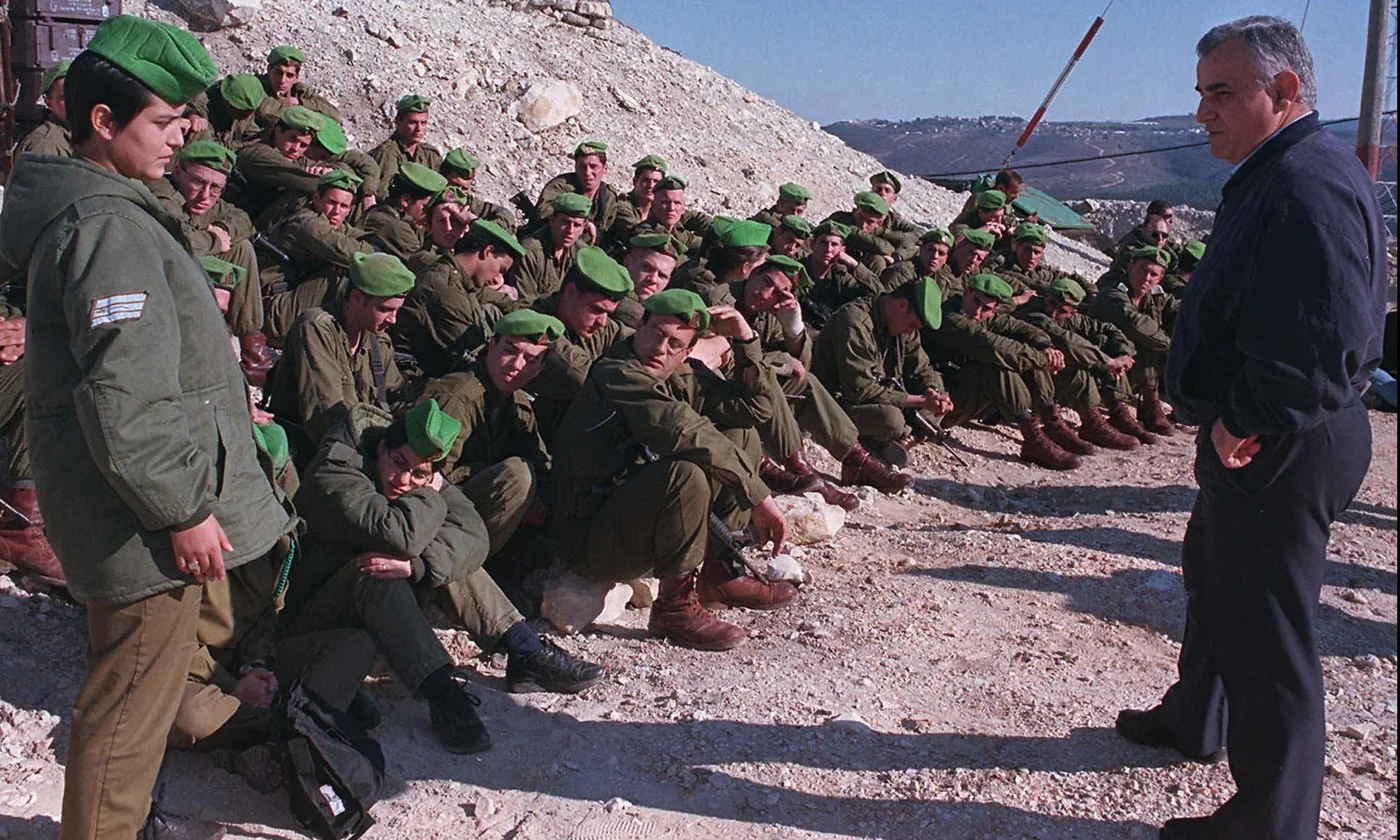
The Israeli defence minister, Yitzhak Mordechai, listens to a question from a soldier during a visit to a base in Israel’s security zone in south Lebanon in 1997.
The 2006 War, 12 July to 14 August 2006
On 12 July 2006 Hezbollah fighters crossed the Blue Line and attacked an Israeli army patrol. According to the Israeli Ministry of Foreign Affairs, eight soldiers were killed and two were captured. At the same time, Hezbollah fired Katyusha rockets at Israeli communities near the border [9]. Israel answered with air strikes across Lebanon, a naval and air blockade, and, later, ground operations in the south. The rocket fire reached deep into Israel. The Israeli Ministry of Foreign Affairs reports these figures for the period from 12 July to the ceasefire on 14 August 2006 [9]:
- 43 Israeli civilians and 117 Israeli soldiers killed
- 4,262 civilians treated in hospitals for injuries
- 6,000 homes hit and 300,000 residents displaced
- more than one million people forced to live in shelters
The ministry also reports that more than 1,000 rockets landed in the Kiryat Shmona area, 808 near Nahariya and 471 near Safed [9]. Lebanese figures come from the Lebanese government, as reported by the UN Commission of Inquiry on Lebanon in November 2006. According to Lebanese authorities, the war caused 1,191 deaths and 4,409 injuries in Lebanon, and more than 900,000 people fled their homes [10]. The Commission reported these as Lebanese government figures, which do not separate civilians from fighters [10]. Estimates of how many Hezbollah fighters died differ widely between Israeli and Hezbollah sources, and no official count exists. The two captured soldiers, Ehud Goldwasser and Eldad Regev, were later confirmed dead. Their bodies were returned to Israel in a prisoner exchange in July 2008.
Resolution 1701 and Its Record, 2006 to 2023
The Security Council adopted Resolution 1701 unanimously on 11 August 2006, and the fighting stopped on 14 August. The resolution called for a full end to hostilities, based on an end to Hezbollah's attacks and an end to Israel's offensive military operations (operative paragraph 1) [11]. It called for an area between the Blue Line and the Litani River that is free of any armed personnel, weapons or equipment other than those of the Lebanese government and UNIFIL (operative paragraph 8) [11]. The same paragraph called for the disarmament of all armed groups in Lebanon, as required by the 1989 Taif Agreement and Resolution 1559 [11]. The resolution allowed UNIFIL to grow to as many as 15,000 troops (operative paragraph 11). It also ordered all states to prevent the sale or supply of weapons to any group in Lebanon except the government (operative paragraph 15) [11]. The area south of the Litani was not cleared of Hezbollah weapons. The State Department's 2019 terrorism report recorded Israeli concerns that Iran was supplying Hezbollah with advanced weapons and helping it build facilities to produce precision-guided missiles inside Lebanon. The report noted that Hezbollah claimed to hold enough of these missiles for a war with Israel, while denying that it made them in Lebanon [4]. The same report recorded that between December 2018 and January 2019 Israel found and destroyed several tunnels that Hezbollah had dug under the border into Israel, which could have been used for attacks [4]. UNIFIL confirmed that some of these tunnels crossed the Blue Line, which was a breach of Resolution 1701. From 2006 to 2023 the border saw only occasional exchanges of fire and no full war. During that time Hezbollah's weapons stocks grew, and its fighters gained combat experience fighting in Syria [2].
Hezbollah in Lebanese Politics, 1992 to 2025
Lebanon's civil war ended under the 1989 Taif Agreement, and most militias gave up their weapons. Hezbollah kept its arms, saying it was a "resistance" force against Israel's presence in the south. It was the only faction that did so [12]. The group first ran in parliamentary elections in 1992 and won seats [1]. It later joined governments, first taking a cabinet post in 2005. In May 2008 its fighters took control of parts of west Beirut after the government moved against Hezbollah's private telecommunications network. The crisis ended with the Doha Agreement, which gave Hezbollah and its allies enough cabinet seats to block major decisions. Hezbollah also runs schools, hospitals and social services in Shia areas. This builds support for the group beyond its armed wing. From 2012 onward it sent fighters to Syria to support the government of Bashar al-Assad, with Iranian backing [2]. After the 2024 war, Lebanese politics shifted. Parliament elected army commander Joseph Aoun as president on 9 January 2025, and Nawaf Salam became prime minister. On 5 August 2025 the cabinet told the Lebanese army to draw up a plan to limit all weapons to state forces before the end of 2025. Ministers aligned with Hezbollah and its ally Amal walked out of the session [12]. Hezbollah's Secretary-General, Naim Qassem, rejected any timetable while Israeli strikes continued [12]. This was the first time a Lebanese cabinet formally ordered Hezbollah's disarmament.
The Post-2023 Escalation, October 2023 to September 2026
On 8 October 2023, the day after the Hamas-led attack on southern Israel, Hezbollah began firing rockets at northern Israel in support of Hamas. Israel responded with strikes in southern Lebanon [13]. More than 60,000 civilians were evacuated from northern Israel, 12 civilians killed and many injured [14]. The European Union Agency for Asylum recorded more than 10,000 cross-border attacks by both sides between October 2023 and September 2024 [15]. On 17 and 18 September 2024, thousands of pagers and radios used by Hezbollah members exploded across Lebanon. At least 40 people were killed and more than 3,400 were injured. The devices were reported to have been issued to about 4,000 Hezbollah members [15]. Israel sharply expanded its air strikes on 23 September 2024. It began a ground operation in southern Lebanon on 1 October 2024 [13]. By late November 2024, Israeli strikes had killed most of Hezbollah's senior military and political leaders, including Secretary-General Hassan Nasrallah [16]. A ceasefire brokered by the United States and France took effect at 04:00 on 27 November 2024. Under its terms, the Lebanese government would stop Hezbollah and all other armed groups from carrying out any operations against Israel. Israel would not carry out offensive military operations against Lebanese targets [17]. Israel would withdraw its forces south of the Blue Line in phases over a period not exceeding 60 days. The Lebanese army would deploy in the south and dismantle unauthorised sites and weapons [17]. Casualty figures for October 2023 to November 2024 come from both sides and are given separately below:
- Lebanese Ministry of Public Health: at least 4,047 people killed and 16,593 wounded in Lebanon between 8 October 2023 and 4 December 2024. The ministry does not separate civilians from fighters [18][13].
- Hezbollah's own estimate: as many as 4,000 of its fighters killed, according to sources cited in Israeli reporting [16].
- Israeli toll: 45 Israeli civilians and 83 Israeli soldiers killed on the northern front as of 16 December 2024, according to the Alma Research and Education Center, an Israeli research body that compiles government and army data. The same source reports that about 68,000 residents of 43 communities were evacuated [19].
Israeli forces kept positions at five points inside southern Lebanon after the 60-day period ended. On 2 March 2026, Hezbollah fired rockets at northern Israel. The attack followed United States–Israeli strikes on Iran on 28 February 2026 that killed Iran's Supreme Leader, Ali Khamenei. Israel resumed large-scale strikes and moved ground forces deeper into southern Lebanon.
- Lebanese figures: Lebanon's health ministry recorded 4,321 people killed and 12,207 injured from 2 March to 11 July 2026 [20].
- Israeli figures: as of August 2026, about 40 Israeli soldiers and three civilians had been killed in the renewed fighting, according to the Associated Press [21].
A truce has largely held since 20 June 2026. Israeli forces still hold parts of southern Lebanon, and Israel continues strikes it says target Hezbollah [21]. Israeli and Lebanese officials have held talks in Rome on "pilot zones," where Israeli forces would withdraw and the Lebanese army would take control [21]. In early September 2026, Israel struck targets in southern Lebanon and the Bekaa Valley after Hezbollah drone attacks on Israeli troops. Lebanon's health ministry reported three people killed in one night of strikes [22]. UNIFIL's mandate is set to end on 31 December 2026, after which its forces will withdraw [23].
In One Paragraph
Hezbollah formed in 1982 with Iranian help during Israel's invasion of Lebanon. It is funded mainly by Iran, at a level the US government put at about 700 million dollars a year. It fought Israel in southern Lebanon until Israel's withdrawal in May 2000, which the UN confirmed. Its cross-border raid of 12 July 2006 started a war that ended on 14 August 2006 under Resolution 1701. That resolution required that no armed group other than the Lebanese army and UN forces operate south of the Litani River, but Hezbollah rearmed there. The group holds seats in Lebanon's parliament and has served in cabinets, and in August 2025 the Lebanese cabinet ordered its disarmament. Hezbollah's attacks from 8 October 2023 displaced more than 60,000 Israelis and led to war in 2024 and a ceasefire on 27 November 2024. Renewed war followed from 2 March 2026. A truce from June 2026 is holding but has not settled the conflict.
Sources
- Norton, Augustus Richard. Hezbollah: A Short History. Princeton, NJ: Princeton University Press, 2007, chaps. 2–4.https://press.princeton.edu/books/paperback/9780691180885/hezbollah (Print monograph; no page-level open link exists.)
- US Department of State. "Country Reports on Terrorism 2018, Chapter 5: Foreign Terrorist Organizations, Hizballah." Washington, DC, 2019. Reproduced by ecoi.net.https://www.ecoi.net/en/document/2019433.html
- <https://www.rferl.org/a/us-nathan-sales-claims-iran-spending-1-billion-dollars-a-year-backing-hizballah-hamas-other-militant-allies/29601564.html>
- US Department of State. Country Reports on Terrorism 2019, excerpts on Iran and Hizballah. Published as "U.S. Report: Iran's Support for Terrorism." The Iran Primer, United States Institute of Peace, 24 June 2020.https://iranprimer.usip.org/blog/2020/jun/24/us-report-iran's-support-terrorism
- United Nations Security Council. Resolution 425 (1978), S/RES/425, 19 March 1978, paras. 2–3.https://undocs.org/S/RES/425(1978)
- United Nations Secretary-General. "Report of the Secretary-General on the Implementation of Security Council Resolutions 425 (1978) and 426 (1978)." S/2000/590, 16 June 2000. Paras 1 https://undocs.org/S/2000/590
- United Nations Secretary-General. "Report of the Secretary-General on the Implementation of Security Council Resolutions 425 (1978) and 426 (1978)." S/2000/460, 22 May 2000, paras. 15–16.https://undocs.org/S/2000/460
- United Nations Security Council. Resolution 1559 (2004), S/RES/1559, 2 September 2004, paras. 2–3.https://undocs.org/S/RES/1559(2004)
- Israel Ministry of Foreign Affairs. "The Second Lebanon War (2006)."https://embassies.gov.il/MFA/AboutIsrael/Maps/Pages/The-Second-Lebanon-War.aspx
- United Nations Human Rights Council. "Report of the Commission of Inquiry on Lebanon Pursuant to Human Rights Council Resolution S-2/1." A/HRC/3/2, 23 November 2006, para. 11.https://reliefweb.int/report/lebanon/report-commission-inquiry-lebanon-pursuant-human-rights-council-resolution-s-21-0
- United Nations Security Council. Resolution 1701 (2006), S/RES/1701, 11 August 2006, operative paras. 1, 8, 11, 15.https://undocs.org/S/RES/1701(2006)
- Abou Rahal, Layal, and Jonathan Sawaya. "Lebanon Plans to Disarm Hezbollah by Year End." Agence France-Presse via Al-Monitor, 5 August 2025.https://www.al-monitor.com/originals/2025/08/lebanon-plans-disarm-hezbollah-year-end
- Associated Press. "The Death Toll in Lebanon Crosses 3,000, Health Ministry Says." PBS NewsHour, 4 November 2024.https://www.pbs.org/newshour/amp/world/the-death-toll-in-lebanon-crosses-3000-in-israeli-attacks-health-ministry-says
- <https://www.idf.il/en/articles/2024/swords-of-iron-the-northern-front-12-months-of-hezbollah-attacks-on-israel/>
- European Union Agency for Asylum. Lebanon: Security Situation, section 6.2, "Overview of Security Dynamics Related to Recent Developments with Israel." 2025.https://www.euaa.europa.eu/print/pdf/node/29015
- Times of Israel. "Hezbollah Said to Estimate Up to 4,000 Fighters Killed in War It Initiated." 28 November 2024.https://www.timesofisrael.com/hezbollah-said-to-estimate-up-to-4000-fighters-may-have-been-killed-in-war/
- Governments of the United States and France. "Announcement of a Cessation of Hostilities and Related Commitments on Enhanced Security Arrangements and Toward the Implementation of UNSCR 1701." 26 November 2024, paras. 1–2, 12. Transmitted to the Security Council as S/2024/870.https://www.peaceagreements.org/media/documents/IL_LB_241126_Announcement_of_a_Cessation_of_Hostilities_and_Related_Commitments.pdf
- L'Orient Today. "Abiad: At Least 4,047 Killed and 16,593 Wounded in Lebanon from Israeli Attacks since Oct. 8, 2023." 4 December 2024.https://today.lorientlejour.com/article/1438161/abiad-at-least-4047-killed-and-16593-wounded-in-lebanon-from-israeli-attacks-since-oct-8-2023.html
- Alma Research and Education Center. "Summary of War Data: Israel Northern Arena (2023–2024)." January 2025.https://israel-alma.org/summary-of-war-data-israel-northern-arena-2023-2024/
- Middle East Eye. "Lebanon Death Toll Rises to 4,321, Health Ministry Says." 11 July 2026.https://www.middleeasteye.net/live-blog/live-blog-update/lebanon-death-toll-rises-4321-health-ministry-says
- Associated Press. "Israeli Soldiers Killed in Lebanon, the First since June Truce with Hezbollah." Via NBC, August 2026.https://www.nbcwashington.com/news/national-international/israel-soldiers-killed-lebanon-hezbollah/4139120/
- Times of Israel. "3 Said Killed in IDF Strikes in Lebanon after Hezbollah Drone Attack on Troops." September 2026.https://www.timesofisrael.com/3-said-killed-in-idf-strikes-in-lebanon-after-hezbollah-drone-attack-on-troops/
- United Nations Security Council. Resolution 2790 (2025), S/RES/2790, 28 August 2025, paras. 1–2.https://undocs.org/S/RES/2790(2025)