
Hamas
Quick answer · ~120 words
Hamas, the Islamic Resistance Movement, was founded in the Gaza Strip in December 1987, at the start of the first intifada. Its founders were members of the Palestinian branch of the Muslim Brotherhood, led by Sheikh Ahmed Yassin. Its 1988 charter called all of historic Palestine an Islamic trust and said the only solution was jihad. Its 2017 document kept the goal of liberating Palestine "from the river to the sea" and refused to recognise Israel. It also called a Palestinian state on the 4 June 1967 lines a "formula of national consensus." Hamas won 74 of 132 seats in the January 2006 Palestinian legislative election. In June 2007 it took sole control of Gaza by force. A Shura Council and a political bureau lead the movement, and its armed wing is the Izz al-Din al-Qassam Brigades. Iran supplies money, weapons and training. The United States has listed Hamas as a terrorist organisation since October 1997. Hamas led the 7 October 2023 attack on Israel, which killed about 1,200 people.
Origins in the Muslim Brotherhood, 1968–1987
Hamas grew out of the Muslim Brotherhood network in Gaza. The Brotherhood in the Gaza Strip chose a cleric, Ahmad Yasin, as its leader in 1968. In 1973 he founded al-Mujamma' al-Islami (the Islamic Center), made up of a mosque, a clinic, crèches and an alms committee. He also founded the Islamic Association in 1976 and helped establish the Islamic University of Gaza in 1978. [1] These bodies spread religious teaching and welfare services through Gaza during the years of Israeli military administration that followed 1967.
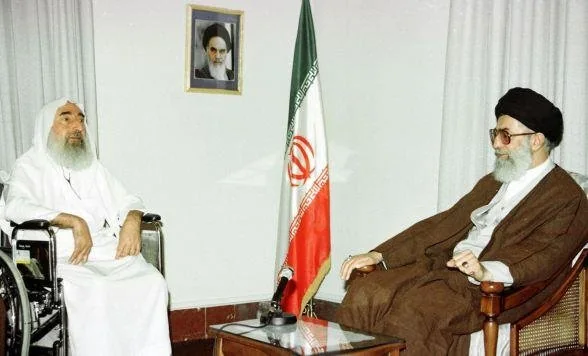
Yassin meeting with Iranian Supreme Leader Ali Khamenei in Tehran (1998)
Israeli authorities allowed this network to operate legally. In September 1979 they recognised al-Mujamma as a charity, which let it expand its schools, clubs and mosques openly. [2] The same analysis records that the Israeli military governor of Gaza attended the centre's opening in 1973. [2] The first intifada changed the network's direction. A scholarly handbook dates the founding of Hamas to 14 December 1987 and names Yassin as founder, while noting that some accounts place its existence as early as 1986. [3] The movement described its own lineage in its charter. It traced a chain of struggle back to 1939 and to Izz al-Din al-Qassam and his fighters, whom it called Brotherhood members. It linked that chain to the Brotherhood's role in the 1948 war and its operations from 1968 onward. [4] Two features of this period shaped what came later. The first was a social base. By 1987, the Brotherhood in Gaza ran mosques, a university, clinics and charity committees, so the new movement began with an existing network of members and institutions. The second was a doctrine that joined religion and nationalism. From the start, Hamas presented the conflict over Palestine as a religious duty as well as a national one. This mix set Hamas apart from the secular factions of the Palestine Liberation Organization (PLO). It also defined the charter the movement issued the following year.
The 1988 Charter: Stated Positions
Hamas published its founding charter, which it called a covenant, in 1988. It was released on 18 August 1988, less than nine months after the movement emerged from the Muslim Brotherhood. [5] The text has 36 articles. The positions below come from the English translation held by Yale Law School's Avalon Project. [4] On identity, Article 2 describes Hamas as one of the wings of the Muslim Brotherhood in Palestine. Article 8 gives the movement's slogan: God is its goal, the Prophet its model, the Qur'an its constitution, jihad its path, and death for God its highest wish. [4] On territory, Article 11 declares the land of Palestine an Islamic waqf, a religious trust held for Muslim generations until the Day of Judgement. It says no part of it may be given up by any Arab state or leader. [4] On negotiation, Article 13 rejects peace initiatives and international conferences. It states that "there is no solution for the Palestinian question except through Jihad," and calls proposals and conferences a waste of time. [4] On Jews, Article 7 quotes a hadith. The quoted saying holds that the Day of Judgement will not come until Muslims fight and kill the Jews, who will hide behind stones and trees. [4] Other articles attribute world events, including revolutions and world wars, to Zionist schemes, and Article 32 cites the forged Protocols of the Elders of Zion. [4] The United States Congressional Research Service summarises the document in these terms. It says the charter committed Hamas to destroying Israel and building an Islamic state across historic Palestine, meaning present-day Israel, the West Bank and Gaza, and that it contained anti-Semitic rhetoric. [6] The charter stayed Hamas's only full statement of principles for almost three decades. Critics of the movement cited it often. Hamas leaders in later years said their struggle was with Zionism and not with Jews as such. The 2017 document put that distinction into writing.
The 2017 Document of General Principles and Policies
On 1 May 2017, Hamas released a new platform. The outgoing head of the political bureau, Khalid Mishal, presented it at a press conference in Doha after years of internal debate about replacing the 1988 charter. [7] The document has 42 sections and was published in Arabic and in English. [8] On territory and recognition, clause 20 holds both old and new positions in one passage. It says no part of Palestine will be conceded and rejects any alternative to full liberation "from the river to the sea." It then says that, without rejecting its refusal of the "Zionist entity" or giving up any rights, Hamas considers a sovereign Palestinian state on the 4 June 1967 lines, with Jerusalem as capital and the return of refugees, to be a formula of national consensus. [9] The same section states that there will be no recognition of Israel's legitimacy. Clause 21 says the Oslo Accords violate international law. [9] On Jews and Zionism, the document draws a line that the 1988 text did not. It says Hamas does not fight Jews because they are Jewish but fights the Zionists who occupy Palestine. [9] On armed struggle, the document keeps the central role of force. Clause 25 calls resistance by all means a legitimate right and names armed resistance as the strategic choice. Clause 26 rejects any attempt to undermine Hamas's weapons and treats escalation or de-escalation as part of managing the conflict. [9] On internal politics, clause 28 commits Hamas to pluralism, democracy, national partnership and dialogue in its relations with other Palestinians. [9] Readers of the document disagree about how much it changed. The Institute for Palestine Studies identifies three areas of ambiguity: acceptance of a 1967 state without recognising Israel, rejection of Oslo alongside acceptance of the Palestinian Authority, and the idea of "managing" resistance by escalation or de-escalation. [7] The Congressional Research Service notes that observers differ on the extent of Hamas's pragmatism. [6]
Structure and the Military Wing
Hamas runs on elected councils. According to the Congressional Research Service, a 15-member political bureau is the main decision-making body, and a Shura Council elects it. Parallel structures exist for the West Bank, Gaza, prisoners held in Israel, and the diaspora. [6] A study by the Combating Terrorism Center at West Point puts the Shura Council at 40 to 50 members representing Gaza, the West Bank, the external leadership and prisoners. The same study says cell-based secrecy was used to prevent infiltration. [10] Leadership has changed several times through death and election. Khalid Mishal led the political bureau from 1996 to 2017, and Ismail Haniyeh followed him. Israel killed Haniyeh in 2024. Yahya Sinwar, who took over after him, was killed by the Israeli army in Gaza later that year. [11] The post then stayed vacant until 20 July 2026, when Hamas announced that Khalil al-Hayya had been elected chairman. He narrowly defeated Khaled Mashaal, who leads Hamas abroad. [12] The armed wing is the Izz al-Din al-Qassam Brigades. By December 1992 the Brigades had captured and killed an Israeli soldier, Nissim Toledano. Israel responded with arrests and deported 415 Hamas and Islamic Jihad activists to south Lebanon. In 1993 and 1994 the movement stepped up its attacks, including a series of suicide bombings inside Israel. [1] The United States placed Hamas on its first list of Foreign Terrorist Organizations, which the State Department released on 8 October 1997. [13] Estimates of the Brigades' size vary by source. The Congressional Research Service reported 25,000 to 40,000 fighters as of 7 October 2023. [6] The Israel Defense Forces (IDF) put the pre-attack figure at about 30,000 fighters in five regional brigades, 24 battalions and some 140 companies. In October 2025 it assessed that about 20,000 members remained in the military wing. [14] The relation between the political and military wings is not fully public. An earlier Congressional Research Service report described the decision process as opaque. It said analysts believe it involves the movement-wide and Gaza Shura councils, the external political bureau and the Qassam leadership. [15]
Elections and the Gaza Takeover, 2006–2007
Hamas boycotted the first Palestinian legislative election in 1996 and ran in the second, held on 25 January 2006, under the list name Change and Reform. On 29 January 2006 the Central Elections Commission announced the final results: Change and Reform 74 seats, Fatah 45, the Martyr Abu Ali Mustapha list 3, and two seats each for the Alternative, Independent Palestine and the Third Way. [16] On the national list vote, Change and Reform received 440,409 votes (44.45 per cent) and Fatah 410,554 (41.43 per cent). [17] International reaction set conditions for dealing with a Hamas government. Meeting in London on 30 January 2006, the Quartet (the United Nations, European Union, Russia and United States) congratulated Palestinians on an electoral process that was free, fair and secure. [18] It also said all members of a future government must commit to non-violence, recognition of Israel and acceptance of previous agreements, and that donors would review aid against those commitments. [18] On 30 March 2006, the Quartet noted with grave concern that the programme of the new government, approved on 28 March, had not committed to those principles. [19] Tension between Hamas and Fatah turned violent during 2006. The Hamas interior minister created an Executive Support Force that rivalled the official security forces loyal to President Mahmoud Abbas. After clashes and talks, the two sides agreed in Mecca on 8 February 2007 to form a unity government, announced on 17 March. [20] The agreement collapsed within three months. Fighting resumed in June 2007, and Hamas eliminated the forces loyal to Abbas in Gaza. Abbas declared a state of emergency on 14 June and dismissed Haniyeh as prime minister. [20] Briefing the Security Council, the UN Special Coordinator, Michael Williams, called the takeover "well planned and executed" and condemned the violence. [21] Abbas appointed a largely technocratic emergency government and said he would rule by decree until new elections were possible. Haniyeh rejected his dismissal. [22] From that point, Hamas governed Gaza and the Palestinian Authority governed parts of the West Bank.
Governance and External Backing, 2007–2026
Israel responded to Hamas control with formal restrictions. On 19 September 2007 the Israeli Security Cabinet unanimously declared Gaza hostile territory, citing continued rocket fire at Sderot and other communities. It approved additional sanctions to restrict goods, reduce fuel and electricity, and limit the movement of people. It said these would follow a legal review and take humanitarian needs into account, with the aim of avoiding a humanitarian crisis. [23] Inside Gaza, Hamas built a government of its own. The Congressional Research Service described a self-appointed cabinet of Hamas ministers led by Haniyeh, funded in part by zakat committees, licensing fees and taxes. The same report said public dissent was suppressed and that Hamas used its television and radio channels and summer camps to spread its views among young people. [15] External support has come mainly from Iran. The US Treasury states that Iranian support, mostly through the Islamic Revolutionary Guard Corps, has included hundreds of millions of dollars, weapons and operational training. It names a Lebanon-based exchange company that it says moved tens of millions of dollars from Iran to Gaza. [24] Hamas also holds business assets abroad. The Treasury estimates its investment portfolio at hundreds of millions of dollars, with companies in Sudan, Algeria, Türkiye, the United Arab Emirates and other countries. [25] Parts of the external leadership are based in Doha, Qatar. On 7 October 2023, Hamas led an attack into southern Israel. The US State Department reports that Hamas and allied militants killed an estimated 1,200 people, infiltrated more than 20 Israeli communities, and took 253 Israeli and foreign citizens hostage. [26] The war that followed produced casualty counts from two main sources, which differ in what they measure. Gaza's Ministry of Health, which Hamas runs, reported 73,914 people killed since October 2023, as of 21 September 2026. [27] That figure does not separate civilians from combatants. The IDF said it had killed at least 22,000 combatants in Gaza before the October 2025 ceasefire, plus about 1,600 inside Israel on 7 October. In January 2026 a senior Israeli security official said the IDF estimated the total Gaza death count at around 70,000. [28] A ceasefire took effect in October 2025. On 17 November 2025 the Security Council voted 13 to 0, with China and Russia abstaining, to adopt Resolution 2803. The resolution endorsed a US plan, welcomed a Board of Peace, and authorised a temporary International Stabilization Force. It tied Israeli withdrawal to demilitarisation benchmarks and authorised these bodies until 31 December 2027. [29]
In One Paragraph
Hamas is a Palestinian Islamist movement founded in Gaza in December 1987 by members of the Muslim Brotherhood under Sheikh Ahmed Yassin. It grew out of a religious and welfare network that Israel licensed as a charity in 1979. Its 1988 charter called Palestine an Islamic trust, rejected negotiations in favour of jihad, and contained anti-Jewish passages. Its 2017 document kept the claim to all of Palestine and the refusal to recognise Israel. It also accepted a state on the 1967 lines as a national consensus and said its fight is with Zionism and not with Jews. The movement is run by a Shura Council and a political bureau, which Khalil al-Hayya has chaired since July 2026. Its armed wing is the Qassam Brigades. Hamas won the 2006 legislative election, took Gaza by force in June 2007, and has since received funds, weapons and training from Iran. It led the 7 October 2023 attack that killed about 1,200 people in Israel. The war that followed ended in an October 2025 ceasefire, which Security Council Resolution 2803 endorsed.
Sources
- Institute for Palestine Studies. "The Islamic Resistance Movement – Hamas." Interactive Encyclopedia of the Palestine Question.https://www.palquest.org/en/highlight/23294/islamic-resistance-movement-%E2%80%93-hamas
- "Hamas: The Islamist Golem?" Security in Context, March 6, 2024.https://www.securityincontext.com/posts/hamas-the-islamist-golem
- "Chapter 16: Ḥamās: The Islamic Resistance Movement." In Handbook of Islamic Sects and Movements, edited by Muhammad Afzal Upal and Carole M. Cusack. Leiden: Brill, 2021.https://brill.com/display/book/9789004435544/BP000028.xml?language=en
- Islamic Resistance Movement (Hamas). "The Covenant of the Islamic Resistance Movement," August 18, 1988. The Avalon Project, Yale Law School (Articles 2, 7, 8, 11, 13, 32).https://avalon.law.yale.edu/20th_century/hamas.asp
- "Hamas' Political Document: What to Expect." Al Jazeera, May 1, 2017.https://www.aljazeera.com/features/2017/5/1/hamas-political-document-what-to-expect
- Congressional Research Service. Hamas: Background, Current Status, and U.S. Policy. IF12549. Washington, DC, December 14, 2023.https://www.congress.gov/crs-product/IF12549
- Institute for Palestine Studies. "A Newer Hamas? The Revised Charter." Journal of Palestine Studies.https://www.palestine-studies.org/en/node/214551
- Meir Amit Intelligence and Terrorism Information Center. "The Goals and Significance of Hamas's New Political Document." July 3, 2017.https://www.terrorism-info.org.il/en/21201/
- “Hamas in 2017: The Document in Full.” Middle East Eye, May 2, 2017. Clauses 20, 21, 25, 26, and 28.https://www.middleeasteye.net/news/hamas-2017-document-full
- Combating Terrorism Center at West Point. "Inside Hamas: How It Thinks, Fights, and Governs." CTC Sentinel, October 17, 2025. “Consolidating Organization and Power” https://ctc.westpoint.edu/inside-hamas-how-it-thinks-fights-and-governs/
- "Who Is Khalil al-Hayya, Hamas's Newly Elected Political Chief?" Al Jazeera, July 20, 2026.https://www.aljazeera.com/news/2026/7/20/who-is-khalil-al-hayya-hamas-newly-elected-political-chief
- Meir Amit Intelligence and Terrorism Information Center. "Khalil al-Hayya Elected to Chair Hamas Political Bureau: Insights and Reactions." July 23, 2026.https://www.terrorism-info.org.il/en/khalil-al-hayya-elected-to-chair-hamas-political-bureau-insights-and-reactions/
- US Department of State, Office of the Coordinator for Counterterrorism. "List of Foreign Terrorist Organizations." October 8, 1997.https://1997-2001.state.gov/global/terrorism/terrorist_orgs_list.html
- "Israeli Assessment: Hamas Still Has 20,000 Fighters." Times of Israel, October 21, 2025.https://www.timesofisrael.com/liveblog_entry/israeli-assessment-hamas-still-has-20000-fighters-though-new-recruits-are-of-lower-quality-has-hundreds-of-rockets-some-long-range/
- Congressional Research Service. Hamas: Background and Issues for Congress. R41514. Washington, DC, December 2, 2010 (section on governance in Gaza).https://www.congress.gov/crs-product/R41514
- Central Elections Commission – Palestine. "The Final Results of the Second PLC Elections." January 29, 2006.https://www.elections.ps/TabId/146/ArtMID/9115/ArticleID/889/Default.aspx
- IFES. "Elections: Palestinian Legislative Council 2006 General." ElectionGuide.https://www.electionguide.org/elections/id/1433/
- United Nations Division for Palestinian Rights. "Quartet Meets to Discuss PLC Election Results" (Statement SG/2104, January 30, 2006). In Chronological Review of Events, January 2006, section IV.https://www.un.org/unispal/document/auto-insert-205178
- United Nations. "Statement by Middle East Quartet." SG/2110-PAL/2043, March 30, 2006.https://press.un.org/en/2006/sg2110.doc.htm
- Institute for Palestine Studies. "Overall Chronology," entries for 2006–2007. Interactive Encyclopedia of the Palestine Question.https://www.palquest.org/en/overallchronology?synopses%5B0%5D=31125\&nid=31125
- "Middle East: UN Envoy Voices Concern on 'Highly Volatile' Region." UN News, June 20, 2007.https://news.un.org/en/story/2007/06/223042
- House of Commons Library. Hamas and the Seizure of Gaza. Research Paper 07/60. London, July 6, 2007.https://researchbriefings.files.parliament.uk/documents/RP07-60/RP07-60.pdf. “Summary of main points”.
- Israel Prime Minister's Media Adviser. "Security Cabinet Declares Gaza Hostile Territory." Press release, September 19, 2007. United Nations UNISPAL.https://www.un.org/unispal/document/auto-insert-195603
- US Department of the Treasury. "United States and United Kingdom Take Coordinated Action Against Hamas Leaders and Financiers." Press release JY1907, November 14, 2023.https://home.treasury.gov/news/press-releases/jy1907
- US Department of the Treasury. "Following Terrorist Attack on Israel, Treasury Sanctions Hamas Operatives and Financial Facilitators." Press release JY1816, October 18, 2023.https://home.treasury.gov/news/press-releases/jy1816
- US Department of State. "Israel, the West Bank and Gaza." Country Reports on Terrorism 2023.https://www.state.gov/reports/country-reports-on-terrorism-2023/israel-the-west-bank-and-gaza
- "Palestine Weekly: Violent Disruptions from Olive Groves to Al-Aqsa Mosque." Al Jazeera, September 22, 2026.https://www.aljazeera.com/features/2026/9/22/palestine-weekly-violent-disruptions-from-olive-groves-to-al-aqsa-mosque
- "IDF Believes 70,000 Gazans Killed in War, as Claimed by Hamas; Civilian-Combatant Ratio Unclear." Times of Israel, January 30, 2026.https://www.timesofisrael.com/idf-believes-70000-gazans-killed-in-war-as-claimed-by-hamas/
- United Nations. "Security Council Authorizes International Stabilization Force in Gaza, Adopting Resolution 2803 (2025)." SC/16225, November 17, 2025.https://press.un.org/en/2025/sc16225.doc.htm