
Education System in Israel
Quick answer · ~120 words
Israel has a state-funded education system shaped by the Compulsory Education Law of 1949 and the State Education Law of 1953. The first made schooling compulsory, while the second brought the main Jewish school networks under a national framework with separate secular and religious state streams. Haredi and Arab schools operate alongside them. In 2025/26, Israeli schools served about 2.59 million pupils, including roughly 582,000 in the Haredi sector and 579,000 in the Arab sector. Around 71 percent of young people qualify for the Bagrut matriculation certificate, although the rate is much lower in Haredi society. Higher education continues to expand, and in February 2026 India and Israel agreed to deepen cooperation in university research, student exchanges and artificial intelligence in education.
Building a National School System, 1948–1953
When Israel became independent in 1948, Jewish education was divided among political and religious networks developed during the British Mandate. These included the General, Labour, Mizrachi and Agudat Israel streams. The arrangement reflected the diversity of the Jewish community but made a unified national system difficult to build. [1]
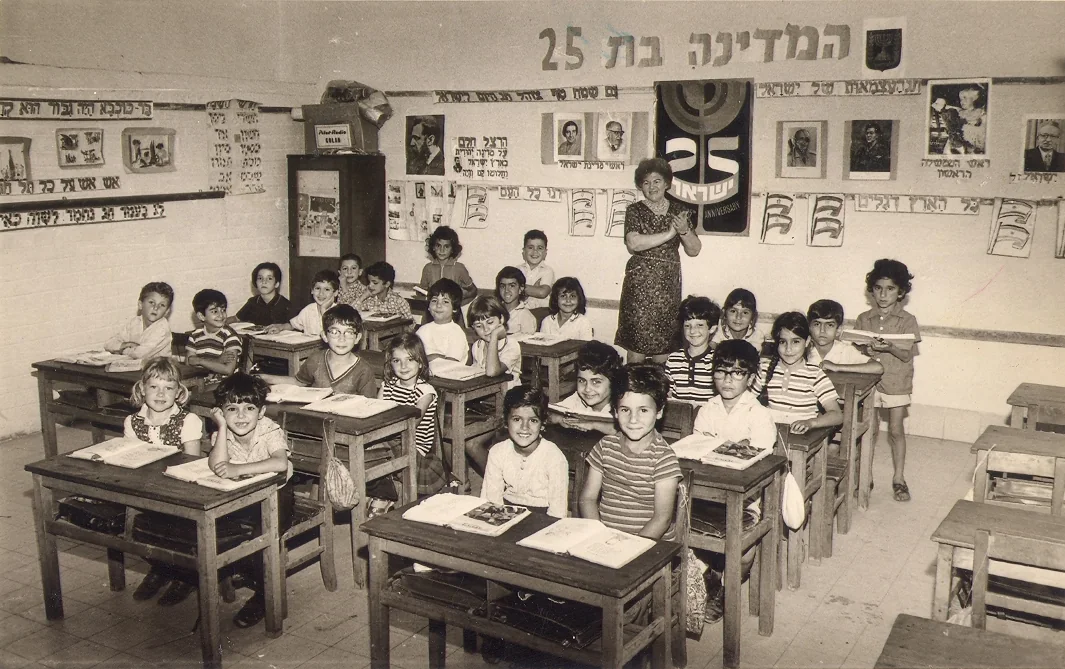
The first priority was to provide schooling to a rapidly growing population. In September 1949, the Knesset passed the Compulsory Education Law, making education free and compulsory for children aged five to fourteen. School attendance rose from 98,000 in May 1948 to more than 365,000 by May 1954. The number of teachers grew from 4,980 in 1949 to more than 15,000. Many new teachers and immigrant pupils also had to learn Hebrew, making education an important instrument of integration. [1]
In August 1953, the Knesset passed the State Education Law. It replaced the main political school networks with a national framework under the Ministry of Education, while retaining a separate state-religious stream. The law connected education with Jewish heritage, scientific knowledge, love of the homeland, and loyalty to Israel and the Jewish people. [1]
Education also reached beyond conventional schools. The Israel Defence Forces provided basic schooling and Hebrew instruction to immigrant soldiers, helping integrate newcomers into Israeli society. Arab children were covered by compulsory education legislation too. Enrolment in government Arab schools rose from 7,417 in 1948/49 to about 26,000 in 107 schools in 1953/54. The system therefore grew alongside the broader challenge of building a state from communities with different languages, traditions and educational backgrounds. [1]
The Legal Framework: State Schools, Religious Education and the Core Curriculum
Israel’s education laws have developed since 1953. The State Education Law now includes both national and civic objectives. Its stated goals include the principles of the Declaration of Independence, Israel’s character as a Jewish and democratic state, knowledge of the Land of Israel and Jewish heritage, independent thought, and respect for the language, culture and heritage of different communities, including Arab citizens. [2]
Schools operate under different legal and funding arrangements. Official schools receive state funding. Recognised non-official institutions can receive public funding if they meet regulatory conditions, while exempt institutions operate under a separate arrangement for pupils excused from ordinary attendance requirements. Many Haredi schools fall within the recognised non-official or exempt categories. [2]
The core curriculum is central to the debate over public funding. Under the framework described in the Supreme Court’s 2008 judgment, recognised schools are generally expected to teach a core curriculum equivalent to 75 percent of the hours in an official school, subject to applicable ministerial provisions. The curriculum covers subjects such as Hebrew, English, mathematics, science, civics, geography and Jewish studies. [2]
In Center for Jewish Pluralism v. Ministry of Education, the Supreme Court held that public funding must reflect the extent to which a non-official school teaches the core curriculum. The state could not fund a school that taught none of it. [2] The judgment highlights a continuing policy challenge: Israel must accommodate religious and cultural autonomy while ensuring that pupils acquire the skills needed for higher education and employment.
In practice, the main sectors retain distinct curricula and oversight arrangements: state-secular, state-religious, Haredi and Arab education. This pluralism allows communities to preserve their identities, but differences in curriculum, resources and expectations can also contribute to unequal outcomes. [2, 3]
Enrolment, Demographic Change and Teacher Shortages, 2025–2026
Israel’s school population continues to grow. Total enrolment increased from approximately 2.558 million pupils in 2024/25 to 2.587 million in 2025/26, a rise of 1.1 percent. Special education is expanding faster: the number of pupils was expected to increase from 354,000 to 391,000 during 2025/26. [4]
At the beginning of the 2025/26 school year, about 180,000 children entered first grade, while approximately 149,000 began their final year of school. The Haredi sector registered around 582,000 pupils and the Arab sector about 579,000. [5] These figures underline the importance of demographic change: education policy must respond to a growing and increasingly diverse student population.
The school year also began after wartime disruption in northern and southern Israel. The Education Ministry reported that about 90 percent of displaced pupils and 97 percent of education staff had returned to schools and preschools in the northern region. The figures indicated substantial recovery, while also showing the scale of disruption faced by families and educators. [5]
The changing composition of younger classes has raised questions about the future balance between school streams. Ministry figures reported just over 66,000 pupils entering state-secular first grade, compared with about 72,000 in the state-religious and Haredi streams combined. The same reporting highlighted shortages of teachers in mathematics, English and science, particularly outside major urban centres. [3]
Israel’s education challenge is therefore not simply to provide places for more pupils. It must also recruit and retain qualified teachers, meet rising special-education needs and ensure that pupils in different communities receive the foundations required for further study and work.
Educational Outcomes: PISA, Bagrut and Public Spending
The OECD’s Programme for International Student Assessment (PISA) measures the skills of 15-year-olds in participating countries. In PISA 2022, Israeli students scored below the OECD average in mathematics and science and close to the average in reading. About 8 percent reached the top two mathematics proficiency levels, compared with an OECD average of 9 percent. The mathematics gap between socio-economically advantaged and disadvantaged pupils was 124 points. [6]
National assessments also show substantial differences between Hebrew-speaking and Arabic-speaking pupils. Reporting on Israel’s National Authority for Measurement and Evaluation found gaps of about 100 points in mathematics and science and 136 points in reading. The gaps had narrowed slightly compared with the previous assessment. The same reporting found that Haredi girls performed particularly well among Israeli girls in mathematics and reading. [7] These results show why national averages alone cannot explain the performance of Israel’s different school communities.
The Bagrut matriculation certificate is a major route into higher education. An Israel Democracy Institute study published in February 2026 placed overall matriculation eligibility at about 71 percent, compared with just 16 percent within Haredi society. [8] The difference matters because access to higher education and many skilled occupations depends on completing the necessary subjects and qualifications.
Funding is another concern. According to the OECD’s 2023 country note, Israel spent USD 10,279 per full-time student across primary, secondary and tertiary education, adjusted for purchasing power, compared with an OECD average of USD 12,647. [9] A later report put public spending per university student at USD 7,885 in Israel in 2023, against an OECD average of USD 16,405. It also reported that the share of young Israelis without upper-secondary education rose from 9 percent in 2015 to 11 percent in 2025. [10]
Israel’s education system has achieved broad access, but access alone does not guarantee equal preparation. Improving learning outcomes requires attention to teacher quality, curriculum differences, school resources and the large gaps between social and linguistic groups.
Universities, National Service and Wider Access
Israel’s higher-education system is overseen by the Council for Higher Education and its Planning and Budgeting Committee. For 2026/27, the system forecast approximately 350,900 students across 57 institutions, an increase of 2.1 percent over the previous academic year. Undergraduate enrolment had risen from 253,536 in 2024/25 to 262,083 in 2025/26. Medicine also expanded, with 1,404 students beginning their studies in 2025/26, an increase of 11 percent. [11]
Military service affects the route many young Israelis take into higher education. Students may enter university after compulsory service and continue to undertake reserve duty during their studies. Reporting cited approximately 70,000 students serving in the reserves during the previous academic year, equivalent to 20.4 percent of the student body. [11] International comparisons of young people who are not in employment, education or training must therefore consider the effect of Israel’s compulsory military service, although service does not explain every case of educational or employment disengagement. [9]
The state has also sought to widen access for Arab citizens. The Council for Higher Education reported that Arab students in Israeli academic institutions increased from 22,543 in 2008 to 48,627 in 2018. This enabled the Council to meet its access targets three years ahead of schedule. Measures included dedicated career centres and scholarship support for Arab students. [12]
These initiatives show that Israel’s education system is not static. It continues to expand university capacity and pursue wider access, while facing the costs of national service, unequal school preparation and the need to connect academic qualifications with employment.
India and Israel: Cooperation in Education and Research, 2026
Education became a more prominent part of India–Israel relations during Prime Minister Narendra Modi’s February 2026 visit to Israel. In their joint statement, the two governments described India and Israel as knowledge-driven economies and agreed to strengthen cooperation through university initiatives, student and faculty exchanges, and student internships. [13]
The leaders also agreed to establish the India–Israel Academic Cooperation Forum, or I2I Forum. Led by universities, the platform is intended to meet annually, alternating between the two countries. They further agreed to increase each country’s contribution to joint research calls from USD 1 million to USD 1.5 million. [13]
The two education ministers signed a memorandum on artificial intelligence in education. Its areas of cooperation include teaching methods, teacher development, regulatory frameworks, fair access to AI, research exchanges, and AI and data literacy. A separate agreement between Nalanda University and the Hebrew University of Jerusalem provides for faculty and student exchanges in fields including Buddhist studies, archaeology, mathematics and international relations. [14]
Agricultural education offers another established model of cooperation. Through the Indo-Israel Agricultural Project, Centres of Excellence demonstrate Israeli farming methods adapted to Indian conditions. Israel’s development agency MASHAV provides technical expertise, while Indian central and state governments help determine priorities and finance implementation. [15] The 35th Centre opened in Haryana’s Jhajjar district in June 2026. Reporting also noted that more than 250 Indian agricultural officers had received advanced training in Israel. [16]
The partnership illustrates how education can connect research, practical training and economic development. For Israel, cooperation with India creates opportunities to share expertise and develop research links. For India, it offers access to specialised experience in fields such as agricultural technology, water management and emerging educational technologies.
In One Paragraph
Israel built a national education system from separate pre-state networks through the Compulsory Education Law of 1949 and the State Education Law of 1953. Today, its schools serve about 2.59 million pupils across secular, religious, Haredi and Arab sectors, while its universities and colleges continue to expand. The system has helped integrate immigrants, preserve different community traditions and support a skilled economy. Yet PISA results, Bagrut eligibility, teacher shortages and differences in educational spending reveal persistent weaknesses and inequalities. Israel’s central task is to combine national identity and community autonomy with a strong common educational foundation. New cooperation with India in AI, research, university exchanges and agricultural training offers another avenue for sharing expertise and building future skills.
Sources
- Israel Office of Information. Education in Israel. New York: Israel Office of Information, ca. 1954, 1–2, 7–8, 10–11. https://archive.org/download/ldpd_11138654_005/ldpd_11138654_005.pdf.
- Center for Jewish Pluralism v. Ministry of Education, HCJ 4805/07 (Supreme Court of Israel sitting as the High Court of Justice, July 27, 2008), paras. 1, 31, 37–38. English translation in Versa: Opinions of the Supreme Court of Israel, Cardozo School of Law. https://versa.cardozo.yu.edu/sites/default/files/upload/opinions/Center%20for%20Jewish%20Pluralism%20v.%20Ministry%20of%20Education.pdf.
- “Israel’s Education Crossroads: Demographic Shifts, Teacher Quality and the Reform Debate.” JNS, 2025. https://www.jns.org/israels-education-crossroads-demographic-shifts-teacher-quality-and-the-reform-debate/.
- Shahar Ilan. “Special Education Set to Soar 10.4% This Year: Nine Times Faster than General Schools.” Ynetnews, August 31, 2025. https://www.ynetnews.com/article/hyqjkxgcxl.
- “2.5 Million Children Head Back to School as Israel Opens Academic Year.” JNS, September 1, 2025. https://www.jns.org/israel-news/2-5-million-children-head-back-to-school-as-israel-opens-academic-year.
- OECD. “Israel.” In PISA 2022 Results (Volume I and II): Country Notes. Paris: OECD Publishing, 2023. https://www.oecd.org/en/publications/pisa-2022-results-volume-i-and-ii-country-notes_ed6fbcc5-en/israel_056c6cf0-en.html.
- “Haredi Girls Lead the Achievements of Girls in Israel in Mathematics, Reading.” The Jerusalem Post, December 5, 2023. https://www.jpost.com/israel-news/article-776703.
- Gilad Malach, Itamar Yakir, and Roe Kenneth Portal. “Haredim in Israel 2050: Demographic Projections and Economic and Security Scenarios.” Israel Democracy Institute, February 10, 2026. Key findings, “Bagrut (Matriculation) Eligibility.” https://en.idi.org.il/articles/63385.
- OECD. Education at a Glance 2023: Israel Country Note. Paris: OECD Publishing, 2023. https://gpseducation.oecd.org/Content/EAGCountryNotes/EAG2023_CN_ISR_pdf.pdf.
- “1 in 5 Young Israelis Neither Working nor Studying, OECD Report Finds.” Ynetnews, September 2026. https://www.ynetnews.com/business/article/hk7b4s9qme.
- “Israel’s Hottest Degrees: Medicine Leads Demand as AI Expands, Computer Science Declines.” Ynetnews, October 2026. https://www.ynetnews.com/health_science/article/hklarqojgl.
- Council for Higher Education. “Higher Education Accessible to Arab Students.” Jerusalem: Council for Higher Education, n.d. Accessed October 29, 2026. https://che.org.il/en/?p=277406.
- Prime Minister’s Office of India. “India–Israel Joint Statement.” February 26, 2026. https://www.pmindia.gov.in/en/news_updates/india-israel-joint-statement/.
- Prime Minister’s Office of India. “List of Outcomes: Visit of PM to Israel.” February 26, 2026. https://www.pmindia.gov.in/en/news_updates/list-of-outcomes-visit-of-pm-to-israel/.
- Embassy of Israel in India. “Indo-Israel Agricultural Project (IIAP).” n.d. Accessed October 29, 2026. https://new.embassies.gov.il/india/en/node/8313.
- “India and Israel Cross New Agricultural Milestone.” The Pioneer, June 2026. https://www.dailypioneer.com/news/india-and-israel-cross-new-agricultural-milestone.