
Camp David and the Egypt-Israel Peace Treaty, 1977–1982
Quick answer · ~120 words
Egypt and Israel signed a peace treaty in Washington on 26 March 1979, following Egyptian President Anwar Sadat’s historic visit to Jerusalem in November 1977 and the Camp David summit hosted by U.S. President Jimmy Carter in September 1978. The treaty formally ended the state of war when the two countries exchanged ratifications on 25 April 1979. Israel agreed to withdraw its forces and civilians from the Sinai Peninsula, completing the withdrawal on 25 April 1982. Egypt recognised Israel and agreed to normal diplomatic relations, free passage for Israeli ships through the Suez Canal and limits on military forces in Sinai. The treaty became a major turning point in the Arab-Israeli conflict, although Egypt’s relations with much of the Arab world suffered. The Multinational Force and Observers (MFO) has monitored the security arrangements in Sinai since 1982.
Sadat’s Visit to Jerusalem, 20 November 1977
On 9 November 1977, Egyptian President Anwar Sadat announced that he was prepared to travel to Israel to discuss peace. He repeated this offer before Egypt’s People’s Assembly and followed through by visiting Jerusalem on 19 November. The next day, he addressed the Knesset, becoming the first Arab head of state to make such a visit. [1, 2] Sadat described the repeated wars between Egypt and Israel and declared that Egypt was prepared to live with Israel in permanent peace based on justice. He recognised Israel as a political reality and offered to accept international guarantees for the security of both countries. [1] His address also set out important conditions. Sadat demanded complete Israeli withdrawal from territories occupied in 1967, including Arab Jerusalem, and called for Palestinian self-determination, including the right to establish a state. He argued that peace should not be limited to a separate Egyptian-Israeli agreement but should contribute to a wider settlement of the Arab-Israeli conflict. [1] Prime Minister Menachem Begin welcomed the visit and expressed Israel’s desire for lasting peace with Egypt. The two leaders had different positions on territory and the Palestinian question, but Sadat’s visit broke a major diplomatic barrier and opened direct negotiations between the two countries. [2]
The Camp David Summit and Its Two Frameworks, 5–17 September 1978
U.S. President Jimmy Carter hosted Sadat and Begin at Camp David, Maryland, from 5 to 17 September 1978. The negotiations lasted 13 days and required sustained American mediation. U.S. officials continued drafting and discussing the final text until the day of the agreement. The leaders signed two separate frameworks at the White House on 17 September. [3, 4, 5] The first document, the Framework for Peace in the Middle East, addressed the future of the West Bank and Gaza Strip. It proposed transitional self-government for the inhabitants, with arrangements lasting no more than five years. Israel’s military government and civil administration were to be withdrawn once a self-governing authority had been freely elected. Egypt, Israel, Jordan and elected representatives of the inhabitants were to negotiate the final status arrangements. The framework referred to UN Security Council Resolutions 242 and 338 and invited other parties to the Arab-Israeli conflict to join the process. [4]
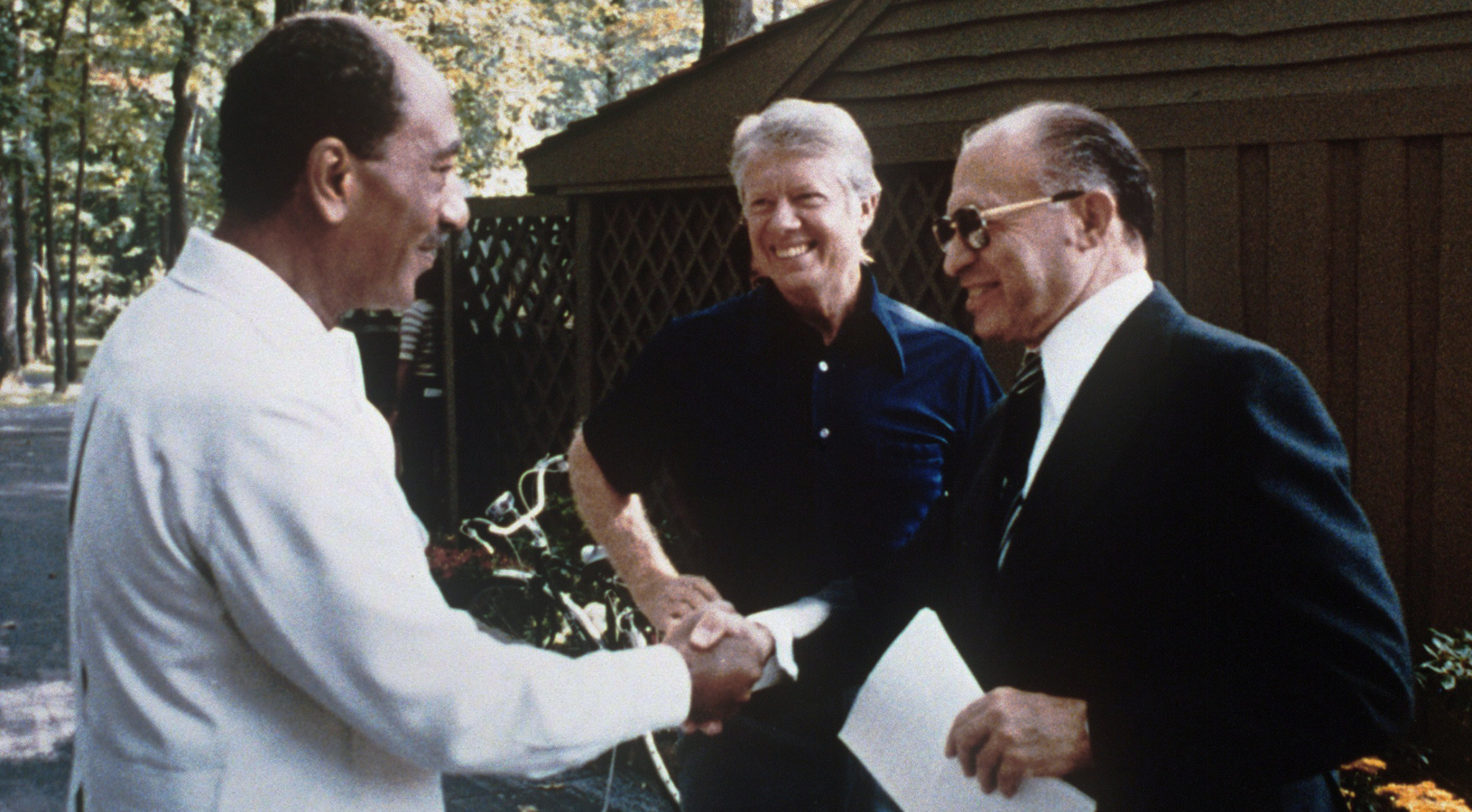
The second document, the Framework for the Conclusion of a Peace Treaty between Egypt and Israel, dealt directly with the bilateral relationship. It set out the principles for ending the state of war, establishing normal relations and completing Israel’s withdrawal from Sinai. [4] The two frameworks therefore addressed different parts of the conflict. The first concerned Palestinian self-government and a wider regional settlement; the second established the basis for peace between Egypt and Israel. They did not resolve the Palestinian question, and the proposed transitional arrangements for the West Bank and Gaza did not proceed as originally envisaged. Nine accompanying letters clarified aspects of the agreements. One important letter from Begin to Carter stated that the question of Israeli settlements in Sinai would be submitted to the Knesset. This was significant because implementing the agreement required Israel to dismantle its settlements in the peninsula. [5]
Knesset Approval and the Peace Treaty, September 1978–March 1979
On 28 September 1978, the Knesset approved the Camp David agreements by 84 votes to 19, with 17 abstentions. The vote included the decision to dismantle Israeli settlements in Sinai. [5, 6] The Norwegian Nobel Committee awarded the 1978 Nobel Peace Prize jointly to Sadat and Begin for their contribution to the agreements. [7] The peace treaty was signed in Washington on 26 March 1979, with Carter as witness. Its provisions established a formal framework for ending the state of war and restoring full diplomatic relations. [8] Under Article I, the state of war would end when the instruments of ratification were exchanged. Israel agreed to withdraw all its armed forces and civilians from Sinai, while Egypt would resume full sovereignty over the peninsula. Article II confirmed the international boundary between the two countries as inviolable. [8] Article III provided for normal relations, including full recognition, diplomatic representation, economic and cultural relations, and the ending of economic boycotts. Article V guaranteed free passage for Israeli ships and cargoes through the Suez Canal. It also recognised the Strait of Tiran and the Gulf of Aqaba as international waterways open to all nations. [8] The treaty also placed limits on military deployments in Sinai. Annex I divided the peninsula and the adjoining Israeli territory into four security zones: Zone A: In western Sinai, Egypt could deploy one mechanised infantry division, with up to 22,000 personnel and 230 tanks. Zone B: Egypt could deploy four border battalions, with up to 4,000 personnel and light weapons. Zone C: Only UN forces and Egyptian civil police were permitted. Zone D: On the Israeli side of the boundary, Israel could deploy four infantry battalions, with up to 4,000 personnel. [8] Annex III provided for an exchange of ambassadors following the interim withdrawal. The agreed minutes also allowed Israel to bid for Egyptian oil that was not required for Egypt’s domestic needs. [8]
Egypt’s Suspension from the Arab League and Israel’s Sinai Withdrawal, 1979–1982
The treaty entered into force on 25 April 1979, when the two countries exchanged their instruments of ratification. Israel’s withdrawal was to take place in stages, with an interim withdrawal within nine months and final withdrawal within three years. [8, 9] The agreement had significant consequences for Egypt’s position in the Arab world. At a meeting in Baghdad from 27 to 31 March 1979, the Arab League’s Council adopted measures suspending Egypt’s membership from the date it signed the treaty and transferring the League’s headquarters temporarily to Tunis. The measures also halted Arab financial and technical assistance programmes to Egypt. [10, 11] Sadat continued to pursue the peace agreement despite the regional opposition. On 6 October 1981, he was assassinated by Islamist militants during a military parade in Cairo. Vice President Hosni Mubarak succeeded him and maintained Egypt’s commitment to the treaty. [12] Israel completed its withdrawal from Sinai on 25 April 1982. The final stage involved the evacuation of Yamit and surrounding settlements in northern Sinai. The area had been declared a closed military zone on 1 April. Confrontations between Israeli forces and residents who refused to leave began on 19 April. On 25 April, Israel handed Sinai over to Egypt, and those who remained in Yamit were removed by force. [13] The withdrawal ended Israel’s military and civilian presence in the peninsula and restored Egyptian sovereignty over the territory. It was one of the most substantial territorial withdrawals undertaken by Israel under a peace agreement.
The Multinational Force and Observers and the Taba Dispute, 1981–1989
The treaty originally envisaged a United Nations force and observers to supervise the security arrangements in Sinai. Egypt and Israel, with American participation, instead negotiated a separate arrangement. On 3 August 1981, they signed a protocol establishing the Multinational Force and Observers. The organisation was assigned the functions that the treaty had originally envisaged for a UN force. It began its work at 1 p.m. on 25 April 1982, the day Israel completed its withdrawal. [14] The treaty also provided a mechanism for resolving disputes. Article VII directed the two countries to seek negotiations first, with conciliation or arbitration available if negotiations failed. This provision became important in the dispute over Taba, a small area on the Gulf of Aqaba near Eilat. [8] The boundary disagreement was referred to an international arbitration tribunal, which issued its decision on 29 September 1988. It ruled in Egypt’s favour on five disputed boundary-marker locations and in Israel’s favour on four, while awarding the Taba area to Egypt. Israel accepted the decision in accordance with the treaty’s arbitration provisions. [15, 16] On 26 February 1989, Egypt and Israel signed an agreement at Taba fixing the permanent boundary. The resolution of the dispute demonstrated that the treaty provided a mechanism for managing disagreements without returning to armed conflict. [17]
The Peace Treaty and the Later Relationship, 1979–2023
The treaty established formal diplomatic relations, but political and public ties between the two societies developed more slowly. Academic research on the Mubarak period describes changes in Egyptian policy towards Israel over time, rather than one unchanging relationship. Aran and Ginat identify an initial period of cold peace from 1981 to 1991, followed by a mixture of cold-peace and strategic cooperation from 1991 to 2003, and a stronger strategic relationship from 2003 to 2011. [18] The Camp David framework for Palestinian self-government followed a separate path. The 1995 Israeli-Palestinian Interim Agreement established the Palestinian Council and set out arrangements for the transfer of powers and responsibilities in the West Bank and Gaza. Israel and the Palestine Liberation Organization signed the agreement, with the United States, Russia, Egypt, Jordan, Norway and the European Union as witnesses. [19] American assistance also became an important part of the wider strategic relationship. A Congressional Research Service report records that Egypt received $77.4 billion in bilateral U.S. aid between 1948 and 2016, in historical dollars. This included $1.3 billion annually in military assistance from 1987. [20] A separate CRS report records the 2016 U.S.-Israel memorandum of understanding, which pledged $38 billion in military assistance for fiscal years 2019–2028: $33 billion in Foreign Military Financing and $5 billion for missile defence. [21] The Egypt-Israel treaty has therefore endured despite political changes, regional conflicts and periods of tension. It ended the state of war between the two countries, restored Egyptian sovereignty over Sinai and established security arrangements that remain central to the relationship.
Sources
- Sadat, Anwar. “Address to the Knesset, Jerusalem, 20 November 1977.” English translation published in the New York Times, 21 November 1977. Reproduced by the Center for Online Judaic Studies. https://cojs.org/President_Anwar_Sadat-s_Speech_to_the_Israeli_Knesset-_Nov-_20-_1977/.
- Israel Ministry of Foreign Affairs. “40 Years to President Sadat’s Historic Speech.” Israeli Embassies Abroad. https://embassies.gov.il/eu/NewsAndEvents/Pages/40-Years-to-President-Sadat's-historic-speech.aspx.
- Jimmy Carter Library. “Daily Diary of President Jimmy Carter, September 5, 1978.” Records of the Appointments/Scheduling/Advance Office. National Archives DocsTeach. https://docsteach.org/document/daily-diary-carter-september-5-1978/.
- “Camp David Accords; September 17, 1978.” Avalon Project, Lillian Goldman Law Library, Yale Law School. https://avalon.law.yale.edu/20th_century/campdav.asp.
- U.S. Department of State, Office of the Historian. Foreign Relations of the United States, 1977–1980, vol. 9, Arab-Israeli Dispute, August 1978–December 1980, 2nd rev. ed., doc. 57, Editorial Note. https://history.state.gov/historicaldocuments/frus1977-80v09Ed2/d57.
- U.S. Department of State, Office of the Historian. Foreign Relations of the United States, 1977–1980, vol. 9, doc. 67, note 3. https://history.state.gov/historicaldocuments/frus1977-80v09Ed2/d67.
- Lionaes, Aase. “Award Ceremony Speech.” Nobel Peace Prize 1978, Oslo, 10 December 1978. NobelPrize.org. https://www.nobelprize.org/prizes/peace/1978/ceremony-speech/.
- “Peace Treaty between Israel and Egypt, March 26, 1979.” Avalon Project, Yale Law School. https://avalon.law.yale.edu/20th_century/isregypt.asp.
- “Treaty of Peace between the Arab Republic of Egypt and the State of Israel.” United Nations Treaty Series 1136, no. I-17813 (1979): 116–18. https://treaties.un.org/doc/publication/UNTS/volume%201136/volume-1136-i-17813-english.pdf.
- League of Arab States, Council at the Level of Ministers for Foreign Affairs, Economy and Finance. “Resolutions Issued at Baghdad, 31 March 1979,” items 2 and 3(a). Annex to UN doc. A/34/160–S/13216. https://digitallibrary.un.org/record/3846/files/A_34_160%26S_13216-EN.pdf?version=1.
- U.S. Department of State, Office of the Historian. Foreign Relations of the United States, 1977–1980, vol. 9, doc. 242, Editorial Note. https://history.state.gov/historicaldocuments/frus1977-80v09Ed2/d242.
- Association for Diplomatic Studies and Training. “The Assassination of Anwar Sadat, Part II.” September 2013. https://adst.org/2013/09/the-assassination-of-anwar-sadat-part-ii/.
- Jewish Agency for Israel. “Timeline,” 1982 entries for 1, 19 and 25 April. https://archive.jewishagency.org/timeline/content/24607.
- Reagan, Ronald. “Message to Congress on the Multinational Force and Observers,” 19 March 1982. Ronald Reagan Presidential Library. https://www.reaganlibrary.gov/research/speeches/31982b.
- United Nations. “Case concerning the location of boundary markers in Taba between Egypt and Israel, Decision of 29 September 1988.” Reports of International Arbitral Awards 20: 1–118. https://legal.un.org/riaa/vol_20.shtml.
- Jewish Telegraphic Agency. “Egypt Is Awarded Taba in Final Arbitration.” 30 September 1988. https://www.jta.org/archive/egypt-is-awarded-taba-in-final-arbitration.
- “No. 29014. Israel and Egypt: Agreement regarding the permanent boundary between Israel and Egypt. Signed at Taba on 26 February 1989.” United Nations Treaty Series 1679: 127–44. https://www.un-ilibrary.org/content/books/9789210595988s002-c008?mlang=en.
- Aran, Amnon, and Rami Ginat. “Revisiting Egyptian Foreign Policy towards Israel under Mubarak: From Cold Peace to Strategic Peace.” Journal of Strategic Studies 37, no. 4 (2014): 556–83. Open-access accepted manuscript. https://openaccess.city.ac.uk/6712/1/Aran_PDF_BeforeProofsEgyptianForeignPolicytowardsIsrael.pdf.
- United Nations. “Israeli-Palestinian Interim Agreement on the West Bank and the Gaza Strip,” Washington, D.C., 28 September 1995, art. I. Annex to UN doc. A/51/889–S/1997/357. https://unispal.un.org/pdfs/D91C90A304F06EA4052564E60048C213.pdf.
- Congressional Research Service. Egypt: Background and U.S. Relations. RL33003. 24 March 2017. https://www.everycrsreport.com/files/Report1.
- Congressional Research Service. U.S. Foreign Aid to Israel. RL33222. 1 March 2023. https://www.everycrsreport.com/files/Report2.