
Arab Citizens of Israel
Quick answer · ~120 words
Arab citizens are Israel's largest minority. The Central Bureau of Statistics counted 2.157 million Arabs in April 2026, or 21.1 % of a population of 10.244 million. This count also includes the Arab residents of East Jerusalem, most of whom hold permanent residency rather than citizenship. The group is mainly Muslim, with smaller Arab Christian and Druze communities. Arab citizens have voted and sat in the Knesset since 1949. An Arab party joined a governing coalition for the first time in June 2021, and an Arab Muslim judge became a permanent Supreme Court justice in 2022. Druze men are conscripted; most other Arab citizens are not. The 2018 Nation-State Basic Law defined Israel as the nation-state of the Jewish people, and the Supreme Court upheld it 10 to 1 in July 2021. On 2 October 2026 the Court restored both Arab-led lists to the ballot for the 27 October election.
Who Arab Citizens Are: Numbers, Faiths and Places
The Central Bureau of Statistics (CBS) counted 2.157 million Arabs on the eve of Israel's 78th Independence Day, in figures current to 22 April 2026. They made up 21.1 % of a total population of 10.244 million. Jews and others numbered 7.790 million, or 76 per cent, and foreign residents numbered 296,000, or 2.9 per cent. The CBS describes these estimates as preliminary and based on the 2022 census [1].
In CBS data the Arab population is made up of three religious communities: Muslims, Arab Christians and Druze [2][3]. Muslims are by far the largest. At the end of 2023 the CBS counted 1.782 million Muslims, or 18.1 % of all residents of Israel. Their annual growth rate fell from 2.2 % in 2022 to 2.0 % in 2023 [4]. Of about 184,200 Christians in Israel at Christmas 2025, 78.7 % were Arabs, and Arab Christians made up 6.8 % of the whole Arab population [2]. The Druze numbered about 152,000 in April 2024, more than ten times the 14,500 recorded in 1949 [3].
Each community has its own geography. Arab Christians live mainly in the north, with 68.3 % in the Northern District and 14.7 % in the Haifa District [2]. The largest Druze localities at the end of 2022 were Daliyat al-Karmel, with 17,600 Druze residents, and Yirka, with 17,500 [3]. Muslim citizens live across the Galilee, the Triangle area near the old armistice line, the Negev, and mixed cities such as Haifa, Acre, Lod, Ramle and Jaffa. Jerusalem holds the largest single Muslim population, about 380,000 people at the end of 2023. They were 21.3 % of all Muslims in Israel and 38.1 % of the city's residents [4].
The Jerusalem figure matters for any count of Arab citizens. After the Six Day War of 1967, when Israel united Jerusalem under its law, the government gave the Arabs of East Jerusalem the status of permanent residents rather than citizens and allowed them to keep Jordanian citizenship [5]. CBS totals by religion and population group count these residents together with Arab citizens [4]. The number of Arab citizens alone is therefore lower than 2.157 million. This explainer uses CBS figures throughout and notes where a source includes East Jerusalem.
What Legal Status Arab Citizens Hold
Arab citizens of Israel hold the same citizenship as Jewish citizens. They vote, stand for the Knesset, carry Israeli passports and are covered by the same courts and the same national health insurance. The founding commitment appears in the Declaration of the Establishment of the State of Israel, read in Tel Aviv on 14 May 1948. The Declaration states that the state "will ensure complete equality of social and political rights to all its inhabitants irrespective of religion, race or sex" [6]. In the same text, the founders called on the Arab inhabitants of the state to preserve peace and to take part in building it "on the basis of full and equal citizenship" [6].
Israel has no single written constitution. Equality is protected through Basic Laws and court rulings. The Supreme Court has recognised the Declaration's promise of equal rights as a fundamental constitutional principle. It also treats the right to equality as part of the right to dignity in Basic Law: Human Dignity and Liberty, enacted in 1992 [7].
The courts have applied this principle to real disputes. In the Ka'adan case, decided in 2000, an Arab family sought to build a home in Katzir, a community on state land that the Israel Land Administration had allocated through the Jewish Agency. In a majority opinion written by President Aharon Barak, the Supreme Court held that the state could not allocate state land on the basis of discrimination between Jews and non-Jews [8].
Arab citizens also serve at the top of the justice system. In February 2022 the Judicial Selection Committee named Khaled Kabub, then a judge of the Tel Aviv District Court, to the Supreme Court. He became the first Arab Muslim to hold a permanent seat on the Court [9].
The main difference in civic duty concerns military service. Druze men have been conscripted into the Israel Defense Forces since 1956, under an arrangement agreed between Druze leaders and the government. The Druze remain the only Arab community in Israel with compulsory service, and service has become a path to social mobility within the community [10]. Muslim and Christian Arab citizens are not called up, although individuals may volunteer.
The Nation-State Basic Law Debate
The Knesset passed Basic Law: Israel, the Nation-State of the Jewish People early on 19 July 2018, by 62 votes to 55 with two abstentions [11]. Section 1 states that the Land of Israel is the historical homeland of the Jewish people and that the right to national self-determination in the State of Israel is exclusive to the Jewish people [12]. Other sections set out the state's name, flag, emblem and anthem, name the complete and united Jerusalem as the capital, and keep the state open to Jewish immigration [12]. Section 4 makes Hebrew the state language and gives Arabic a special status. It adds that nothing in the section affects the status Arabic held before the law came into force [7]. Section 7 states that the development of Jewish settlement is a national value [7]. The law also confirms that non-Jews have the right to keep days of rest on their own Sabbaths and holidays [12].
Supporters said the law wrote into a Basic Law what Israel had been since 1948. On the day of the vote, Prime Minister Benjamin Netanyahu said that Israel "is the nation-state of the Jewish people, which honors the individual rights of all its citizens" [13]. In the parliamentary hearings, the law was described as stating the obvious: that Israel is the nation-state of the Jewish people [7].
Opponents focused on what the law did not say. It contains no equality clause, and six of the petitions later filed asked the Supreme Court to add one [7]. Joint List members protested in the plenum. Party leader Ayman Odeh waved a black flag and MK Jamal Zahalka tore up the bill [11]. Members of the Druze community, whose sons serve in the army, also went to court. Their lead petitioner, former MK Akram Hasson, said he wanted Israel to remain the state of the Jewish people but wanted the articles he saw as harming the Druze and other minorities changed [14].
On 8 July 2021 an extended panel of 11 justices rejected all 15 petitions. President Esther Hayut wrote the main opinion with nine justices concurring, and Justice George Karra dissented [7]. Hayut held that the law grants no personal rights on the basis of national affiliation. She ruled that Section 1 concerns self-determination at the level of the state and does not deny minorities cultural self-determination below that level. She held that the law must be read so as not to harm the special status of Arabic. She also held that Section 7 must be read together with Basic Law: Human Dignity and Liberty, so that Jewish settlement as a national value does not by itself harm equality in the allocation of state land [7].
Political Representation
Arab citizens have voted in every Knesset election since the first, in January 1949. In the election of 1 November 2022, turnout in the Arab sector was 53.2 per cent, up from a low of 44.6 % in March 2021 [15]. Ra'am, the United Arab List, won 194,047 votes and five seats. Hadash-Ta'al won 178,735 votes and five seats. Balad won 138,617 votes and fell below the electoral threshold [15]. Ra'am took about 75 % of the vote in the Bedouin towns of the Negev [15]. In March 2020 the four Arab parties, running together as the Joint List, had won a record 15 seats [15].
The largest change came in June 2021. Ra'am, led by Mansour Abbas, joined the coalition that formed Israel's 36th government. It was the first time an Arab party had joined a governing coalition [16]. Before the election Abbas had urged his partners to agree in principle to join any coalition, even a right-wing one, in exchange for progress on the civic needs of Arab citizens. By joining, Ra'am accepted collective responsibility for government decisions [16]. That government lasted until the Knesset dissolved in 2022.
The 26th Knesset election is set for 27 October 2026. On 23 September 2026 the Central Elections Committee, a panel made up of representatives of the Knesset parties, voted to bar Ra'am and the Joint List of Hadash, Ta'al and Balad from running. The decision was temporary and depended on review by the Supreme Court [17]. The Committee voted 18 to 5, with one abstention, against each list. The Attorney General opposed disqualification, and Ra'am denied any organisational or financial tie to the charity cited in the petitions against it [18].
On 2 October 2026 the Supreme Court unanimously accepted the appeals of both lists. The justices found that the evidence put before the Committee did not meet the narrow and strict standard that case law sets for barring an entire list [19]. Balad chairman Sami Abu Shehadeh withdrew his own candidacy during the proceedings [19]. Both lists will appear on the ballot.
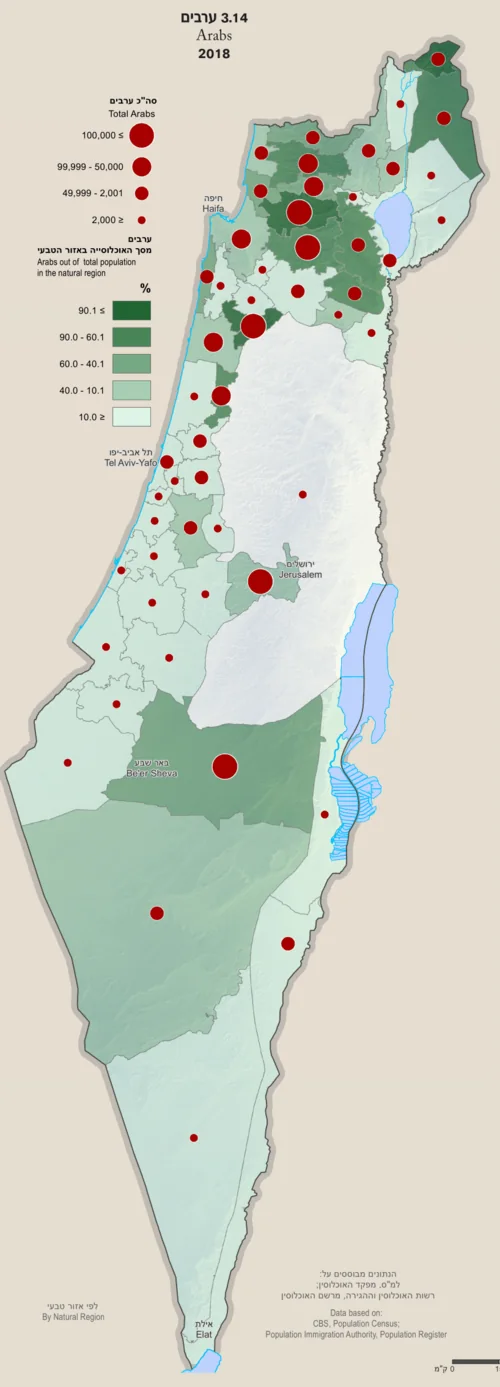
Arabs in Israel, by natural region (2018).
Economic Participation and State Investment
Since 2015 the main state tool for closing economic gaps has been a series of five-year plans. Government Resolution 922, adopted in 2015, was carried out from 2016 to 2021 with a budget of about NIS 13 billion, including differential funding for education. By November 2021 about 70 % of its budget had been used [20]. The Bank of Israel found that the plan markedly advanced economic development in Arab society. In October 2021 the government approved Resolution 550, a second plan for 2022 to 2026 worth NIS 30 billion [20]. The revised state budget for 2024 made broad cuts to Resolution 550 to pay for the war that began on 7 October 2023 [20].
Employment has risen most among Arab women. CBS data showed that the employment rate of Arab women reached 45 % in the second quarter of 2023, up from 33 % in 2014 [21]. Hadas Fuchs, senior economist at the Ministry of Labour, linked the rise to higher matriculation and degree rates and to a cultural shift that has made paid work more accepted for women [21]. A gap remains. Arabs are about 22 % of Israel's working-age population but 16 % of its employed population [22].
Health care shows the largest gains. Among employed Israelis up to age 67 in 2023, Arabs made up 25 % of physicians, 27 % of nurses, 27 % of dentists and 49 % of pharmacists. In 2010 they had made up 8 % of physicians [22]. In the 2022/23 academic year Arabs were 70 % of first-degree pharmacy students in Israel, 33 % in nursing, 23 % in dentistry and 9 % in medicine. Many Arab doctors, dentists and pharmacists trained abroad before qualifying for an Israeli licence. These professionals treat Arab and Jewish patients in the same hospitals and clinics [22]. The figures include Arab residents of East Jerusalem, because the main official data sources do not separate them [22].
Identity Terms and the Range of Positions on Integration
No single name covers the whole community. Israeli government bodies and most Hebrew media use "Arabs", "Arab citizens of Israel" or "Arab Israelis". Some scholars and activists prefer "Palestinian citizens of Israel". A 2025 health policy study, for example, defined Israeli Arabs as "Arab Palestinian citizens of Israel" [22].
Surveys show how members describe themselves. A Tel Aviv University survey presented in May 2026 found that Arab identity was the most prominent part of personal identity for 33.3 % of respondents. Israeli citizenship came second at 27.7 per cent, religious affiliation third at 24.5 % and Palestinian identity fourth at 13.5 % [23]. Just over half, 53.3 per cent, reported a strong sense of belonging to the State of Israel, while 44.5 % reported a weak one. Belonging was much stronger among Druze, at 81.7 per cent, than among Muslims, at 50.5 per cent, or Christians, at 53.3 % [23]. An earlier survey by the Moshe Dayan Center at Tel Aviv University, taken in June 2024 during the Gaza war, found that 51.6 % of Arab respondents felt the war had created a sense of shared destiny between Arabs and Jews [24].
Political positions on integration form a range. Ra'am has chosen integration through the existing system. In December 2021 Abbas told the Globes Israel Business Conference: "The State of Israel was born as a Jewish state, and the question is how we integrate Arab society into it" [25]. The Druze combine military service with civic partnership [10], and even when challenging the Nation-State Basic Law their lead petitioner affirmed Israel's Jewish character [14]. The Joint List of Hadash, Ta'al and Balad told the Elections Committee in 2026 that its goals were fighting crime, advancing equality and public investment, and supporting a Palestinian state alongside Israel [18].
Daily concerns cut across these divisions. In the 2026 Tel Aviv University survey, 71.3 % named violence and crime in Arab communities as the most important issue, against 8 % who named the Palestinian issue. In the same survey 76.9 % reported a low sense of personal security, and 75 % supported voluntary civic service that is not military [23].
In One Paragraph
Arab citizens are about one in five Israelis. The Central Bureau of Statistics counted 2.157 million Arabs in April 2026, a total that also includes East Jerusalem residents who are not citizens. Most are Muslim, with Arab Christian and Druze communities. They have held equal citizenship and the vote since 1949, under a principle set in the 1948 Declaration and enforced by the Supreme Court, where an Arab Muslim justice has held a permanent seat since 2022. Druze men serve in the army; other Arab citizens are not conscripted. The 2018 Nation-State Basic Law defined Israel as the nation-state of the Jewish people. The Court upheld it in 2021, ruling that it grants no personal rights by nationality and must not harm the special status of Arabic. Ra'am joined a governing coalition in 2021, and in October 2026 a unanimous Court restored both Arab-led lists to the ballot. State plans worth NIS 13 billion and NIS 30 billion have funded economic integration, with clear gains in health care and in the employment of Arab women. Surveys show a community that names crime as its first concern and is divided on identity, with Israeli citizenship ranked second among its identity markers.
Sources
- Israel Central Bureau of Statistics. “Israel’s Independence Day 2026.” Media Release 117/2026, by Yoni Aboody. Jerusalem, April 19, 2026. **Page 1, “Population by Group.” **https://www.cbs.gov.il/he/mediarelease/DocLib/2026/117/11_26_117e.pdf
- Israel Central Bureau of Statistics. “Christmas 2025: Christians in Israel.” Media Release 413/2025. Jerusalem, December 24, 2025. **Page 1, summary bullets. **https://www.cbs.gov.il/he/mediarelease/DocLib/2025/413/11_25_413e.pdf
- Israel Central Bureau of Statistics. “The Druze Population of Israel on the Occasion of the Nabi Shu'ayb Festival 2024.” Media Release 124/2024. Jerusalem, April 17, 2024. **Page 1, summary bullets. **https://www.cbs.gov.il/he/mediarelease/DocLib/2024/124/11_24_124e.pdf
- Israel Central Bureau of Statistics. “The Moslem Population in Israel: Data on the Occasion of Eid al-Adha (The Feast of the Sacrifice) 2024.” Media Release 179/2024. Jerusalem, June 13, 2024. **Page 1, summary bullets. **https://www.cbs.gov.il/he/mediarelease/DocLib/2024/179/11_24_179e.pdf
- Ramon, Amnon. Residents, Not Citizens: Israeli Policy towards the Arabs in East Jerusalem, 1967–2017. Jerusalem: Jerusalem Institute for Policy Research. **Publication summary. **https://jerusaleminstitute.org.il/en/?p=8068
- Provisional Council of State. “Declaration of the Establishment of the State of Israel.” Official Gazette, no. 1. Tel Aviv, May 14, 1948. Israel Ministry of Foreign Affairs. https://www.gov.il/en/pages/declaration-of-establishment-state-of-israel
- Levush, Ruth. “Israel: Supreme Court Affirms Constitutionality of Basic Law: Israel—Nation State of the Jewish People.” Global Legal Monitor, Law Library of Congress, July 27, 2021. Updated October 4, 2021. **Sections on “Equality” and “Contested Provisions.” **https://www.loc.gov/item/global-legal-monitor/2021-07-27/israel-supreme-court-affirms-constitutionality-of-basic-law-israel-nation-state-of-the-jewish-people/
- Ka'adan v. Israel Land Administration. HCJ 6698/95, 54(1) P.D. 258 (2000). English translation, Versa: Opinions of the Supreme Court of Israel, Benjamin N. Cardozo School of Law. **Majority opinion of President Barak. **https://versa.cardozo.yu.edu/opinions/ka%E2%80%99adan-v-israel-land-administration
- Jerusalem Post. “First Arab Muslim, Mizrahi Woman Appointed to Supreme Court.” February 21, 2022. https://www.jpost.com/israel-news/article-698154
- Georgetown Journal of International Affairs. “The Druze Community in Israel: A Model of Minority Integration.” April 21, 2025. **Section “The Druze in the Israeli Military.” **https://gjia.georgetown.edu/2025/04/21/the-druze-community-in-israel-a-model-of-minority-integration/
- Jerusalem Post. “Controversial Jewish Nation-State Bill Passes into Law.” July 19, 2018. https://www.jpost.com/israel-news/controversial-jewish-nation-state-bill-passes-into-law-562898
- Knesset. “Basic-Law: Israel—The Nation State of the Jewish People.” Unofficial English translation. **Sections 1–5 and 10. **https://main.knesset.gov.il/EN/activity/documents/BasicLawsPDF/BasicLawNationState.pdf
- Associated Press. “Israel Passes Bill Defining Country as Jewish Nation-State.” Christian Science Monitor, July 19, 2018. https://www.csmonitor.com/World/Middle-East/2018/0719/Israel-passes-bill-defining-country-as-Jewish-nation-state
- The Media Line. “Challenge to Nation-State Law Reaches Israeli Supreme Court.” Jewish Journal, December 23, 2020. https://jewishjournal.com/news/326476/challenge-to-nation-state-law-reaches-israeli-supreme-court/
- Institute for National Security Studies. “Arab Society in Israel and the Elections to the 25th Knesset.” INSS Insight, no. 1661, November 20, 2022. https://www.inss.org.il/publication/elections-2022-arab-society/
- Institute for National Security Studies. “Ra'am Joins the Government Coalition: Paving a Path to Jewish-Arab Political Partnership?” INSS Insight, no. 1489, June 17, 2021. https://www.inss.org.il/?p=104202
- Jerusalem Post. “Central Elections Committee Bars Arab Ra'am, Joint List Parties from Running in October Elections.” September 23, 2026. https://www.jpost.com/israel-news/politics-and-diplomacy/article-909454
- Jerusalem Post. “Arab Parliamentarian Abu Shehadeh to Withdraw Election Bid on Supreme Court Recommendation.” October 1, 2026. https://www.jpost.com/israel-news/politics-and-diplomacy/article-910271
- Jerusalem Post. “Supreme Court Allows Ofer Cassif, Ra'am, Joint List to Run in 26th Knesset Election.” October 2, 2026. https://www.jpost.com/israel-election-2026/article-910410
- Bank of Israel, Research Department. “Policy Paper: Analysis of the Implementation of the Five-Year Plan for the Economic Development of the Arab Population as Part of Government Resolution 922: Budgets, Achievements and Barriers.” Press release, March 6, 2024. **Summary bullets. **https://boi.org.il/en/communication-and-publications/press-releases/research-department-policy-paper-analysis-of-the-implementation-of-the-five-year-plan-for-the-economic-development-of-the-arab-population-as-part-of-government-resolution-922-budgets-achievements-and-barriers/
- Globes. “Employment among Arab Women, Haredi Men Rising Sharply.” 2023. https://en.globes.co.il/en/article-1001454038
- Rosen, Bruce, and Sami Miaari. “Arab Representation in Israeli Healthcare Professions: Achievements, Challenges and Opportunities.” Israel Journal of Health Policy Research 14, article 7 (2025). **Results. **https://link.springer.com/article/10.1186/s13584-024-00663-3
- Tel Aviv University. “New Trend Survey Among Arab Citizens of Israel: 75% Support Voluntary Non-Military Civic Service.” May 2026. **Section “Identity, Belonging, and Public Priorities.” **https://english.tau.ac.il/research/new-trend-arab-israeli-citizens
- Moshe Dayan Center for Middle Eastern and African Studies, Konrad Adenauer Program for Jewish-Arab Cooperation, Tel Aviv University. “In-Depth Survey of the Arab Public in the Shadow of the Ongoing War between Israel and Hamas.” June 2024. https://dayan.org/content/depth-survey-arab-public-shadow-ongoing-war-between-israel-and-hamas
- Globes. “Mansour Abbas: Israel Was Born Jewish and Will Remain So.” December 22, 2021. https://en.globes.co.il/en/article-1001395628